
Global RAID Controller Battery Market
 |
Author:
Achal E
|
Pages:
210
|
Author:
Achal E
|
Pages:
210
Global RAID Controller Battery Market Size, Share, By Battery Type (Lithium-Ion, Nickel-Metal Hydride, and Supercapacitors/Flash-Based Backup) By RAID Level (RAID 0, RAID 1, RAID 5, RAID 6, and Others) By Application (Enterprise Servers, Data Centers, Workstations, and Storage Area Networks) By End User (IT and Telecom, BFSI, Healthcare, Government, and E-commerce) and By Region (North America, Europe, Asia-Pacific, Latin America, Middle East and Africa), Analysis and Forecast 2026-2035
CAGR
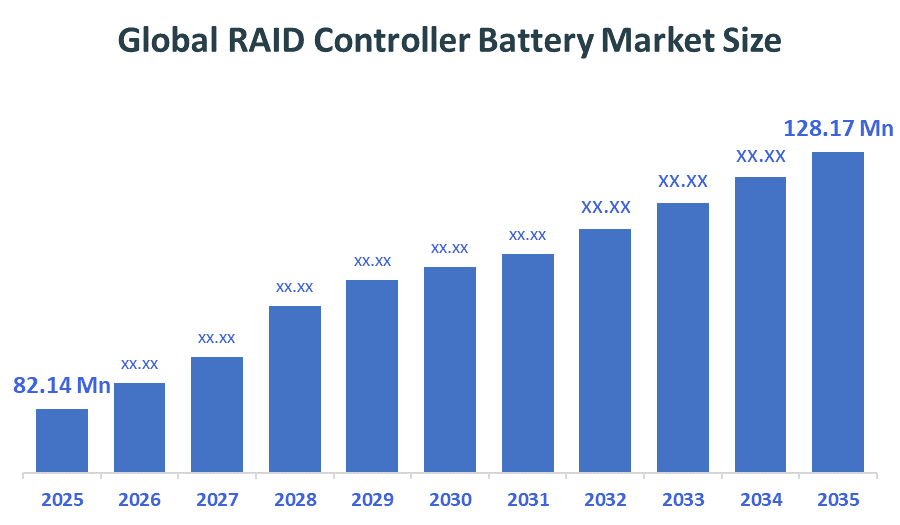
4.55%
REVENUE 2025
USD Million 82.14
FORECAST 2035
USD Million 128.17
REPORT COVERAGE
Global
Market Snapshot
- Global RAID Controller Battery Market Size (2025): USD 82.14 Million
- Global RAID Controller Battery Projected Market Size (2035): USD 128.17 Million
- Global RAID Controller Battery Compound Annual Growth Rate (CAGR): 4.55%
- Largest Regional Market: North America
- Fastest Growing Region: Asia-Pacific
- 3rd Largest Region: Europe
- Base Year: 2025
- Historical Period: 2021 to 2024
- Forecast Period: 2026 to 2035
Market Overview / Introduction
RAID Controller BBU (Battery Backup Unit) is an advanced piece of hardware that provides a temporary power supply to the cache of the RAID controller to ensure no loss of data stored in the cache happens due to an unexpected power failure. RAID Controller BBUs have evolved from standard nickel-metal hydride batteries to high-end Lithium-ion batteries and highly efficient supercapacitors with a Flash Back unit that stores data using non-volatile flash memory temporarily during any power outage. Such BBUs are crucial when dealing with heavy-duty operations in databases, banks, or cloud storage systems, as any power outage for even milliseconds can lead to disastrous consequences in terms of data corruption and damage to the entire file system. With regard to recent governmental policy developments, data resilience requirements have been made stringent by the US Department of Energy and several European Governments for sustainable digital infrastructure by 2026. The Indian government, through its budget for the year 2026, has classified data centres as critical infrastructure and provided tax incentives for domestic manufacture of Fail-Safe hardware products.
- The Data Center and IT segments contribute to approximately 70% of the application-based use in the market, driven by the increasing demand for server reliability, high-speed transactional databases, and the safeguarding of financial records.
- Automated Battery Health Monitoring in the enterprise sector is experiencing substantial growth, with a CAGR forecasted to surpass 9% on account of the increasing adoption of predictive analytics to prevent server downtime caused by aged or failing backup units.
Notable Insights: -
- About 78.2% of all installations occur in mission-critical environments like BFSI (Banking, Financial Services, and Insurance) and cloud service provider facilities, where data volatility is a primary concern.
- Applications of RAID batteries in Edge Computing account for almost 35.8% of new demand. The growth of localised processing requires robust protection in environments where power grids may be less stable.
- About 38.4% of the market value belongs to the North American region in 2026, driven by the massive presence of hyperscale data center operators and high-end hardware manufacturers.
- Supercapacitor-based solutions show an annual increase above 8.5%. The rise in Zero-Maintenance requirements encourages enterprises to invest more in capacitor-based flash protection.
What is the Role of Technology in Shaping the Market?
The development of new technologies is causing a major change within the industry of data protection through the use of battery efficiency during charge/discharge cycles and its form factor. The latest generation of RAID systems is not made up of basic lead-acid or nickel metal hydride batteries but is equipped with advanced Flash Back devices capable of writing cache data to NAND flash memory in case of battery failure.
How are Recent Developments Helping the Market?
Recent innovations include battery life-cycle estimation using AI, the adoption of the Cool-Charge technique in order to prevent the swelling of the battery, and the use of environmentally friendly batteries that do not contain cobalt. Innovations have contributed significantly to the development of this market because less frequent replacements of physical components are possible due to innovations. Innovations have also been witnessed in remote mount battery kits, where the battery is mounted far away from the heat inside the server.
Market Drivers
There has been an exponential rise in demand for RAID controller batteries in the international market due to the shift towards NVMe-enabled ultra-high-speed storage devices, as well as the significance of constant data accessibility in an economy that heavily relies on artificial intelligence technology. As more businesses opt for all-flash disks, there is a need for a quick-discharge battery to ensure that any cache data is swiftly written into permanent storage during any emergency events, calling for high levels of throughput efficiency. Moreover, the expansion of hyperscale data centers and edge computing sites under varying power situations calls for an upgrade to highly dependable and hassle-free energy backup systems like supercapacitors to guarantee 100% security of the write caches. This trend has been driven by the need to comply with the global laws governing data sovereignty and the popularity of Big Data analysis techniques, which necessitate the presence of robust hardware components.
Restraints
The expansion of the market is limited due to the growing trend of using battery-less capacitors, which, despite being included in the market, limits the potential profits earned from battery changes. Moreover, the transport regulations associated with the transportation of large lithium batteries also serve as a hurdle to global delivery.
Competitive Analysis:
The report offers the appropriate analysis of the key organisations/companies involved within the RAID controller battery market, along with a comparative evaluation primarily based on their product offerings, business overviews, geographic presence, enterprise strategies, segment market share, and SWOT analysis. The report also provides an elaborate analysis focusing on the current news and developments of the companies, which includes product development, innovations, joint ventures, partnerships, mergers & acquisitions, strategic alliances, and others. This allows for the evaluation of the overall competition within the market.
Top 10 Companies in the Global RAID Controller Battery Market
- Broadcom Inc. (LSI)
- Hewlett Packard Enterprise (HPE)
- Dell Technologies Inc.
- Intel Corporation
- Microchip Technology Inc. (Adaptec)
- Lenovo Group Limited
- Fujitsu Limited
- Cisco Systems, Inc.
- IBM Corporation
- Kingston Technology Company, Inc.
Government Initiatives
|
Country |
Key Government Initiatives |
|
US |
In alignment with Executive Order 14320 and the 2026 American AI Exports Program, the federal government has launched a call for proposals to fund Full-Stack AI infrastructure. This initiative provides strategic financing and technical assistance for AI-optimised hardware |
|
EU |
The Digital Operational Resilience Act (DORA), which entered full enforcement on January 17, 2025, mandates that all financial entities and their critical ICT third-party providers, including RAID hardware vendors, adhere to strict ICT Risk Management standards. Non-compliance can result in fines of up to 2% of total annual worldwide turnover |
|
India |
In the Union Budget 2026-27, the Indian government introduced a landmark tax holiday until 2047 for foreign cloud and AI data center providers. Coupled with the India Semiconductor Mission (ISM) 2.0 and an increased allocation of ?40,000 crore for electronics component manufacturing |
Study on the Supply, Demand, Distribution, and Market Environment
The viability of the RAID controller battery market is contingent upon the interaction between the availability of semiconductors and the manufacturing of high-grade battery cells. Currently, supply trends are leaning towards an integration model whereby the battery or capacitor is embedded within the controller board to conserve space, although off-board or remote-mount variants are favoured in hot servers that generate excessive heat. The chain of distribution is highly dependent upon Tier 1 server OEMs and individual storage hardware suppliers who enable the worldwide movement of power backups to local data centres. The environment surrounding the market is defined by an accelerated trend towards maintenance-free components due to the demand for minimal human contact in server racks.
Price Analysis and Consumer Behaviour Analysis
The pricing of RAID controller batteries changes based on their energy storage capacity, discharge rates, and technology used. Expensive models incorporate technology that provides flash protection via supercapacitors as well as smart firmware. Standard Lithium-Ion and Nickel-Metal Hydride battery packs are cheaper but present great purchasing value for medium-sized businesses as well as localised servers, which may require an initial investment of minimal costs. The end user's interest in lower costs over a longer period of time and higher longevity has resulted in increased purchases of supercapacitor models regardless of their high price. This is because customers prefer to minimise labour costs and downtime involved with the replacement and maintenance of traditional chemical batteries.
Market Segmentation
The Global RAID Controller Battery Market share is classified into battery type, RAID level, application, and end user.
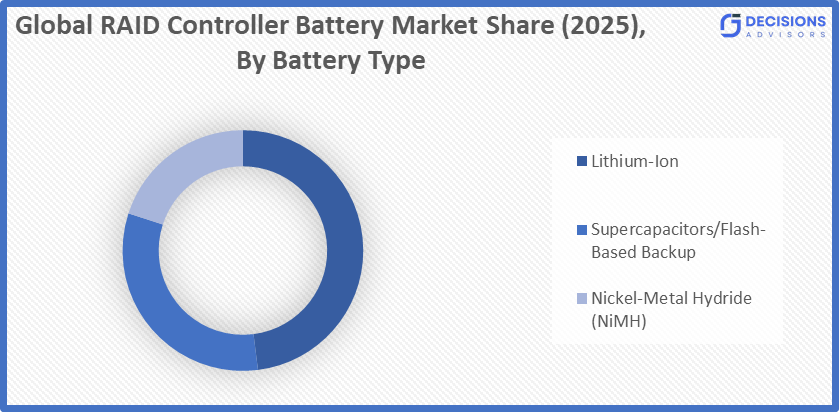
The Lithium-Ion segment holds the largest share, contributing approximately 48% of the market in 2025.
Based on the Battery Type, the global RAID controller battery market is divided into Lithium-Ion, Nickel-Metal Hydride (NiMH), and Supercapacitors/Flash-Based Backup. Among these, the Lithium-Ion segment holds the largest share, contributing approximately 48% of the market in 2025. The reason for this dominance lies in their high energy density and ability to provide sustained power to the controller cache during extended outages. While NiMH was the previous standard, Lithium-Ion offers a better power-to-weight ratio for modern slim servers. Meanwhile, Supercapacitors are the fastest-growing sub-segment due to their zero-maintenance nature and ability to offload data to flash memory in seconds.
The RAID 5 segment accounts for the largest share, representing over 42% of the global market in 2025.
Based on the RAID Level, the global RAID controller battery market is divided into RAID 0, RAID 1, RAID 5, RAID 6, and Others. Among these, the RAID 5 segment accounts for the largest share, representing over 42% of the global market in 2025. This is because RAID 5 is the most common configuration for enterprise storage, balancing performance and fault tolerance through parity. Because RAID 5 is highly dependent on write-caching to maintain speed, a reliable battery backup is essential to prevent parity write-hole errors during power loss. RAID 6 is also seeing increased adoption in high-capacity environments where double-disk redundancy is required.
Data Centers dominate the global market, accounting for approximately 55% of the total revenue in 2025.
Based on the Application, the global RAID controller battery market is divided into Enterprise Servers, Data Centers, Workstations, and Storage Area Networks (SAN). Among these, Data Centers dominate the global market, accounting for approximately 55% of the total revenue in 2025. This segment is preferred by operators who manage massive arrays of high-density storage that require integrated fail-safe solutions for AI and Cloud infrastructure. The Storage Area Networks (SAN) category is seeing a sharp increase in use, especially as businesses move toward centralized, high-speed storage architectures that demand high-availability power modules for their controllers.
The IT and Telecom segment dominates the global market, accounting for approximately 50% of the total revenue in 2025.
Based on the End User, the global RAID controller battery market is divided into IT and Telecom, BFSI, Healthcare, Government, and E-commerce. Among these, the IT and Telecom segment dominates the global market, accounting for approximately 50% of the total revenue in 2025. This segment is preferred by infrastructure planners who require large-scale data protection for 5G network logs and public cloud services. The BFSI (Banking, Financial Services, and Insurance) segment is seeing a sharp increase in use, especially by institutions that value the absolute data integrity and regulatory compliance provided by hardware-level write-cache protection for transactional databases.
Strategies to Implement for Growth of the Market in Non-Leading Regions
Growth prospects in the market of RAID controller batteries in developing countries can be improved by implementing energy-efficient, maintenance-free modules that can serve as backups in local data centers and regional banks. Efforts made to digitise public records and increase sovereign cloud capacity have been playing a major role in creating demand in regions characterised by unreliable electricity networks. Additional efforts to improve demand in these regions should include boosting investments in training local computer hardware specialists and establishing local battery distribution centers and recycling stations to foster uptake of Zero Maintenance supercapacitor modules and advanced thermal resistance battery technology.
Regional Segment Analysis of the Global RAID Controller Battery Market
- North America (U.S., Canada, Mexico)
- Europe (Germany, France, U.K., Italy, Spain, Rest of Europe)
- Asia-Pacific (China, Japan, India, South Korea, Rest of APAC)
- Latin America (Brazil and the Rest of Latin America)
- The Middle East and Africa (UAE, South Africa, Rest of MEA)
Asia-Pacific is projected to be the fastest-growing region over the forecast period. This region is anticipated to witness a growth rate of around 15.09% CAGR, making it the Fastest Growing Region within the global industry. This is owing to the fast-developing digital housing infrastructure and the massive investment in new storage area networks (SAN) in countries such as China and India. Other reasons for the same include state-supported indigenous server manufacturing projects, the rise of localized e-commerce platforms requiring robust database protection, and the widespread adoption of AI-driven predictive maintenance for hardware components
.
Europe is anticipated to hold a substantial share, representing the 3rd Largest Region in the market. There is a competitive advantage in the region owing to stringent data protection regulations (such as GDPR) that emphasize hardware-level data mirroring and fail-safe redundancy. There is also a comparative advantage with countries like Germany, the United Kingdom, and the Netherlands, which are home to advanced semiconductor research and clusters of high-security banking infrastructure. Moreover, the rigorous environmental standards in the EU regarding battery disposal further drive the transition toward longer-lasting, eco-friendly supercapacitor modules over traditional chemical batteries.
Recent Developments
- In April 2026, the industry recognised a major architectural shift at CloudFest with the introduction of the SmartRAID 4300 series, which takes the burden of RAID computation to specialised hardware to enable dense NVMe configurations and artificial intelligence processing without hampering battery efficiency.
- In May 2025, the results from the industry studies showed a sharp increase in valuation in the RAID backup area, particularly the observation that the Lithium-ion market valuation was above $250 million due to the high density of power supply.
- In March 2023, global analytics on data center stability revealed that power-related inconsistencies contribute to approximately 30% of critical data loss incidents, triggering a 15% rise in the adoption of automated self-testing diagnostics within RAID battery management systems.
- In November 2022, the new directive issued by the European Commission with the goal of cutting energy consumption by 11.7% by 2030 forced storage vendors to introduce smart charging technology for RAID battery packs that minimised energy waste.
Market Segmentation
This study forecasts revenue at global, regional, and country levels from 2021 to 2035. The Global RAID Controller Battery Market is segmented based on the following categories:
Global RAID Controller Battery Market, By Battery Type
- Lithium-Ion
- Nickel-Metal Hydride
- Supercapacitors/Flash-Based Backup
Global RAID Controller Battery Market, By RAID Level
- RAID 0
- RAID 1
- RAID 5
- RAID 6
- Others (RAID 10, RAID 50, RAID 60)
Global RAID Controller Battery Market, By Application
- Enterprise Servers
- Data Centers
- Workstations
- Storage Area Networks (SAN)
Global RAID Controller Battery Market, By End User
- IT and Telecom
- BFSI (Banking, Financial Services, and Insurance)
- Healthcare
- Government
- E-commerce
Global RAID Controller Battery Market, By Regional Analysis
- North America
- United States
- Canada
- Mexico
- Europe
- Germany
- United Kingdom
- France
- Italy
- Spain
- Russia
- Rest of Europe
- Asia Pacific
- China
- Japan
- India
- South Korea
- Australia
- Rest of Asia Pacific
- Latin America
- Brazil
- Argentina
- Rest of Latin America
- Middle East & Africa
- United Arab Emirates
- Saudi Arabia
- Qatar
- South Africa
- Rest of Middle East & Africa
Frequently Asked Questions (FAQ)
What happens to server performance if the RAID battery fails but the power stays on?
If a RAID battery fails or its health drops below a certain threshold, most controllers automatically switch from Write-Back mode to Write-Through mode. In Write-Through mode, the system bypasses the high-speed cache and writes data directly to the physical drives. This typically results in a significant performance degradation, sometimes reducing write speeds by over 50% as the system waits for the physical disks to confirm every transaction.
Can RAID batteries be hot-swapped while the server is running?
In most standard enterprise servers, hot-swapping a RAID battery is not recommended and can be extremely risky. Unless the specific hardware (such as certain high-end IBM or HP storage arrays) explicitly supports hot-plug batteries, removing a battery while the system is live can trigger an immediate controller reset or cause the array to drop into a critical error state. The safest protocol is to schedule a downtime window to power down the system before replacement.
Why are supercapacitors replacing traditional batteries in high-density data centers?
Supercapacitors are becoming the industry standard because they solve the wear-out problem. While a standard Lithium-Ion battery might require replacement every 2 years due to chemical ageing, a supercapacitor typically lasts 5 to 10 years, matching the entire lifecycle of the server. Additionally, supercapacitors do not require a 24-hour relearn or charging cycle after installation, providing immediate protection.
What are the environmental regulations for disposing of old RAID batteries?
Under the 2025 Battery Waste Management Amendment Rules, RAID batteries are classified as industrial e-waste. Organisations are now subject to Extended Producer Responsibility (EPR), meaning they must ensure that used batteries are collected and sent to certified recyclers. Landfill disposal is strictly prohibited in most regions, including the US, EU, and India, due to the toxic lead, cadmium, or lithium content within the cells.
Do RAID batteries protect data if the physical RAID controller card itself fails?
A RAID battery only protects data that is temporarily stuck in the controller's cache during a power outage. If the actual RAID controller hardware fails or the silicon chip burns out, the battery cannot help. To protect against controller failure, organisations must implement Dual-Controller or High-Availability (HA) configurations where a secondary card can take over the storage operations instantly.
How does Flash-Based Cache Protection differ from traditional Battery Backup Units (BBU)?
A traditional BBU uses electricity to keep the cache memory alive (volatile) until power returns. If the battery runs out before the power comes back, the data is lost. Flash-Based Protection uses a supercapacitor to provide just enough power (usually for 30-60 seconds) to copy the entire cache onto a permanent NAND flash chip. Once the data is on the flash chip, it is safe indefinitely, even if the supercapacitor loses its charge.
Check Licence
Choose the plan that fits you best: Single User, Multi-User, or Enterprise solutions tailored for your needs.
We Have You Covered
- 24/7 Analyst Support
- Clients Across the Globe
- Tailored Insights
- Technology Tracking
- Competitive Intelligence
- Custom Research
- Syndicated Market Studies
- Market Overview
- Market Segmentation
- Growth Drivers
- Market Opportunities
- Regulatory Insights
- Innovation & Sustainability
Report Details
| Scope | Global |
| Pages | 210 |
| Delivery | PDF & Excel via Email |
| Language | English |
| Release | Apr 2026 |
| Access | Download from this page |