
Global Rail Freight Market
 |
Author:
Sanket C
|
Pages:
220
|
Author:
Sanket C
|
Pages:
220
Global Rail Freight Market Size, Share By Freight Type (Bulk Freight, Intermodal Freight, Containerized Freight, and Liquid Freight), By Cargo Type (Coal & Chemicals, Agricultural Products, Automotive, Consumer Goods, and Industrial Materials), By Service Type (Domestic Freight, International Freight, and Logistics Services), and By Region (North America, Europe, Asia-Pacific, Latin America, Middle East & Africa), Analysis and Forecast 2026-2035.
CAGR
4.51%
REVENUE 2025
USD Billion 389.2
FORECAST 2035
USD Billion 604.9
REPORT COVERAGE
Global
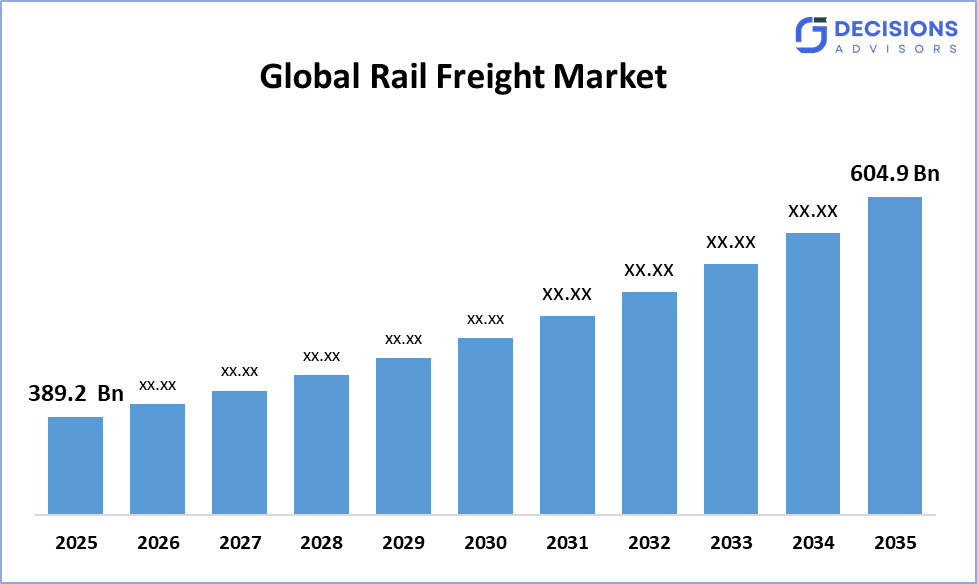
The Global Rail Freight Market Size is predicted to grow from USD 389.2 Billion in 2025 and is likely to reach around USD 604.9 Billion by 2035 with a CAGR of 4.51%. According to Spherical Insights & Consulting, a detailed research report on the market reflects that the containerized freight trend dominates the Global Rail Freight Market, accounting for approximately 44% of the total share worldwide. Union Pacific Corporation leads the market with annual revenue of approximately USD 24.3 billion, making it one of the key contributors to global market development and growth dynamics.
Market Snapshot
- Global Rail Freight Market Size (2025): USD 389.2 Billion
- Projected Global Rail Freight Market Size (2035): USD 604.9 Billion
- Global Rail Freight Market Compound Annual Growth Rate (CAGR): 4.51%
- Largest Regional Market: Asia Pacific
- 2nd Largest Region: North America
- Fastest Growing Region: Europe
- Base Year: 2025
- Historical Period: 2021-2024
- Market Forecast Period: 2026-2035
Market Overview/ Introduction
The Global Rail Freight Market refers to the industry that provides transportation of bulk, containerized, and intermodal cargo across rail networks connecting industrial hubs, ports, and inland terminals. The market is experiencing substantial growth because of increasing global trade volumes, rising demand for cost-effective long-haul bulk transportation, and the expansion of dedicated freight corridors. Government programs like the US CRISI grant program and the EU Digital Automatic Coupler initiative and India’s Dedicated Freight Corridor project are creating better conditions for freight rail modernization and network capacity expansion. Key companies, including Union Pacific, BNSF Railway, Deutsche Bahn (DB Cargo), Canadian National Railway, and China Railway are developing higher-capacity, more efficient rail freight solutions that use less energy while achieving high throughput. The market provides customers with services that combine bulk-handling capacity through intermodal flexibility which provide long-term cost savings and lower carbon emissions. The global market will experience future expansion through the development of dedicated freight corridors, smart rail technologies, electrification of locomotive fleets, and advanced digital freight management systems.
- The UK government supports rail freight growth through the Great British Railways restructuring and freight grant schemes, promoting modal shift from road to rail and reducing carbon emissions across the logistics sector.
- Smart port and digital freight corridor initiatives in Europe are driving the adoption of the Digital Automatic Coupler (DAC), supporting the development of connected, automated freight train operations across the region.
Notable Insights: -
- Asia Pacific is anticipated to hold approximately 41% share of the Global Rail Freight Market over the predicted timeframe.
- North America is expected to grow at a rapid CAGR in the Global Rail Freight Market by holding approximately 27% of the share during the forecast period.
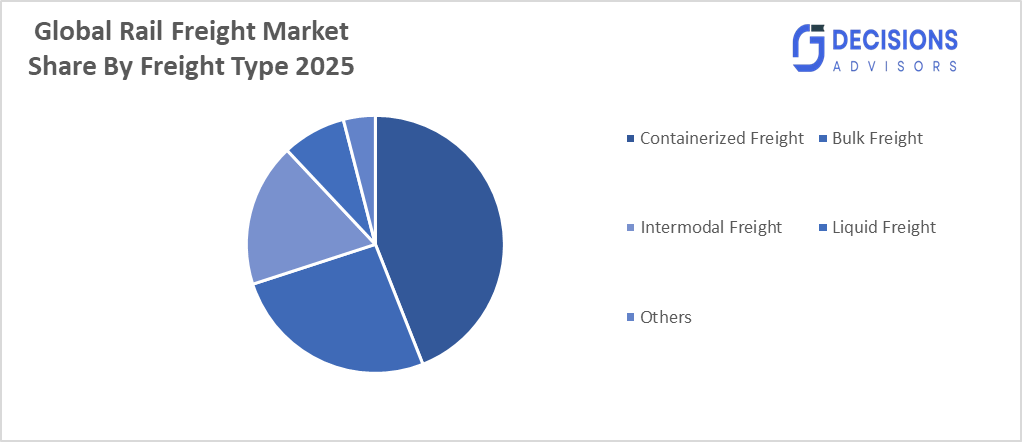
- By freight type, the Containerized Freight segment dominated the market and holds approximately 44% share in 2025 and is projected to grow at a substantial CAGR during the forecast period.
- By cargo type, the industrial materials & bulk commodities segment dominated the market and holds approximately 38% share in 2025 and is projected to grow at a substantial CAGR during the forecast period.
- The compound annual growth rate of the Global Rail Freight Market is 4.51%.
- The market is likely to achieve a valuation of USD 604.9 Billion by 2035.
Market Drivers
The Global Rail Freight Market experiences growth because more industries seek cost-effective bulk transportation of coal, minerals, agricultural products, and industrial goods over long distances. The expansion of intermodal and cross-border trade corridors drives increased adoption of containerized rail freight services in global supply chains. The growing focus on sustainable and low-emission transportation drives the adoption of rail freight over road transport, as rail offers significantly lower carbon emissions per tonne-kilometer. The e-commerce sector shows increasing demand because of the rising use of intermodal logistics and last-mile rail-to-road integration. The market expands because governments worldwide invest in dedicated freight corridors and rail infrastructure modernization projects. The global logistics industry moves towards digitalization and automation which drives railway operators to implement AI-driven scheduling, predictive maintenance, and smart rail technologies.
Restrain
The Global Rail Freight Market faces challenges such as high capital investment requirements for track, rolling stock, and terminal infrastructure, along with limited network flexibility compared to road transport. Aging rail infrastructure in several regions also increases maintenance costs and constrains capacity expansion.
Competitive Analysis:
The report offers the appropriate analysis of the key organizations/companies involved within the Global Rail Freight Market along with a comparative evaluation primarily based on their product offerings, business overviews, geographic presence, enterprise strategies, segment market share, and SWOT analysis. The report also provides an elaborative analysis focusing on the current news and developments of the companies, which includes product development, innovations, joint ventures, partnerships, mergers & acquisitions, strategic alliances, and others. This allows for the evaluation of the overall competition within the market.
Top Companies in the Global Rail Freight Market
- Union Pacific Corporation
- BNSF Railway
- Deutsche Bahn (DB Cargo)
- Canadian National Railway
- Norfolk Southern Corporation
- CSX Corporation
- China Railway Corporation
- Russian Railways (RZD)
- Indian Railways
- SNCF Group
Government Initiatives
|
Country |
Key Government Initiatives |
|
US |
The U.S. government, through the Federal Railroad Administration’s CRISI grant program, has made more than USD 2.04 billion available for fiscal years 2025-2026, supporting freight rail infrastructure upgrades, safety improvements, and network modernization across short line and Class I railroads. |
|
Europe |
The European Union, through Europe’s Rail Joint Undertaking, is coordinating an estimated €18 billion investment programme (2028-2034) to deploy the Digital Automatic Coupler (DAC) across the region, enabling automated train coupling, digital freight operations, and improved cross-border interoperability. |
|
India |
India’s Dedicated Freight Corridor (DFC) programme, led by the Ministry of Railways, has commissioned over 2,741 km of the planned 2,843 km freight-only network, doubling average freight train speeds and supporting three new corridors worth an estimated €16.5 billion under the PM Gati Shakti initiative. |
Market Segmentation
The Global Rail Freight Market share is classified into freight type, cargo type and service type
- The Containerized Freight segment dominated the market and holds approximately 44% share in 2025 and is projected to grow at a substantial CAGR during the forecast period.
Based on the freight type, the Global Rail Freight Market is divided into Bulk Freight, Intermodal Freight, Containerized Freight, and Liquid Freight. Among these, the Containerized Freight segment dominates the market and holds approximately 44% share in 2025. This dominance is due to standardized handling, strong compatibility with intermodal logistics, and seamless integration across rail, road, and maritime networks. These services are widely used for consumer goods, automotive parts, and e-commerce shipments, making containerized freight the most preferred choice across global supply chains.
- The Industrial Materials & Bulk Commodities segment accounted for the largest share of approximately 38% in 2025 and is anticipated to grow at a significant CAGR during the forecast period.
Based on the cargo type, the market is divided into Coal, Chemicals, Agricultural Products, Automotive, Consumer Goods, and Industrial Materials. Among these, Industrial Materials and bulk commodities accounted for the largest share and hold approximately 38% share in 2025. This dominance is due to rising demand for coal, minerals, cement, and steel movement over long distances. Increasing industrial output and infrastructure activity further supports segment growth, making bulk commodities the primary revenue contributor in the Global Rail Freight Market.
- The Domestic Freight segment accounted for the largest share of approximately 52% in 2025 and is anticipated to grow at a significant CAGR during the forecast period.
Based on service type, the market is divided into Domestic Freight, International Freight, Logistics Services, and Terminal & Warehousing Services. Among these, Domestic Freight dominates the market and holds approximately 52% share in 2025. This dominance is due to widespread use in national supply chains, mining operations, and agricultural distribution networks. Their cost efficiency, reliability, and high load capacity make domestic freight services essential for industrial economies, driving strong adoption across multiple end-use sectors.
Regional Segment Analysis of the Global Rail Freight Market
- North America (U.S., Canada, Mexico)?
- Europe (Germany, France, U.K., Italy, Spain, Rest of Europe)
- Asia-Pacific (China, Japan, India, Rest of APAC)
- South America (Brazil and the Rest of South America)?
- The Middle East and Africa (UAE, South Africa, Rest of MEA)
Asia Pacific is anticipated to hold approximately 41% share of the Global Rail Freight Market over the predicted timeframe.
Asia Pacific holds approximately 41% share of the Global Rail Freight Market due to extensive rail networks in China and India, high-volume bulk commodity movement, and large-scale industrial and manufacturing activity. The region benefits from the presence of major state-owned rail operators, which support continuous investment in network capacity and electrification. High adoption of dedicated freight corridors, digital freight management, and port-linked rail connectivity further strengthens market growth. Additionally, expanding cross-border rail trade routes such as the China-Europe Railway Express contribute to sustained demand. The industrial sector also plays a key role, with increasing integration of rail freight in coal, steel, and automotive supply chains across the region.
North America is expected to grow at a rapid CAGR in the Global Rail Freight Market, holding approximately 27% of the share during the forecast period
North America is expected to grow at a rapid CAGR in the Global Rail Freight Market, holding approximately 27% share during the forecast period due to strong demand from bulk commodities, intermodal logistics, and cross-border trade with Mexico and Canada. The region benefits from the presence of leading Class I railroads, which drive continuous investment in network capacity, locomotive technology, and terminal automation. High adoption of precision scheduled railroading, digital tracking, and predictive maintenance further supports market expansion. Additionally, the proposed transcontinental merger between major U.S. railroads and growing integration of rail freight in e-commerce and automotive supply chains contribute to sustained demand across the region, strengthening North America’s position in the global market.
Europe is the fastest-growing region in the Global Rail Freight Market during the period, holding approximately 19% share.
Europe is the fastest-growing region in the Global Rail Freight Market during the forecast period, holding approximately 19% share due to strong adoption of the Digital Automatic Coupler, cross-border interoperability standards, and dedicated freight corridor expansion. The region benefits from increasing deployment of electrified and low-emission locomotives, which support the EU’s sustainability and modal-shift targets. Additionally, strict carbon reduction regulations are encouraging the use of rail over road for long-haul freight. Growing demand for intermodal logistics, port connectivity, and connected industrial supply chains further supports market expansion. Continuous investments in digital rail infrastructure across countries such as Germany, France, and the UK are accelerating the adoption of rail freight solutions across multiple end-use industries.
Future Market Trends in Global Rail Freight Market: -
- Expansion of Digital Automatic Coupler (DAC) and Rail Automation
Digital Automatic Couplers are increasingly deployed across freight wagons due to their ability to automate coupling, braking, and power connections, reducing manual shunting time and improving safety. They enable real-time wagon-level data, improved operating efficiency, and innovative fleet designs. Growing demand for digitized, automated freight operations in Europe is accelerating adoption globally.
- AI-Enabled Predictive Maintenance and Smart Scheduling
AI integration enhances rail freight operations by enabling intelligent predictive maintenance, adaptive train scheduling, and congestion-aware routing. It improves reliability, reduces unplanned downtime, and optimizes asset utilization across bulk, intermodal, and containerized services. This trend is driving more efficient, responsive, and cost-effective freight networks worldwide.
- Growth in Dedicated Freight Corridors
Governments are increasingly investing in dedicated freight corridors to separate freight and passenger traffic, enhancing transit speeds and network capacity. These corridors offer better reliability, higher throughput, and reduced congestion. Rising trade volumes and demand for faster, more predictable bulk transport are significantly boosting this trend globally.
- Rising Adoption of Electrification and Low-Emission Locomotives
Rail operators are widely adopting electric, hybrid, and hydrogen-powered locomotives for freight operations to reduce emissions and fuel costs. Their lower operating costs and compliance with sustainability regulations make them ideal for long-term fleet modernization. Growing decarbonization mandates are accelerating market expansion globally.
Recent Developments
- In December 2025, Union Pacific Corporation and Norfolk Southern Corporation filed an application with the Surface Transportation Board seeking approval to combine their rail networks and create America’s first transcontinental railroad.
- In March 2026, DB Cargo announced that its reorganisation concept had been officially approved, supporting the company's strategic transformation and strengthening its position in the European rail freight market.
Market Segment
This study forecasts revenue at global, regional, and country levels from 2020 to 2035. Decision Advisors has segmented the Global Rail Freight Market based on the below-mentioned segments:
Global Rail Freight Market, By Freight Type
- Bulk Freight
- Intermodal Freight
- Containerized Freight
- Liquid Freight
- Others
Global Rail Freight Market, By Cargo Type
- Coal & Chemicals
- Agricultural Products
- Automotive
- Consumer Goods
- Industrial Materials
Global Rail Freight Market, By Service Type
- Domestic Freight
- International Freight
- Logistics Services
- Terminal & Warehousing Services
Global Rail Freight Market, By Regional Analysis
- North America
- US
- Canada
- Mexico
- Europe
- Germany
- UK
- France
- Italy
- Spain
- Russia
- Rest of Europe
- Asia Pacific
- China
- Japan
- India
- South Korea
- Australia
- Rest of Asia Pacific
- South America
- Brazil
- Argentina
- Rest of South America
- Middle East & Africa
- UAE
- Saudi Arabia
- Qatar
- South Africa
- Rest of the Middle East & Africa
Frequently Asked Questions (FAQ)
Q. What is driving the growth of the Global Rail Freight Market?
A. Growth is driven by rising demand for cost-effective bulk transportation, expansion of dedicated freight corridors, increasing intermodal and containerized trade, and government investment in rail infrastructure modernization worldwide.
Q. Why is rail freight preferred over road freight for long-haul transportation?
A. Rail freight offers lower cost per tonne-kilometer, higher load capacity, lower carbon emissions, and greater reliability for long-distance bulk and containerized cargo movement compared to road transport.
Q. Which region is expected to lead the Global Rail Freight Market during the forecast period?
A. Asia Pacific is expected to lead the market, supported by extensive rail networks in China and India, large-scale bulk commodity movement, and continued investment in dedicated freight corridors.
Q. How is digitalization influencing the rail freight industry?
A. Adoption of Digital Automatic Couplers, AI-driven scheduling, and predictive maintenance systems is enabling more automated, efficient, and reliable freight rail operations across global networks.
Check Licence
Choose the plan that fits you best: Single User, Multi-User, or Enterprise solutions tailored for your needs.
We Have You Covered
- 24/7 Analyst Support
- Clients Across the Globe
- Tailored Insights
- Technology Tracking
- Competitive Intelligence
- Custom Research
- Syndicated Market Studies
- Market Overview
- Market Segmentation
- Growth Drivers
- Market Opportunities
- Regulatory Insights
- Innovation & Sustainability
Report Details
| Scope | Global |
| Pages | 220 |
| Delivery | PDF & Excel via Email |
| Language | English |
| Release | Aug 2026 |
| Access | Download from this page |