
Global Raman Spectroscopy Market
 |
Author:
Pranali P
|
Pages:
240
|
Author:
Pranali P
|
Pages:
240
Global Raman Spectroscopy Market Size, Share By Product Type (Handheld Raman Spectrometers, Benchtop Raman Spectrometers, Portable Raman Systems), By Technology (FT-Raman, Dispersive Raman, Surface-Enhanced Raman Spectroscopy), By End-Use Industry (Pharmaceuticals, Biotechnology, Chemical & Material Science, Food & Beverage, Environmental Testing), and By Region (North America, Europe, Asia-Pacific, Latin America, Middle East & Africa), Analysis and Forecast 2026-2035.
CAGR
7.72%
REVENUE 2025
USD Billion 1.45
FORECAST 2035
USD Billion 3.05
REPORT COVERAGE
Global
Market Snapshot
- Global Raman Spectroscopy Market Size (2025): USD 1.45 Billion
- Projected Global Raman Spectroscopy Market Size (2035): USD 3.05 Billion
- Global Raman Spectroscopy Market Compound Annual Growth Rate (CAGR): 7.72%
- Largest Regional Market: North America
- 2nd Largest Region: Asia Pacific
- Fastest Growing Region: Europe
- Base Year: 2025
- Historical Period: 2021–2024
- Market Forecast Period: 2026–2035
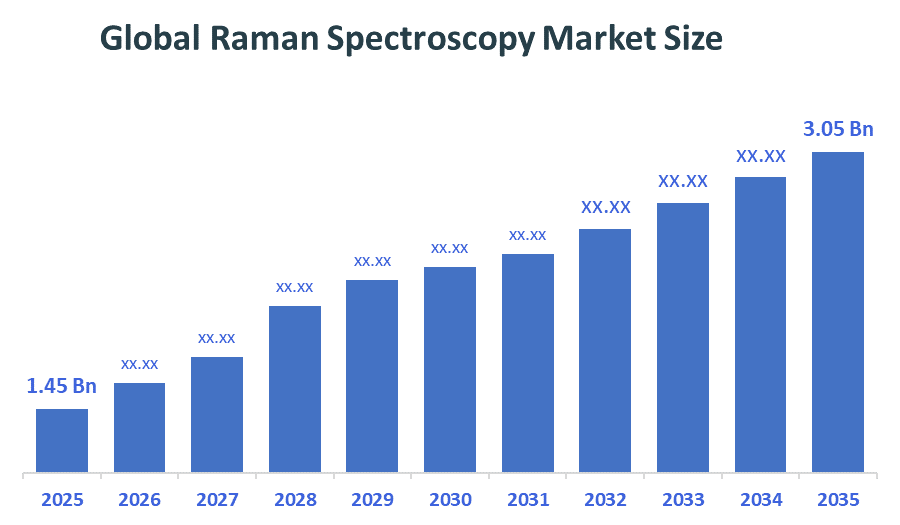
According to Decision Advisors, the Global Raman Spectroscopy Market Size is expected to grow from USD 1.45 Billion in 2025 to USD 3.05 Billion by 2035, at a CAGR of 7.72% during the forecast period 2026-2035. The Global Raman Spectroscopy Market is projected to grow steadily, driven by rising demand for non-destructive testing, pharmaceutical research expansion, technological advancements, and increasing adoption in quality control and material analysis applications.
Market Overview/ Introduction
The Global Raman Spectroscopy Market refers to advanced analytical technologies that use light scattering techniques to determine molecular composition and currently experiences steady growth because of increasing need for non-destructive testing, rapid chemical analysis and expanding usage in pharmaceutical and biotechnology and material science fields. The government initiatives, provide support for life sciences research, laboratory modernization efforts and strict quality standard regulations, have established a system that promotes technology adoption while companies develop portable devices and AI-integrated systems to enhance their operational efficiency. The system requires minimal sample preparation, provides real-time results and delivers accurate measurement results which enable industrial automation and research funding to drive market development in the healthcare, environmental testing and industrial industries worldwide.
Notable Insights: -
- North America is anticipated to hold approximately 37% share of the global raman spectroscopy market over the predicted timeframe.
- Asia Pacific is expected to grow at a rapid CAGR in the global raman spectroscopy market by holding approximately 22% of the share during the forecast period.
- By product type, the handheld raman spectrometer segment dominated the market and holds approximately 42% share in 2025 and is projected to grow at a substantial CAGR during the forecast period.
- By technology, the dispersive raman spectroscopy segment dominated the market and holds approximately 48% share in 2025 and is projected to grow at a substantial CAGR during the forecast period.
- The compound annual growth rate of the global raman spectroscopy market is 7.72%.
- The market is likely to achieve a valuation of USD 3.05 Billion by 2035.
What is the role of technology in grooming the market?
The development of raman spectroscopy systems depends on technology to improve their precision, speed and user experience of their systems. The combination of advanced laser sources and high-resolution detectors with improved optical components enables scientists to identify molecular substances with exact precision. The combination of AI with machine learning technologies enables systems to conduct automatic spectral examinations while they quickly analyze complicated information. The development of portable and handheld Raman devices has opened new possibilities for field operations because their cloud connectivity system allows users to share data in real time while they monitor operations from a distance. Pharmaceutical manufacturing facilities now implement automation together with inline systems to maintain product quality throughout their entire production process. The new technologies accomplish three objectives, they achieve this by enhancing operational performance while decreasing mistakes made by workers and extending their usefulness to different business sectors.
Market Drivers
The Global Raman Spectroscopy Market expands because pharmaceutical and chemical industries require their non-destructive rapid analytical methods to meet their need for quality control, while 60% of companies in the industries use spectroscopy to validate drugs, and the technology now finds use in biotechnology environmental protection and food safety testing. Automated system implementation improves business processes by decreasing mistakes leading to operational efficiency gains of almost 30%, while research and development spending and strict regulatory standards drive market expansion.
Restrain
High costs of advanced Raman instruments limit adoption among small and medium enterprises. The need for skilled professionals to interpret spectral data adds complexity. The presence of fluorescence interference in specific samples creates challenges for obtaining accurate results. The developing regions face two main obstacles that stop their market expansion their lack of knowledge and the difficulties combining new systems with their current ones.
Competitive Analysis:
The report offers the appropriate analysis of the key organizations/companies involved within the global raman spectroscopy market, along with a comparative evaluation primarily based on their product offerings, business overviews, geographic presence, enterprise strategies, segment market share, and SWOT analysis. The report also provides an elaborative analysis focusing on the current news and developments of the companies, which includes product development, innovations, joint ventures, partnerships, mergers & acquisitions, strategic alliances, and others. This allows for the evaluation of the overall competition within the market.
Top Companies in the Global Raman Spectroscopy Market
- Thermo Fisher Scientific Inc.
- Agilent Technologies, Inc.
- Horiba, Ltd.
- Bruker Corporation
- Renishaw plc
- Metrohm AG
- PerkinElmer, Inc.
- Ocean Insight
- Kaiser Optical Systems, Inc.
- Wasatch Photonics
Government Initiatives
|
Country |
Key Government Initiatives |
|
UK |
The UK Government’s Advanced Manufacturing Plan (2021) promotes innovation, digitalisation, process automation, and sensor technology, encouraging industrial adoption of Raman spectroscopy for real?time monitoring and quality control. |
|
US |
The U.S. Food and Drug Administration (FDA) launched the Process Analytical Technology (PAT) initiative in 2004 to encourage adoption of real?time analytical methods for manufacturing quality control. |
|
Japan |
Japan’s government initiatives, including the Science and Technology Basic Plan and JST instrument programs, indirectly boost the Raman spectroscopy market by funding research infrastructure and instrument adoption in universities and labs |
Study on the Supply, Demand, Distribution, and Market Environment of the Global Raman Spectroscopy Market
The global raman spectroscopy market receives its main demand from pharmaceutical companies, chemical manufacturers and research institutions that need detailed molecular analysis for their product testing and development work. The market maintains its supply because of ongoing technological improvements and the rising availability of portable high-performance spectroscopy equipment. The company distributes its products through direct sales, authorized distributors, and online platforms, which enable customers to access products while receiving comprehensive after-sales support and technical assistance. The market environment develops through strict regulatory requirements, increasing industrial activities and fast technological advancements creating a competitive market environment that drives continuous innovation and leads to sustained economic development throughout worldwide markets.
Price Analysis and Consumer Behaviour Analysis
The global raman spectroscopy market experiences its main market force because pharmaceuticals and chemical industries and research institutions need high-precision molecular testing resulting in 55% of pharmaceutical companies using Raman systems to conduct quality control and material testing, while 65% of new pharmaceutical facilities implement these systems to perform real-time process supervision. The chemical industry reports that 46% of its companies use Raman technology to oversee their production activities, which leads to more than 30% error reduction, while 41% of food safety laboratories employ this technology to identify contamination. The increasing use of AI affects about 27% of purchase choices, and the growing need for automated systems and compliance with regulations, drives both global market demand and market adoption.
Market Segmentation
The global raman spectroscopy market share is classified into product type, measurement angle and end-use industry.
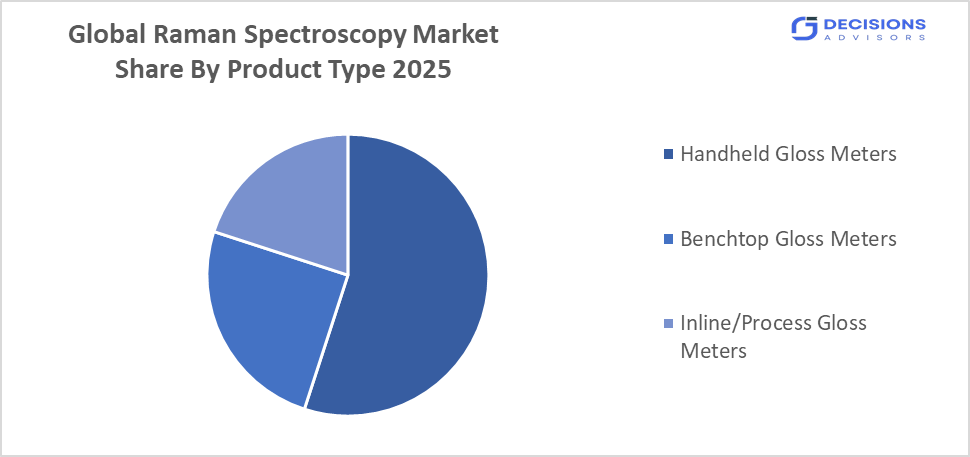
- The handheld raman spectrometer segment dominated the market and holds approximately 42% share in 2025 and is projected to grow at a substantial CAGR during the forecast period.
Based on the product type, the global raman spectroscopy market is divided into handheld Raman spectrometers, benchtop Raman spectrometers, and portable Raman systems. Among these, the handheld gloss meters segment dominated the market and holds approximately 48% share in 2025 and is projected to grow at a substantial CAGR during the forecast period. This dominance is attributed to portability, ease of use, and suitability for on-site chemical analysis, enabling rapid and accurate identification across pharmaceuticals, security screening, and industrial applications, while reducing analysis time and improving operational efficiency.
- The dispersive raman spectroscopy segment accounted for the largest share of approximately 48% in 2025 and is anticipated to grow at a significant CAGR during the forecast period.
Based on the measurement angle, the global raman spectroscopy market is divided into FT-Raman, dispersive Raman spectroscopy, and surface-enhanced Raman spectroscopy (SERS). Among these, the dispersive raman spectroscopy segment accounted for the largest share of approximately 48% in 2025 and is anticipated to grow at a significant CAGR during the forecast period. This dominance is due to its wide applicability, high sensitivity, and suitability for general-purpose molecular analysis, making it widely adopted across pharmaceuticals, chemicals, and research sectors where accurate, reliable, and fast spectral identification is essential for quality and analysis.
- The pharmaceuticals segment accounted for the largest share of approximately 38% in 2025 and is anticipated to grow at a significant CAGR during the forecast period.
Based on the end-use industry, the global raman spectroscopy market is divided into pharmaceuticals, biotechnology, chemical & material science, food & beverage, environmental testing, forensic science, and academic & research institutes. Among these, the pharmaceuticals segment accounted for the largest share of approximately 38% in 2025 and is anticipated to grow at a significant CAGR during the forecast period. This growth is driven by increasing demand for drug development, quality control, regulatory compliance, and real-time process monitoring.
Strategies to Implement for Growth of the Market in Non-Leading Regions
The raman spectroscopy market outside its major markets will expand through mainly through affordable products, easily accessible products, and increased public knowledge of the technology. Companies should develop cost-effective and portable Raman devices tailored for small and medium enterprises to increase adoption. Local partnerships with regional distributors will enable companies to expand the distribution networks that help them access more markets. The organization needs to establish training programs and technical workshops which will help people understand and operate Raman technology better. Local manufacturing and after-sales service infrastructure investment will decrease operational expenses while building customer confidence. Digital platforms and e-commerce channels will make products easier to access for customers during research institution partnerships will help the company enter new markets and achieve sustainable growth.
Regional Segment Analysis of the Global Raman Spectroscopy Market
- North America (U.S., Canada, Mexico)?
- Europe (Germany, France, U.K., Italy, Spain, Rest of Europe)
- Asia-Pacific (China, Japan, India, Rest of APAC)
- South America (Brazil and the Rest of South America)?
- The Middle East and Africa (UAE, South Africa, Rest of MEA)
North America is anticipated to hold approximately 37% share of the global raman spectroscopy market over the predicted timeframe.
North America is anticipated to hold approximately 37% share of the global raman spectroscopy market over the predicted timeframe. This dominance is driven by a well-established industrial base, strong adoption of advanced measurement technologies, stringent regulatory standards, and continuous investment in research and development across pharmaceuticals, chemicals, and industrial applications.
Asia Pacific is expected to grow at a rapid CAGR in the global raman spectroscopy market, holding approximately 22% of the share during the forecast period
Asia Pacific is expected to grow at a rapid CAGR in the global raman spectroscopy market, holding approximately 22% share during the forecast period. The region’s growth is driven by rapid industrialization, expansion of pharmaceutical and chemical manufacturing, and increasing adoption of advanced analytical technologies for quality control and research. Countries such as China, India, and Japan are investing heavily in laboratory modernization and industrial automation. Rising awareness, government initiatives supporting scientific research, and growing export standards further accelerate market adoption, making Asia Pacific a key growth region.
Europe is the fastest-growing region in the global raman spectroscopy market during the period, holding approximately 27% share.
Europe is the fastest-growing region in the global raman spectroscopy market during the forecast period, holding approximately 27% share. This growth is driven by strong demand from pharmaceuticals, chemical, and research sectors requiring high-precision molecular analysis, strict regulatory standards, increasing investment in advanced manufacturing technologies, and widespread adoption of automation and digital analytical solutions across industries.
Future Market Trends in Global Raman Spectroscopy Market: -
1. Rising Adoption of Portable and Handheld Systems
The demand for compact, portable, and handheld Raman devices is increasing, allowing on-site and field analysis. These systems enhance accessibility, reduce analysis time, and expand usage in pharmaceuticals, environmental monitoring, and industrial applications.
2. Advancements in Sensor Technology and Accuracy
Ongoing innovations in optical sensors and measurement techniques are improving precision, repeatability, and multi-angle capabilities. These advancements allow accurate analysis across diverse materials, surface finishes, and complex samples, boosting research and industrial adoption.
3. Increased Automation and Inline Integration
Industries are integrating Raman spectroscopy into automated and inline production systems for continuous real-time monitoring. This reduces manual intervention, improves operational efficiency, and ensures consistent quality in high-volume manufacturing.
4. AI and Data Analytics Adoption
Artificial intelligence and advanced data analytics are being incorporated for spectral interpretation, anomaly detection, and predictive analysis. This improves decision-making, accelerates R&D, and enhances the overall efficiency of laboratories and manufacturing facilities.
Recent Development
- In January?2025, Bruker Corporation announced the launch of the LUMOS?II FT?IR imaging microscope for pharma and life science research, which includes enhanced analytical workflows that support complementary IR and Raman measurements, contributing to the Raman spectroscopy market’s technological ecosystem
- In September 2024, Thermo Fisher Scientific launched AI-powered chemometrics software for the DXR Raman series and DXR3 microscopes, enhancing usability and driving adoption, positively impacting the global Raman spectroscopy market
- In July 2022, Renishaw plc launched the inLux SEM Raman interface, enabling in?situ Raman spectroscopy with SEMs, enhancing industrial applications and driving adoption, positively impacting the global Raman spectroscopy market
How is Recent Developments Helping the Market?
The global raman spectroscopy market is experiencing growth because recent technological advancements enhance device performance and make devices more accessible to multiple industries. Companies are developing portable and handheld spectrometers enabling users to conduct precise field tests without needing extra tools. The combination of advanced digital interfaces with IoT connectivity and cloud-based platforms enables users to monitor data in real time while they store information and create reports that lead to better operational performance and product quality management. The combination of AI-driven analytics with spectral analysis tools enables researchers to interpret results and forecast outcomes, which speeds up their research work. The combination of product announcements and strategic partnerships with market expansion into new territories provides businesses with improved accessibility while they strengthen their brand recognition and discover new opportunities for growth in worldwide markets.
Market Segment
This study forecasts revenue at global, regional, and country levels from 2020 to 2035. Decision Advisors has segmented the global raman spectroscopy market based on the below-mentioned segments:
Global Raman Spectroscopy Market, By Product Type
- Handheld Raman Spectrometers
- Benchtop Raman Spectrometers
- Portable Raman Systems
Global Raman Spectroscopy Market, By Technology
- FT-Raman (Fourier Transform Raman)
- Dispersive Raman Spectroscopy
- Surface-Enhanced Raman Spectroscopy (SERS)
Global Raman Spectroscopy Market, By End-Use Industry
- Pharmaceuticals
- Biotechnology
- Chemical & Material Science
- Food & Beverage
- Environmental Testing
- Forensic Science
- Academic & Research Institutes
Global Raman Spectroscopy Market, By Regional Analysis
- North America
- US
- Canada
- Mexico
- Europe
- Germany
- UK
- France
- Italy
- Spain
- Russia
- Rest of Europe
- Asia Pacific
- China
- Japan
- India
- South Korea
- Australia
- Rest of Asia Pacific
- South America
- Brazil
- Argentina
- Rest of South America
- Middle East & Africa
- UAE
- Saudi Arabia
- Qatar
- South Africa
- Rest of the Middle East & Africa
Frequently Asked Questions (FAQ)
Q. How is Raman spectroscopy adoption changing in emerging markets?
Emerging markets are adopting Raman technology faster due to portable devices, affordable pricing, and government initiatives supporting research. Local partnerships and training programs are increasing accessibility, creating new growth opportunities beyond traditional regions.
Q. What role does AI play in Raman spectroscopy?
AI helps interpret complex spectral data, identify patterns, and predict material properties. This reduces manual analysis time, improves accuracy, and supports decision-making in R&D and quality control across multiple industries.
Q. How does Raman spectroscopy improve lab-to-field transition in research?
Portable Raman devices allow scientists to collect accurate spectral data outside traditional labs, bridging the gap between controlled experiments and real-world conditions, which accelerates product testing and environmental analysis.
Q. How does it support regulatory compliance beyond pharmaceuticals?
Industries like food, cosmetics, and chemicals use Raman spectroscopy to verify ingredient authenticity and safety, ensuring compliance with international standards and minimizing risks of recalls or penalties.
Check Licence
Choose the plan that fits you best: Single User, Multi-User, or Enterprise solutions tailored for your needs.
We Have You Covered
- 24/7 Analyst Support
- Clients Across the Globe
- Tailored Insights
- Technology Tracking
- Competitive Intelligence
- Custom Research
- Syndicated Market Studies
- Market Overview
- Market Segmentation
- Growth Drivers
- Market Opportunities
- Regulatory Insights
- Innovation & Sustainability
Report Details
| Scope | Global |
| Pages | 240 |
| Delivery | PDF & Excel via Email |
| Language | English |
| Release | Apr 2026 |
| Access | Download from this page |