
Global Raynauds Disease Market
 |
Pages:
195
|
Pages:
195
Global Raynauds Disease Market Size, Share, and COVID-19 Impact Analysis, By Type (Primary Raynaud?s Disease and Secondary Raynaud?s Phenomenon), By Treatment Type (Calcium Channel Blockers, Vasodilators, Alpha Blockers, Topical Nitrates, Prostacyclin Therapy, and Others) and By Region (North America, Europe, Asia-Pacific, Latin America, Middle East, and Africa), Analysis and Forecast 2025 - 2035.
REPORT COVERAGE
Global
Global Raynauds Disease Market Insights Forecasts to 2035
- The Global Raynauds Disease Market Size was valued at USD 1.5 billion in 2024
- The Global Raynauds Disease Market Size is Expected to Grow at a CAGR of around 7.72% from 2025 to 2035
- The Worldwide Raynauds Disease Market Size is Expected to Reach USD 3.4 Billion by 2035
- Asia-Pacific is expected to grow the fastest during the forecast period.
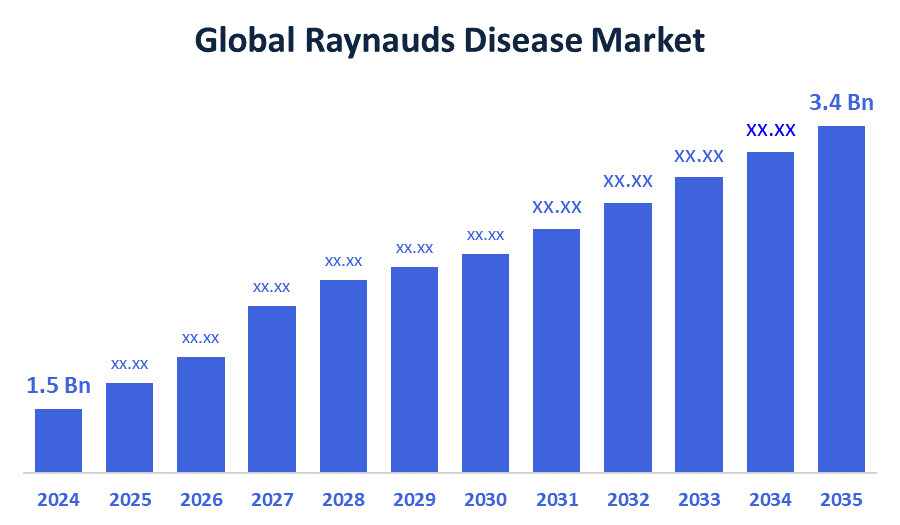
According to a research report published by Spherical Insights and Consulting, the global raynauds disease market size was worth around USD 1.5 billion in 2024 and is predicted to grow to around USD 3.4 billion by 2035 with a compound annual growth rate (CAGR) of 7.72% from 2025 to 2035. Future opportunities in the global Raynaud's disease market will emerge through six specific developments, which include targeted vasodilator therapies, wearable circulation-monitoring devices, biologics research, expanded diagnosis capabilities in emerging markets, telemedicine adoption, and development of personalized treatment methods that enhance long-term patient outcomes.
Market Overview
Raynaud's disease causes temporary blood vessel narrowing, which affects finger and toe blood flow and results in color changes, numbness, and pain during cold weather and stress. The global Raynaud's disease market is growing because more people develop autoimmune disorders, public awareness increases, and diagnostic technologies become better. The combination of better vascular imaging methods and greater access to specialized medical services allows for more effective disease identification and patient care. Advanced vasodilators, calcium channel blockers, and biologics represent new pharmaceutical advancements that improve patient symptom control. The expansion of healthcare facilities in developing countries creates additional opportunities for market development. The market will experience sustained long-term growth through personalized medical treatments and wearable technology that tracks blood circulation, telemedicine services, and research that investigates the root causes of vascular disorders.
Report Coverage
This research report categorizes the raynauds disease market based on various segments and regions, forecasts revenue growth, and analyzes trends in each submarket. The report analyses the key growth drivers, opportunities, and challenges influencing the raynauds disease market. Recent market developments and competitive strategies such as expansion, type launch, development, partnership, merger, and acquisition, have been included to draw the competitive landscape in the market. The report strategically identifies and profiles the key market players and analyses their core competencies in each sub-segment of the raynauds disease market.
Driving Factors
The international Raynaud's disease market grows because three main factors drive its expansion. The first factor consists of increasing cases of autoimmune and connective tissue disorders in the population. The second factor involves public educational efforts, which lead to greater understanding of the disease. The third factor brings about more effective disease identification methods, which medical professionals now have. The population increase in cold regions, combined with stress from modern living, creates additional demand for Raynaud's disease treatment. The market growth accelerates because advanced vasodilator drugs, biologic therapies, and wearable circulation-monitoring devices, and AI-assisted vascular imaging and telemedicine-enabled specialist consultations work together to improve disease management.
Restraining Factors
The global raynaud's disease market faces restraining factors, which include three main elements of limited disease awareness in developing regions, high treatment costs for advanced medical therapies, and the existence of untreated mild cases and the difficulties of diagnostic testing and the regulatory system, which requires extensive time for new drugs to receive approval.
Market Segmentation
The raynauds disease market share is classified into type and treatment type.
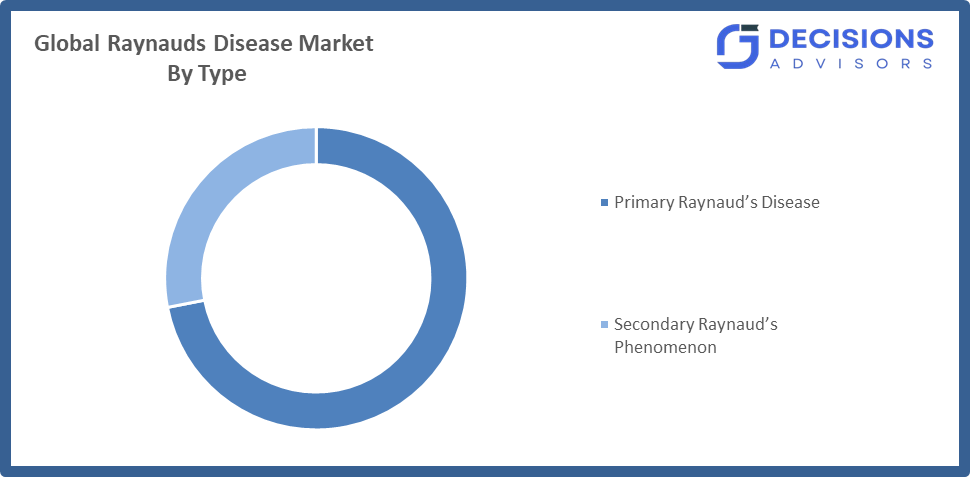
- The primary raynaud’s disease segment dominated the market in 2024, approximately 65% and is projected to grow at a substantial CAGR during the forecast period.
Based on the type, the raynauds disease market is divided into primary raynaud’s disease and secondary raynaud’s phenomenon. Among these, the primary raynaud’s disease segment dominated the market in 2024, approximately 65% and is projected to grow at a substantial CAGR during the forecast period. The primary reason for this condition to affect young adults and women at higher rates than its secondary cases should be treated as the main reason for their occurrence. The majority of patients need extended time for managing their symptoms which leads to an increased requirement for medical services. The segment development receives additional support from increased public knowledge and improved diagnostic methods and the common application of vasodilator treatments. The outpatient visits and medication requirements of patients with mild-to-moderate conditions establish a constant pattern of medical usage.
- The calcium channel blockers segment accounted for the largest share in 2024, approximately 55% and is anticipated to grow at a significant CAGR during the forecast period.
Based on the treatment type, the raynauds disease market is divided into calcium channel blockers, vasodilators, alpha blockers, topical nitrates, prostacyclin therapy, and others. Among these, the calcium channel blockers segment accounted for the largest share in 2024, approximately 55% and is anticipated to grow at a significant CAGR during the forecast period. The proven effectiveness of the first-line recommendation demonstrates that it protects patients from vasospasm events while maintaining a high safety record. The medication remains accessible to patients because doctors prefer its use and because it remains affordable and effective for extended treatment. The combination of physician preference for the medication and its simple oral use and established clinical guidelines create a strong basis for its application. The expansion of patient knowledge together with the introduction of generic drugs creates stronger market dominance and drives growth in the segment.
Regional Segment Analysis of the Raynauds Disease Market
- North America (U.S., Canada, Mexico)
- Europe (Germany, France, U.K., Italy, Spain, Rest of Europe)
- Asia-Pacific (China, Japan, India, Rest of APAC)
- South America (Brazil and the Rest of South America)
- The Middle East and Africa (UAE, South Africa, Rest of MEA)
North America is anticipated to hold the largest share of the raynauds disease market over the predicted timeframe.
North America is anticipated to hold the largest share of the raynauds disease market over the predicted timeframe. The advanced healthcare systems result in high public knowledge about vascular and autoimmune disorders which, combined with their ability to access specialist medical services, create better health outcomes for patients. The regional market maintains its leadership position because of multiple factors which include beneficial reimbursement policies and the availability of diagnostic tests and the increased use of treatments and the rising healthcare expenses.
Asia-Pacific is expected to grow at a rapid CAGR in the raynauds disease market during the forecast period. The healthcare market experiences growth because of three main factors. The healthcare sector in the region develops through increasing population numbers and rising rates of autoimmune diseases and better healthcare funding and new medical specialty facilities.
Competitive Analysis:
The report offers the appropriate analysis of the key organizations/companies involved within the raynauds disease market, along with a comparative evaluation primarily based on their type of offering, business overviews, geographic presence, enterprise strategies, segment market share, and SWOT analysis. The report also provides an elaborative analysis focusing on the current news and developments of the companies, which includes type development, innovations, joint ventures, partnerships, mergers & acquisitions, strategic alliances, and others. This allows for the evaluation of the overall competition within the market.
List of Key Companies
- Pfizer Inc.
- Novartis AG
- Sanofi S.A.
- Johnson & Johnson (Janssen)
- GlaxoSmithKline
- Bayer AG
- Merck & Co., Inc.
- AstraZeneca plc
- Boehringer Ingelheim
- Bristol Myers Squibb (BMS)
- Others
Key Target Audience
- Market Players
- Investors
- End-users
- Government Authorities
- Consulting and Research Firm
- Venture capitalists
- Value-Added Resellers (VARs)
Market Segment
This study forecasts revenue at global, regional, and country levels from 2020 to 2035. Spherical Insights has segmented the raynauds disease market based on the below-mentioned segments:
Global Raynauds Disease Market, By Type
- Primary Raynaud’s Disease
- Secondary Raynaud’s Phenomenon
Global Raynauds Disease Market, By Treatment Type
- Calcium Channel Blockers
- Vasodilators
- Alpha Blockers
- Topical Nitrates
- Prostacyclin Therapy
- Others
Global Raynauds Disease Market, By Regional Analysis
- North America
- US
- Canada
- Mexico
- Europe
- Germany
- UK
- France
- Italy
- Spain
- Russia
- Rest of Europe
- Asia Pacific
- China
- Japan
- India
- South Korea
- Australia
- Rest of Asia Pacific
- South America
- Brazil
- Argentina
- Rest of South America
- Middle East & Africa
- UAE
- Saudi Arabia
- Qatar
- South Africa
- Rest of the Middle East & Africa
Frequently Asked Questions (FAQ)
Q1. What is the projected growth of the Raynaud’s disease market?
A: According to Spherical Insights and Consulting, the market will grow from USD 1.5 billion in 2024 to USD 3.4 billion by 2035, registering a CAGR of 7.72%.
Q2. What key factors are driving market expansion?
A: Rising autoimmune disorder prevalence, improved public awareness, better diagnostics, growing cold-climate populations, and innovations like biologics, advanced vasodilators, wearable circulation monitors, AI imaging, and telemedicine-enabled specialist care drive growth.
Q3. Which segment dominates by disease type?
A: Primary Raynaud’s disease leads due to higher prevalence among young adults and women, long-term symptom management needs, frequent outpatient visits, improved diagnostics, and widespread use of vasodilator-based therapies.
Q4. Which treatment segment holds the largest share?
A: Calcium channel blockers dominate due to first-line clinical recommendation, proven vasospasm reduction, strong safety profile, affordability, physician preference, simple oral dosing, guideline support, and wide availability of generics.
Q5. Which regions lead and grow fastest?
A: North America leads with advanced healthcare and high treatment adoption, while Asia-Pacific grows fastest due to expanding infrastructure, large populations, rising autoimmune cases, and improving healthcare investments.
Check Licence
Choose the plan that fits you best: Single User, Multi-User, or Enterprise solutions tailored for your needs.
We Have You Covered
- 24/7 Analyst Support
- Clients Across the Globe
- Tailored Insights
- Technology Tracking
- Competitive Intelligence
- Custom Research
- Syndicated Market Studies
- Market Overview
- Market Segmentation
- Growth Drivers
- Market Opportunities
- Regulatory Insights
- Innovation & Sustainability
Report Details
| Scope | Global |
| Pages | 195 |
| Delivery | PDF & Excel via Email |
| Language | English |
| Release | Mar 2026 |
| Access | Download from this page |