
Global Rhodium Carbon Catalyst Market
 |
Author:
Aditya G
|
Pages:
240
|
Author:
Aditya G
|
Pages:
240
Global Rhodium Carbon Catalyst Market Size, By Catalyst Type (Homogeneous Catalysts, Heterogeneous Catalysts, and Microbial Catalysts), By Form (Supported Catalysts, Unsupported Catalysts, and Colloidal Catalysts), By Application (Automotive, Industrial Catalysis, Chemical Synthesis, Electronics, and Pharmaceuticals), and By Region (North America, Europe, Asia-Pacific, Latin America, Middle East, and Africa), Analysis and Forecast 2026 â 2035.
CAGR
6.4%
REVENUE 2025
USD Billion 1.77
FORECAST 2035
USD Billion 3.29
REPORT COVERAGE
Global
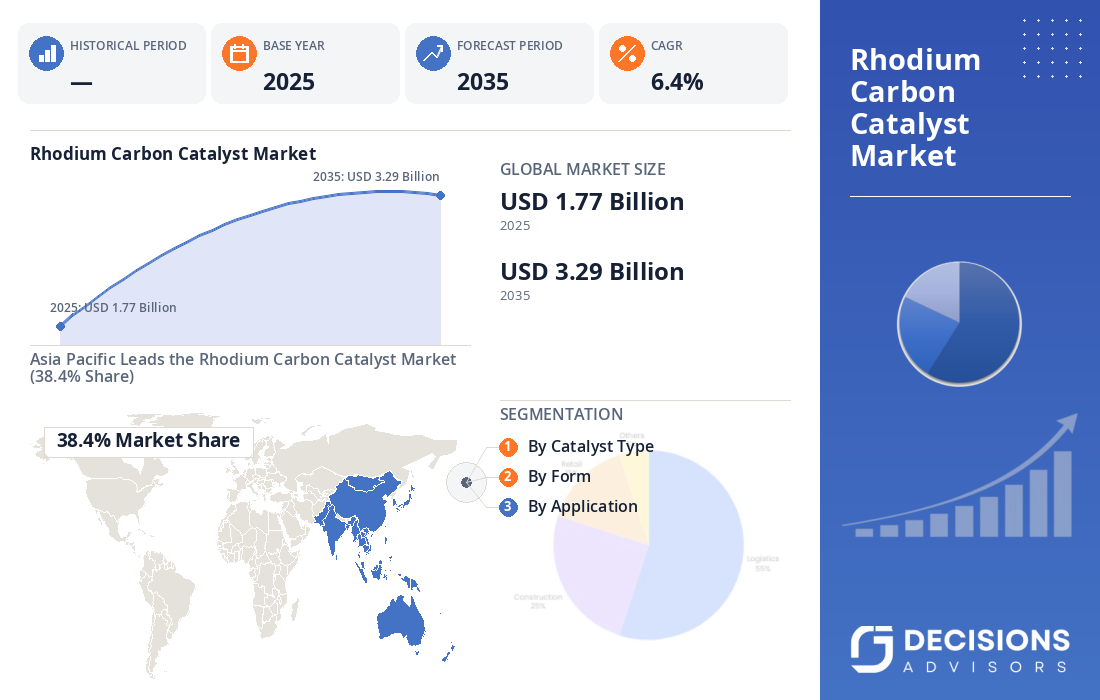
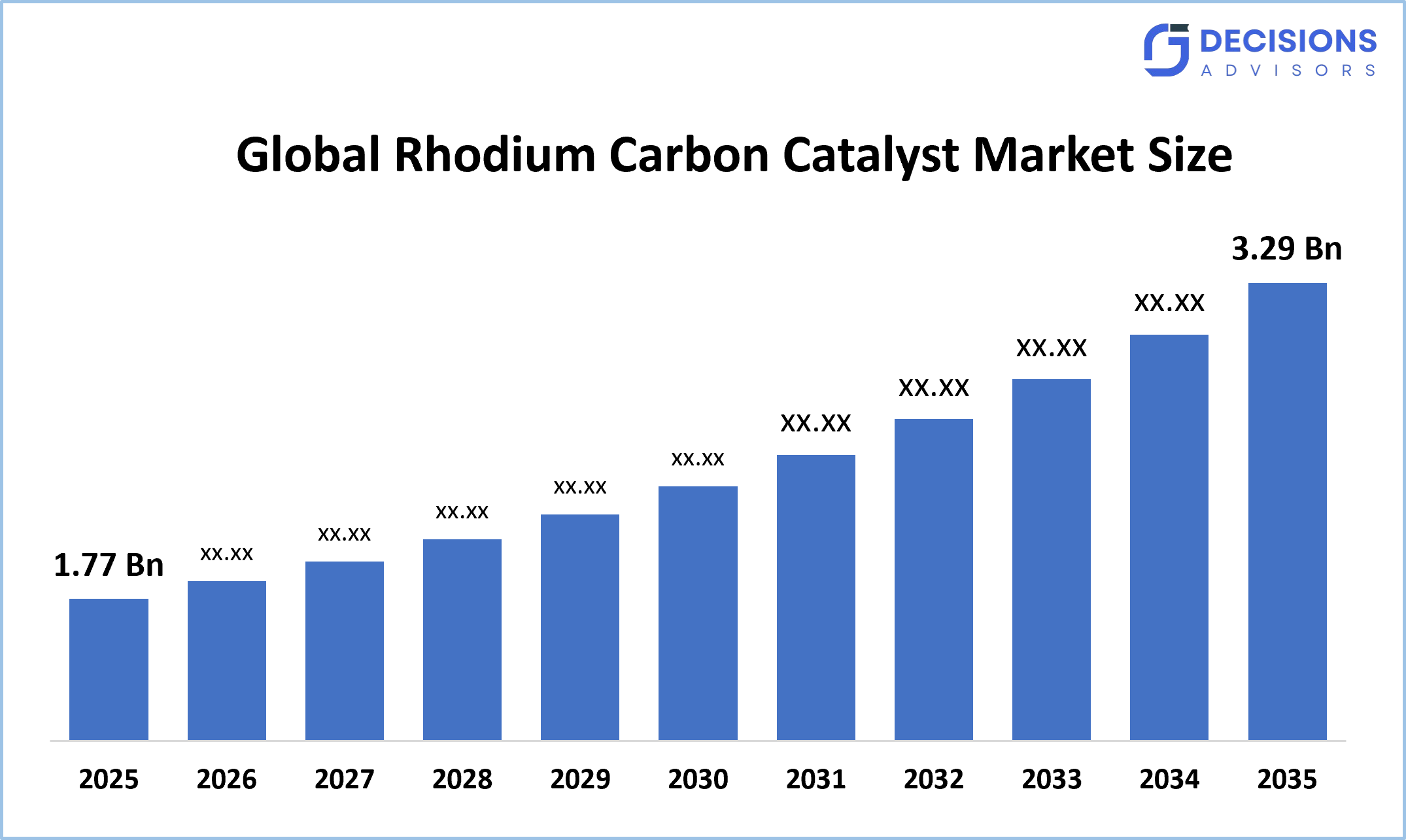
According to Decision Advisors, The Global Rhodium Carbon Catalyst Market Size was valued at USD 1.77 Billion in 2025 and is anticipated to reach USD 3.29 Billion by 2035 to grow with a CAGR of 6.4% during the forecast period 2026-2035. The growing demand for pharmaceuticals and chemicals is driving the rhodium carbon catalyst market, as these catalysts support efficient chemical production and processing.
Global Rhodium Carbon Catalyst Market Insights Forecasts to 2035
- The Global Rhodium Carbon Catalyst Market Size Was Estimated at USD 1.77 Billion in 2025
- The Market Size is Expected to Grow at a CAGR of around 6.4% 2025 to 2035
- The Worldwide Rhodium Carbon Catalyst Market Size is Expected to Reach USD 3.29 Billion by 2035
- North America is Expected to Grow the Fastest during the Forecast Period.
What is the Rhodium Carbon Catalyst?
Rhodium carbon catalyst is a catalyst made by placing rhodium metal on activated carbon. Rhodium is a rare and valuable metal known for its strong catalytic properties. The activated carbon provides a large surface area, allowing rhodium to interact effectively with chemical substances during reactions. This catalyst is mainly used in chemical manufacturing, pharmaceutical production, petrochemical processing, and fine chemical synthesis. It supports reactions such as hydrogenation, dehydrogenation, and reduction. Rhodium carbon catalysts are valued for their high activity, selectivity, and stability. Their ability to improve chemical reactions while requiring relatively small amounts makes them useful in various industrial processes.
Report Coverage
This research report categorizes the rhodium carbon catalyst market based on various segments and regions, forecasts revenue growth, and analyzes trends in each submarket. The report analyses the key growth drivers, opportunities, and challenges influencing the rhodium carbon catalyst market developments and competitive strategies, such as expansion, product launch, development, partnership, merger, and acquisition, have been included to draw the competitive landscape in the market. The report strategically identifies and profiles the key market players and analyses their core competencies in each sub-segment of the rhodium carbon catalyst market.
Trending Factors
- Growing use in selective hydrogenation: Rhodium carbon catalysts are increasingly used to carry out selective hydrogenation of aromatic compounds and nitrile groups under mild reaction conditions in chemical manufacturing processes.
- Rising demand for high-activity catalysts: Chemical manufacturers are seeking highly active catalysts with good filtration properties for efficient batch and continuous production across various industrial chemical processes.
- Increasing use in pharmaceutical synthesis: Rhodium-on-carbon catalysts are increasingly used in pharmaceutical and biopharmaceutical manufacturing for controlled chemical reactions involved in producing specialized medicines and compounds.
- Growing demand for customized catalysts: Catalyst manufacturers are developing rhodium-based products designed for specific chemical reactions, operating conditions, and production needs across pharmaceutical and chemical manufacturing applications.
- Rising focus on rhodium recovery: The high value of rhodium is increasing interest in recovering the metal from used catalysts, allowing manufacturers to recycle valuable materials for further industrial applications.
What is the use of AI in the Rhodium Carbon Catalyst Market?
AI is being used in the rhodium carbon catalyst market to improve catalyst development, testing, and production. AI-based tools can analyze chemical data and identify suitable catalyst compositions for specific reactions. Machine learning can predict catalyst performance, reaction conditions, and material behavior before laboratory testing. AI can also support process monitoring by analyzing production data and identifying changes in temperature, pressure, or catalyst performance. In research, AI can speed up the screening of different catalyst formulations and support the development of more efficient rhodium carbon catalysts for chemical and pharmaceutical applications.
Market Outlook
Driving Factor
The growing use of hydroformylation in chemical manufacturing is increasing demand for rhodium-based catalysts. These catalysts convert olefins into aldehydes through reactions with hydrogen and carbon monoxide. The resulting aldehydes are used to produce alcohols and other chemicals for surfactants, solvents, plasticizers, coatings, and specialty products. Rising demand for these downstream chemicals is encouraging greater hydroformylation activity. Rhodium catalysts are valued for their high activity and selectivity, supporting efficient chemical production. Expanding chemical manufacturing capacity and downstream product demand are further strengthening their use in hydroformylation applications.
In May 2025, Umicore announced an expansion of its homogeneous catalyst production facility in the U.S. The company also supplies highly active rhodium catalysts for the oxo industry, where hydroformylation is used to produce aldehydes.
Restraining Factors
High rhodium prices, catalyst deactivation, recovery and recycling challenges, limited availability of rhodium, and the high cost of catalyst replacement can restrain the growth of the Rhodium Carbon Catalyst Market.
Opportunities
Increasing focus on catalyst recycling creates opportunities for the rhodium carbon catalyst market. Rhodium is a valuable precious metal, making recovery and reuse attractive for chemical manufacturers. Companies are developing methods to recover rhodium from used catalysts and return it to production processes. Improved recycling can reduce the need for new rhodium and support better resource use. Longer catalyst life can also reduce replacement needs and operating costs. Growing use of rhodium catalysts in pharmaceutical, chemical, and specialty chemical production is increasing interest in efficient recovery systems. Advances in recycling technologies can further support sustainable catalyst management and market growth.
Market Segmentation
By Catalyst Type
The heterogeneous catalysts segment held the largest share of the market in 2025, supported by the widespread use of supported rhodium catalysts in industrial chemical reactions and hydrogenation processes.
The homogeneous catalysts segment is expected to grow at the fastest rate during the forecast period, driven by their high activity, selectivity, and increasing use in chemical synthesis and specialized catalytic reactions.
By Form
The supported catalysts segment held the largest share of the market in 2025, due to the use of rhodium deposited on materials such as activated carbon to provide high surface area and efficient catalytic performance.
The colloidal catalysts segment is expected to grow at the fastest rate during the forecast period, driven by their high surface activity and increasing use in specialized chemical and pharmaceutical reactions.
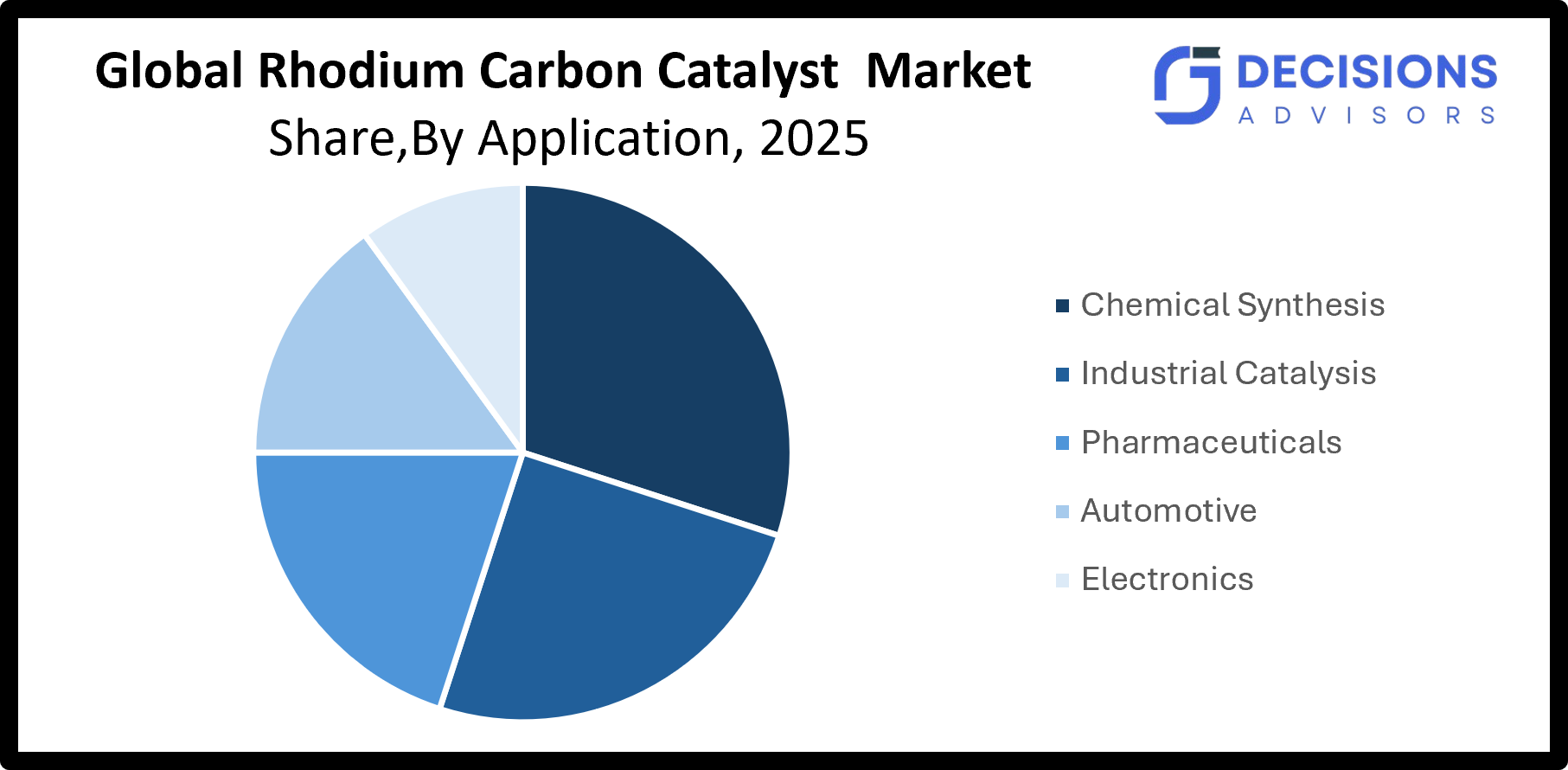
By Application
The chemical synthesis segment held the largest share of the market in 2025, supported by the use of rhodium catalysts in hydrogenation, reduction, and other chemical reactions.
The pharmaceuticals segment is expected to grow at the fastest rate during the forecast period, due to increasing pharmaceutical production and the rising use of rhodium catalysts in drug synthesis and specialized chemical processes.
Asia-Pacific dominated the rhodium carbon catalyst market in 2025 accounting for approximately 38.4% of the global market share.
Asia-Pacific dominated the rhodium carbon catalyst market in 2025. The regional growth is supported by expanding pharmaceutical and chemical manufacturing, rising API production, and increasing use of hydrogenation processes. China and India are leading countries, driven by large pharmaceutical industries, specialty chemical production, and growing manufacturing capacity. India's PLI Scheme for Bulk Drugs supports domestic production of key starting materials, drug intermediates, and APIs, encouraging pharmaceutical manufacturers to expand production and adopt efficient catalytic processes. This supports the demand for rhodium carbon catalysts used in hydrogenation and other chemical reactions during pharmaceutical and chemical manufacturing. Leading companies such as Hindustan Platinum and Antai Fine Chemical support the regional market through rhodium-based catalysts for hydrogenation and chemical manufacturing.
In March 2026, India’s Department of Pharmaceuticals reported â¹6,940 crore in approved outlay for the Bulk Drugs PLI Scheme. Expansion of API and drug-intermediate manufacturing can support demand for rhodium carbon catalysts used in pharmaceutical synthesis.
North America is expected to grow at a rapid CAGR of approximately 27.3% in the rhodium carbon catalyst market during the forecast period. The region’s growth is supported by strong pharmaceutical manufacturing, specialty chemical production, and increasing use of hydrogenation processes. The United States and Canada are leading countries, driven by established pharmaceutical industries, advanced chemical manufacturing, and research into efficient catalytic processes. In the United States, the Department of Energy’s ASPECT initiative supports the development and scale-up of innovative chemical technologies, strengthening domestic chemical manufacturing and creating demand for advanced catalyst technologies. Leading companies such as Johnson Matthey and BASF offer rhodium-on-carbon catalysts for hydrogenation of aromatic compounds, nitriles, alkenes, and other chemical groups, supporting regional demand for rhodium carbon catalysts.
In September 2026, the U.S. Department of Energy announced up to $58 million through the ASPECT initiative to advance innovative chemical technologies and domestic chemical production, increasing demand for advanced catalysts such as rhodium carbon catalysts.
SWOT Analysis
|
Strengths |
High Catalytic Selectivity |
|
Weaknesses |
Complex System Integration |
|
Opportunities |
Customized Catalyst Development |
|
Threats |
Growing Demand for Palladium Carbon Catalysts |
List of Key Companies
- BASF SE
- Evonik Industries AG
- Johnson Matthey Plc
- Umicore
- Heraeus Holding
- Hindustan Platinum Pvt Ltd
- Clariant AG
- Alfa Aesar
- Strem Chemicals, Inc.
- Vineeth Precious Catalysts Pvt Ltd
- Antai Fine Chemical Co Ltd
- N.E. Chemcat Corporation
- KaiDa Technology Co Ltd
- Tanaka Precious Metals
- Other
Key Target Audience
- Market Players
- Investors
- End-users
- Government Authoritiesâ¯
- Consulting and Research Firm
- Venture capitalists
- Value-Added Resellers (VARs)
Recent Development
- In October 2025, Evonik launched its Noblyst F catalyst portfolio for flow applications, featuring precious-metal catalysts supported on granular activated carbon. The portfolio targets pharmaceutical, agrochemical, and fine-chemical processes.
Market Segment
This study forecasts revenue at global, regional, and country levels from 2020 to 2035. Decision Advisors has segmented the rhodium carbon catalyst market based on the below-mentioned segments:
Global Rhodium Carbon Catalyst Market, By Catalyst Type
- Homogeneous Catalysts
- Heterogeneous Catalysts
- Microbial Catalysts
Global Rhodium Carbon Catalyst Market, By Form
- Supported Catalysts
- Unsupported Catalysts
- Colloidal Catalysts
Global Rhodium Carbon Catalyst Market, By Application
- Automotive
- Industrial Catalysis
- Chemical Synthesis
- Electronics
- Pharmaceuticals
Global Rhodium Carbon Catalyst Market, By Regional Analysis
- North America
- US
- Canada
- Mexico
- Europe
- Germany
- UK
- France
- Italy
- Spain
- Russia
- Rest of Europe
- Asia Pacific
- China
- Japan
- India
- South Korea
- Australia
- Rest of Asia Pacific
- South America
- Brazil
- Argentina
- Rest of South America
- Middle East & Africa
-
- UAE
- Saudi Arabia
- Qatar
- South Africa
- Rest of the Middle East & Africa
Frequently Asked Questions (FAQ)
- What is the market size of the rhodium carbon catalyst market?
The global rhodium carbon catalyst market was valued at USD 1.77 billion in 2025 and is expected to reach USD 3.29 billion by 2035, growing at a CAGR of 6.4% during the forecast period.
- What are the key driving factors of the rhodium carbon catalyst market?
Key driving factors include increasing pharmaceutical production, expanding chemical manufacturing, rising use of hydrogenation processes, growing demand for selective catalysts, and increasing applications in specialty and fine chemical synthesis.
- What are the main features of the rhodium carbon catalyst market?
Rhodium carbon catalysts provide high catalytic activity, selectivity, and stability. They use activated carbon as a support and are suitable for hydrogenation, reduction, and specialized chemical reactions across pharmaceutical and chemical manufacturing.
- What are the key trends in the rhodium carbon catalyst market?
Key trends include growing use in selective hydrogenation, rising demand for high-activity catalysts, increasing pharmaceutical applications, development of customized catalyst formulations, and greater focus on efficient rhodium recovery and catalyst management.
- What are the key applications of rhodium carbon catalyst market?
Key applications include chemical synthesis, pharmaceutical manufacturing, industrial catalysis, automotive processes, and electronics. Chemical synthesis is a major application due to the use of rhodium carbon catalysts in hydrogenation and reduction reactions.
Check Licence
Choose the plan that fits you best: Single User, Multi-User, or Enterprise solutions tailored for your needs.
We Have You Covered
- 24/7 Analyst Support
- Clients Across the Globe
- Tailored Insights
- Technology Tracking
- Competitive Intelligence
- Custom Research
- Syndicated Market Studies
- Market Overview
- Market Segmentation
- Growth Drivers
- Market Opportunities
- Regulatory Insights
- Innovation & Sustainability
Report Details
| Scope | Global |
| Pages | 240 |
| Delivery | PDF & Excel via Email |
| Language | English |
| Release | Oct 2026 |
| Access | Download from this page |