
Global Ride-Hailing Market
 |
Author:
Atul K
|
Pages:
230
|
Author:
Atul K
|
Pages:
230
Global Ride-Hailing Market Size, Share By Service Type (E-Hailing, Ride Sharing/Pooling, Car Sharing, Corporate Mobility Services, and Others), By Vehicle Type (Economy Cars, Premium Cars, Two-Wheelers, Three-Wheelers, and Others), By Booking Mode (Mobile App-Based, Web-Based, and Offline), and By Region (North America, Europe, Asia-Pacific, Latin America, Middle East & Africa), Analysis and Forecast 2026-2035.
CAGR
12.08%
REVENUE 2025
USD Billion 78.65
FORECAST 2035
USD Billion 245.8
REPORT COVERAGE
Global
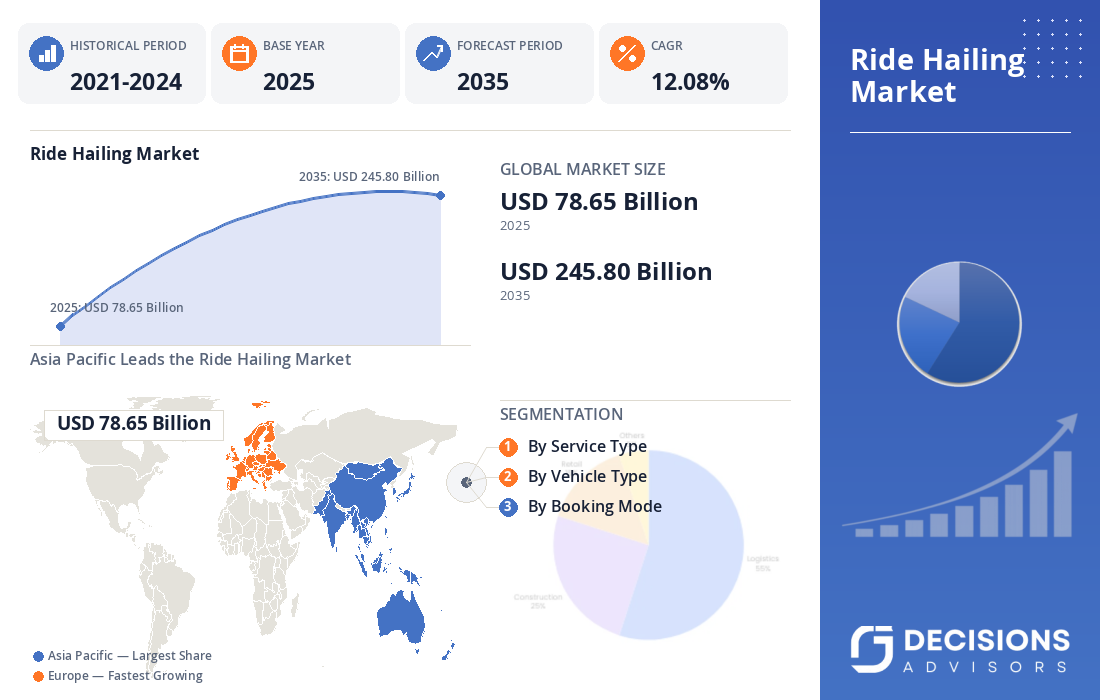
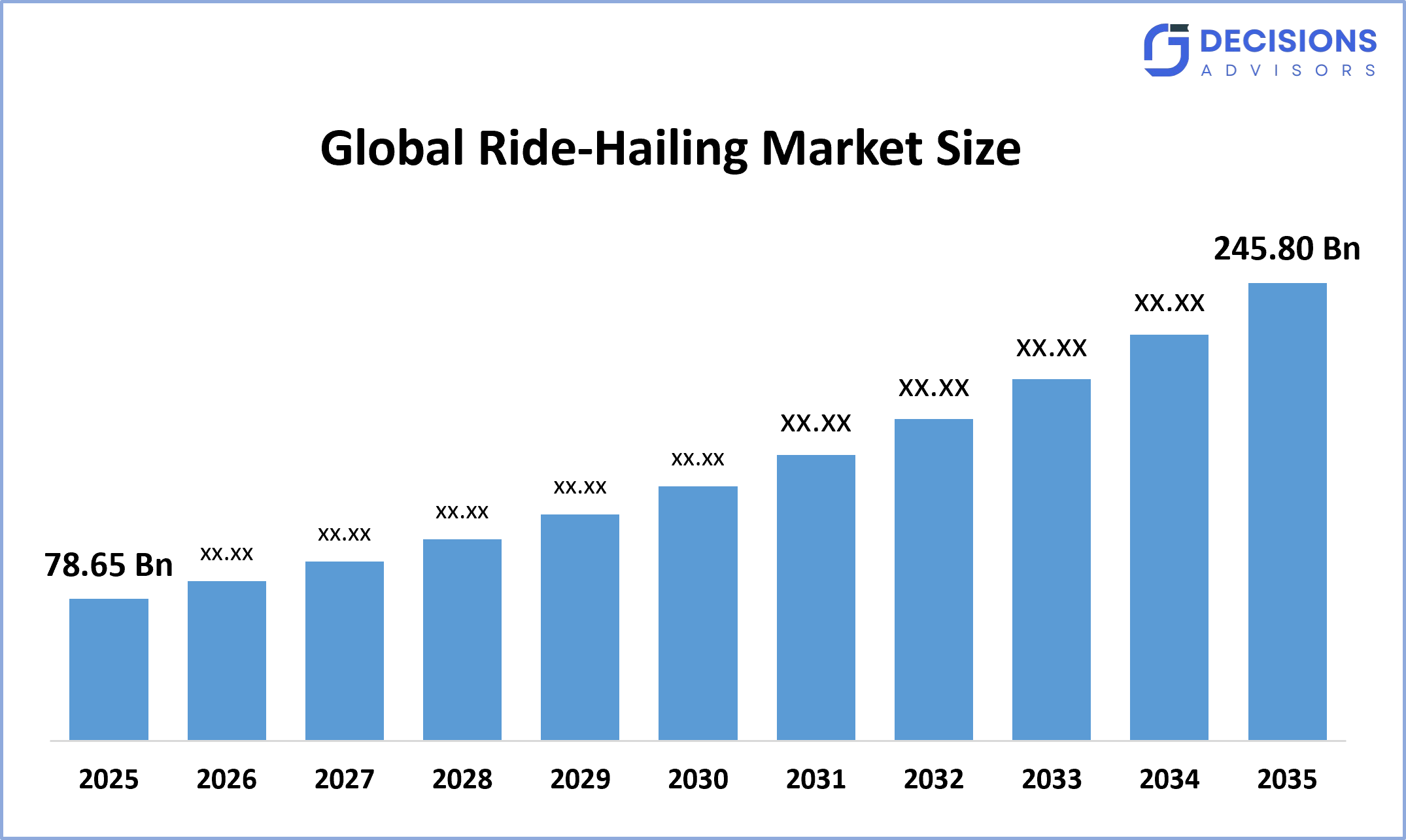
The Global Ride-Hailing Market Size is predicted to grow from USD 78.65 Billion in 2025 and is likely to reach around USD 245.80 Billion by 2035 with a CAGR of 12.08%. According to Decision Advisors, a detailed research report on the market reflects that the growing adoption of smartphone-based on-demand transportation services dominates the Global Ride-Hailing Market, accounting for approximately 52% of the total share worldwide. Uber Technologies leads the market through its extensive global mobility platform, large customer base, and strong presence across major urban transportation markets, making it a key contributor to global market development and growth dynamics.
Market Snapshot
- Global Ride-Hailing Market Size (2025): USD 78.65 Billion
- Projected Global Ride-Hailing Market Size (2035): USD 245.80 Billion
- Global Ride-Hailing Market Compound Annual Growth Rate (CAGR): 12.08%
- Largest Regional Market: Asia Pacific
- 2nd Largest Region: North America
- Fastest Growing Region: Europe
- Base Year: 2025
- Historical Period: 2021-2024
- Market Forecast Period: 2026-2035.
Market Overview/ Introduction
The Global Ride-Hailing Market refers to the industry that provides technology-enabled, on-demand transportation services by connecting passengers with drivers through mobile applications and digital platforms. These services allow users to book rides, track vehicles in real time, estimate fares, make digital payments, and access transportation conveniently through smartphones. The market has become an important part of the modern Transportation & Mobility industry as consumers increasingly prefer flexible and convenient mobility solutions over traditional transportation options. The market is experiencing substantial growth because of rapid urbanization, increasing smartphone penetration, expanding internet connectivity, and the growing adoption of digital payment systems. Major companies, including Uber Technologies, Lyft, DiDi Global, Grab Holdings, Ola, Bolt, Careem, and inDrive, are continuously expanding their mobility ecosystems and introducing new transportation solutions.
- The United States is supporting the development of intelligent transportation systems, electric mobility, and advanced transportation technologies, creating favorable opportunities for digitally enabled mobility platforms.
- Japan's smart-city and digital transformation initiatives are supporting connected transportation systems and encouraging the development of technology-based urban mobility services.
- China's smart transportation and digital infrastructure initiatives continue to support large-scale adoption of app-based mobility services, electric vehicles, and intelligent transportation platforms.
Notable Insights: -
- Asia Pacific is anticipated to hold approximately 39% share of the Global Ride-Hailing Market over the predicted timeframe.
- North America is expected to grow at a rapid CAGR in the Global Ride-Hailing Market by holding approximately 27% of the share during the forecast period.
- By Service Type, the E-Hailing segment dominated the market and holds approximately 52% share in 2025 and is projected to grow at a substantial CAGR during the forecast period.
- By Vehicle Type, the Economy Cars segment dominated the market and holds approximately 58% share in 2025 and is projected to grow at a substantial CAGR during the forecast period.
- By Booking Mode, the Mobile App-Based segment dominated the market and holds approximately 87% share in 2025 and is projected to grow at a substantial CAGR during the forecast period.
- The compound annual growth rate of the Global Ride-Hailing Market is 12.08%.
- The market is likely to achieve a valuation of USD 245.80 Billion by 2035.
Market Drivers
The Global Ride-Hailing Market experiences significant growth because of increasing consumer demand for convenient, affordable, and flexible transportation services. Rapid urbanization has increased traffic congestion and created greater demand for efficient point-to-point transportation. The widespread use of smartphones and mobile internet allows consumers to access ride-hailing platforms instantly, while GPS technology enables real-time vehicle tracking and efficient route planning. The expansion of digital payment systems has also simplified transactions and improved the overall customer experience. Artificial intelligence and data analytics are increasingly being used for driver-passenger matching, demand forecasting, route optimization, dynamic pricing, and fraud prevention. The growing adoption of electric vehicles and shared mobility services is further supporting market development as governments and transportation companies focus on reducing emissions and improving urban transportation efficiency. Additionally, increasing demand for two-wheeler and three-wheeler ride-hailing services in emerging economies is expanding access to affordable mobility solutions.
Restrain
The Global Ride-Hailing Market faces challenges related to regulatory complexity, intense competition, and operational costs. Different countries and cities have different regulations regarding driver licensing, insurance, passenger safety, taxation, and transportation network operations. These varying regulations increase compliance requirements and can limit the expansion of international ride-hailing platforms. The market also faces pressure from high driver incentives, customer discounts, fuel price fluctuations, insurance costs, and technology investments.
Competitive Analysis:
The report offers the appropriate analysis of the key organizations/companies involved within the global ride-hailing market, along with a comparative evaluation primarily based on their product offerings, business overviews, geographic presence, enterprise strategies, segment market share, and SWOT analysis. The report also provides an elaborative analysis focusing on the current news and developments of the companies, which includes product development, innovations, joint ventures, partnerships, mergers & acquisitions, strategic alliances, and others. This allows for the evaluation of the overall competition within the market.
Top Companies in the Global Ride-Hailing Market
- Uber Technologies
- Lyft
- DiDi Global
- Grab Holdings
- Ola
- Bolt
- Careem
- inDrive
- Gett
- Kakao Mobility.
Government Initiatives
|
Country |
Key Government Initiatives |
|
United States |
The U.S. government supports intelligent transportation systems, electric vehicle adoption, and advanced mobility technologies through federal and state-level transportation and infrastructure programs |
|
Japan |
Japan's smart-city and digital transportation initiatives support connected mobility solutions and the modernization of urban transportation systems |
|
China |
Policies focused on smart transportation, digital infrastructure, and electric mobility are supporting the development of technology-enabled transportation and ride-hailing ecosystems |
Market Segmentation
The Global Ride-Hailing Market share is classified into Service Type, Vehicle Type, and Booking Mode.
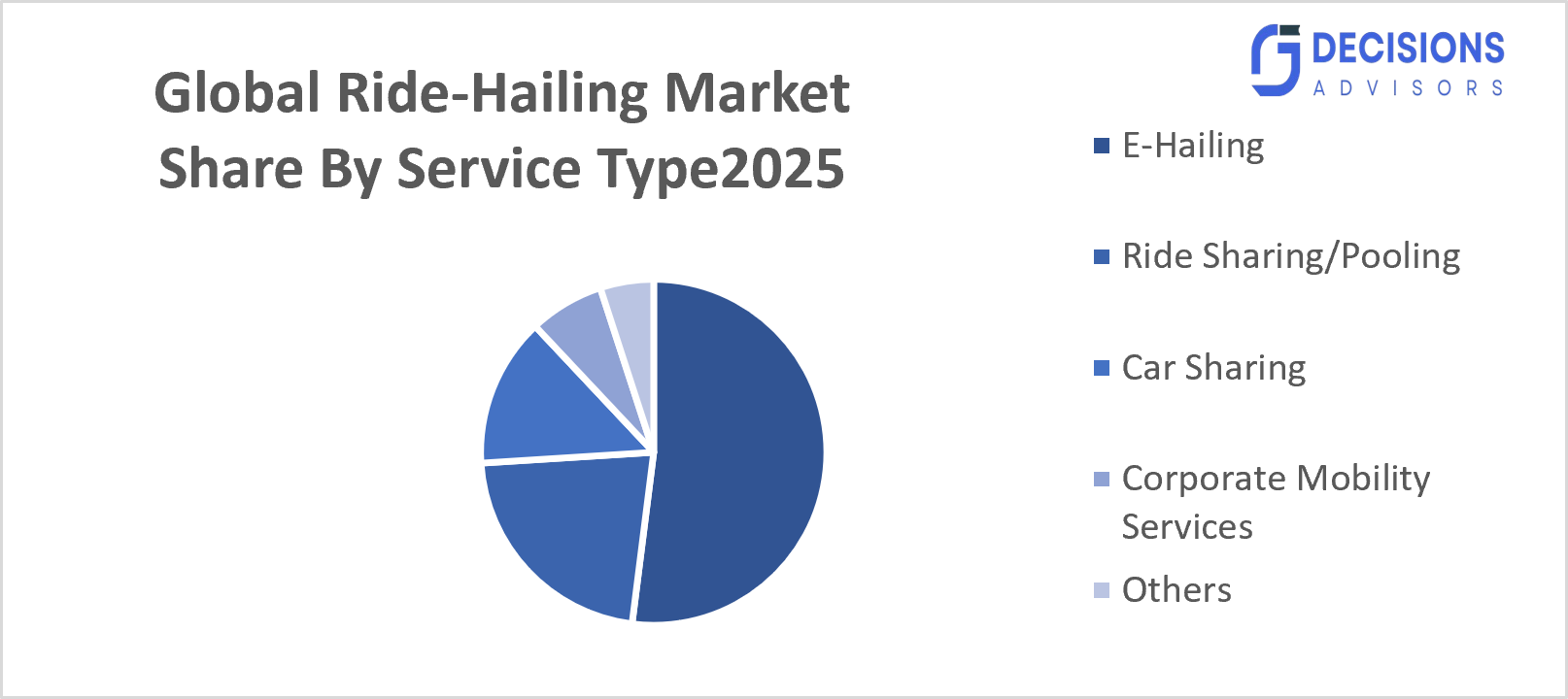
- The E-Hailing segment dominated the market and holds approximately 52% share in 2025 and is projected to grow at a substantial CAGR during the forecast period.
Based on the Service Type, the Global Ride-Hailing Market is divided into E-Hailing, Ride Sharing/Pooling, Car Sharing, Corporate Mobility Services, and Others. Among these, the E-Hailing segment dominates the market and holds approximately 52% share in 2025. This dominance is due to the widespread availability of smartphone-based transportation platforms and increasing consumer preference for instant ride booking. Real-time tracking, transparent fare estimates, digital payments, and driver ratings have improved convenience and customer confidence. The expansion of major mobility platforms across urban and suburban locations continues to strengthen the growth of this segment.
- The Economy Cars segment accounted for the largest share of approximately 58% in 2025 and is anticipated to grow at a significant CAGR during the forecast period.
Based on Vehicle Type, the market is divided into Economy Cars, Premium Cars, Two-Wheelers, Three-Wheelers, and Others. Among these, Economy Cars accounted for the largest share and hold approximately 58% share in 2025. This dominance is due to their affordability and widespread availability across major urban transportation markets. Economy cars are widely preferred for daily commuting, airport transportation, business travel, and other routine mobility requirements. Their lower fare structure makes them particularly attractive to price-sensitive consumers.
- The Mobile App-Based segment accounted for the largest share of approximately 87% in 2025 and is anticipated to grow at a significant CAGR during the forecast period.
Based on Booking Mode, the market is divided into Mobile App-Based, Web-Based, and Offline. Among these, the Mobile App-Based segment dominates the market and holds approximately 87% share in 2025. This dominance is due to the widespread adoption of smartphones and increasing availability of high-speed mobile internet. Mobile applications provide users with real-time booking, vehicle tracking, fare estimates, driver information, and integrated payment systems. The increasing use of digital wallets and mobile payments further supports the expansion of app-based ride-hailing services globally.
Regional Segment Analysis of the Global Ride-Hailing Market
- North America (U.S., Canada, Mexico)?
- Europe (Germany, U.K., France, Italy, Spain, Netherlands, Rest of Europe).
- Asia-Pacific (China, Japan, India, Australia, South Korea, Rest of Asia-Pacific).
- South America (Brazil, Argentina, Rest of South America).
- Middle East & Africa (UAE, Saudi Arabia, South Africa, Rest of MEA).
Asia Pacific is anticipated to hold approximately 39% share of the Global Ride-Hailing Market over the predicted timeframe.
Asia Pacific holds approximately 39% share of the Global Ride-Hailing Market due to its large urban population, rapid smartphone adoption, expanding digital payment infrastructure, and increasing demand for affordable transportation services. China represents one of the most important markets because of its large digital mobility ecosystem and extensive adoption of app-based transportation platforms. India and Southeast Asian countries are also contributing significantly to growth due to rapid urbanization and increasing adoption of two-wheeler and three-wheeler ride-hailing services.
North America is expected to grow at a rapid CAGR in the Global Ride-Hailing Market, holding approximately 27% of the share during the forecast period.
North America is expected to maintain approximately 27% share during the forecast period due to strong consumer adoption of technology-based transportation services and the presence of leading global ride-hailing companies. The United States remains a major contributor because of widespread use of ride-hailing services for commuting, airport transportation, business travel, and leisure activities. The region benefits from advanced digital infrastructure, strong smartphone penetration, and continuous investment in artificial intelligence and autonomous mobility technologies.
Europe is the fastest-growing region in the Global Ride-Hailing Market during the period, holding approximately 22% share.
Europe is the fastest-growing region in the Global Ride-Hailing Market during the forecast period, holding approximately 22% share. The region benefits from growing demand for sustainable transportation, smart mobility systems, and low-emission urban transportation solutions. Environmental regulations are encouraging ride-hailing companies to increase the adoption of electric and hybrid vehicles. Countries including Germany, France, the UK, Italy, and Spain are experiencing increasing adoption of digital transportation platforms.
Future Market Trends in Global Ride-Hailing Market: -
-
- Expansion of Electric Ride-Hailing Fleets.
Ride-hailing companies are increasingly integrating electric vehicles into their fleets to reduce carbon emissions and comply with environmental regulations. Electric vehicles can help operators reduce long-term fuel and maintenance costs while supporting sustainability targets.
-
- AI-Enabled Route Optimization and Mobility Management.
Artificial intelligence is increasingly being integrated into ride-hailing platforms to improve route planning, passenger-driver matching, demand forecasting, and pricing strategies. AI systems can analyze real-time traffic conditions and customer demand to reduce waiting times and improve operational efficiency.
-
- Growth of Shared and Multi-Modal Mobility.
Ride-sharing and pooling services are gaining importance as consumers seek affordable transportation and cities focus on reducing congestion. Mobility platforms are increasingly integrating ride-hailing services with public transportation, bicycles, scooters, and other transportation modes.
-
- Development of Autonomous Ride-Hailing Services.
Autonomous vehicle technology is expected to create significant long-term opportunities for the ride-hailing industry. Technology companies and mobility platforms are investing in self-driving transportation systems to improve fleet availability and reduce dependence on human drivers.
Recent Development
- In October 2025, Grab expanded its autonomous mobility strategy through investments and partnerships focused on developing future transportation services across Southeast Asia.
- In February 2026, Uber Technologies continued expanding partnerships supporting autonomous vehicle deployment and technology-enabled mobility services across selected markets.
- In June 2026, DiDi Global continued strengthening its international mobility operations and technology capabilities to support the expansion of its ride-hailing ecosystem.
Market Segment
This study forecasts revenue at global, regional, and country levels from 2021 to 2035. Decision Advisors has segmented the global ride-hailing market based on the below-mentioned segment:
Global Ride-Hailing Market, By Service Type.
- E-Hailing
- Ride Sharing/Pooling
- Car Sharing
- Corporate Mobility Services
- Others.
Global Ride-Hailing Market, By Vehicle Type.
- Economy Cars
- Premium Cars
- Two-Wheelers
- Three-Wheelers
- Others.
Global Ride-Hailing Market, By Booking Mode.
- Mobile App-Based
- Web-Based
- Offline.
Global Ride-Hailing Market, By Regional Analysis.
- North America
- US
- Canada
- Mexico
- Europe
- Germany
- UK
- France
- Italy
- Spain
- Russia
- Rest of Europe
- Asia Pacific
- China
- Japan
- India
- South Korea
- Australia
- Rest of Asia Pacific
- South America
- Brazil
- Argentina
- Rest of South America
- Middle East & Africa
- UAE
- Saudi Arabia
- Qatar
- South Africa
- Rest of the Middle East & Africa
Frequently Asked Questions (FAQ)
Q. What factors are driving the growth of the Global Ride-Hailing Market?
A. The market is driven by increasing urbanization, growing smartphone penetration, expanding digital payment systems, and rising consumer demand for convenient on-demand transportation. AI-based route optimization and real-time mobility technologies are further improving service efficiency and customer experience.
Q. How is electric vehicle adoption influencing the Ride-Hailing Market?
A. Electric vehicles are becoming increasingly important as ride-hailing companies focus on reducing emissions and complying with environmental regulations. The transition toward electric fleets is also expected to support long-term operating efficiency and sustainable urban transportation.
Q. Why does mobile app-based ride-hailing services dominate the market?
A. Mobile applications provide consumers with convenient access to instant ride booking, GPS tracking, fare estimates, driver information, and digital payment systems. Increasing smartphone ownership and mobile internet penetration have made app-based platforms the dominant booking method globally.
Check Licence
Choose the plan that fits you best: Single User, Multi-User, or Enterprise solutions tailored for your needs.
We Have You Covered
- 24/7 Analyst Support
- Clients Across the Globe
- Tailored Insights
- Technology Tracking
- Competitive Intelligence
- Custom Research
- Syndicated Market Studies
- Market Overview
- Market Segmentation
- Growth Drivers
- Market Opportunities
- Regulatory Insights
- Innovation & Sustainability
Report Details
| Scope | Global |
| Pages | 230 |
| Delivery | PDF & Excel via Email |
| Language | English |
| Release | Sep 2026 |
| Access | Download from this page |