
Global Road Profile Laser Sensor Market
 |
Author:
Atul K
|
Pages:
210
|
Author:
Atul K
|
Pages:
210
Global Road Profile Laser Sensor Market Size, Share, By Measurement Range (Less than 200 mm, 200?600 mm, and More than 600 mm) By Sensor Type (Vehicle-mounted Sensors and Fixed/Stationary Sensors) By Application (Longitudinal Profile, Transverse Profile, Side Projections, and Macro Texture) and By Region (North America, Europe, Asia-Pacific, Latin America, Middle East, and Africa), Analysis and Forecast 2026 ? 2035
CAGR
10.6%
REVENUE 2025
USD Million 673.5
FORECAST 2035
USD Million 1845.3
REPORT COVERAGE
Global
Market Snapshot
- Market Size (2025): USD 673.50 Million
- Market Size (2035): USD 1845.30 Million
- Compound Annual Growth Rate (CAGR): 10.6%
- Largest Regional Market: North America
- Fastest Growing Region: Asia-Pacific
- 3rd Largest Region: Europe
- Base Year: 2025
- Historical Period: 2020–2024
- Forecast Period: 2026–2035
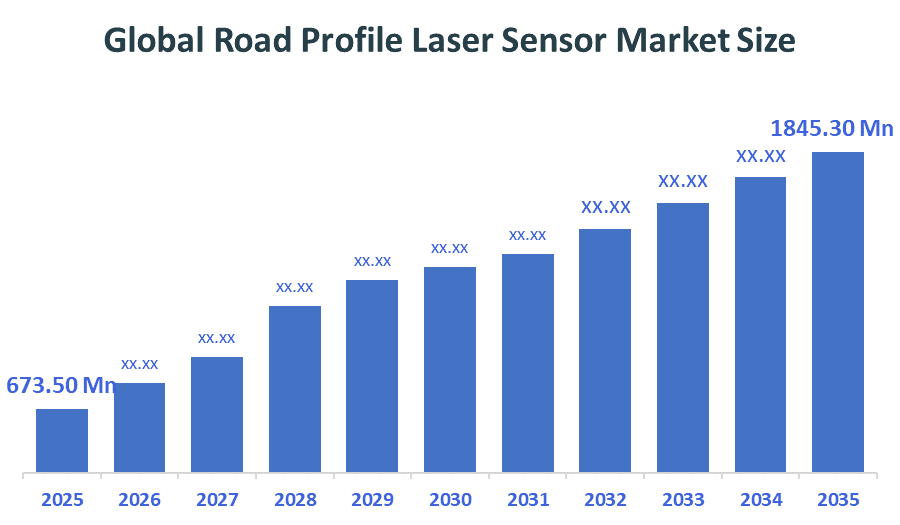
According to Decision Advisors, the Global Road Profile Laser Sensor Market Size was expected to grow from USD 673.50 million in 2025 to USD 1845.30 million by 2035, with a CAGR of 10.6% during the forecast period from 2026 to 2035. The market is projected to experience rapid expansion as automated pavement monitoring and high-speed infrastructure assessment tools become more integrated into modern transportation networks. This growth is mainly fuelled by the increased demand for real-time surface quality analysis, as well as the expanding use of non-contact measurement technology in smart city maintenance programs. Innovations in signal processing speed and environmental resilience are also significantly contributing to this expansion.
Market Overview / Introduction
The increasing emphasis on ensuring efficiency in high-precision pavement assessment and infrastructure maintenance, especially in modern smart city initiatives and automated transportation research, is one of the major growth drivers for the global road profile laser sensor market. Road profile laser sensors refer to advanced non-contact measurement technology involving high-frequency laser beams aimed at a pavement surface, which creates a precise data point cloud for evaluating surface geometry with extreme longitudinal and transverse precision. From its specialised origins in manual survey tools, this technology has advanced into highly sophisticated systems characterised by high data density, millimetre-level vertical accuracy, and the capability for capturing surface macrotexture at highway speeds. Road profile laser sensors have a crucial function in ensuring efficiency in high-performance infrastructure management, especially in situations where civil engineers and government agencies apply this technology for high-speed roughness indexing compared to conventional walking profilers and manual rod-and-level technology.
- North America holds approximately 40% of global revenue, supported by strong infrastructure spending in highway modernisation, federal safety mandates, and a high concentration of advanced sensor manufacturing companies and national transport laboratories.
- Longitudinal and transverse profiling applications account for nearly 50% of total demand, driven by increasing use of road profile laser sensors in international roughness index (IRI) calculations, rutting depth analysis, and advanced pavement management systems.
Notable Insights: -
- Vehicle-mounted systems account for over 60% of total deployments, driven by the need for high-speed and large-scale road inspection across highways and urban networks.
- Adoption of predictive maintenance solutions has increased by nearly 35%, as road authorities shift from reactive repairs to data-driven infrastructure management.
- Longitudinal and transverse profiling together contribute to more than 50% of total application usage, due to their importance in measuring ride quality and pavement performance.
- 3D laser scanning adoption is growing at a rate above 12% annually, supported by demand for higher accuracy and detailed surface mapping compared to conventional methods.
- Integration of AI-based analytics in road monitoring systems has improved defect detection efficiency by up to 40%, reducing inspection time and operational costs.
What is the role of technology in shaping the market?
Technology is playing a transformative role in the road profile laser sensor market by enhancing measurement consistency, data acquisition speeds, and overall surface profiling uniformity. Modern profiling units are evolving from manual survey tools into fully automated mobile mapping systems equipped with in-situ monitoring sensors like high-speed accelerometers, advanced Global Navigation Satellite Systems (GNSS), and seamless compatibility with multi-laser synchronisation. This shift allows civil engineers and infrastructure researchers to streamline pavement condition assessment, reduce manual labour risks on busy highways, and maintain consistent operational accuracy across different terrain types from urban asphalt to complex concrete highway junctions.
How are Recent Developments Helping the Market?
Recent developments, such as the integration of AI-driven analytics, the adoption of 3D laser profiling systems, and the implementation of real-time data transmission technologies, are significantly supporting market growth. Manufacturers are introducing compact, vehicle-mounted sensor systems capable of operating at highway speeds while delivering high-resolution surface data. The incorporation of cloud-based platforms enables instant processing and sharing of road condition data, improving decision-making for maintenance activities. Additionally, advancements in connectivity technologies, including 5G-enabled systems, are allowing seamless communication between field equipment and control centres, enhancing the effectiveness of smart transportation infrastructure.
Market Drivers
The global road profile laser sensor market is growing with the increasing investments of government transportation agencies in advanced infrastructure monitoring to improve road longevity and precision in the maintenance process. Modern laser profiling systems are gaining strong preference in the market with the advantage of integrating multiple capabilities such as real-time rutting analysis, high-resolution texture mapping, and flexible mounting options on various vehicle types in one compact system. At the same time, the increasing trend of autonomous driving technology is driving the market with the need for high-definition road maps that can enhance the navigation of self-driving cars, along with their reliability in diverse weather conditions. The awareness of proactive pavement preservation is motivating municipalities to upgrade their diagnostic equipment with high-frequency sensors and ruggedised data loggers.
Restraints
The growth of the global road profile laser sensor market is restricted by the high cost associated with high-precision laser components and specialised inertial navigation systems. Additional cost factors for vehicle integration, routine calibration services, and sophisticated data analysis software also affect the implementation cost of such systems for smaller municipal engineering departments. Global supply chain fluctuations and the requirement for highly skilled technicians to operate and maintain the equipment further limit the rapid adoption of these advanced sensing solutions in emerging economies.
Competitive Analysis:
The report offers the appropriate analysis of the key organisations/companies involved within the road profile laser sensor market, along with a comparative evaluation primarily based on their product offerings, business overviews, geographic presence, enterprise strategies, segment market share, and SWOT analysis. The report also provides an elaborate analysis focusing on the current news and developments of the companies, which includes product development, innovations, joint ventures, partnerships, mergers & acquisitions, strategic alliances, and others. This allows for the evaluation of the overall competition within the market.
Top 10 Companies in the Road Profile Laser Sensor Market
- Trimble Inc.
- Pavemetrics Systems Inc.
- SICK AG
- Hexagon AB (Leica Geosystems)
- Teledyne Technologies Incorporated
- Fugro N.V.
- LMI Technologies Inc.
- Ames Engineering, Inc.
- International Cybernetics (ICC-IMS)
- Micro-Epsilon Messtechnik GmbH & Co. KG
Government Initiatives
|
Country |
Key Government Initiatives |
|
US |
In the United States, high-speed profiling is mandated by the Federal Highway Administration (FHWA) under its Long-Term Pavement Performance (LTPP) program. The Bipartisan Infrastructure Law (BIL) allocates around USD 350 billion for funding highway programs over a period of five years. In 2022, USD 28.44 billion was allocated for the National Highway Performance Program. This money is for fixing 15,000 bridges and thousands of highway pavements using automated laser-based systems. |
|
European Union |
The EU's Road Safety Policy Framework for 2021 to 2030 has the European Commission aiming for a reduction of 50% in road fatalities and injuries by the year 2030. The European Union's Connecting Europe Facility for 2021 to 2027 has billions of euros in funding for safe infrastructure. |
|
India |
In India, the Ministry of Road Transport and Highways (MoRTH) has identified the Bharatmala Pariyojana project with an initial investment of USD 65 billion. The project focuses on upgrading over 34,800 km of highways, which requires 100% of the National Highway network to be monitored by Network Survey Vehicles (NSV) with laser profilers to achieve a target of increasing the highway development speed from 11.6 km/day to over 34 km/day. |
Study on the Supply, Demand, Distribution, and Market Environment
The road profile laser sensor market thrives on the balance between high-speed data acquisition and infrastructure safety needs. On the supply side, manufacturers are developing rugged, vehicle-mounted sensors with integrated inertial units to capture pavement geometry without disrupting traffic flow. Demand is primarily driven by the global shift toward automated road surveys, smart city integration, and the rising need for high-definition mapping for autonomous vehicles. Distribution relies on direct industrial sales and specialised geomatics partnerships, ensuring these precision tools reach both government transport departments and private engineering firms.
Price Analysis and Consumer Behaviour Analysis
Pricing for road profile laser sensors fluctuates based on sampling frequency, vertical accuracy, and software integration capabilities. High-end systems featuring 3D surface mapping and real-time distress detection command premium prices, while standard longitudinal profilers offer a more accessible entry point. Consumer behaviour shows a clear trend toward long-term value; agencies prioritise sensors with high environmental durability and low calibration requirements. The market is increasingly moving toward modular designs that allow for easy upgrades as pavement management standards evolve.
Market Segmentation
The Global Road Profile Laser Sensor Market share is classified into measurement range, sensor type, and application.
By measurement range, the 200 to 600 mm segment holds the largest share, contributing approximately 46% of the market in 2025.
The road profile laser sensor market is segmented into Less than 200 mm, 200 to 600 mm, and more than 600 mm. By measurement range, the 200 to 600 mm segment holds the largest share, contributing approximately 46% of the market in 2026. This specific range segment accounted for the largest share of the market in 2024. The segment is likely to grow at a steady rate as more comprehensive rutting and longitudinal profile data are required by transport authorities.
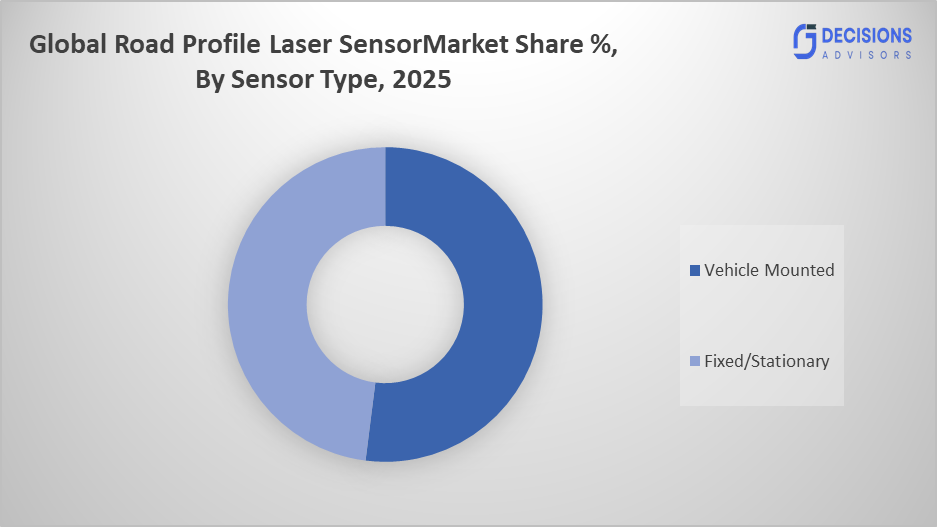
By sensor type, Vehicle-mounted Sensors dominate the global road profile laser sensor market, accounting for approximately 52% of the total market share in 2025.
The road profile laser sensor market is segmented into Vehicle-mounted Sensors and Fixed/Stationary Sensors. By sensor type, Vehicle-mounted Sensors dominate the global road profile laser sensor market, accounting for approximately 52% of the total market share in 2026. The Vehicle-mounted segment dominated the market in 2024 and is expected to grow at a steady CAGR of around 11.2% during the forecast period. This dominance is mainly attributed to their widespread use in high-speed network surveys and large-scale highway inspections due to integrated mobility features, data collection efficiency, and suitability for a wide range of pavement management procedures.
By application, Longitudinal Profile accounts for the largest share, representing over 40% of the global market in 2025.
The road profile laser sensor market is categorised into Longitudinal Profile, Transverse Profile, Side Projections, and Macro Texture. By application, Longitudinal Profile accounts for the largest share, representing over 40% of the global market in 2026. The longitudinal profile segment is the leader in the market because these measurements are necessary for the calculation of the International Roughness Index, ride quality scores, and fuel efficiency impacts, which require precision on a high-frequency level.
By end user, Government Agencies account for the largest share, representing over 35% of the global market in 2025.
Based on the end user, the road profile laser sensor market is categorised into Government Agencies, Construction Companies, Automotive Manufacturers, and Road Monitoring Service Providers. By end user, Government Agencies account for the largest share, representing approximately 35% of the global market in 2026. The government agencies segment is the leader in the market because these entities are responsible for the national oversight of highway safety, long-term infrastructure planning, and the enforcement of pavement quality standards. The increased global interest in the development of data-driven maintenance schedules and the modernisation of public transit corridors has also contributed to the growth of the market.
Strategies to Implement for Growth of the Market in Non-Leading Regions
The growth rate in the road profile laser sensor market in non-leading regions can be further increased by implementing the following strategies in those territories. First and foremost, the best strategy to boost the growth rate in the non-leading regions would be to introduce entry-level portable laser profiling systems to the local municipalities and emerging engineering firms in the non-leading regions. Secondly, the infrastructure modernisation funds and the government’s digital highway missions would also boost the growth rate in the non-leading regions. Thirdly, more funds would be required to be spent on the education and training of civil engineers in the field of high-speed data acquisition and laser sensor calibration. Strengthening distribution channels through partnerships with global geomatics equipment suppliers and utilising digital procurement technologies can help to improve access to specialised replacement sensors and mounting hardware in remote infrastructure project locations.
Regional Segment Analysis of the Road Profile Laser Sensor Market
- North America (U.S., Canada, Mexico)
- Europe (Germany, France, U.K., Italy, Spain, Rest of Europe)
- Asia-Pacific (China, Japan, India, South Korea, Rest of APAC)
- Latin America (Brazil and the Rest of Latin America)
- The Middle East and Africa (UAE, South Africa, Rest of MEA)
North America is expected to hold the largest share of the road profile laser sensor market during the forecast period. The region accounts for approximately 38% of the global revenue share, backed by highly advanced infrastructure in transportation management and high adoption rates for laser profiling technology in federal highway safety and autonomous vehicle testing applications. The majority of the revenue in this region comes from the United States due to high federal spending on research for pavement longevity and smart corridor development. The constant upgrade in surface friction testing and early adoption of 3D laser mapping for fast defect discovery are contributing to demand for the technology in this region.
Asia-Pacific is projected to be the fastest-growing region over the forecast period. The region is expected to grow at a CAGR of approximately 11.8% while accounting for approximately 30% of the global market share. This can be attributed to the improvement in infrastructure for urban mobility and the ever-expanding road construction projects in China, South Korea, and India. Additional factors include increased investments in national highway connectivity, smart city initiatives taken by various countries’ governments, and a massive increase in high-speed rail and expressway monitoring facilities.
Europe is anticipated to hold the third-largest share, contributing approximately 24% of the global market share. The region is in a good position owing to the established research clusters in intelligent transport systems and consistent investment in sustainable road safety materials. Countries like Germany, France, and the UK are important players due to their high level of knowledge about automated pavement assessment and the implementation of safety projects like the Vision Zero framework. Moreover, the existence of major sensor equipment producers and the modernisation of municipal maintenance facilities are contributing to the gradual uptake of road profile laser sensors.
Future Market Trends in the Global Road Profile Laser Sensor Market
- Increasing Adoption of 3D LiDAR and Automated AI Analysis
A clear trend away from single-point laser sensors and towards fully integrated 3D LiDAR profiling systems with real-time diagnostic tools such as artificial intelligence for automated crack detection is evident. Such sophisticated equipment has the potential to improve data accuracy and survey efficiency by up to 35% through precise point cloud processing.
- Rising Demand for High-Speed Mobile Mapping Systems
Infrastructure agencies are now shifting their surveys from slow-moving manual inspections to high-speed mobile mapping. This is causing an increased demand for vehicle-mounted sensor arrays and high-frequency data loggers to accommodate highway speeds of 100km/h or higher without losing vertical precision.
- Expansion of Digital Twins for Predictive Road Maintenance.
The market is currently seeing rapid growth in the use of digital twin technology, which enables the simultaneous simulation of road wear and environmental impact on a virtual substrate. This approach greatly accelerates the planning phase of new infrastructure repairs, especially in the quest for cost-effective pavement preservation and long-term asset management.
Recent Developments
- In June 2025, KEYENCE Corporation launched a superior high-speed laser displacement sensor series for infrastructure inspection. The product ensures a speed of over 60 kHz, thus improving the accuracy of surface detection by nearly 25%
- In February 2025, SICK AG improved its LiDAR-based road monitoring systems by adding 3D profiling features. This improved the efficiency of data acquisition by nearly 30%.
- In September 2024, Omron Corporation launched a series of compact laser sensors with improved resistance to environmental factors. This improved the performance of the sensors by nearly 20% when exposed to harsh weather conditions such as dust and different lighting conditions, thus enabling continuous outdoor road inspection systems.
- In November 2024, Banner Engineering improved its range of industrial laser measurement systems by adding superior real-time processing features. This improved the efficiency of inspection by nearly 15%, particularly for detecting cracks and other irregularities on the surface of the road.
Market Segmentation
This study forecasts revenue at global, regional, and country levels from 2020 to 2035. The road profile laser sensor market is segmented based on the following categories:
Global Road Profile Laser Sensor Market, By Measurement Range
- Less than 200 mm
- 200 to 600 mm
- More than 600 mm
Global Road Profile Laser Sensor Market, By Application
- Longitudinal Profile
- Transverse Profile
- Side Projections
- Macro Texture
Global Road Profile Laser Sensor Market, By Sensor Type
- Vehicle-mounted Sensors
- Fixed/Stationary Sensors
Global Road Profile Laser Sensor Market, By Technology
- Time of Flight
- Triangulation
- Phase Shift
Global Road Profile Laser Sensor Market, By End User
- Government Agencies
- Construction Companies
- Automotive Manufacturers
- Road Monitoring Service Providers
Global Road Profile Laser Sensor Market, By Regional Analysis
- North America
- United States
- Canada
- Mexico
- Europe
- Germany
- United Kingdom
- France
- Italy
- Spain
- Russia
- Rest of Europe
- Asia Pacific
- China
- Japan
- India
- South Korea
- Australia
- Rest of Asia Pacific
- Latin America
- Brazil
- Argentina
- Rest of Latin America
- Middle East & Africa
- United Arab Emirates
- Saudi Arabia
- Qatar
- South Africa
- Rest of Middle East & Africa
Frequently Asked Questions (FAQ)
What is a road profile laser sensor, and why is it important?
A road profile laser sensor is an advanced measurement device used to assess the surface condition of roads by capturing precise elevation and texture data using laser technology. It plays a crucial role in evaluating parameters such as roughness, rutting, and surface irregularities, helping authorities maintain road quality, improve ride comfort, and ensure safety standards.
What factors are driving the growth of the road profile laser sensor market?
The market is growing due to increasing investments in transportation infrastructure, rising demand for efficient road maintenance solutions, and the adoption of automated inspection systems. The expansion of smart city projects and the need for real-time road condition monitoring are also contributing significantly to market growth.
Which sensor type dominates the road profile laser sensor market?
Vehicle-mounted laser sensors hold the largest market share. This is because they enable high-speed data collection over long road distances, making them highly suitable for large-scale infrastructure monitoring and highway inspection projects.
Which technologies are widely used in this market?
Technologies such as laser triangulation and time-of-flight are widely used due to their ability to deliver accurate and high-resolution surface measurements. These technologies support both 2D and 3D road profiling applications, improving overall inspection efficiency.
Check Licence
Choose the plan that fits you best: Single User, Multi-User, or Enterprise solutions tailored for your needs.
We Have You Covered
- 24/7 Analyst Support
- Clients Across the Globe
- Tailored Insights
- Technology Tracking
- Competitive Intelligence
- Custom Research
- Syndicated Market Studies
- Market Overview
- Market Segmentation
- Growth Drivers
- Market Opportunities
- Regulatory Insights
- Innovation & Sustainability
Report Details
| Scope | Global |
| Pages | 210 |
| Delivery | PDF & Excel via Email |
| Language | English |
| Release | Apr 2026 |
| Access | Download from this page |