
Global Robotic Surgery Simulation Platforms Market
 |
Pages:
240
|
Pages:
240
Global Robotic Surgery simulation Platforms Market Size, Share, By Type (Virtual Reality simulation, Augmented Reality simulation, Mixed Reality simulation, AI-Based simulation, and Others), By Deployment Mode (On-Premise, Cloud-Based, and Web-Based), By End-User (Hospitals, Academic & Training Institutes, Ambulatory Care, and Others) and By Region (North America, Europe, Asia-Pacific, Latin America, Middle East, and Africa), Analysis and Forecast 2025 ? 2035
REPORT COVERAGE
Global
Market Snapshot
- Compound Annual Growth Rate (CAGR): 14.02%
- Largest Regional Market: North America
- Fastest Growing Region: Asia Pacific
- 3rd Largest Region: Europe
- Base Year: 2025
- Historical Period: 2021–2024
- Forecast Period: 2025–2035
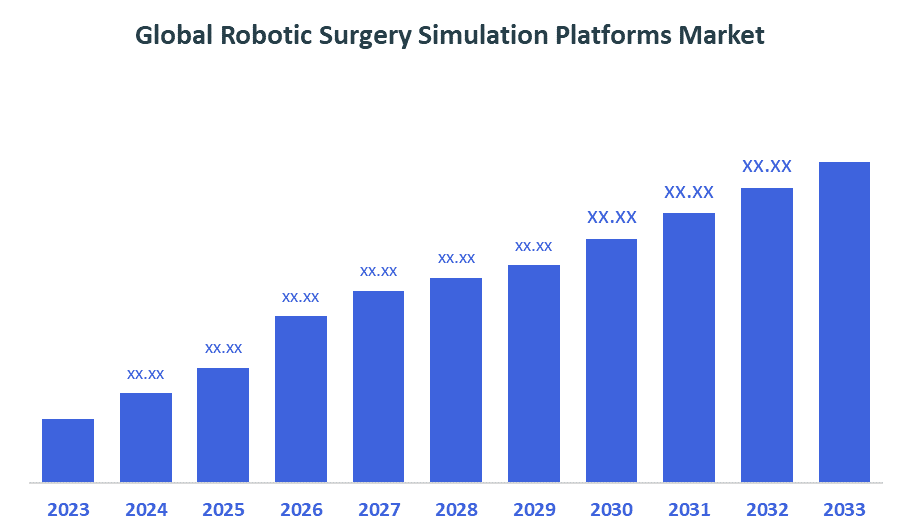
According to Decision Advisors, the Global Robotic Surgery Simulation Platforms Market Size is expected to grow from at a CAGR of 14.02% during the forecast period 2025-2035. The global robotic surgery simulation platforms market is expanding rapidly due to the increasing adoption of robotic-assisted procedures and the growing need for structured surgical training. simulation platforms allow surgeons to practice complex procedures in a risk-free virtual environment, improving precision and patient safety.
Market Overview/ Introduction
The global robotic surgery simulation platforms market represents the intersection of cutting-edge aerospace-grade simulation and modern medicine. At its core, this market provides high-fidelity virtual environments where surgeons can practice complex, robot-assisted procedures using haptic feedback and 3D visualisation before ever touching a patient. The robotic surgery simulation platforms market is getting more popular because patients around the world want medical care that is less invasive. Hospitals are using robots to do surgeries on people, and this means that surgeons need to be trained in a standardised way. It is no longer a luxury to have this kind of training; it is a necessity. Government healthcare groups are also making simulation a part of the way to certify doctors. Large companies in the industry are not just making equipment; they are creating digital systems.
Companies like Surgical Science and Intuitive are using Artificial Intelligence to help surgeons get better. The software can watch how steady a surgeon's hands are and how well they do the operation, and then give them tips on how to improve. Some new companies are also working on a way to let experts in one country help train surgeons in another country using tools. This means that surgeons around the world can get help from the best experts. Looking ahead, the horizon is filled with untapped potential. The next frontier lies in patient-specific simulation, the ability to upload a specific patient’s MRI or CT scan into the simulator to practice a unique, difficult surgery the night before the real event. As high-speed 5G and portable VR headsets become more accessible, we are moving toward a future where world-class surgical training isn't confined to elite teaching hospitals but is available to any clinic with an internet connection, ultimately making high-precision surgery a global standard of care.
- WHO and Society of Robotic Surgery launch health innovation initiative to expand access to virtual care and telesurgery
- Intuitive Surgical (ISRG) continues to strengthen its leadership in robotic-assisted surgery, supported by robust procedure growth, expanding global adoption and a steady rollout of next-generation platforms. The company delivered strong financial performance in 2025, with revenue rising 21% to 10.1 billion dollars and procedures increasing 19% year over year.
- Rapid Prototyping, Training, and Product Testing Drive a US$1.4 Billion Robotics simulation Software Market by 2030.
Notable Insights: -
- North America holds the largest regional market share in the global robotic surgery simulation platforms market.
- Asia Pacific is the fastest-growing region in the global robotic surgery simulation platforms market in 2025.
- By type, VR-based simulation dominated the market in 2025, holding the largest share, driven by high immersion and realism.
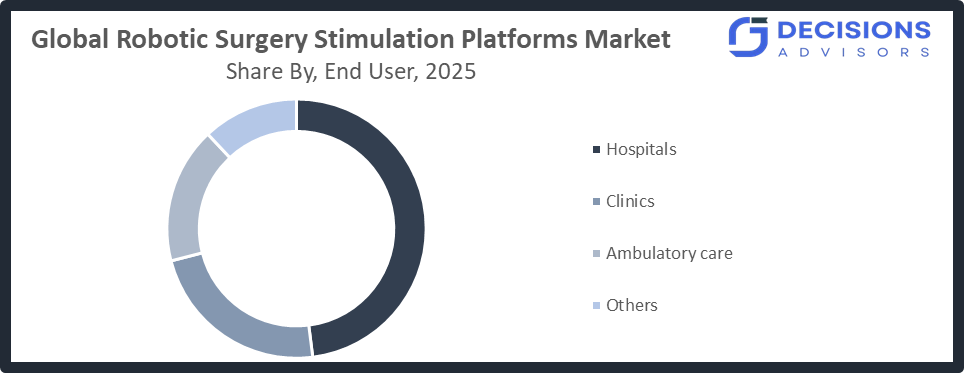
- By end-user, hospitals dominate due to high surgical volumes and the need for continuous training in the market in 2025.
- The compound annual growth rate of the global robotic surgery simulation platforms market is 14.02%
What is role of technology in grooming the market?
Technology is central to the growth of robotic surgery simulation platforms. Virtual reality and augmented reality enable immersive training environments that closely replicate real surgical conditions. Artificial intelligence is increasingly used to provide real-time feedback and performance analytics. According to the National Institutes of Health, simulation-based surgical training significantly improves procedural accuracy and reduces complication rates. Cloud-based platforms further enhance accessibility, allowing remote training and collaboration across institutions.
Market Drivers
The robotic surgery simulation platforms market is primarily driven by the rapid growth of robotic-assisted surgeries and the increasing need for highly skilled surgeons. According to the American College of Surgeons, simulation-based training is essential for improving surgical outcomes and reducing medical errors. Additionally, a global shortage of trained surgeons and the high costs associated with surgical errors are prompting healthcare institutions to adopt advanced simulation platforms. The rising preference for minimally invasive procedures further fuels demand, as these techniques require specialized skills that can be effectively developed through VR-based and cloud-enabled simulation solutions.
Restrain
The market is restrained due to it facing challenges such as high initial investment costs, limited access in developing regions, and the need for specialized infrastructure. Additionally, resistance to adopting new training technologies and a lack of standardized certification frameworks may hinder growth.
Competitive Analysis:
The report offers the appropriate analysis of the key organizations/companies involved within the global robotic surgery simulation platforms market, along with a comparative evaluation primarily based on their product of offering, business overviews, geographic presence, enterprise strategies, segment market share, and SWOT analysis. The report also provides an elaborative analysis focusing on the current news and developments of the companies, which includes product development, innovations, joint ventures, partnerships, mergers & acquisitions, strategic alliances, and others. This allows for the evaluation of the overall competition within the market.
Top Companies in the Global Robotic Surgery Simulation Platforms Market
- Surgical Sciences sweden AB
- Intuitive Surgical, Inc.
- Medtronic plc
- VirtaMed AG
- Mentice AB
- Stryker Corporation
- FundamentalVR
- Johnson & Johnson MedTech
- CAE Healthcare
- CMR Surgical Ltd.
Government Initiatives
|
Country |
Key Government Initiatives |
|
UK |
The NHS Long Term Plan focuses on transforming healthcare delivery through digital innovation, workforce expansion, and improved patient access. The plan includes a funding commitment of approximately £20.5 billion to enhance healthcare services, expand mental health support, and reduce waiting times. It also emphasizes the adoption of digital technologies and data-driven systems to improve care delivery and operational efficiency across the NHS. |
|
US |
The United States is strongly focused on healthcare interoperability and AI integration through the adoption of HL7 FHIR standards and electronic health record (EHR) systems. Federal initiatives led by CMS and ONC emphasize standardized data exchange and interoperability frameworks to improve healthcare delivery. Additionally, the deployment of ambient and generative AI technologies for clinical documentation is gaining traction, helping reduce administrative burden and physician burnout. These initiatives aim to enhance data flow, improve clinical efficiency, and support better patient outcome. |
|
China |
China is advancing healthcare transformation through initiatives such as Healthy China 2030 and Made in China 2025, which emphasize the transition from traditional medical records to big data-driven and internet-based healthcare systems. Government policies strongly support industrial upgrading, innovation in medical technologies, and the development of advanced healthcare infrastructure. Additionally, digital health and medical technology innovation are key priorities under China’s latest Five-Year Plan, positioning healthcare modernization as a central pillar of national development. |
Market Segmentation
The robotic surgery simulation platforms market share is classified into type, deployment mode and end user.
- VR-based simulation dominated the market in 2025, holding the largest share, driven by high immersion and realism.
Based on the type, the robotic surgery simulation platform market is divided into virtual reality (VR) simulation, augmented reality (AR) simulation, mixed reality simulation Among these, VR-based simulation dominated the market in 2025, holding the largest share, driven by high immersion and realism. This growth is driven by the high level of immersion and realism these platforms provide, allowing surgeons and trainees to practice complex procedures in a safe, controlled environment. The interactive nature of VR simulations enhances skill acquisition, improves procedural accuracy, and reduces the risk of errors during real surgeries, making it a preferred choice for hospitals, clinics, and training centres seeking effective surgical training solutions.
- Cloud-based platforms are expected to dominate, holding the dominant share due to scalability and remote access benefits.
Based on the deployment mode, the robotic surgery simulation platforms market is divided into on-premise, cloud-based, and web-based. Among these, cloud-based platforms are expected to dominate, holding the dominant share due to scalability and remote access benefits. This growth is driven heir widespread adoption is primarily driven by the scalability they offer, allowing healthcare providers to expand capabilities without significant infrastructure investment. Additionally, these platforms provide seamless remote access, enabling surgeons and medical teams to collaborate, monitor procedures, and perform training from any location. The combination of flexibility, cost efficiency, and enhanced connectivity makes cloud-based solutions a preferred choice among hospitals, clinics, and ambulatory care centers, supporting the overall growth of the market.
- The Hospital segment accounted for the largest share in 2025, and is anticipated to grow at a significant CAGR during the forecast period.
Based on the end-user, the robotic surgery simulation platforms market is divided into hospitals, clinics, ambulatory care centers, and others. Among these, the hospital segment accounted for the largest share in 2025, and is anticipated to grow at a significant CAGR of approximately 70% during the forecast period. It is driven by high patient volumes, complex workflows, and widespread adoption of digital health systems. The clinics segment holds the second-largest share due to the rising number of outpatient visits and increasing use of digital solutions. Ambulatory care centres are witnessing steady growth, supported by the shift toward outpatient and same-day care services.
Strategies to Implement for Growth of the Market in Non-Leading Regions
To drive growth in non-leading regions, companies in the robotic surgery simulation platforms market should focus on expanding infrastructure and enhancing awareness among healthcare providers. Investment in training programs and demonstration centers can help hospitals and clinics understand the benefits of VR-based and cloud-enabled surgical solutions. Strategic partnerships with local healthcare institutions and technology providers can facilitate smoother adoption and integration of advanced platforms. Additionally, offering cost-effective and scalable solutions tailored to the needs of emerging markets, along with leveraging government incentives and digital health initiatives, can accelerate market penetration. Strengthening technical support and providing localized content for training modules will further enhance user confidence and drive adoption in these regions.
Regional Segment Analysis of the Workflow Clinical Solutions Market
- North America (U.S., Canada, Mexico)
- Europe (Germany, France, U.K., Italy, Spain, Rest of Europe)
- Asia-Pacific (China, Japan, India, Rest of APAC)
- South America (Brazil and the Rest of South America)
- The Middle East and Africa (UAE, South Africa, Rest of MEA)
North America holds the largest regional market share in the global robotic surgery simulation platforms market.
North America holds the largest regional market share in the global robotic surgery simulation platforms market. This dominance is primarily driven by the region’s advanced healthcare infrastructure, high adoption of robotic-assisted surgical systems, and strong presence of leading companies such as Intuitive Surgical and Medtronic. The United States, in particular, contributes the majority of the regional revenue due to widespread use of robotic surgery systems like the da Vinci platform. Additionally, strong government and institutional support for surgical training and digital health technologies further strengthens the region’s leadership.
Asia Pacific is the fastest growing region in the global robotic surgery simulation platforms market in 2025.
Asia Pacific is the fastest growing region in the global robotic surgery simulation platforms market in 2025. It is driven by rapid healthcare digitalization, increasing adoption of robotic-assisted surgeries, and rising investments in medical infrastructure across countries such as China, India, and Japan. Governments in the region are actively promoting digital health transformation and advanced medical technologies through national initiatives like Healthy China 2030, which emphasizes healthcare modernization and innovation. Additionally, the growing demand for minimally invasive procedures and the increasing need for skilled surgeons are accelerating the adoption of simulation-based training platforms.
Europe is the 3rd largest region to grow in the global robotic surgery simulation platforms during the period Europe is the third largest region in the global robotic surgery simulation platforms market during the forecast period, supported by its well-established healthcare systems, increasing adoption of advanced surgical technologies, and strong focus on medical training and patient safety. Countries such as Germany, the United Kingdom, and France are investing significantly in robotic-assisted surgery and simulation-based training to improve surgical outcomes and reduce procedural risks.
Future Market Trends in Global Robotic Surgery Simulation Platforms Market: -
1. Patient-Specific Procedural Rehearsal
Using a patient’s actual CT or MRI data, simulation platforms can now create a 3D digital twin of that specific individual's anatomy. This allows a surgeon to rehearse a complex operation—such as a tumour removal near a major artery—on the simulator the night before the actual surgery. This reduces intraoperative surprises, shortens surgery times, and is becoming a key feature in high-end platforms like NVIDIA Isaac for Healthcare and Surgical Science’s latest modules
2. AI-Powered "Proficiency-Based" Analytic
Modern platforms like SimNow 2 use AI to track a surgeon’s kinematics (hand economy, smoothness, and force applied). The AI compares these movements against a database of thousands of expert procedures to provide an instant "proficiency score." This enables "Proficiency-Based Progression," where a resident cannot move to a real patient until the AI certifies their simulator performance. It removes human bias from surgical credentialing.
3. Cloud-Based "simulation-as-a-Service" (SaaS)
Instead of buying a 100,000-standalone simulator, hospitals are adopting integrated software that runs directly on the surgical console (like the da Vinci 5). These systems are cloud-connected, allowing for Remote Proctoring, where a mentor can grade a student's performance from a different city. This lowers the "cost of entry" for smaller hospitals and ensures that a surgeon’s training data and "digital resume" follow them via their My Intuitive ID across any networked system globally.
Recent Development
In March 2026, Intuitive Surgical reported strong growth, with procedures increasing significantly and revenue rising over 20% in 2025. This surge in robotic-assisted surgeries is directly increasing the need for advanced simulation platforms to train surgeons efficiently and safely. As robotic systems become more widely adopted, simulation-based training is emerging as a critical component of surgical education.
In March 2025, NVIDIA Isaac for Healthcare Launched platform that uses a "three-computer" framework to develop and simulate AI for medical robots. It enables digital prototyping and training through reinforcement and imitation learning in photorealistic environments.
In March 2024, the U.S. Food and Drug Administration granted clearance for the da Vinci 5 robotic surgical system, which includes enhanced computing power, improved precision, and advanced digital capabilities. These improvements are expected to further drive the demand for high-fidelity simulation platforms to support training on next-generation robotic systems.
How is Recent Developments Helping the Market?
Recent developments, such as AI-integrated simulators and haptic feedback systems, are enhancing realism in surgical training. In 2024, over 65% of teaching hospitals in developed countries adopted simulation-based surgical training, reflecting strong demand. Companies like Simbionix USA Corporation (a subsidiary of 3D Systems) and VirtaMed are introducing advanced robotic simulators with real-time analytics and performance tracking.
Market Segment
This study forecasts revenue at global, regional, and country levels from 2020 to 2035. Decision Advisors has segmented the robotic surgery simulation platforms market based on the below-mentioned segments:
Global Robotic Surgery Simulation Platforms Market, By Type
- Virtual Reality (VR) simulation
- Augmented reality (AR) simulation
- Mixed Reality simulation
Global Robotic Surgery Simulation Platforms Market, By Deployment Mode
- On-Premise
- Cloud-Based
- Web-based
Global Robotic Surgery Simulation Platforms Market, By End-User
- Hospitals
- Clinics
- Ambulatory care
- Others
Global Robotic Surgery Simulation Platforms Market, By Regional Analysis
- North America
- US
- Canada
- Mexico
- Europe
- Germany
- UK
- France
- Italy
- Spain
- Russia
- Rest of Europe
- Asia Pacific
- China
- Japan
- India
- South Korea
- Australia
- Rest of Asia Pacific
- South America
- Brazil
- Argentina
- Rest of South America
- Middle East & Africa
- UAE
- Saudi Arabia
- Qatar
- South Africa
- Rest of the Middle East & Africa
Frequently Asked Questions (FAQ)
Q. How do robotic surgery simulation platforms support certification and credentialing of surgeons?
A. These platforms provide standardized training modules, performance tracking, and skill assessment tools that help institutions evaluate surgeon competency. Many training centers use simulation-based metrics to support certification and continuous professional development programs.
Q. What role do haptic feedback systems play in robotic surgery simulation?
A. Haptic feedback systems simulate the sense of touch, allowing surgeons to feel tissue resistance and instrument interaction. This enhances realism and helps improve precision and muscle memory during robotic surgical training.
Q. How are simulation platforms integrated with real robotic surgical systems?
A. Modern simulation platforms are increasingly integrated with actual robotic systems, enabling surgeons to train on the same interface and controls used in real procedures. This reduces the learning curve and improves the transition from training to live surgery.
Q. What are the cost considerations associated with robotic surgery simulation platforms?
A. Costs include hardware (VR systems, consoles), software licensing, maintenance, and training programs. While initial investment is high, simulation platforms help reduce long-term costs by minimizing surgical errors and improving efficiency.
Q. How is data analytics used in robotic surgery simulation platforms?
A. Advanced platforms use AI-driven analytics to track surgeon performance, identify skill gaps, and provide personalized training recommendations. This data-driven approach enhances learning outcomes and supports continuous skill improvement.
Check Licence
Choose the plan that fits you best: Single User, Multi-User, or Enterprise solutions tailored for your needs.
We Have You Covered
- 24/7 Analyst Support
- Clients Across the Globe
- Tailored Insights
- Technology Tracking
- Competitive Intelligence
- Custom Research
- Syndicated Market Studies
- Market Overview
- Market Segmentation
- Growth Drivers
- Market Opportunities
- Regulatory Insights
- Innovation & Sustainability
Report Details
| Scope | Global |
| Pages | 240 |
| Delivery | PDF & Excel via Email |
| Language | English |
| Release | Mar 2026 |
| Access | Download from this page |