
Global Robotics in Drug Discovery Market
 |
Pages:
210
|
Pages:
210
Global Robotics in Drug Discovery Market Size, Share, By Type (Traditional Robots, and Collaborative Robots), By Component (Hardware, Software, and Service) By Robot (Autonomous, and Semi-Autonomous) By End User (Biopharmaceutical & Pharmaceutical Companies, and Research Laboratories), and By Region (North America, Europe, Asia-Pacific, Latin America, Middle East, and Africa), Analysis and Forecast 2026-2035
REPORT COVERAGE
Global
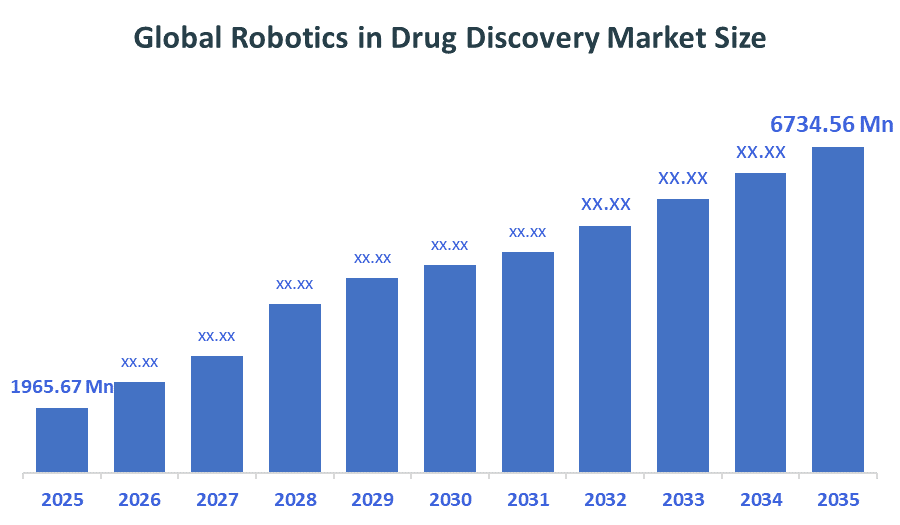
The Global Robotics in Drug Discovery Market Size is projected USD 1965.67 Million in 2025 and is forecasted to reach around USD 6734.56 Million by 2035. According to Decision Advisors, a detailed report on analysis of the Global Robotics in Drug Discovery Market indicates that the AI-integrated robotics trend dominates the market, accounting for approx. 40-50% of the total global demand worldwide. Thermo Fisher Scientific Inc. dominates the Global Robotics in Drug Discovery Market, supported by revenue of approx. USD 42-44 billion, due to strong global presence, advanced automation and AI integration, broad product portfolio, strategic partnerships, and continuous innovation drive Thermo Fisher’s leadership worldwide in drug discovery robotics.
Market Snapshot
- Global Robotics in Drug Discovery Market Size (2025): USD 1965.67 Million
- Projected Global Robotics in Drug Discovery Market Size (2035): USD 6734.56 Million
- Global Robotics in Drug Discovery Market Compound Annual Growth Rate (CAGR): 13.1%
- Largest Regional Market: Asia pacific
- Fastest Growing Region: North America
- 3rd Largest Region: Europe
- Base Year: 2025
- Historical Period: 2021-2024
- Forecast Period: 2026-2035
Market Overview/ Introduction
The Robotics in Drug Discovery market is one of the industries that involves the employment of automated robotic machinery and intelligent platforms in order to facilitate faster development of pharmaceutical research. This sector is very important within modern drug discovery since it helps to increase the speed of carrying out high-throughput screening, compound management, assay development, and sample preparation procedures. The term Robotics in Drug Discovery implies the process of using automatic machinery along with intelligent solutions such as AI and ML for performing repetitive operations in laboratory conditions with minimal human intervention. Such robotic systems are widely employed in pharmaceutical and biotechnological enterprises as well as research institutions in order to accelerate drug development and reduce its cost. Some of the key technologies in Robotics in Drug Discovery are related to the employment of robotic arms, automated liquid handlers, laboratory automation platforms, cloud computing, and AI-enabled predictive modelling software. Further advances in the industry are aimed at creation of self-driving or fully-automated laboratories in which robots independently conduct laboratory tests. Robotic development in drug discovery is being encouraged by government programs in regions like the US, Europe, China, and India. The increase in demand for personalized medicine, higher spending on research and development, and the necessity for quicker drug approval processes are some of the significant drivers that will boost the market's expansion. In general, robotic systems in drug discovery have revolutionized pharmaceutical research into an automated, efficient, and data-driven environment.
- In March 2026, India launched the ?1 lakh crore RDI Scheme in November 2025 to boost AI, robotics, biotechnology, and pharmaceuticals, strengthening innovation in deep technologies including robotics-driven drug discovery.
- In November 2025, India’s PRIP Scheme with ?5,000 crore outlay boosts pharma and MedTech innovation, establishing Centres of Excellence at NIPERs and strengthening R&D, supporting advanced drug discovery and robotics integration.
- In January 2021, The European Union’s Horizon Europe (2021–2027) program allocates €95.5 billion to research and innovation, supporting AI, robotics, and pharmaceutical advancements, strengthening robotics-enabled drug discovery across Europe.
Notable Insights: -
- Asia-Pacific holds the largest regional market share approximately 38% in the global Robotics in Drug Discovery market.
- North America is the fastest growing region market share approximately 32% in the global Robotics in Drug Discovery market.
- By type, the traditional robots segment held a dominant position with 67% in terms of market share in 2025.
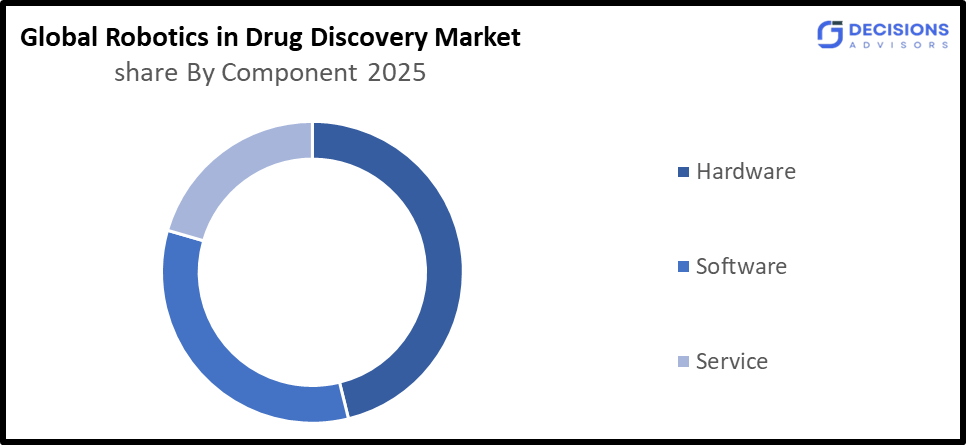
- By Component, hardware segment is the dominating accounting for market is approximately 54%.
- By end user, biopharmaceutical & pharmaceutical companies segment held a dominant position market is approximately 71%.
- By Robot, semi-autonomous segment held a dominant position market is approximately 68%.
- The market is likely to achieve a valuation of USD 6734.56 Million by 2035.
What is role of technology in grooming the market?
Technological advancements are instrumental in driving the growth of the Robotics in Drug Discovery market due to their contribution towards speed and accuracy during the process of developing drugs. Technologies like AI and ML help to identify prospective drugs quickly and minimize human errors during the drug discovery process. Technology automation enables the completion of repetitive tasks such as sample collection, compound evaluation, and data analysis to decrease drug development time and costs. Data integration through cloud computing ensures collaborative work and quick data analysis. There is an ongoing innovation in self-driving labs and robots based on AI technology, which is revolutionizing the entire process of drug discovery.
How is Recent Developments Helping the Market?
Recent advancements have considerably aided in the growth of the market for Robotics in Drug Discovery through improved efficiency, speed, and accuracy of operations in pharmaceutical R&D. The combination of artificial intelligence (AI) with robots helps to make automated decisions, quick screening of compounds, and efficient identification of drug targets. High throughput screening, along with self-driving laboratories, has helped to reduce human involvement and increase the pace of research. Collaboration between pharmaceutical firms and technology providers is fostering innovation in the sector. Investments in automation of laboratories and robotic platforms based on the cloud is increasing. In addition, the use of cobots in research has added flexibility and safety in the research environment.
Market Drivers
There exist various factors behind the growth and development of the Robotics in Drug Discovery market, which are contributing to the changing face of pharmaceutical research today. First, there exists an urgent need to minimize the time and costs associated with drug development processes, which are typically quite costly and take a lot of time. The use of robotics technologies makes processes such as high throughput screening, compound handling, and data management faster and more successful. Another factor is related to the increased involvement of AI and ML in drug discovery, which allows modelling and identification of drugs. The increase in investments in the development of new medicines within the pharmaceutical sector is another driver fuelling the growth of the robotics market due to the increased focus of biopharma companies on the development of treatment options for various diseases, including cancers and neurological disorders. Personalized medication is becoming popular, increasing the need for drug development tools. Moreover, there are various other factors involved in driving the market, such as improvements in laboratory automation, cloud computing, and development of self-driving laboratories. There are also various governmental initiatives promoting biotech innovations.
Restrain
Key restraints in the Robotics in Drug Discovery market include high initial investment and maintenance costs, which limit adoption among small and mid-sized laboratories. Integration complexity with existing lab systems and requirement of skilled personnel also hinder growth. Additionally, data security concerns and regulatory challenges in pharmaceutical validation processes further restrict widespread implementation of advanced robotic systems in drug discovery workflows.
Competitive Analysis:
The report offers the appropriate analysis of the key organizations/companies involved within the Robotics in Drug Discovery market, along with a comparative evaluation primarily based on their Product of offering, business overviews, geographic presence, enterprise strategies, segment market share, and SWOT analysis. The report also provides an elaborative analysis focusing on the current news and developments of the companies, which includes Product development, innovations, joint ventures, partnerships, mergers & acquisitions, strategic alliances, and Others. This allows for the evaluation of the overall competition within the market.
Top Companies in Global Robotics in Drug Discovery Market
- Thermo Fisher Scientific Inc.
- Danaher Corporation
- Agilent Technologies Inc.
- PerkinElmer Inc.
- Tecan Group AG
- Beckman Coulter Life Sciences
- Hamilton Company
- Siemens Healthineers AG
- Bio-Rad Laboratories Inc.
- Roche (F. Hoffmann-La Roche AG)
Government Initiatives
|
Country |
Key Government Initiatives |
|
China
|
In April 2026: Beijing's 32 Measures mandate AI-driven drug discovery and high-tech robotics integration. Key targets include 15 AI/organ-chip models and insurance-backed surgical robots to accelerate biomedical innovation and global clinical trials. |
|
India |
In February 2026: India’s Draft National Strategy on Robotics designates healthcare and lab automation as high-growth sectors. Backed by ARTPARK and IHFC, the mission accelerates AI-driven drug discovery and indigenous medical cobotics. |
|
India |
In July 2023, India’s Draft National Strategy on Robotics promotes AI-integrated robotics to strengthen R&D and industrial automation across sectors including healthcare, indirectly supporting pharmaceutical manufacturing and drug discovery innovation. |
Study on the Supply, Demand, Distribution, and Market Environment of Robotics in Drug Discovery Market
The drug discovery robotics industry is governed by the perfect balance of forces that includes the factors of supply, demand, distribution, and market environment. The forces that drive supply include major producers who manufacture laboratory automation equipment, robotic technology, and AI-integrated products. Meanwhile, demand is rising significantly due to the increased needs for efficient and fast drug development offered by pharma and biotech firms. The distribution process is mainly handled by direct sales channels and specialized distributors, as well as through collaborations with research organizations and pharmaceutical firms. As far as the market environment goes, there are significant trends related to innovations in the fields of AI and machine learning, along with lab automation.
Price Analysis and Consumer Behaviour Analysis
This market features heavy investments in terms of capital and pricing since expensive robotic systems, platforms featuring AI technology, and liquid handlers need substantial financial input. Prices depend largely on the complexity of each system purchased, starting at thousands to millions of dollars per purchase. It is not accessible to medium and small businesses since the price level is relatively high. The buying behaviour of consumers reflects the priority placed on such features as precision, scalability, compatibility with AI workflows, and conformity with regulation. Big pharmaceutical organizations tend to opt for comprehensive automation technologies as a means to save money and decrease drug development times.
Market Segmentation
The Robotics in Drug Discovery market share is classified into mounting type, component, robot, and end user
- The type segment dominated the market in 2025, and is projected to grow at a substantial CAGR of approximately 11.5% during the forecast period.
Based on the type, the Robotics in Drug Discovery market is divided into traditional robots, and collaborative robots. Among these, Traditional Robots dominate the type segment, accounting for approximately 60–70% of total revenue share, grows at approximately 10%–14% CAGR due to their extensive use in high-throughput screening, compound handling, and automated laboratory workflows. Their dominance is driven by high precision, scalability, and established deployment in pharmaceutical R&D.
Top of Form
- The Component segment accounted for the largest share in 2025, and is anticipated to grow at a significant CAGR of approximately 11% during the forecast period.
Based on the component, the Robotics in Drug Discovery market is divided into hardware, software, and service. Among these, hardware dominates, accounting for approximately 50–60% of total revenue share in 2025, due to high adoption of robotic arms, automated liquid handlers, and lab instrumentation in pharmaceutical R&D. Hardware is essential for high-throughput screening and sample processing. However, software is the fastest-growing segment CAGR is moderate at around 10–12%, driven by AI integration, workflow automation, and data analytics.
Bottom of Form
- The end user segment dominated the market in 2025, and is projected to grow at a substantial CAGR of approximately 11.4% during the forecast period.
Based on the end user, the Robotics in Drug Discovery market is divided into biopharmaceutical & pharmaceutical companies, and research laboratories. Among these, biopharmaceutical & pharmaceutical companies dominate, accounting for approximately 65–75% of total revenue share in 2025. Their dominance is driven by large-scale investment in automated drug discovery, high-throughput screening, and advanced R&D infrastructure to accelerate drug pipelines. These companies have greater budgets and faster adoption of robotics compared to research laboratories. Their CAGR is around 11–12%, supported by rising drug development demand.
- The Robot segment dominated the market in 2025, and is projected to grow at a substantial CAGR of approximately 11.6% during the forecast period.
Based on the Robot, the Robotics in Drug Discovery market is divided into autonomous, and semi-autonomous. Among these, semi-autonomous robots dominate, holding approximately 60–70% of the 2025 revenue share. Their dominance is driven by strong adoption in pharmaceutical and biotech labs where human oversight is still essential for precision, regulatory compliance, and complex experimental workflows. They are easier to integrate into existing laboratory systems and require lower transition risk compared to fully autonomous systems. Semi-autonomous robots grow at around 11–12% CAGR.
Top of Form
Bottom of Form
Strategies to Implement for Growth of the Market in Non-Leading Regions
For fostering faster growth in the robotics for drug discovery industry in non-prevalent locations, businesses must concentrate on providing affordable automation options for medium-sized labs and upcoming biotechnology companies. Setting up public-private partnerships is one way to overcome funding problems. Creating manufacturing and service facilities locally will help reduce costs associated with automation hardware. Education programs are also important for tackling the lack of trained individuals in robotics and AI for drug discovery. Businesses must also emphasize robotic systems that are modular and cloud-based to make it easier for organizations to adopt them. Government grants and funding can also be provided as an incentive.
Regional Segment Analysis of the Robotics in Drug Discovery Market
- North America (U.S., Canada, Mexico)
- Europe (Germany, France, U.K., Italy, Spain, Rest of Europe)
- Asia-Pacific (China, Japan, India, Rest of APAC)
- South America (Brazil and the Rest of South America)
- The Middle East and Africa (UAE, South Africa, Rest of MEA)
Asia pacific is anticipated to hold the largest share of the Robotics in Drug Discovery market over the predicted timeframe.
Asia Pacific is expected to hold the largest share of the Robotics in Drug Discovery market in 2025, accounting for approximately 35–40% of global revenue. This dominance is driven by rapid expansion of pharmaceutical and biotechnology industries, strong government funding in countries like China, Japan, and India, and increasing adoption of AI-driven lab automation. Lower operational costs and growing R&D investments further support growth. The region is also expected to register a strong CAGR of around 12–14%, fuelled by rising drug development demand and technological advancements.
North America is expected to grow at a rapid CAGR in the Robotics in Drug Discovery market during the forecast period. North America is expected to grow at a rapid pace in the Robotics in Drug Discovery market due to strong adoption of advanced technologies, high R&D investments, and presence of leading pharmaceutical and biotechnology companies. The region benefits from early integration of AI, machine learning, and laboratory automation in drug development processes. In 2025, North America is estimated to hold approximately 30–35% of global market revenue share, driven by the United States’ strong innovation ecosystem. The region is projected to register a CAGR of around 11–13%, supported by increasing demand for faster drug development, high-throughput screening, and automation in clinical research, along with supportive regulatory frameworks and funding initiatives.
Top of Form
Bottom of Form
Europe is the 3rd largest region to grow in the Robotics in Drug Discovery market during the region. Europe is the third-largest region in the Robotics in Drug Discovery market, accounting for approximately 20–25% of global revenue share in 2025. Growth is driven by strong pharmaceutical R&D infrastructure, increasing adoption of laboratory automation, and supportive initiatives such as EU Horizon Europe funding for AI and biotech innovation. Countries like Germany, the UK, and Switzerland lead in advanced drug discovery research. Europe is expected to register a CAGR of around 10–12%, supported by rising demand for cost-efficient drug development, precision medicine, and increasing integration of robotics in research laboratories.
Future Market Trends in Global Robotics in Drug Discovery Market: -
- AI-driven autonomous drug discovery labs
The future of the Robotics in Drug Discovery market will be strongly shaped by AI-driven autonomous or “self-driving” laboratories. These systems integrate robotics, machine learning, and real-time analytics to independently design, execute, and optimize experiments. They significantly reduce human intervention, accelerate compound screening, and improve decision-making accuracy. Pharmaceutical companies adopt them to shorten drug development cycles and lower costs. This trend will enhance predictive drug modelling and enable continuous experimentation, making drug discovery faster, more efficient, and highly data-driven.
2. Expansion of collaborative robotics (cobots) in labs
Collaborative robots (cobots) are expected to become a major trend as pharmaceutical and biotech labs seek flexible and safe automation solutions. Cobots work alongside researchers, assisting in repetitive tasks such as sample handling, pipetting, and assay preparation. Their ease of programming, lower cost, and adaptability make them ideal for mid-sized laboratories. This trend supports wider adoption of robotics in emerging markets and smaller research facilities, improving productivity while maintaining human oversight in complex experimental workflows.
- Cloud-integrated and data-centric robotic platforms
Cloud-based robotics platforms will transform drug discovery by enabling real-time data sharing, remote experimentation, and global collaboration. These systems integrate robotics with cloud computing, big data analytics, and AI algorithms to manage large-scale experimental datasets efficiently. Researchers can access and control robotic systems remotely, improving scalability and operational efficiency. This trend enhances transparency, speeds up decision-making, and supports global pharmaceutical collaboration, ultimately making drug discovery more connected, intelligent, and cost-effective across research ecosystems.
Recent Development
- In February 2026, The Genesis Mission (Executive Order 14363) aims to double U.S. scientific productivity via AI and robotics. This "Manhattan Project" scales self-driving labs, revolutionizing the robotics-enabled drug discovery and materials markets
- In July 2024, Exscientia and AWS expanded their partnership in 2024 to develop an AI-driven platform integrating robotics and cloud computing for automated drug discovery and laboratory testing workflows.
Market Segment
This study forecasts revenue at global, regional, and country levels from 2021 to 2035. Decision Advisors has segmented the Robotics in Drug Discovery Market based on the below-mentioned segments:
Global Robotics in Drug Discovery Market, By Product Type
- Traditional Robots
- Collaborative Robots
Global Robotics in Drug Discovery Market, By Component
- Hardware
- Software
- Service
Global Robotics in Drug Discovery Market, By Robot
- Autonomous
- Semi-Autonomous
Global Robotics in Drug Discovery Market, By End User
- Biopharmaceutical & Pharmaceutical Companies
- Research Laboratories
Global Robotics in Drug Discovery Market, By Regional Analysis
- North America
- US
- Canada
- Mexico
- Europe
- Germany
- UK
- France
- Italy
- Spain
- Russia
- Rest of Europe
- Asia Pacific
- China
- Japan
- India
- South Korea
- Australia
- Rest of Asia Pacific
- South America
- Brazil
- Argentina
- Rest of South America
- Middle East & Africa
- UAE
- Saudi Arabia
- Qatar
- South Africa
- Rest of the Middle East & Africa
Frequently Asked Questions (FAQ)
1. How does robotics improve reproducibility in drug discovery experiments?
Robotics reduces variability caused by manual handling by ensuring highly consistent execution of laboratory protocols such as pipetting, sample preparation, and assay execution. This leads to more reliable and reproducible experimental outcomes, which is critical for validating drug candidates.
2. What are the main integration challenges when combining robotics with AI systems in laboratories?
Key challenges include interoperability between legacy lab equipment and modern AI platforms, data standardization issues, and the need for robust calibration of robotic systems to ensure accurate machine learning outputs in dynamic experimental environments.
3. How are small biotech firms using robotics differently from large pharmaceutical companies?
Large pharmaceutical companies typically deploy fully integrated automation ecosystems across multiple research stages, while smaller biotech firms often adopt modular robotic tools for specific tasks like compound screening or sample handling due to budget and scalability constraints.
4. Why is regulatory compliance important in robotics-based drug discovery?
Regulatory compliance ensures that automated laboratory processes meet strict quality, safety, and validation standards required for clinical research. This is essential for ensuring that data generated through robotic systems is acceptable for regulatory submissions.
5. What skills are becoming important for professionals working in robotics-driven drug discovery?
Professionals increasingly need expertise in laboratory automation, data science, AI model interpretation, and systems integration, along with a strong understanding of pharmaceutical research workflows and quality assurance practices.
Check Licence
Choose the plan that fits you best: Single User, Multi-User, or Enterprise solutions tailored for your needs.
We Have You Covered
- 24/7 Analyst Support
- Clients Across the Globe
- Tailored Insights
- Technology Tracking
- Competitive Intelligence
- Custom Research
- Syndicated Market Studies
- Market Overview
- Market Segmentation
- Growth Drivers
- Market Opportunities
- Regulatory Insights
- Innovation & Sustainability
Report Details
| Scope | Global |
| Pages | 210 |
| Delivery | PDF & Excel via Email |
| Language | English |
| Release | Apr 2026 |
| Access | Download from this page |