
Global Rotary Actuators Market
 |
Author:
Omkar J
|
Pages:
200
|
Author:
Omkar J
|
Pages:
200
Global Rotary Actuators Market Size, Share, By Type (Pneumatic, Hydraulic, and Electric Rotary Actuators) By Design (Vane Type and Rack and Pinion) By Application (Industrial Automation, Robotics, Aerospace and Defense, Automotive, and Healthcare) By End User (Manufacturing, Energy and Utilities, Transport and Logistics, and Oil and Gas) and By Region (North America, Europe, Asia-Pacific, Latin America, Middle East and Africa), Analysis and Forecast 2026-2035
CAGR
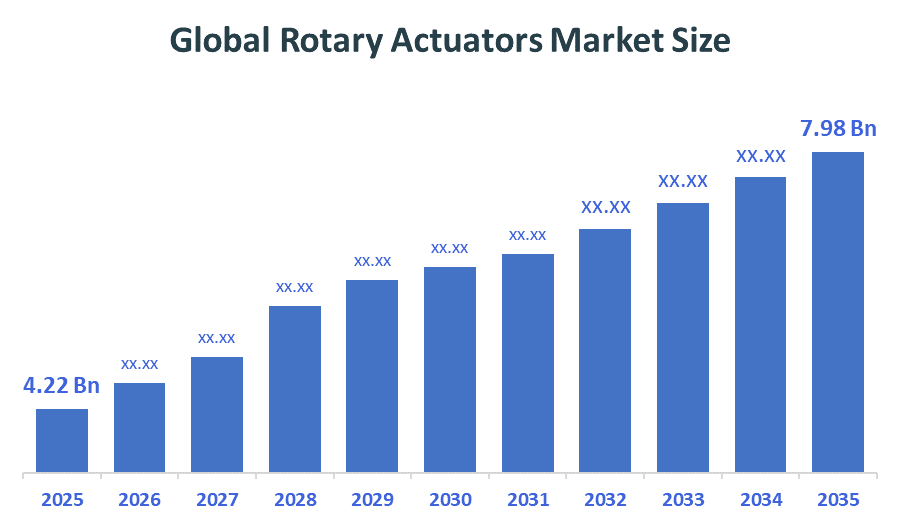
6.58%
REVENUE 2025
USD Billion 4.22
FORECAST 2035
USD Billion 7.98
REPORT COVERAGE
Global
Market Snapshot
- Global Rotary Actuators Market Size (2025): USD 4.22 Billion
- Global Rotary Actuators Projected Market Size (2035): USD 7.98 Billion
- Global Rotary Actuators Compound Annual Growth Rate (CAGR): 6.58%
- Largest Regional Market: Asia-Pacific
- Fastest Growing Region: North America
- 3rd Largest Region: Europe
- Base Year: 2025
- Historical Period: 2021 to 2024
- Forecast Period: 2026 to 2035
Market Overview / Introduction
A rotary actuator represents a highly accurate mechanical component that transforms hydraulic, pneumatic, or electrical energy into a precisely regulated rotation over an angular stroke. As a result of the advancement of technologies over the years, modern systems have evolved from simple piston-type actuation to state-of-the-art digital solutions employing electromagnetic forces and complex fluid dynamics in order to produce maximum torque output along with built-in sensors for real-time feedback on the system's performance. Rotary actuators have become absolutely essential in critical applications ranging from controlling valves in oil and gas pipelines to operating robotic joints in semiconductor factories and moving aerodynamic surfaces in aircraft. Government programs like the Advanced Manufacturing Partnership of 2026 in the US and the Factories of the Future in Europe have facilitated the deployment of these self-controlled systems in local manufacturing processes through large-scale financial aid worth millions of dollars in terms of energy-efficient motion control devices. This development has led to a marked decrease in industrial downtime and reduced energy usage owing to the ability of these autonomous systems to slow down and protect the equipment.
- The industrial automation and robotics segments contribute to approximately 60% of the application-based use in the market, driven by the increasing demand for collaborative robots and smart factory upgrades.
- Automated steering and valve control technology in the automotive sector is experiencing substantial growth, with a CAGR forecasted to surpass 10.5% due to the integration of rotary systems in electric vehicle drivetrains and autonomous driving hardware.
Notable Insights: -
- Electric rotary modules make up about 52.4% of the total market share. They have gained a reputation for precision in cleanroom environments and semiconductor manufacturing.
- About 68% of all installations occur in large-scale manufacturing plants and aerospace assembly units. These investments are stimulated by a shift toward fully automated production cycles.
- Applications of rotary actuators in the sphere of renewable energy, particularly for solar tracking systems, account for almost 38.5% of new demand.
- About 45.2% of the market value belongs to the Asia-Pacific region in 2026. Countries like China and Japan are investing heavily in robotic infrastructure.
- Compact modular actuators show an annual increase above 7.2%. The rise in edge automation creates conditions that encourage enterprises to invest in smaller, high-torque solutions.
What is the Role of Technology in Shaping the Market?
It should be noted that technological advancements are creating innovations in the field of motion control thanks to improved torque density, faster reaction times, and better energy consumption. Thanks to innovations in engineering, the current range of products can provide substantially greater power outputs with much smaller physical sizes. Current rotator systems can no longer be referred to simply as mechanical couplings since they have become complex electronic devices equipped with advanced microchips. These innovations make it possible for new systems to conduct self-calibration and monitoring for longer periods of time without the necessity to regularly intervene manually. By using advanced feedback and digital twin capabilities, these new devices guarantee maximum operation of industrial machinery for extended periods of time.
How are Recent Developments Helping the Market?
The innovations include the adoption of brushless DC motors and high-performance planetary gears that enhance torque without changing the size of the product. Such innovations have played an important role in fostering development in the market. The modularity nature of the systems allows for easy substitution and scalability in industries. With the help of smart positioners, the system ensures independent control of angular displacement with software limitations.
Market Drivers
There is a significant increase in the demand for global rotary actuators due to the growing investment made by manufacturers and governments to attain the industry 4.0 standards. As the production plants move towards automation, it becomes imperative for them to install smart parts that can interface with the control system. Modern rotary actuators come with several high-end functions such as smart load detection and quick automatic adjustments within an enclosure that is durable and vibration-proof. The development of small robots and robots has created a vital need for actuators that can deliver maximum output with minimum weight.
Restraints
The growth of the international market for rotary actuators is constrained by the difficulties in maintaining high-pressure seals in hydraulic and pneumatic variants under extreme temperature conditions, which can lead to fluid leaks and performance degradation.
Competitive Analysis:
The report offers the appropriate analysis of the key organisations/companies involved within the rotary actuators market, along with a comparative evaluation primarily based on their product offerings, business overviews, geographic presence, enterprise strategies, segment market share, and SWOT analysis. The report also provides an elaborate analysis focusing on the current news and developments of the companies, which includes product development, innovations, joint ventures, partnerships, mergers & acquisitions, strategic alliances, and others. This allows for the evaluation of the overall competition within the market.
Top 10 Companies in the Global Rotary Actuators Market
- Emerson Electric Co.
- Parker Hannifin Corporation
- Flowserve Corporation
- ABB Ltd
- Rotork plc
- Moog Inc.
- SMC Corporation
- Festo SE & Co. KG
- Curtiss-Wright Corporation
- Rockwell Automation, Inc.
Government Initiatives
|
Country |
Key Government Initiatives |
|
China |
The Chinese government is projected to spend approximately $400 billion on the robotics sector. Under its robot + Application Action Plan, Beijing provides massive subsidies for domestic manufacturing of core components, including high-torque rotary actuators and precision reducers, aiming to achieve 70% self-sufficiency in industrial robotics by 2030. |
|
Germany |
Through the High-Tech Agenda 2026, the German government is investing €36 million into research initiatives like the Helmholtz Quantum Use Challenge. These funds support the development of next-generation actuators based on smart materials and micro-technologies for high-precision engineering and robogami. |
|
United States |
Beyond the sustainability-focused COOLERCHIPS program, the U.S. federal government has expanded the Advanced Manufacturing Partnership (AMP) in 2026. This includes specific grants for Software-Defined Automation, encouraging the transition from traditional pneumatic systems to smart electric actuators in the aerospace and defense supply chains. |
Study on the Supply, Demand, Distribution, and Market Environment
The efficiency of the business in rotary actuators rests upon achieving the right balance between robust mechanical performance and sophisticated digital integration. Supply of rotary actuators originates from the emphasis on using durable materials and synthetic materials with reduced friction that allow for many million cycles of operation without any mechanical breakdown. Contemporary supply chains place emphasis on producing components that will be successfully incorporated in smart grids and guarantee status feedback in real time to centralized management systems. The demand for rotary actuators arises due to increasing tendency towards automation with positioning units replacing manual operations. The current market environment is defined by the trend toward electric solutions that would enable operators to use electric motors rather than environmentally hazardous hydraulic liquids.
Price Analysis and Consumer Behaviour Analysis
The price of rotary actuators is greatly determined by the ratings of the torque output capabilities, the environmental protection standards (IP67 or IP68 rated, for instance), and also by the type of interface required for control purposes. The more advanced types of actuators, such as electric models which feature sophisticated built-in encoders and network communication cards, may initially prove expensive to purchase but will definitely cost much less when put to use owing to lower power consumption. Standard pneumatic devices and simpler rack and pinion versions are cheaper to purchase and represent perfect options for basic automation and valve operation in less harsh conditions. The customers have obviously shown their inclination towards modularity and simplicity in use, meaning that companies need to focus their attention on developing products which can operate independently, be compatible, and have global technical support.
Market Segmentation
The Global Rotary Actuators Market share is classified into type, design, application, and end user.
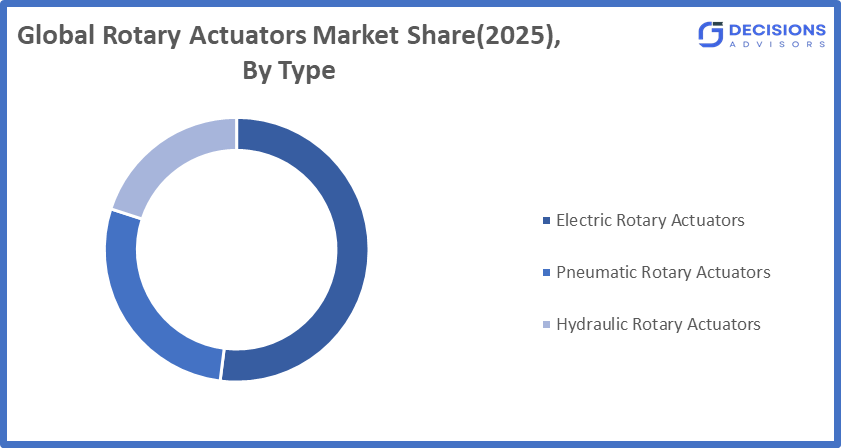
The Electric Rotary Actuator segment holds the largest share, contributing approximately 52% of the market in 2025.
Based on the Type, the global rotary actuators market is divided into Pneumatic, Hydraulic, and Electric Rotary Actuators. Among these, the Electric Rotary Actuator segment holds the largest share, contributing approximately 52% of the market in 2025. Due to superior heat dissipation during high-frequency cycles, and the ability to perform with extreme precision in high-density manufacturing. The reason for this dominance lies in their ability to perform better in terms of energy efficiency and their ability to integrate with AI-driven control networks without the need for complex fluid piping.
The Rack and Pinion segment accounts for the largest share, representing over 58% of the global market in 2025.
Based on the Design Type, the global rotary actuators market is divided into Vane Type and Rack and Pinion. Among these, the Rack and Pinion segment accounts for the largest share, representing over 58% of the global market in 2025. These designs are critical for maintaining the physical integrity of heavy-duty industrial valves and providing consistent torque across a full range of motion. On the other hand, the Vane Type segment has emerged as a rapidly growing sector for compact robotics where space is limited and high-speed oscillation is required.
Industrial Automation dominates the global market, accounting for approximately 55% of the total revenue in 2025.
Based on the Application, the global rotary actuators market is divided into Industrial Automation, Robotics, Aerospace and Defense, Automotive, and Healthcare. Among these, Industrial Automation dominates the global market, accounting for approximately 55% of the total revenue in 2025. This segment is preferred by operators who require large-scale integrated solutions and professional engineering services for complex assembly lines. The Robotics category is seeing a sharp increase in use, especially in the production of collaborative robots, where precise angular movement is required to ensure human-robot safety.
The Manufacturing segment dominates the global market, accounting for approximately 50% of the total revenue in 2025.
Based on the End User, the market is divided into Manufacturing, Energy and Utilities, Transport and Logistics, and Oil and Gas. Among these, the Manufacturing segment dominates the global market, accounting for approximately 50% of the total revenue in 2025. This segment is preferred by planners who require robust hardware for high-volume production. The Automotive segment is seeing a sharp increase in use, especially by manufacturers in the electric vehicle industry who value the precision of automated battery positioning and power electronic assembly.
Strategies to Implement for Growth of the Market in Non-Leading Regions
The potential for growth within the rotary actuators industry in emerging regions could be increased through the deployment of efficient modular platforms for local industrial developers. Programs aimed at achieving modern industrialisation by governments contribute substantially to demand within regions with older machinery that poses challenges to modern digital integration. Further support through increasing investments in training local mechanical engineering technicians and setting up regional maintenance facilities will facilitate the adoption of sustainable motion control and smart response solutions.
Regional Segment Analysis of the Global Rotary Actuators Market
- North America (U.S., Canada, Mexico)
- Europe (Germany, France, U.K., Italy, Spain, Rest of Europe)
- Asia-Pacific (China, Japan, India, South Korea, Rest of APAC)
- Latin America (Brazil and the Rest of Latin America)
- The Middle East and Africa (UAE, Saudi Arabia, South Africa, Rest of MEA)
Asia-Pacific is projected to be the fastest-growing region over the forecast period, maintaining its status as a dominant force in the global landscape. By 2025, the region will already account for approximately 36.5% of global revenue. This rapid ascent is primarily driven by the massive digital infrastructure projects and the surging demand for modern automation hardware in emerging economies like China, India, and Vietnam. The regional growth is further bolstered by the presence of major electronics manufacturing hubs and a significant shift toward indigenous production of high-precision robotic components. Government initiatives such as Smart Cities and large-scale investments in semiconductor fabrication plants are creating a fertile ground for the adoption of advanced rotary motion solutions.
North America is expected to hold a significant share of the market throughout the forecast period. In 2025, this region will command approximately 27.2% of the global revenue share, a position sustained by a highly sophisticated aerospace and defense infrastructure. The United States, in particular, is a major contributor due to the extensive adoption of energy-efficient technology within national security applications and commercial aviation. The market in this region is characterised by a high concentration of key industry players and a strong emphasis on Research and Development (R&D). Furthermore, the rapid integration of Internet of Things (IoT) technologies into factory floors is driving the demand for smart actuators that offer remote diagnostic capabilities and enhanced operational safety.
Europe is anticipated to hold a substantial share, contributing approximately 21.5% to the global market valuation. The region possesses a distinct competitive advantage rooted in long-standing clusters of precision engineering innovation, particularly in Germany, Italy, and France. European manufacturers are at the forefront of developing sustainable industrial protection systems that align with strict environmental regulations. This focus on green manufacturing has led to a significant replacement of traditional hydraulic systems with high-efficiency electric rotary actuators. Additionally, the presence of a robust automotive sector that is rapidly pivoting toward electric vehicle (EV) production provides a consistent stream of demand for specialised actuation components used in battery assembly and automated testing environments.
Recent Developments
- In October 2025, leading companies such as ABB Ltd. and Rockwell Automation expanded digital actuator integration strategies, leveraging Industry 4.0 trends as the global actuators market grows at a CAGR of around 6.58% through 2035.
- In August 2025, global automation leaders such as Festo SE & Co. KG and SMC Corporation expanded partnerships with robotics OEMs to develop advanced hollow-shaft rotary actuators, supporting a market where top manufacturers collectively hold around 40% share globally.
- In January 2025, SMC Corporation launched its CRB/CDRB rotary actuator series with a compact double-vane design, enhancing precision and integration in industrial automation systems.
- In June 2024, major firms, including Rotork plc and Flowserve Corporation, focused on expanding intelligent valve and rotary actuator solutions for oil & gas and water sectors, where top players account for nearly 24% of the total market share.
Frequently Asked Questions (FAQ)
What is the primary difference between vane-type and rack-and-pinion rotary actuators?
The distinction lies in their mechanical construction and torque delivery. Rack and pinion actuators use a gear and piston system to provide consistent torque across the entire range of motion, making them ideal for heavy-duty industrial valves. In contrast, vane-type actuators use a simpler internal paddle design, which is highly valued in space-constrained applications like compact robotics due to their smaller physical footprint and high-speed oscillatory capabilities.
How is Industry 4.0 influencing the design of modern rotary actuators?
Industry 4.0 has transformed these components from purely mechanical links into intelligent assets. Modern designs now incorporate microprocessors and sensors that allow for autonomous self-calibration and real-time data transmission. This connectivity enables facility managers to implement predictive maintenance strategies, as the actuators can signal potential wear or alignment issues before a system failure occurs.
Why is there a significant shift toward electric rotary actuators in manufacturing?
Manufacturers are increasingly favouring electric models over hydraulic or pneumatic variants because of their superior energy efficiency and precision. Electric actuators allow for software-defined limits and precise angular positioning that fluid-based systems struggle to match. Furthermore, they eliminate the risk of fluid leaks, which is a critical requirement in cleanroom environments like semiconductor fabrication and medical device assembly.
What role do rotary actuators play in the renewable energy sector?
Rotary actuators are vital for maximising the efficiency of solar energy systems. They are used in solar tracking mechanisms to rotate panels throughout the day, ensuring they remain at the optimal angle to the sun. This application requires high durability and weather resistance, as the hardware must operate reliably in harsh outdoor environments with minimal maintenance.
Check Licence
Choose the plan that fits you best: Single User, Multi-User, or Enterprise solutions tailored for your needs.
We Have You Covered
- 24/7 Analyst Support
- Clients Across the Globe
- Tailored Insights
- Technology Tracking
- Competitive Intelligence
- Custom Research
- Syndicated Market Studies
- Market Overview
- Market Segmentation
- Growth Drivers
- Market Opportunities
- Regulatory Insights
- Innovation & Sustainability
Report Details
| Scope | Global |
| Pages | 200 |
| Delivery | PDF & Excel via Email |
| Language | English |
| Release | Apr 2026 |
| Access | Download from this page |