
Global Rugged Thermal Camera Market
 |
Author:
Kunal M
|
Pages:
210
|
Author:
Kunal M
|
Pages:
210
Global Rugged Thermal Camera Market Size, Share, By Type (Cooled Thermal Cameras, Uncooled Thermal Cameras) By Application (Security & Surveillance, Monitoring & Inspection, Detection & Measurement, Others) By Product (Handheld Portable Cameras, Fixed Mounted Systems, Drone-mounted Thermal Cameras, Smartphone-integrated Thermal Cameras) By End User (Military & Defense, Industrial, Commercial, Government & Public Safety, Residential), and By Region (North America, Europe, Asia-Pacific, Latin America, Middle East, and Africa), Analysis and Forecast 2025 ? 2035.
CAGR
8.78%
REVENUE 2025
USD Billion 2.44
FORECAST 2035
USD Billion 6.16
REPORT COVERAGE
Global
Market Snapshot
- Market Size (2025): USD 2.44 billion
- Projected Market Size (2035): USD 6.16 Billion
- Compound Annual Growth Rate (CAGR): 8.78%
- Largest Regional Market: North America
- Fastest Growing Region: Asia-Pacific
- 3rd Largest Region: Latin America
- Base Year: 2025
- Historical Period: 2021–2024
- Forecast Period: 2026–2035
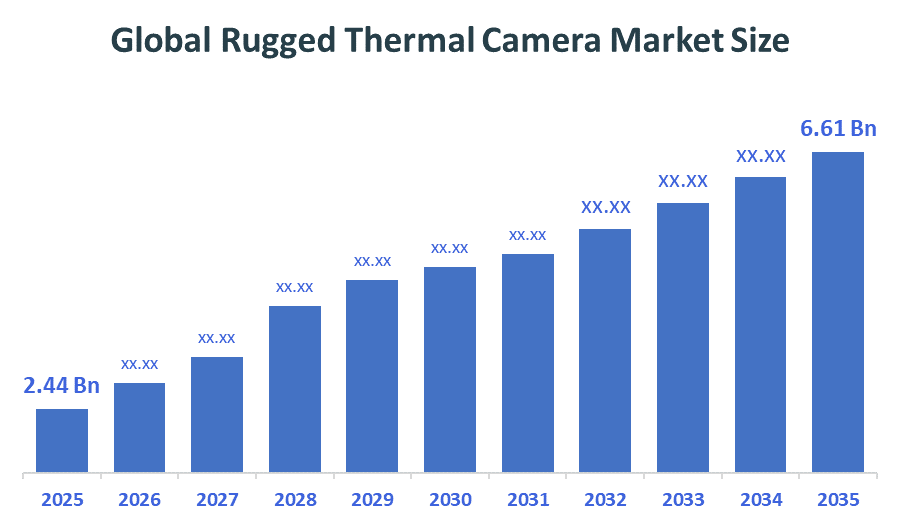
According to Decision Advisors, the Global Rugged Thermal Camera Market Size is expected to grow from USD 2.44 billion in 2025 to USD 6.16 billion by 2035, at a CAGR of 8.78% during the forecast period 2026-2035. The global rugged thermal camera market exists because defense surveillance needs continue to rise and industrial predictive maintenance requires growing usage and advanced driver-assistance systems need thermal cameras for better safety. The market growth process currently benefits from two factors, which include advanced technological development and artificial intelligence-powered analytics and high-resolution imaging and affordable uncooled sensors.
Market Overview/ Introduction
The global rugged thermal camera market includes advanced infrared imaging systems that operate under extreme conditions to deliver precise heat measurement capabilities. The solutions provide economic benefits through increased operational productivity and decreased maintenance expenses while they enhance corporate risk management processes across various industrial sectors. The main applications of these technologies include defense surveillance industrial predictive maintenance infrastructure protection firefighting automotive safety systems and environmental monitoring which together enhance productivity and safety compliance while enabling organizations to make decisions based on data in multiple industries. The global rugged thermal camera market is evolving through AI-driven analytics and IoT-enabled connectivity and advanced sensor innovations which improve real-time decision-making and imaging accuracy. The commercial viability of automotive and smart city and industrial ecosystems has expanded through the combined effects of miniaturization and system integration. Future opportunities exist in autonomous mobility and intelligent infrastructure monitoring and data-centric security frameworks which enable businesses to use scalable thermal solutions for efficiency improvements and asset optimization and new revenue generation in digital economies.
- In New Delhi the government-backed cultural schemes in India are boosting programmable stage lighting demand, with public investments in performing arts infrastructure rising by 12-15%, accelerating adoption of advanced LED lighting across theatres and event venues globally.
- EU Ecodesign mandates are accelerating LED adoption, with Europe’s lighting investments exceeding USD 34-40 billion annually, rising by 10-14%, driving gradual transition in programmable stage lighting despite special-purpose exemptions.
Notable Insights: -
- North America holds the largest regional market share, approximately 40.9% in the global rugged thermal camera market.
- Asia-Pacific is the fastest growing region in the global rugged thermal camera market, because of defense expenditures together with the development of advanced smart infrastructure systems which currently enhances the deployment of surveillance systems and industrial operations and public safety technologies.
- By type, the Uncooled Thermal Cameras segment held a dominant position with 66.8% in terms of market share in 2025.
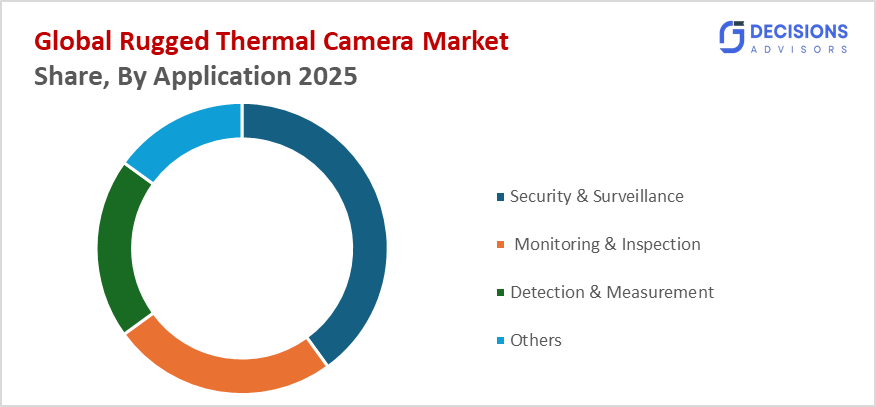
- By Application, Security & Surveillance is the dominating accounting for over 35.6% of the global market share in 2025.
- The compound annual growth rate of the global rugged thermal camera market is 8.78%.
- The market is likely to achieve a valuation of USD 6.16 billion by 2035.
What is role of technology in grooming the market?
The Global Rugged Thermal Camera market is undergoing fundamental changes which technology is driving through its capacity to improve precision and durability and analytical capabilities. The detection accuracy of systems has improved through high-resolution sensors and uncooled infrared technologies and AI-powered image processing advancements which also lower system expenses. Real-time monitoring and predictive maintenance and seamless data transmission across industrial and defense networks become possible through IoT platform integration. The combination of miniaturization and power efficiency innovations enables organizations to use portable and vehicle-mounted systems in expanded deployment operations. The developments which thermal imaging systems have achieved now create new operational capabilities while making thermal imaging essential for next-generation safety and surveillance and automation systems.
How is Recent Developments Helping the Market?
Recent development in the global rugged thermal camera market is experiencing transformation because of recent advancements which improve system interoperability and digital ecosystem integration. Thermal imaging technology is being integrated by manufacturers into multi-sensor systems, which allow complete situational awareness through the combination of LiDAR, radar, and IoT network data. The development of battery technology which offers improved efficiency together with smaller batteries results in extended operational capabilities for both remote and mission-critical operations. The growing investments for border security upgrades and critical infrastructure protection are driving the need for rugged imaging systems. The combination of cloud data storage with remote diagnostic tools enables effective lifecycle management, which results in reduced operational downtime and supports various deployment models, thus making the market more competitive while driving revenue growth.
Market Drivers
The global rugged thermal cameras market is growing rapidly because of two factors which include government support and public funding and advancements in technology. India uses its "Make in India" defense initiative and its domestic capability development plans to promote local manufacturing of advanced EO/IR and thermal imaging systems which decreases its need to import these systems and strengthens its supply chains. The defense industry will experience increased demand because the military accepted major defense procurement requests which include thermal imager systems for armored vehicles. The government-supported digitalization projects use thermography technology for predictive maintenance in public infrastructure systems which include railways. The combination of security-driven funding and industrial automation growth is creating a thermal imaging market expansion which increases investment while establishing thermal imaging as an essential tool for national security and infrastructure protection.
Restrain
The global rugged thermal camera market experiences structural limitations because of its need for high capital investments and its restricted operational capabilities. High upfront system costs often exceeding USD 5,000-20,000 per unit for advanced military-grade devices restrict adoption among price-sensitive industries ([FLIR Systems]). The performance inefficiencies under adverse climatic conditions further impact reliability in critical deployments. The combination of regulatory uncertainties about surveillance practices and the requirement for specialized thermal data analysis training drives up both compliance costs and training expenses.
Competitive Analysis:
The report offers the appropriate analysis of the key organizations/companies involved within the spirits market, along with a comparative evaluation primarily based on their product of offering, business overviews, geographic presence, enterprise strategies, segment market share, and SWOT analysis. The report also provides an elaborative analysis focusing on the current news and developments of the companies, which includes product development, innovations, joint ventures, partnerships, mergers & acquisitions, strategic alliances, and others. This allows for the evaluation of the overall competition within the market.
Top Companies in Global Rugged Thermal Camera Market
- Teledyne FLIR
- Fluke Corporation
- Leonardo S.p.A.
- L3Harris Technologies
- BAE Systems
- Raytheon Technologies
- Testo SE & Co. KGaA
- Opgal Optronic Industries
- Seek Thermal
- Axis Communications
- InfraTec GmbH
- Hikvision
- Guide Infrared
- Zhejiang Dali Technology
- Tonbo Imaging
- Tata Advanced Systems
Government Initiatives
|
Country |
Key Government Initiatives |
|
Singapore |
Singapore’s Smart Nation initiative, backed by $2.4 billion (USD 1.7 Billion) investment, accelerates digital infrastructure and surveillance integration, driving demand in the global rugged thermal camera market through enhanced public safety systems, sensor networks, and smart monitoring applications. |
|
Australia |
Australia’s Smart Cities and Suburbs Program, backed by approximately USD 50 Million in federal funding, is advancing data-driven urban monitoring and infrastructure modernization, thereby supporting adoption of advanced surveillance solutions and strengthening growth prospects in the global rugged thermal camera market. |
|
China |
China’s Smart City Pilot Program, led by Ministry of Housing and Urban-Rural Development and supported by USD 16 Billion funding, is accelerating AI, IoT, and surveillance integration, thereby strengthening demand dynamics in the global rugged thermal camera market. |
Market Segmentation
The Rugged Thermal Camera Market share is classified into type, application, product, and end user
- The uncooled thermal cameras segment dominated the market in 2024 and is projected to grow at a substantial CAGR of approximately 66.9% during the forecast period.
Based on the type, the rugged thermal camera market is divided into cooled thermal cameras, uncooled thermal cameras. Among these, the uncooled thermal cameras segment dominated the market in 2024 and is projected to grow at a substantial CAGR of approximately 66.9% during the forecast period. It is because it provides better cost efficiency and compact design and needs less maintenance. From an economic perspective, these systems are enabling wider commercial penetration across industrial inspection, infrastructure monitoring, and security applications. The system architecture which operates without cryogenics allows users to spend less money on operations while providing them with greater capacity to implement the system, which makes it ideal for extensive applications.
- The security & surveillance segment accounted for the largest share in 2024 and is anticipated to grow at a significant CAGR of approximately 7.7% during the forecast period.
Based on the application, the rugged thermal camera market is divided into security & surveillance, monitoring & inspection, detection & measurement, others. Among these, the security & surveillance segment accounted for the largest share in 2024 and is anticipated to grow at a significant CAGR of approximately 7.7% during the forecast period. It is dominating because the advanced monitoring systems has increased at critical infrastructure sites and border security locations and urban security systems. The operational effectiveness of low-visibility operations improves through the growing use of intelligent surveillance systems and thermal sensing technology.
The fixed mounted systems segment dominated the market in 2024 and is projected to grow at a substantial CAGR during the forecast period.
Based on the product, the rugged thermal camera market is divided into handheld portable cameras, fixed mounted systems, drone-mounted thermal cameras, smartphone-integrated thermal cameras. Among these, the fixed mounted systems segment dominated the market in 2024 and is projected to grow at a substantial CAGR during the forecast period. The ongoing need for constant surveillance throughout essential facilities and manufacturing sites creates persistent demand for monitoring services. Their integration capability with main control systems enables them to achieve better operational productivity while reducing expenses throughout their operational lifetime.
Strategies to Implement for Growth of the Market in Non-Leading Regions
The global rugged thermal camera market requires non-leading regions to implement three essential elements which include cost optimization, localized manufacturing and policy alignment. The companies need to create entry-level products while they should implement tiered pricing systems to help customers from emerging markets who face budget limitations. The creation of public safety and smart city initiatives can boost adoption through the establishment of strategic partnerships between governments and infrastructure developers. The company will achieve better market access through the establishment of local distribution systems and its investment in technical education initiatives. The company can increase demand through its focus on creating application-specific solutions that serve energy, mining and transportation sectors while its financing models and leasing options create affordable solutions which support continuous economic development in the region.
Regional Segment Analysis of the Rugged Thermal Camera Market
- North America (U.S., Canada, Mexico)
- Europe (Germany, France, U.K., Italy, Spain, Rest of Europe)
- Asia-Pacific (China, Japan, India, Rest of APAC)
- South America (Brazil and the Rest of South America)
- The Middle East and Africa (UAE, South Africa, Rest of MEA)
North America is anticipated to hold the largest share of the rugged thermal camera market over the predicted timeframe. North America is anticipated to hold the largest share of the global rugged thermal camera market, accounting for approximately 32% of total revenue over the forecast period. It is because of its strong defense budget and advanced technological infrastructure and its early adoption of next-generation imaging systems. The region benefits from strong presence of key industry players and continuous investments in border security, aerospace, and critical infrastructure protection. The growing use of thermal imaging technology in both industrial automation and public safety applications is driving market demand.
Europe is expected to grow at a rapid CAGR in the rugged thermal camera market during the forecast period. The Europe market will experience fast growth because it accounts for approximately 22% of the global rugged thermal camera market the strict safety regulations and environmental assessment requirements. The growing funding for border protection and renewable energy projects and advanced security monitoring technologies is driving increased system adoption. The combination of technological progress and the establishment of advanced manufacturing facilities in Europe enables the region to develop its markets into an important global economic centre.
Asia-Pacific is the 3rd largest region to grow in the rugged thermal camera market during the region. The Asia-Pacific region stands as the third biggest area global for the rugged thermal camera market since it holds approximately 28.2% market share which grows through its industrialization is increasing its speed while infrastructure projects receive more funding. The current share of the market remains lower than developed regions, but manufacturing and energy and public safety sectors show increasing demand which results from better affordability and greater system deployment.
Future Market Trends in Global Rugged Thermal Camera Market: -
- AI-Integrated Thermal Analytics
The market currently shows a transition toward AI-powered thermal imaging systems which provide instant anomaly detection together with machine-based decision processing. The system integration process improves operational productivity for both defense operations and industrial business functions. The system helps businesses because it decreases their need for workers while reducing expenses linked to operational interruptions thus creating better output results.
- Expansion of Edge Computing Capabilities
The rugged thermal cameras now use edge computing technologies to process data on their devices which results in faster response times. The system achieves improved performance because it decreases both latency issues and the need for centralized system operations especially in remote areas and critical mission situations. The market trend enables thermal imaging solutions to scale better while their data transmission expenses decrease, which results in greater accessibility for various uses in infrastructure and defense and industrial sectors.
- Rising Demand in Smart Infrastructure Projects
The need for durable thermal cameras in traffic monitoring and energy management and public safety systems is increasing because smart city projects and infrastructure development initiatives are being implemented. Governments are making substantial financial commitments to build sensor-based monitoring systems which will result in continuous demand for high-tech imaging solutions. The current market trend demonstrates that thermal cameras have become essential components for smart city systems and digital government operation systems which will drive future market growth.
Recent Development
- In February 2026, In China, the global rugged thermal camera market is witnessing cost reductions of nearly 20-30% due to technological advancements, enabling wider adoption across commercial and mid-scale industrial applications, thereby accelerating market penetration and demand growth.
- In January 2026, Guide Sensmart introduced ApexVision technology, featuring high-sensitivity detectors with temperature measurement accuracy of 1°C, enabling predictive analytics and proactive monitoring, thereby enhancing industrial efficiency and supporting innovation-driven growth in the global rugged thermal camera market.
- In January 2026, In the United States, the global rugged thermal camera market is witnessing diversification beyond defense, with industrial and commercial applications contributing over 45% of demand, supporting broader adoption across energy, construction, and environmental monitoring sectors.
Market Segment
This study forecasts revenue at global, regional, and country levels from 2020 to 2035. Decision Advisor has segmented the rugged thermal camera market based on the below-mentioned segments:
Global Rugged Thermal Camera Market, By Type
- Cooled Thermal Cameras
- Uncooled Thermal Cameras
Global Rugged Thermal Camera Market, By Application
- Security & Surveillance
- Monitoring & Inspection
- Detection & Measurement
- Others
Global Rugged Thermal Camera Market, By Product
- Handheld Portable Cameras
- Fixed Mounted Systems
- Drone-mounted Thermal Cameras
- Smartphone-integrated Thermal Cameras
Global Rugged Thermal Camera Market, End User
- Military & Defense
- Industrial
- Commercial
- Government & Public Safety
- Residential
Global Rugged Thermal Camera Market, By Regional Analysis
- North America
- US
- Canada
- Mexico
- Europe
- Germany
- UK
- France
- Italy
- Spain
- Russia
- Rest of Europe
- Asia Pacific
- China
- Japan
- India
- South Korea
- Australia
- Rest of Asia Pacific
- South America
- Brazil
- Argentina
- Rest of South America
- Middle East & Africa
- UAE
- Saudi Arabia
- Qatar
- South Africa
- Rest of the Middle East & Africa
Frequently Asked Questions (FAQ)
Q. How do rugged thermal cameras enhance operational resilience in harsh environments?
A. Rugged thermal cameras are engineered to withstand extreme temperatures, vibrations, and weather conditions, ensuring uninterrupted performance in critical operations. This reliability minimizes system failures and maintenance disruptions, enabling consistent monitoring in sectors such as mining, offshore energy, and defense, thereby improving operational resilience and cost efficiency.
Q. What role do rugged thermal cameras play in sustainability and energy efficiency?
A. These cameras support sustainability by identifying heat loss, energy inefficiencies, and equipment faults in real time. This enables industries to optimize energy consumption, reduce emissions, and enhance resource utilization, aligning with global environmental regulations and corporate sustainability goals while lowering operational costs.
Q. How are rugged thermal cameras influencing risk management strategies?
A. Rugged thermal imaging systems are increasingly used for early hazard detection, such as overheating equipment or fire risks. This proactive approach reduces accident probability and financial losses, allowing organizations to strengthen risk mitigation frameworks and improve compliance with safety standards.
Q. What impact does localization of manufacturing have on market growth?
A. Localization reduces production costs, shortens supply chains, and improves product accessibility in emerging markets. Governments supporting domestic manufacturing are encouraging regional players to enter the market, thereby increasing competition and driving affordability, which boosts overall adoption rates.
Check Licence
Choose the plan that fits you best: Single User, Multi-User, or Enterprise solutions tailored for your needs.
We Have You Covered
- 24/7 Analyst Support
- Clients Across the Globe
- Tailored Insights
- Technology Tracking
- Competitive Intelligence
- Custom Research
- Syndicated Market Studies
- Market Overview
- Market Segmentation
- Growth Drivers
- Market Opportunities
- Regulatory Insights
- Innovation & Sustainability
Report Details
| Scope | Global |
| Pages | 210 |
| Delivery | PDF & Excel via Email |
| Language | English |
| Release | Apr 2026 |
| Access | Download from this page |