
Global Security Cameras Market
 |
Author:
Achal E
|
Pages:
230
|
Author:
Achal E
|
Pages:
230
Global Security Cameras Market Size, Share, By Type (Infrared (IR), Bullet, Dome, and Box), By Application (Indoor, and Outdoor), By Professional Service (Consulting, Installation, and Support), and By Region (North America, Europe, Asia-Pacific, Latin America, Middle East, and Africa), Analysis and Forecast 2026-2035.
CAGR
9.05%
REVENUE 2025
USD Billion 18.6
FORECAST 2035
USD Billion 44.24
REPORT COVERAGE
Global
Market Snapshot
- Global Security Cameras Market Size (2025): USD 18.6 billion
- Projected Global Security Cameras Market Size (2035): USD 44.24 billion
- Global Security Cameras Market Compound Annual Growth Rate (CAGR): 9.05%
- Largest Regional Market: Asia-Pacific
- Fastest Growing Region: North America
- 3rd Largest Region: Europe
- Base Year: 2025
- Historical Period: 2021–2024
- Forecast Period: 2026–2035
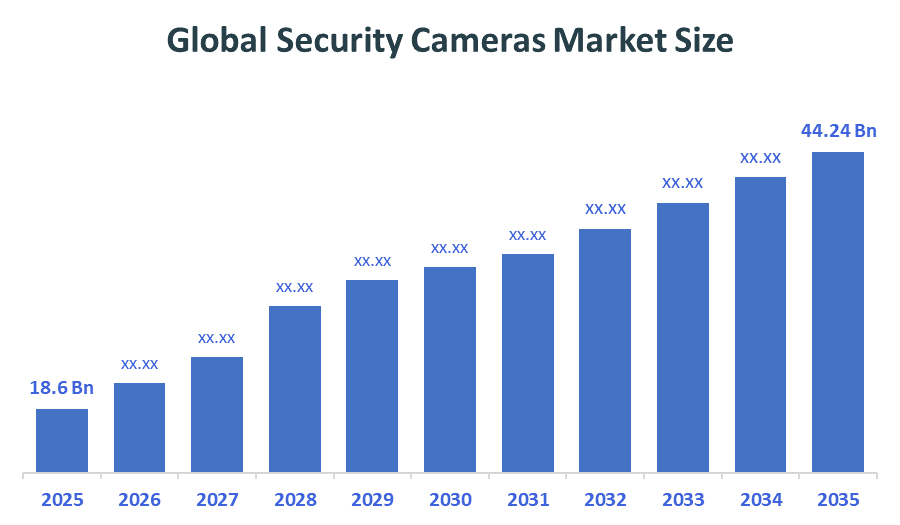
According to Decision Advisors, the Global Security Cameras Market Size is expected to grow from USD 18.6 billion in 2025 to USD 44.24 billion by 2035, at a CAGR of 9.05% during the forecast period 2026-2035. The global security cameras market develops because of the three factors which include fast AI system integration that provides advanced analytics and the expansion of smart home and city ecosystems and increasing crime rates and continuous technological development which includes 4K imaging and night vision and cloud-based surveillance systems that improve system performance and user adoption.
Market Overview/ Introduction
The security cameras function as surveillance systems which record and transmit video and audio data to enable immediate monitoring and analysis through their combination of IP-based and analog technologies and AI and infrared and cloud capabilities. The global security cameras market offers applications which protect assets in commercial and industrial facilities and enable remote monitoring of residential smart homes and support public safety and traffic control and perimeter security in government infrastructure across critical environments. The innovation in the global security cameras market has moved towards its development of autonomous systems that use artificial intelligence to perform real-time surveillance through their edge processing capabilities and 4K imaging technology. The system now achieves improved scalability through its integration with IoT devices and cloud platforms while blockchain technology and AR interfaces and drone-based monitoring systems create fresh possibilities. The market now provides growth opportunities through its demand for security services that focus on cybersecurity and need energy-efficient security products.
- In April 2024, India mandated STQC certification and Essential Requirements for CCTV cameras, impacting the global security cameras market by raising compliance thresholds. The move disrupts Chinese supply dominance and is expected to influence a USD 50+ billion global surveillance industry.
- In March 2025, the U.S. Department of Homeland Security allocated over USD 1.8 billion under Homeland Security Grant Programs, accelerating surveillance deployments and boosting demand, supporting expansion of the USD 50+ billion global security cameras market.
- In January 2025, FEMA allocated USD 274.5 million under the Nonprofit Security Grant Program, driving surveillance upgrades across high-risk infrastructure and reinforcing demand trends in the USD 50+ billion global security cameras market, particularly across North America.
Notable Insights: -
- Asia-Pacific holds the largest regional market share, approximately 42.3% in the global security cameras market.
- North America is the fastest growing region in the global security cameras market, because of the growing investments done for vital infrastructure security protection together with the implementation of AI-based surveillance systems and the rising federal budget allocations for innovative public safety technology
- By type, the Infrared (IR) segment held a dominant position with 57.5% in terms of market share in 2025.
- By application, Outdoor Systems segment is the dominating accounting for over 52.4% of the global market share in 2025.
- The compound annual growth rate of the global security cameras market is 9.05%.
- The market is likely to achieve a valuation of USD 44.24 billion by 2035.
What is role of technology in grooming the market?
The global security cameras market sees technology emerge as its main expansion driver because it transforms traditional monitoring into advanced network-based systems. The combination of artificial intelligence and deep learning technologies provides organizations with immediate analytical capabilities that include facial recognition and behavioural detection while needing less human input and delivering better accuracy results. The edge computing enables quicker device-level processing it decreases both latency and bandwidth expenses. The growth of virtual surveillance as a service (VSaaS) through cloud-based surveillance occurs because of the enterprises need digital space which can be accessed from any location. The combination of IoT systems with 5G networks enables security networks to achieve uninterrupted high-speed connections. The European Commission advanced the €7.5 billion Digital Europe Programme, funding AI, cybersecurity, and cloud infrastructure, indirectly accelerating innovation and supporting growth in the USD 45-50 billion global security cameras market.
How is Recent Developments Helping the Market?
The global security cameras market is experiencing rapid change because of technological innovation which uses AI analytics to enhance threat detection while decreasing false alarm rates. The installation expenses decrease through wireless and cloud-based systems, which combine with HD and infrared imaging to provide reliable 24/7 monitoring capabilities. The implementation of motion-triggered alerts together with deterrence systems establishes enhanced security results for both residential and commercial spaces. The U.S. Department of Homeland Security's Homeland Security Grant Program which provides over USD 1 billion every year for surveillance and critical infrastructure protection purposes serves as a main global policy driver which maintains ongoing demand in the worldwide security cameras market.
Market Drivers
The global security cameras are growing because of the increasing security needs and the development of new technologies. The residential and commercial and public infrastructure sectors experience heightened demand because of rising criminal and vandalism and terrorist activities. The AI-based surveillance solutions allow security systems to detect threats in real time while decreasing the need for human operators. The rising public safety concerns have become a major factor driving the market according to Japan which deployed more than 1000 security cameras and the government spent about ¥135 million 0.9 million USD to acquire these cameras for increasing the security of their emergency response systems. The growth of IoT-enabled smart homes drives the expansion of residential smart home adoption through user-friendly wireless systems that require no professional installation. The shift to IP and cloud-based systems enhances both system scalability and storage performance and enables users to access data from remote locations while edge computing technology reduces bandwidth usage and speeding up system response times through efficient data processing.
Restrain
The global security cameras market operates under permanent limitations which prevent its ability to meet existing high demand. The high initial expenses together with ongoing costs related to AI systems and high-definition systems hinder their implementation especially among users who prioritize their budget. The growing privacy issues combined with increasing government oversight on data collection methods create obstacles for organizations to implement their systems in urban surveillance operations. The IP-based cameras now face rising cybersecurity threats which allow hackers to access networks and utilize DDoS attacks, making users less secure about their system.
Competitive Analysis:
The report offers the appropriate analysis of the key organizations/companies involved within the security cameras market, along with a comparative evaluation primarily based on their product of offering, business overviews, geographic presence, enterprise strategies, segment market share, and SWOT analysis. The report also provides an elaborative analysis focusing on the current news and developments of the companies, which includes product development, innovations, joint ventures, partnerships, mergers & acquisitions, strategic alliances, and others. This allows for the evaluation of the overall competition within the market.
Top Companies in Global Security Cameras Market
- Hangzhou Hikvision Digital Technology Co., Ltd.
- Dahua Technology Co., Ltd.
- Axis Communications AB
- Bosch Security Systems GmbH
- Hanwha Vision Co., Ltd.
- Honeywell International Inc.
- Motorola Solutions, Inc.
- Zhejiang Uniview Technologies Co., Ltd.
- Teledyne FLIR LLC
- Panasonic Corporation
Government Initiatives
|
Country |
Key Government Initiatives |
|
India |
India’s Ministry of Electronics and Information Technology mandated STQC certification and Essential Requirements for CCTV cameras, impacting the USD 45-50 billion global security cameras market by increasing compliance costs and strengthening cybersecurity and quality standards globally. |
|
US |
In the United States, the USD 1.9 trillion American Rescue Plan enabled significant public safety funding, indirectly supporting surveillance infrastructure upgrades and reinforcing demand momentum within the global security cameras market. |
|
China |
In China, large-scale initiatives like Skynet and Sharp Eyes have driven deployment of 700+ million cameras, backed by investments exceeding USD 11 billion and broader smart surveillance spending nearing USD140 billion, significantly shaping the global security cameras market. |
Market Segmentation
The security cameras market share is classified into type, application, and professional service
- The infrared (IR) segment dominated the market in 2024 and is projected to grow at a substantial CAGR of approximately 57.5% during the forecast period.
Based on the type, the security cameras market is divided into infrared (IR), bullet, dome, and box. Among these, the Infrared (IR) segment dominated the market in 2024 and is projected to grow at a substantial CAGR of approximately 57.5% during the forecast period. It is because of the deployment of the system has been expanded to public infrastructure and transport networks and urban surveillance projects. The ongoing increase in investments for smart cities and perimeter security and critical infrastructure protection will maintain steady demand which will result in global market expansion.
- The outdoor systems segment accounted for the largest share in 2024 and is anticipated to grow at a significant CAGR of approximately 52.4% during the forecast period.
Based on the application, the security cameras market is divided into indoor, and outdoor. Among these, the Outdoor Systems segment accounted for the largest share in 2024 and is anticipated to grow at a significant CAGR of approximately 52.4% during the forecast period. It is dominating because the reliable system, low latency and stable signal transmission capabilities meet essential requirements for conducting large-scale live events.
- The installation segment dominated the market in 2024, and is projected to grow at a substantial CAGR during the forecast period.
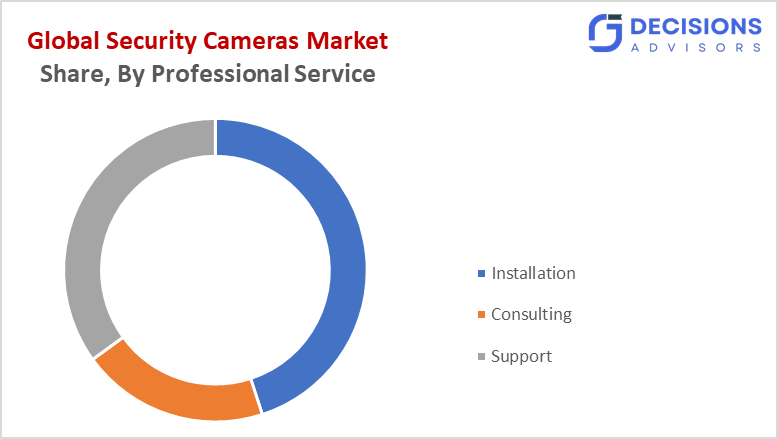
Based on the professional service, the security cameras market is divided into consulting, installation, and support. Among these, the Installation segment dominated the market in 2024, and is projected to grow at a substantial CAGR during the forecast period. The deployment process of large-scale surveillance systems contains multiple technical difficulties. The combination of network configuration work and system integration work requires expert installation staff to achieve peak system performance, system reliability, and system compliance requirements.
Strategies to Implement for Growth of the Market in Non-Leading Regions
Growth in non-leading regions of the security cameras market requires a calibrated mix of affordability, localisation, and ecosystem development. The vendors must develop affordable solutions which satisfy the needs of budget-conscious markets while using partnerships with local governments and infrastructure developers to expand their business operations. The companies need to establish strong distribution systems and effective post-sale support services to gain customer trust in markets with multiple options. Companies can achieve rapid adoption through the use of cloud-based and wireless technologies which help them overcome existing infrastructure obstacles. In the Safety awareness campaigns and smart surveillance education together with adjustable payment systems will help emerging markets achieve better penetration results and create sustained future demand.
Regional Segment Analysis of the Security Cameras Market
- North America (U.S., Canada, Mexico)
- Europe (Germany, France, U.K., Italy, Spain, Rest of Europe)
- Asia-Pacific (China, Japan, India, Rest of APAC)
- South America (Brazil and the Rest of South America)
- The Middle East and Africa (UAE, South Africa, Rest of MEA)
Asia-Pacific is anticipated to hold the largest share of the Security Cameras Market over the predicted timeframe. Asia-Pacific is anticipated to hold the largest share of the global security cameras market, accounting for approximately 42.3% of total revenue over the forecast period. The scale, policy implementation, and economic cost analysis work together to create a single point of intersection between their respective domains. The countries like China and India require complete surveillance systems to monitor their transportation networks and residential areas and public infrastructure because of their growing urban populations and their expanding metropolitan areas. The governments are deploying video analytics systems inside their smart city frameworks while they purchase equipment at record-breaking levels. The region maintains its manufacturing strength which enables companies to produce goods at lower expenses while they can quickly scale their operations.
North America is expected to grow at a rapid CAGR in the Security Cameras Market during the forecast period. The North America market will experience fast growth because it accounts for approximately 8.3% of the global security cameras market. It is because of safety expenditures together with fast deployment of artificial intelligence surveillance systems and strict legal requirements. The United States and Canada experience increased infrastructure protection requirements which drive the implementation of new technological systems.
Europe is the 3rd largest region to grow in the Security Cameras Market during the region. The Europe region stands as the third biggest area global for the Security Cameras Market since it holds approximately 22.9% market, it is because of regulatory-driven adoption and mature infrastructure landscape. The global security requirements together with the strict data protection regulations. The countries such as Germany and United Kingdom enforce have created an ongoing demand for advanced surveillance systems which meet compliance standards.
Future Market Trends in Global Security Cameras Market: -
- Cloud-Native Surveillance Expansion
The enterprises now prefer cloud-based surveillance systems because they provide better opportunities for expansion and remote monitoring capabilities. The Video Surveillance as a Service (VSaaS) system allows users to store video content flexibly while accessing it in real time, which decreases their need for physical facilities and helps security systems adapt to their organization's digital transformation efforts.
- AI-Led Surveillance Evolution
The artificial intelligence has transformed surveillance methods from their original function as passive recording systems into advanced predictive intelligence systems. Security systems now function as active risk management systems because their advanced camera systems can conduct behavioural analysis and anomaly detection and real-time decision-making processes across commercial and public infrastructure.
- Rising Demand for Privacy-First Technologies
The manufacturers are developing privacy-focused technologies which include data anonymization and encryption and secure storage solutions because regulatory authorities are increasing their inspection activities. The need to comply with changing international data protection regulations has become a key factor that determines how companies develop their products and market them across different countries.
Recent Development
- In March 2026, India enforced strict CCTV certification norms, effectively restricting Chinese-linked imports, alongside surveillance investments exceeding ?10,000 crores, reshaping supply chains and strengthening domestic manufacturing within the global security cameras market.
- In September 2024, Seoul allocated KRW 51.2 billion for AI-enabled CCTV deployment, accelerating smart surveillance adoption and reinforcing government-driven demand trends in the global security cameras market.
- In April 2024, Axis Communications launched Axis Cloud Connect, amid industry cloud and AI surveillance investments exceeding $5 billion annually, accelerating scalable deployment and digital transformation across the global security cameras market.
- In March 2024, India advanced the PLI scheme, attracting ?1.7 lakh crore investments, boosting local surveillance manufacturing and reducing import dependence, thereby influencing supply dynamics in the global security cameras market.
Market Segment
This study forecasts revenue at global, regional, and country levels from 2020 to 2035. Decision Advisors has segmented the security cameras market based on the below-mentioned segments:
Global Security Cameras Market, By Type
- Infrared (IR)
- Bullet
- Dome
- Box
Global Security Cameras Market, By Application
- Indoor
- Outdoor
Global Security Cameras Market, By Professional Service
- Consulting
- Installation
- Support
Global Security Cameras Market, By Regional Analysis
- North America
- US
- Canada
- Mexico
- Europe
- Germany
- UK
- France
- Italy
- Spain
- Russia
- Rest of Europe
- Asia Pacific
- China
- Japan
- India
- South Korea
- Australia
- Rest of Asia Pacific
- South America
- Brazil
- Argentina
- Rest of South America
- Middle East & Africa
- UAE
- Saudi Arabia
- Qatar
- South Africa
- Rest of the Middle East & Africa
Frequently Asked Questions (FAQ)
Q. How is artificial intelligence reshaping the security cameras industry?
A. The security field undergoes transformation because artificial intelligence enables systems to monitor activities. The current analytics technology used in cameras allows the system to recognize patterns and detect unusual events, which leads to immediate warning systems. The implementation of AI systems for monitoring security operations eliminates the need for human guards while delivering enhanced accuracy, which makes these systems essential for today's security systems across various industries.
Q. Why are cloud-based surveillance systems gaining popularity?
A. The cloud-based surveillance shows increasing popularity because it offers both flexible system expansion and financial savings and remote system access. Businesses and homeowners can monitor systems in real time without heavy infrastructure investments. The system supports digital transformation by allowing users to store data flexibly and perform system upgrades easily and connect their systems with other business technologies.
Q. How is the shift to smart cities influencing the market?
A. The demand for advanced surveillance systems receives major growth from smart city initiatives. The installation of cameras into traffic management systems and law enforcement networks and public safety operations enables organizations to monitor events as they happen while making decisions based on collected information. The current urban environments of cities use camera systems as essential components of their main infrastructure.
Q. What is the future outlook for the global security cameras market?
A. The market will experience ongoing development because technological advancements keep creating new ways to use existing technologies. The combination of AI, edge computing, and IoT will create new surveillance systems, and increased security infrastructure funding will boost system development in both advanced and developing countries throughout the world.
Check Licence
Choose the plan that fits you best: Single User, Multi-User, or Enterprise solutions tailored for your needs.
We Have You Covered
- 24/7 Analyst Support
- Clients Across the Globe
- Tailored Insights
- Technology Tracking
- Competitive Intelligence
- Custom Research
- Syndicated Market Studies
- Market Overview
- Market Segmentation
- Growth Drivers
- Market Opportunities
- Regulatory Insights
- Innovation & Sustainability
Report Details
| Scope | Global |
| Pages | 230 |
| Delivery | PDF & Excel via Email |
| Language | English |
| Release | Apr 2026 |
| Access | Download from this page |