
Global Seed Market
 |
Author:
Sayali T
|
Pages:
210
|
Author:
Sayali T
|
Pages:
210
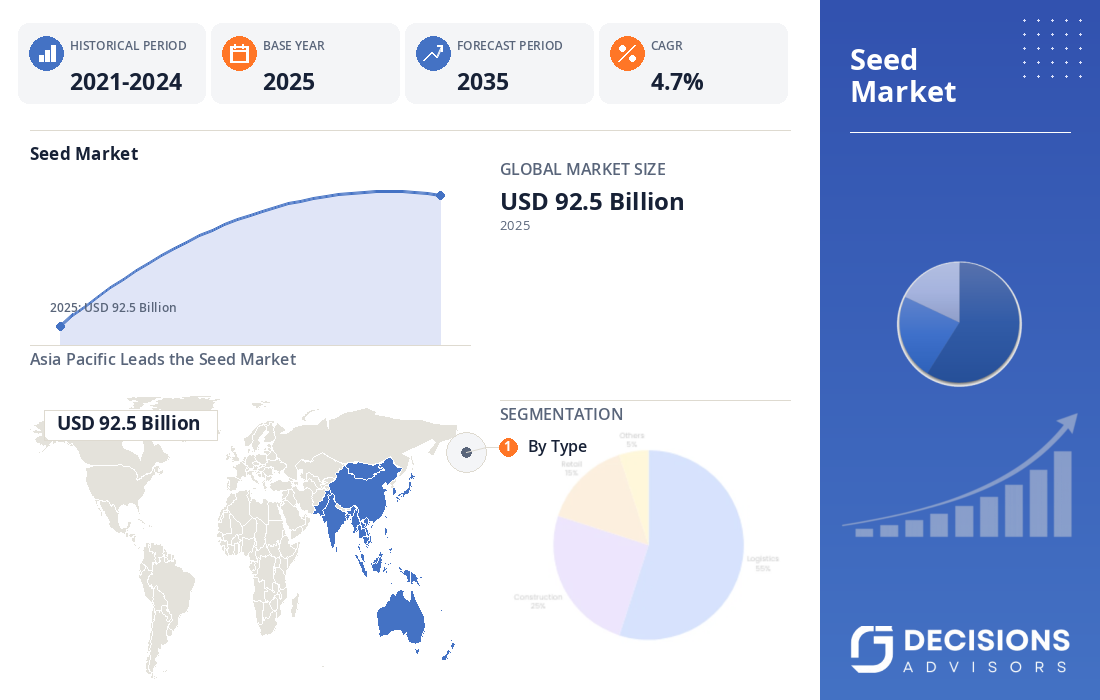
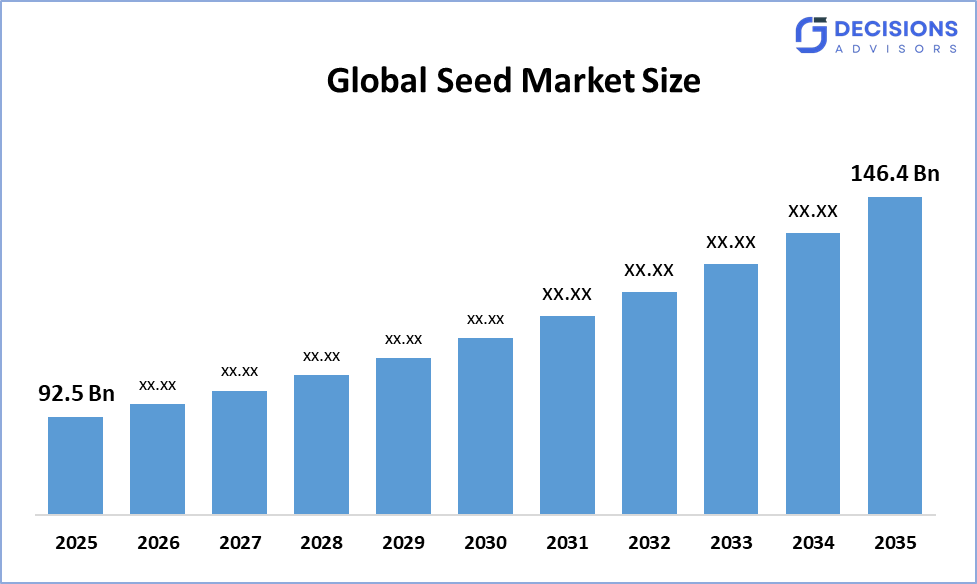
The report by Decision Advisors indicates that the Global Seed Market Size will experience notable growth from 2026 to 2035, with market USD 92.5 Billion in 2025 to USD 146.4 Billion by 2035 with a CAGR of 4.7%.
CAGR
4.7%
REVENUE 2025
USD Billion 92.5
FORECAST 2035
USD Billion 146.4
REPORT COVERAGE
Global
The Global Seed Market Size is predicted to grow from USD 92.5 Billion in 2025 and is likely to reach around USD 146.4 Billion by 2035 with a CAGR of 4.7%. According to Vantage Market Research, a detailed research report on the market reflects that the hybrid seed adoption trend dominates the Global Seed Market, accounting for approximately 36% of the total share worldwide. Bayer AG leads the market with a strong global seed and crop science portfolio and holds a leading global market share, making it the key contributor to global market development and growth dynamics.
Market Snapshot
- Global Seed Market Size (2025): USD 92.5 Billion
- Projected Global Seed Market Size (2035): USD 146.4 Billion
- Global Seed Market Compound Annual Growth Rate (CAGR): 4.7%
- Largest Regional Market: Asia Pacific
- 2nd Largest Region: North America
- Fastest Growing Region: Latin America
- Base Year: 2025
- Historical Period: 2021-2024
- Market Forecast Period: 2026-2035
Market Overview/ Introduction
The Global Seed Market refers to the industry engaged in the breeding, production, processing, and distribution of seeds used across cereals, oilseeds, fruits, vegetables, and specialty crops for commercial and subsistence agriculture. The market is experiencing steady growth because of rising global food security pressures, shrinking arable land per capita, and the growing need for farmers to extract higher yields from fixed acreage.Government programs like India’s National Mission on High-Yielding Seeds and the US Farmer Seed Liaison initiative and China’s Seed Industry Revitalization Action Plan are creating better conditions for domestic breeding self-reliance and seed supply chain security. Key companies, including Bayer AG, Corteva, Syngenta Group, BASF SE, and KWS SAAT are developing climate-resilient, high-yielding seed varieties that combine disease resistance with lower input intensity. The market provides farmers with products that combine higher yield stability, trait integration and improved climate adaptability. The global market will experience future expansion through the development of gene-edited seed technologies, precision agriculture-enabled seed selection, biofortified varieties, and digital seed distribution platforms.
- The EU’s Farm to Fork Strategy supports plant breeding innovation and sustainable seed certification standards, promoting the adoption of climate-resilient and biotech-enabled seed varieties across member states.
- Seed industry revitalization initiatives in China are driving the adoption of domestically bred hybrid and genetically modified seed varieties, supporting the development of a self-reliant, technology-driven agricultural seed supply chain.
Notable Insights: -
- Asia Pacific is anticipated to hold approximately 35% share of the Global Seed Market over the predicted timeframe.
- North America is expected to grow at a steady CAGR in the Global Seed Market by holding approximately 27% of the share during the forecast period.
- By type, the Hybrid Seeds segment dominated the market and holds approximately 36% share in 2025 and is projected to grow at a substantial CAGR during the forecast period.
- By crop, the Cereals & Grains segment dominated the market and holds approximately 41% share in 2025 and is projected to grow at a substantial CAGR during the forecast period.
- The compound annual growth rate of the Global Seed Market is 4.7%.
- The market is likely to achieve a valuation of USD 146.4 Billion by 2035.
Market Drivers
The Global Seed Market experiences growth because rising global population and shrinking arable land are pushing farmers to adopt higher-yielding hybrid and genetically enhanced seed varieties. Climate volatility, including unpredictable rainfall, heat stress, and soil degradation, is accelerating demand for drought-tolerant and disease-resistant seed formats. The expansion of industrial and biofuel crop applications for corn, soybean, and oilseeds is tightening supply-demand balances and increasing seed yield optimization requirements. The agriculture sector shows increasing demand because of the rising adoption of precision farming and data-driven planting strategies. The market expands because regulatory frameworks governing seed certification, traceability, and intellectual property protection are consolidating demand around organized, compliant suppliers.
Restrain
The Global Seed Market faces challenges such as high research and development expenditure and extended regulatory approval timelines for biosafety certification of genetically modified varieties. Climate-induced crop failures during seed multiplication phases and intense price competition within conventional seed segments also increase operational and margin pressure for suppliers.
Competitive Analysis:
The report offers the appropriate analysis of the key organizations/companies involved within the Global Seed Market along with a comparative evaluation primarily based on their product offerings, business overviews, geographic presence, enterprise strategies, segment market share, and SWOT analysis. The report also provides an elaborative analysis focusing on the current news and developments of the companies, which includes product development, innovations, joint ventures, partnerships, mergers & acquisitions, strategic alliances, and others. This allows for the evaluation of the overall competition within the market.
Top Companies in the Global Seed Market
- Bayer AG
- Corteva, Inc.
- Syngenta Group
- BASF SE
- Groupe Limagrain Holding
- KWS SAAT SE & Co. KGaA
- FMC Corporation
- Takii & Co., Ltd.
- Sakata Seed Corporation
- DLF Seeds A/S
Government Initiatives
|
Country |
Key Government Initiatives |
|
US |
The U.S. government, through the USDA Farmer Seed Liaison initiative, supports transparency and access to the starting materials plant breeders need, driving innovation in advanced breeding systems and enhancing development of next-generation, competitive commercial seed varieties. |
|
India |
The Union Budget 2025 National Mission on High-Yielding Seeds, alongside the National Food Security Mission, subsidizes up to 50-75% of certified seed costs for rice, wheat, pulses, and oilseeds, driving the adoption of advanced sensing technologies, including improving seed availability, reducing import dependency, and boosting domestic seed production. |
|
China |
Policies focusing on the Seed Industry Revitalization Action Plan, phased GM corn and soybean variety registration, and “Made in China 2025” are driving innovation and increasing the adoption of domestically bred hybrid and biotech seed technologies across agricultural applications. |
Market Segmentation
The Global Seed Market share is classified into type, crop and farming method
- The Hybrid Seeds segment dominated the market and holds approximately 36% share in 2025 and is projected to grow at a substantial CAGR during the forecast period.
Based on the type of seed, the Global Seed Market is divided into Hybrid Seeds, Conventional/Open-Pollinated Seeds, Genetically Modified (GM) Seeds, Organic Seeds, and Others. Among these, the Hybrid Seeds segment dominates the market and holds approximately 36% share in 2025. This dominance is due to superior yield consistency, strong trait integration, and wide compatibility with modern high-density planting systems. These seeds are widely used in maize, rice, vegetables, and oilseed cultivation, making them the most preferred choice across large-scale commercial farming operations globally.
- The Cereals & Grains segment accounted for the largest share of approximately 41% in 2025 and is anticipated to grow at a significant CAGR during the forecast period.
Based on the crop, the market is divided into Cereals & Grains, Oilseeds, Fruits & Vegetables, and Others. Among these, Cereals & Grains accounted for the largest share and holds approximately 41% share in 2025. This dominance is due to rising staple food demand, expanding feed requirements, and large-scale cultivation of wheat, rice, and maize. Increasing adoption of hybrid and climate-resilient varieties further supports segment growth, making cereals and grains the primary revenue contributor in the Global Seed Market.
- The Conventional Farming segment accounted for the largest share of approximately 58% in 2025 and is anticipated to grow at a significant CAGR during the forecast period.
Based on farming method, the market is divided into Conventional, Organic, Precision Agriculture, and Controlled Environment. Among these, Conventional Farming dominates the market and holds approximately 58% share in 2025. This dominance is due to widespread infrastructure readiness, established distribution networks, and scale advantages across large-acreage farms. Growing adoption of certified seeds and integrated nutrient management practices make conventional farming systems essential for global seed demand, driving strong adoption across multiple crop categories.
Regional Segment Analysis of the Global Seed Market
- North America (U.S., Canada, Mexico)?
- Europe (Germany, France, U.K., Italy, Spain, Rest of Europe)
- Asia-Pacific (China, Japan, India, Rest of APAC)
- South America (Brazil and the Rest of South America)?
- The Middle East and Africa (UAE, South Africa, Rest of MEA)
Asia Pacific is anticipated to hold approximately 35% share of the Global Seed Market over the predicted timeframe.
Asia Pacific holds approximately 35% share of the Global Seed Market due to large-scale cereal cultivation, accelerating hybrid seed penetration, and strong smallholder-to-commercial farming transitions across China, India, and Southeast Asia. The region benefits from the presence of major domestic and multinational seed companies, which support continuous innovation in breeding and germplasm development. High adoption of certified seeds, government-backed subsidy programs, and expanding irrigation infrastructure further strengthen market growth. Additionally, rising food security priorities and rapid modernization of agricultural value chains contribute to sustained demand. The region also plays a key role in oilseed and horticultural seed cultivation, with increasing integration of hybrid and biotech varieties across diverse agro-climatic zones.
North America is expected to grow at a steady CAGR in the Global Seed Market, holding approximately 27% of the share during the forecast period
North America is expected to grow at a steady CAGR in the Global Seed Market, holding approximately 27% share during the forecast period due to strong demand from large-acreage cereal, oilseed, and specialty crop production. The region benefits from the presence of leading seed and agri-biotechnology companies, which drive continuous innovation in trait-stacked and precision-bred seed varieties. High adoption of genetically modified seeds, advanced farm management systems, and data-driven planting strategies further supports market expansion. Additionally, the growing integration of climate-resilient hybrids in corn, soybean, and wheat cultivation contributes to sustained demand across the region, strengthening North America’s position in the global market.
Latin America is the fastest-growing region in the Global Seed Market during the period, holding approximately 14% share.
Latin America is the fastest-growing region in the Global Seed Market during the forecast period, holding approximately 14% share due to rapid expansion of soybean, corn, and cotton acreage across Brazil and Argentina. The region benefits from increasing adoption of genetically modified and hybrid seed varieties, which widely support higher yields and reduced input intensity. Additionally, growing investment in seed processing infrastructure is encouraging the use of high-performance, region-adapted seed technologies. Growing demand for double and triple cropping systems, along with expanding export-oriented commercial agriculture, further supports market expansion. Continuous investment in breeding programs and germplasm development across countries such as Brazil and Argentina are accelerating the adoption of advanced seed solutions across multiple crop categories.
Future Market Trends in Global Seed Market: -
-
- Expansion of Climate-Resilient and Drought-Tolerant Seed Varieties
Climate-resilient seeds are increasingly bred to withstand heat stress, irregular rainfall, and soil degradation, helping farmers maintain yield stability under adverse growing conditions. These varieties reduce crop loss risk, support sustainable input use, and lower reliance on saved or informal seed. Growing climate volatility across staple-crop growing regions is accelerating adoption globally.
-
- AI and Genomic Selection in Breeding Programs
AI-integrated genomic selection enhances breeding accuracy by predicting trait performance, disease resistance, and yield potential earlier in the development cycle. It shortens breeding timelines, reduces field-trial costs, and personalizes variety development for region-specific stress conditions. This trend is driving faster, more precise seed innovation worldwide.
-
- Growth in Biotech and Gene-Edited (CRISPR) Seed Adoption
Seed developers are increasingly using CRISPR and other gene-editing tools to accelerate trait development beyond traditional genetic modification frameworks. These techniques enable faster regulatory pathways in several markets, improved pest and herbicide resistance, and enhanced nutritional profiles. Rising biotech investment and expanding regulatory acceptance are significantly boosting this trend globally.
-
- Rising Demand for Organic and Non-GMO Seeds
Organic and non-GMO seeds are gaining traction as consumers and regulators favor chemical-free, traceable food production systems. Their low residual chemical footprint and compatibility with certified organic farming make them ideal for premium horticultural and specialty crop segments. Growing organic farming adoption is accelerating market expansion globally.
Recent Development
- In March 2025, Bayer’s Crop Science division launched Vyconic soybeans, a trait technology offering tolerance to five herbicides in a single variety, enhancing weed control flexibility and yield potential for soybean growers.
- In October 2025, Corteva announced plans to separate its Seed business from its Crop Protection business into a standalone, publicly traded company, a structural shift expected to alter competitive dynamics and investor focus within the Global Seed Market.
- In February 2026, Syngenta Group advanced plans for a large-scale Hong Kong IPO targeting up to USD 10 billion in capital to deleverage its balance sheet and accelerate R&D and acquisition strategies, highlighting growing capital-market activity within the global seed industry.
Market Segment
This study forecasts revenue at global, regional, and country levels from 2020 to 2035. Decision Advisors has segmented the Global Seed Market based on the below-mentioned segments:
Global Seed Market, By Type
- Hybrid Seeds
- Conventional/Open-Pollinated Seeds
- Genetically Modified (GM) Seeds
- Organic Seeds
- Others
Global Seed Market, By Crop
- Cereals & Grains
- Oilseeds
- Fruits & Vegetables
- Forage & Turf
- Others
Global Seed Market, By Farming Method
- Conventional
- Organic
- Precision Agriculture
- Controlled Environment
Global Seed Market, By Regional Analysis
- North America
- US
- Canada
- Mexico
- Europe
- Germany
- UK
- France
- Italy
- Spain
- Russia
- Rest of Europe
- Asia Pacific
- China
- Japan
- India
- South Korea
- Australia
- Rest of Asia Pacific
- South America
- Brazil
- Argentina
- Rest of South America
- Middle East & Africa
- UAE
- Saudi Arabia
- Qatar
- South Africa
- Rest of the Middle East & Africa
Frequently Asked Questions (FAQ)
Q. How are climate-resilient seed varieties transforming crop productivity?
A. Climate-resilient seed varieties help crops withstand heat stress, irregular rainfall, and soil degradation, allowing farmers to maintain stable yields, reduce crop-loss risk, and improve long-term productivity under changing weather conditions.
Q. Why are hybrid seeds preferred over conventional open-pollinated seeds?
A. They offer higher yield consistency, stronger trait integration, and better resistance to pests and disease, making them more suitable for modern large-scale and commercial farming operations.
Q. What role do certified seeds play in reducing crop losses?
A. They ensure genetic purity, higher germination rates, and freedom from seed-borne diseases, enabling early fault detection and reducing yield losses across commercial and smallholder farming systems.
Q. How is biotechnology influencing seed industry development?
A. Advances in gene editing, trait stacking, and genomic selection are enabling faster breeding cycles, more precise, disease-resistant, and climate-adapted seed varieties across cereal, oilseed, and horticultural crops.
Check Licence
Choose the plan that fits you best: Single User, Multi-User, or Enterprise solutions tailored for your needs.
We Have You Covered
- 24/7 Analyst Support
- Clients Across the Globe
- Tailored Insights
- Technology Tracking
- Competitive Intelligence
- Custom Research
- Syndicated Market Studies
- Market Overview
- Market Segmentation
- Growth Drivers
- Market Opportunities
- Regulatory Insights
- Innovation & Sustainability
Report Details
| Scope | Global |
| Pages | 210 |
| Delivery | PDF & Excel via Email |
| Language | English |
| Release | Aug 2026 |
| Access | Download from this page |