
Global Self-Cleaning Bottles Market
 |
Author:
Rahul B
|
Pages:
210
|
Author:
Rahul B
|
Pages:
210
Global Self-Cleaning Bottles Market Size, Share, By Technology (UV-C LED Sterilization Bottles and Electrolytic Self-Cleaning Bottles) By Material Type (Stainless Steel Bottles, Plastic Bottles, and Glass Bottles) By Distribution Channel (Online Retail, Supermarkets and Hypermarkets, and Specialty Stores) By End User (Personal Use, Travel and Outdoor Enthusiasts, and Sports and Fitness Users) By Region (North America, Europe, Asia-Pacific, Latin America, Middle East, and Africa), Analysis and Forecast 2026 ? 2035
CAGR
8.21%
REVENUE 2025
USD Million 175.4
FORECAST 2035
USD Million 385.98
REPORT COVERAGE
Global
Market Snapshot
- Market Size (2025): USD 175.40 Million
- Market Size (2035): USD 385.98 Million
- Compound Annual Growth Rate (CAGR): 8.21%
- Largest Regional Market: North America
- Fastest Growing Region: Asia-Pacific
- 3rd Largest Region: Europe
- Base Year: 2025
- Historical Period: 2020–2024
- Forecast Period: 2026–2035
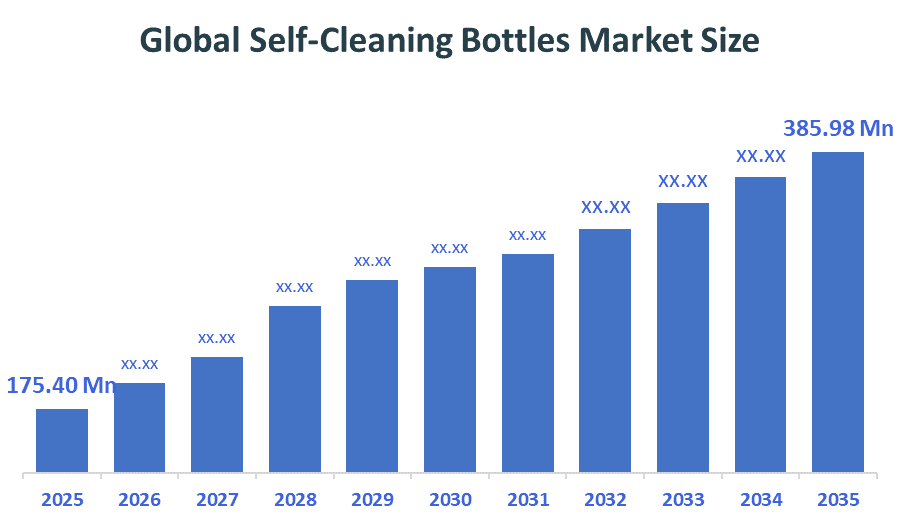
According to Decision Advisors, the Global Self-Cleaning Bottles Market size is expected to grow from USD 175.40 million in 2026 to USD 385.98 million by 2035, with a CAGR of 8.21% during the forecast period from 2026 to 2035. The market for the industry is also expected to grow significantly with the development and integration of next-generation technologies in the field of portable water purification. The growth in the market has been attributed to the demand for chemical-free sanitation and the adoption of UV-C LED technology in high-performance hydration devices. Innovations in the field of photonics and battery efficiency have also played a significant role in the development and growth of the industry.
Market Overview/ Introduction
The growing focus on guaranteeing hygiene in daily hydration and effective germ elimination, especially in travel and fitness sectors, is a primary driver for the global self-cleaning bottles market. The term self-cleaning bottles refers to advanced hydration vessels that utilise UV-C light technology, a specific wavelength of ultraviolet radiation with germicidal properties, to neutralise bacteria and viruses without manual scrubbing. From their initial entry as niche outdoor gear, these bottles have evolved into highly sophisticated lifestyle accessories characterised by medical-grade stainless steel construction, long-lasting battery life, and the ability to eliminate 99.99% of harmful pathogens. Self-cleaning bottles play a crucial role in ensuring consistent water safety in various settings, where commuters and adventurers use this technology to achieve superior sterilisation and better odour control compared to traditional reusable bottles. The increasing emphasis placed on sustainability and the reduction of single-use plastics has led to the integration of smart sensors that offer greater convenience in challenging environments, such as remote hiking trails, international travel, and daily office use.
- North America holds a commanding share of more than 35% of global revenue, a position sustained by high consumer interest in luxury wellness technology and a deep-rooted culture of outdoor adventure.
- Stainless steel models currently dominate the product landscape, accounting for over 70% of the market share. This preference is driven by the durability of the material and its ability to maintain water temperature, making these self-sanitising vessels a staple for fitness enthusiasts and professionals who prioritise chemical-free purification and long-term product value.
- Heightened hygiene awareness and the urgent move away from single-use plastics are significant growth catalysts. As consumers seek sustainable alternatives, the demand for high-performance antimicrobial materials has surged, leading to the widespread adoption of automated bottles capable of neutralizing 99.9% of bacteria and viruses without manual scrubbing.
Notable Insights: -
- Technological efficiency has improved significantly in 2026. Next-generation UV-C LED modules now achieve a 99.99% pathogen elimination rate in just 60 to 180 seconds, compared to the 5-minute cycles of earlier models. These advanced modules are also 30% more energy-efficient, extending battery life to over 30 days on a single charge.
- Stainless steel remains the preferred material, projected to account for 73.68% of the market share by 2034. This is driven by its ability to house delicate electronics safely while offering superior vacuum insulation, keeping beverages cold for 24 hours, which is a top-tier requirement for 85% of premium bottle buyers.
- Self-cleaning bottles are no longer standalone gadgets; they are becoming core components of digital health. Recent trends show that user engagement with hydration apps increases by 60% when synced with wearable fitness trackers, leading to a 25% higher customer retention rate for brands offering Smart Hydration ecosystems.
- In the fitness niche, there is a notable shift toward corporate and medical use. Over 40% of Fortune 500 companies now include reusable bottle programs in their sustainability reports. Hospitals are also adopting UV-C bottles to ensure sterile hydration for staff and patients, reducing the risk of cross-contamination in clinical settings.
- 60% of consumers prioritise eco-friendly products, and the market is successfully positioning self-cleaning technology as the ultimate solution to single-use plastic. This sustainable-tech crossover is fuelling a robust CAGR of 8.21%, as the industry moves toward a projected value of USD 385.98 Million by 2035.
What is the role of technology in shaping the market?
Technology is significantly impacting the self-cleaning bottles market as it is enhancing the hygiene, convenience, and functional reliability of reusable hydration vessels. The purification unit is not an ordinary filtration system, it is a highly integrated unit with UV-C LED technology that can be used with high-efficiency sterilisation protocols while being compatible with durable stainless-steel designs. It is in this way that engineers and researchers have been able to simplify the process of maintaining a germ-free bottle while reducing the need for manual scrubbing, while being accurate in neutralizing 99.99% of bacteria and viruses, while functioning in various environments, ranging from remote hiking trails to urban office settings.
How are Recent Developments Helping the Market?
Recent trends like constant material innovations, the inclusion of smart hydration tracking, and the development of high-capacity battery systems are driving the self-cleaning bottles market. The manufacturers of self-sanitising containers are introducing new models with programmable cleaning cycles, vacuum-sealed insulation, and solar-charging capabilities. The recent trend of using app-connected wellness ecosystems and wearable health devices is creating the need for the integration of self-cleaning bottles with AI-based hydration monitoring technologies. These advancements ensure that the water remains fresh and the vessel stays odour-free without the use of harsh chemicals or complex maintenance routines.
Market Drivers
The Global Self-Cleaning Bottles Market is expanding as technology providers are investing in advanced UV-C LED solutions for improving microbial elimination speed. The latest sterilisation technology is highly preferred for its ability to integrate various features into a single device, including its ability to clean water in under 60 seconds, prevent biofilm build-up, and offer long-lasting portability. North America has dominated the smart hydration market in recent years and is expected to have a significant market share in 2026 due to its high adoption rate for premium wellness gadgets and a robust culture of fitness and outdoor recreation. In addition, the increasing trend of miniaturised electronics among consumers is driving the demand for advanced technology for improving the functionality and user experience of automated cleaning features.
Restraints
The self-cleaning bottles market is limited by the high cost of advanced UV-C LED components and specialised electronic integration, which is beyond the means of price-sensitive consumer segments. Additional costs incurred due to the high-grade material requirements and moisture-proof sealing add to the cost burden. This premium pricing structure can slow the adoption rate in emerging markets where traditional reusable bottles remain the dominant choice.
Competitive Analysis:
The report offers the appropriate analysis of the key organisations/companies involved within the self-cleaning bottles market, along with a comparative evaluation primarily based on their product offerings, business overviews, geographic presence, enterprise strategies, segment market share, and SWOT analysis. The report also provides an elaborate analysis focusing on the current news and developments of the companies, which includes product development, innovations, joint ventures, partnerships, mergers & acquisitions, strategic alliances, and others. This allows for the evaluation of the overall competition within the market.
Top 10 Companies in the Self-Cleaning Bottles Market
- LARQ (The BRITA Group)
- CrazyCap (WAATR)
- Mahaton
- NOERDEN
- Philips Water (AquaShield)
- Grayl Inc.
- CamelBak (Vista Outdoor)
- S'well (Lifetime Brands)
- HidrateSpark
- Auron Bottle
Government Initiatives
|
Country |
Key Government Initiatives |
|
US |
In the USA, high-performance sustainable hydration is promoted by the Department of the Interior through Secretary's Order 3407, which aims at phasing out single-use plastics on Department-managed lands by 2032. Recent research indicates that a mere shift of 13% of single-use plastics to reusable metal or glass alternatives would result in a 12% reduction of plastics and a taxpayer benefit of over $1 billion annually. |
|
China |
In China, the Plastic Pollution Control Action Plan (2021-2026) and the 14th Five-Year Plan emphasise the development of a circular economy. The government has made a binding plan to achieve a reduction in the intensity of 13.5% in energy and 18% in CO2 by 2026. The country’s policies have already achieved a 90% coverage of waste management in rural areas and the establishment of more than 3,000 recycling outlets. |
|
European Union |
In the European Union, the Single-Use Plastics (SUP) Directive is intended to result in a 77% separate collection rate for plastic bottles by 2026, growing to 90% by 2029. The EU has also made it mandatory for PET drink bottles to contain at least 25% recycled content by 2026. With a budget of EUR 1 billion under the Quantum Technologies Flagship and Horizon Europe programme. |
Study on the Supply, Demand, Distribution, and Market Environment
The self-cleaning bottles market is affected by the interplay of supply, demand, distribution, and the general market environment. In terms of supply, the focus of manufacturers has been on developing technologically advanced and cost-effective UV-C LED sterilisation units for the changing needs of wellness and outdoor professionals. In terms of demand, the self-cleaning bottles market has seen growth due to the increasing incorporation of high-performance hygiene sensors in consumer goods, the increasing occurrence of sustainable practices in daily hydration, and the increasing recognition of the potential of automated purification for microbial safety. In terms of distribution, the self-cleaning bottles market has seen a combination of direct-to-consumer (D2C) online sales, high-end lifestyle retailers, and specialised fitness platforms, which have enhanced the accessibility of the product in both developed urban centres and emerging health-conscious markets.
Price Analysis and Consumer Behaviour Analysis
Pricing in the self-cleaning bottles market differs depending on the materials and technology used in the product. The advanced purification vessels with medical-grade 316L stainless steel and rapid 60-second sterilisation cycles tend to be more expensive compared to standard insulated bottles or basic filtered models. The main consumer behaviours in the self-cleaning bottles market are determined by several key elements such as germicidal efficiency, battery longevity, ease of integration into digital health ecosystems, and maintenance-free operation.
Market Segmentation
The Global Self-Cleaning Bottles Market share is classified into technology, material type, distribution channel, and end user.
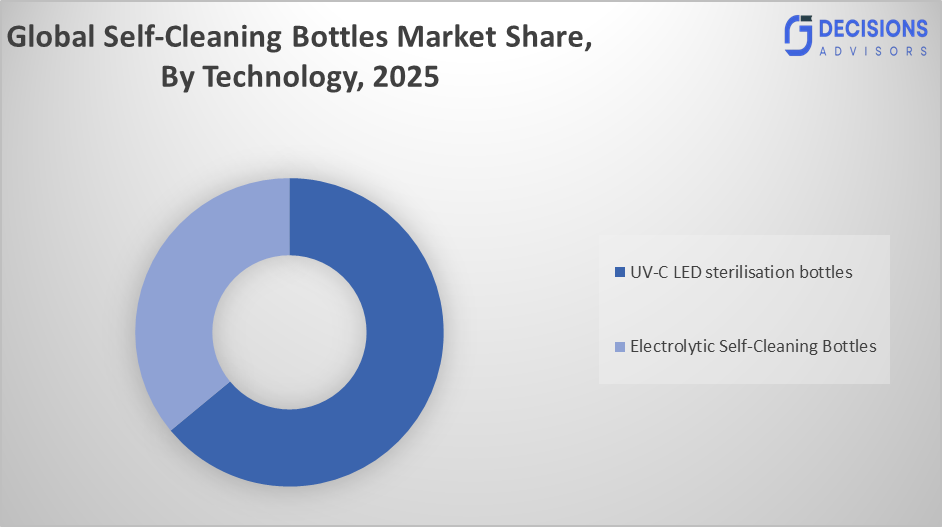
UV-C LED sterilisation bottles dominate the global self-cleaning bottles market, accounting for approximately 64% of the total market share in 2026.
Based on technology, the market is segmented into UV-C LED sterilisation bottles and electrolytic self-cleaning bottles. UV-C LED sterilisation bottles dominate the global self-cleaning bottles market, accounting for approximately 64% of the total market share in 2026. The UV-C LED segment dominated the market in 2024 and is expected to grow at a steady CAGR of around 8.5% during the forecast period.
Stainless steel bottles hold the largest share, contributing approximately 74% of the market in 2026.
Based on material type, the self-cleaning bottles market is segmented into stainless steel bottles, plastic bottles, and glass bottles. Stainless steel bottles hold the largest share, contributing approximately 74% of the market in 2026. The stainless-steel segment dominates due to its superior durability, vacuum insulation properties, and established manufacturing processes compared to fragile or less sustainable alternatives. These materials provide better protection for internal electronic components and better integration with premium lifestyle branding. Therefore, they are highly favoured in the present high-performance hydration application.
Online retail accounts for the largest share, representing over 63% of the global market in 2026.
Based on distribution channel, the market is categorised into online retail, supermarkets and hypermarkets, and speciality stores. Online retail accounts for the largest share, representing over 63% of the global market in 2026. Online retail leads the market as these platforms use a large number of direct-to-consumer (D2C) strategies, digital marketing campaigns, and subscription models requiring highly accessible purchasing routes.
Travel and outdoor enthusiasts represent the dominant end-user segment, accounting for approximately 45% of the market share.
Based on end user, the market is segmented into personal use, travel and outdoor enthusiasts, and sports and fitness users. Travel and outdoor enthusiasts represent the dominant end-user segment, accounting for approximately 45% of the market share. Travel and outdoor enthusiasts dominate the market due to the critical need for portable water purification in environments where clean water access is limited.
Strategies to Implement for Growth of the Market in Non-Leading Regions
The development of the self-cleaning bottles market in non-leading regions can be enhanced by employing measures that promote these products’ affordability and technical as well as infrastructural viability. One of the most effective measures is promoting cost-effective sterilisation units targeting middle-income consumers and fitness enthusiasts with limited budgets. Enhancing health and wellness grants, as well as government-backed sustainability schemes, can also promote the development and use of UV-C LED technology in non-leading consumer markets. Moreover, investing in public awareness campaigns regarding waterborne pathogens as well as specialised retail training is vital for ensuring that technical staff can efficiently explain the benefits of these advanced vessels to local customers.
Regional Segment Analysis of the Self-Cleaning Bottles Market
- North America (U.S., Canada, Mexico)
- Europe (Germany, France, U.K., Italy, Spain, Rest of Europe)
- Asia-Pacific (China, Japan, India, South Korea, Rest of APAC)
- Latin America (Brazil and the Rest of Latin America)
- The Middle East and Africa (UAE, South Africa, Rest of MEA)
North America is expected to hold the largest share of the self-cleaning bottles market during the forecast period. The region accounts for approximately 35% of the global revenue share, supported by a highly advanced wellness infrastructure and strong adoption of smart hydration equipment in the fitness and outdoor recreation sectors. The United States contributes the majority of this regional revenue due to high consumer expenditure on premium health technology, which exceeds several billion dollars annually, along with a large number of well-established e-commerce fulfilment centres.
Asia-Pacific is projected to be the fastest-growing region in the self-cleaning bottles market over the forecast period. The region is expected to grow at a CAGR of approximately 10.5% while accounting for approximately 28% of the global market share. This growth is driven by improving urban infrastructure, rising demand for next-generation lifestyle gadgets, and a rapidly expanding middle class in countries such as China, South Korea, and India. Increasing investments in smart home technology, government environmental initiatives, and a massive consumer base for wellness products are also contributing to higher demand for advanced and durable hydration tools, particularly in major metropolitan corridors.
Europe is anticipated to hold the third-largest share in the self-cleaning bottles market, contributing approximately 22% of the global market share. The region maintains a strong position due to well-established sustainability movements and consistent investment in eco-friendly product research. Countries such as Germany, France, and the United Kingdom play a key role due to high awareness of plastic reduction and the implementation of strict environmental regulations favouring long-lasting, reusable alternatives.
Future Market Trends in the Self-Cleaning Bottles Market
1. Integration of Smart Hydration Ecosystems and AI
The industry is undergoing a significant transition from passive containers to AI-driven wellness companions. Modern self-cleaning bottles are increasingly equipped with Bluetooth connectivity and integrated sensors that sync seamlessly with wearable fitness trackers and health applications. These smart units analyse individual physiology, local temperature, and activity levels to provide personalised hydration nudges. Research indicates that this level of digital engagement can improve consistent water intake by approximately 25%, transforming the bottle into a core component of a user’s digital health ecosystem.
2. Technological Breakthroughs in UV-C Sterilisation Speed
A primary trend for the 2026–2035 forecast period is the dramatic reduction in purification cycle times. Next-generation UV-C LED modules have evolved to neutralize 99.99% of bacteria and viruses in as little as 60 to 180 seconds, a vast improvement over the 5-minute cycles of earlier models. Furthermore, these advanced semiconductor-based modules are 30% more energy-efficient, allowing a single USB-C charge to power the device for over 30 days.
3. Expansion of Eco-Tech and Sustainable Materials in Emerging Markets
As global environmental regulations tighten, there is a massive shift toward Sustainable-Tech in rapidly developing regions like the Asia-Pacific. Driven by stringent bans on single-use plastics and rising middle-class health awareness, this region is projected to experience a robust CAGR of 10.5%. Manufacturers are prioritising medical-grade 316L stainless steel and mercury-free LED components to meet the demands of the eco-conscious consumer. This trend is further supported by corporate sustainability programs, with over 40% of Fortune 500 companies now integrating reusable bottle initiatives into their workplace wellness and environmental reports.
Recent Developments
- In January 2024, the company announced the expansion of its UV-C purification bottle with increased energy efficiency. The company’s technology is capable of killing 99.99% of harmful bacteria and providing more than 99.8% reduction of E. coli within seconds.
- In September 2023, CrazyCap introduced an enhanced version of its smart cap with advanced UV-C LED sterilisation technology that is capable of eliminating up to 99.9% of bacteria and viruses.
- In June 2023, Philips developed innovations in UV-C LED component technology for use in portable sterilisation devices, which are helping to promote the use of portable UV-based sterilisation technologies with established microbial reduction rates of over 99%.
- In March 2023, Hidrate Inc. improved its smart hydration bottles by adding tracking and user engagement capabilities. This contributed to the growing adoption of connected hydration devices by consumers, especially fitness enthusiasts and urban dwellers.
Market Segmentation
This study forecasts revenue at global, regional, and country levels from 2020 to 2035. The self-cleaning bottles market is segmented based on the following categories:
Global Self-Cleaning Bottles Market, By Technology
- UV-C LED Sterilisation Bottles
- Electrolytic Self-Cleaning Bottles
Global Self-Cleaning Bottles Market, By Material Type
- Stainless Steel Bottles
- Plastic Bottles
- Glass Bottles
Global Self-Cleaning Bottles Market, By Distribution Channel
- Online Retail
- Supermarkets and Hypermarkets
- Speciality Stores
Global Self-Cleaning Bottles Market, By End User
- Personal Use
- Travel and Outdoor Enthusiasts
- Sports and Fitness Users
Global Self-Cleaning Bottles Market, By Regional Analysis
- North America
- United States
- Canada
- Mexico
- Europe
- Germany
- United Kingdom
- France
- Italy
- Spain
- Russia
- Rest of Europe
- Asia Pacific
- China
- Japan
- India
- South Korea
- Australia
- Rest of Asia Pacific
- Latin America
- Brazil
- Argentina
- Rest of Latin America
- Middle East & Africa
- United Arab Emirates
- Saudi Arabia
- Qatar
- South Africa
- Rest of Middle East & Africa
Frequently Asked Questions (FAQ)
What are self-cleaning bottles, and why are they important?
Self-cleaning bottles are advanced hydration vessels equipped with automated purification technologies, most commonly UV-C LED systems. They are extremely important for modern wellness as they neutralize 99.99% of bacteria, viruses, and bio-contaminants without the use of chemicals.
What factors are driving the growth of the self-cleaning bottles market?
The market is expanding due to a significant rise in hygiene consciousness, a global push to eliminate single-use plastics, and the integration of smart-tech into everyday lifestyle products.
Which technology dominates the self-cleaning bottles market?
UV-C LED sterilisation currently holds the largest market share. Its dominance is due to its high efficiency, compact size, and maintenance-free nature. Unlike traditional filters, UV-C modules do not require replacement parts and provide rapid, chemical-free sanitisation of both the water and the inner surface of the bottle.
Which region leads the self-cleaning bottles market?
North America holds the highest market share due to its large population of health-conscious consumers, high disposable income, and a strong culture of fitness and outdoor recreation. However, the Asia-Pacific region is growing at the highest rate due to rapid urbanisation, rising health awareness, and increasing government initiatives promoting sustainable consumer goods.
Who are the key end users of these self-sanitising bottles?
The primary end users include travel and outdoor enthusiasts, fitness professionals, and daily commuters. The largest end-user segment is the travel and outdoor category, driven by the need for portable water safety. However, the sports and fitness segment is rapidly expanding as users seek odour-resistant and low-maintenance alternatives to traditional plastic gym bottles.
Check Licence
Choose the plan that fits you best: Single User, Multi-User, or Enterprise solutions tailored for your needs.
We Have You Covered
- 24/7 Analyst Support
- Clients Across the Globe
- Tailored Insights
- Technology Tracking
- Competitive Intelligence
- Custom Research
- Syndicated Market Studies
- Market Overview
- Market Segmentation
- Growth Drivers
- Market Opportunities
- Regulatory Insights
- Innovation & Sustainability
Report Details
| Scope | Global |
| Pages | 210 |
| Delivery | PDF & Excel via Email |
| Language | English |
| Release | Apr 2026 |
| Access | Download from this page |