
Global Single-Use Packaging Market
 |
Author:
Rahul B
|
Pages:
200
|
Author:
Rahul B
|
Pages:
200
Global Single-Use Packaging Market Size, Share By Material (Plastic, Paper & Paperboard, Glass, Metal, and Others), By Packaging Format (Flexible Packaging, Rigid Packaging, Pouches & Sachets, Cups & Containers, and Others), By End Use (Food & Beverage, Healthcare & Pharmaceutical, Personal Care, Household, and Others), and By Region (North America, Europe, Asia-Pacific, Latin America, Middle East & Africa), Analysis and Forecast 2026-2035
CAGR
3.75%
REVENUE 2025
USD Billion 48.85
FORECAST 2035
USD Billion 70.6
REPORT COVERAGE
Global
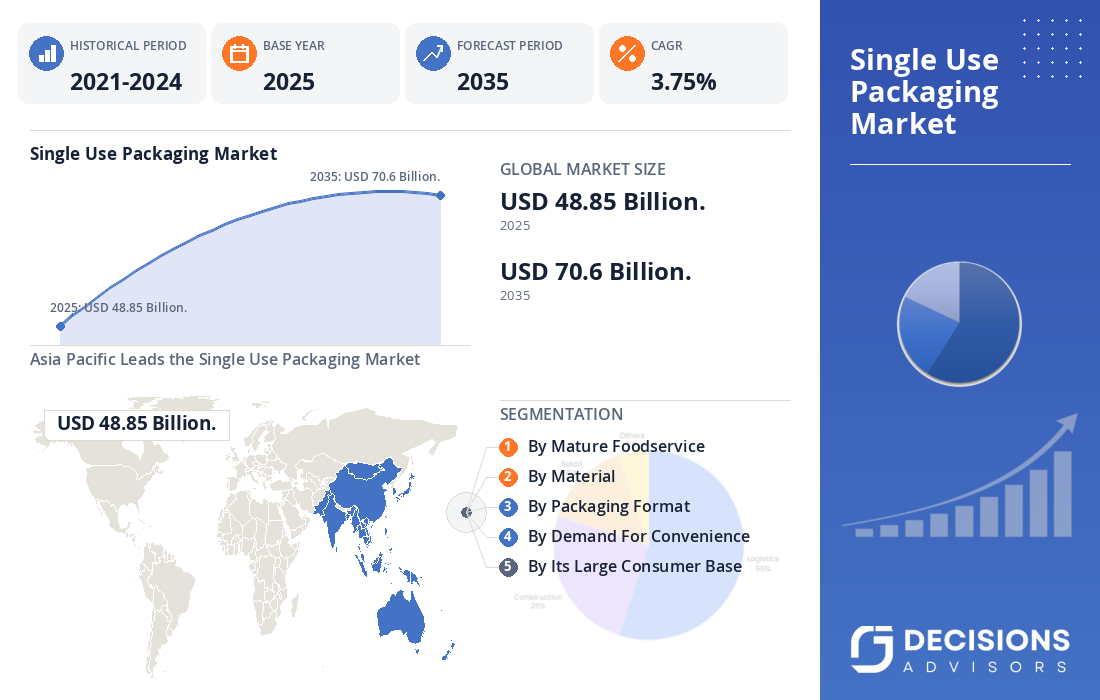
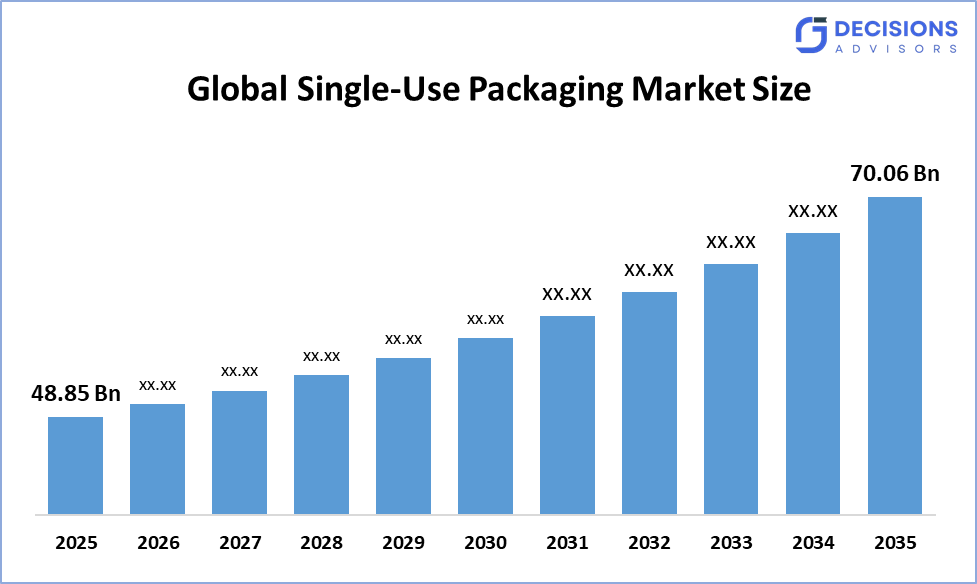
The Global Single-Use Packaging Market Size is predicted to grow from USD 48.85 Billion in 2025 and is likely to reach around USD 70.6 Billion by 2035 with a CAGR of 3.75%. According to Decision Advisors, rising demand for convenient, hygienic, lightweight, and portion-controlled packaging is supporting market expansion across food and beverage, healthcare, personal care, foodservice, household products, and e-commerce. Asia Pacific represents the largest regional market, while flexible packaging and plastic-based formats remain important revenue contributors. The market is also undergoing a significant sustainability transition. Packaging producers are investing in lightweight structures, recyclable mono-materials, recycled-content packaging, fiber-based alternatives, and improved barrier technologies. Regulatory pressure in Europe, North America, and Asia is encouraging companies to balance the convenience of single-use packaging with improved recyclability and resource efficiency.
Market Snapshot
- Global Single-Use Packaging Market Size (2025): USD 48.85 Billion.
- Projected Global Single-Use Packaging Market Size (2035): USD 70.6 Billion.
- Global Single-Use Packaging Market Compound Annual Growth Rate (CAGR): 3.75%.
- Largest Regional Market: Asia Pacific
- 2nd Largest Region: North America
- Fastest Growing Region: Middle East & Africa
- Base Year: 2025
- Historical Period: 2021-2024
- Market Forecast Period: 2026-2035
Market Overview/ Introduction
The global single-use packaging market includes packaging products designed primarily for one-time use across food and beverage, healthcare, pharmaceutical, personal care, household, foodservice, retail, and e-commerce applications. Products include plastic films, pouches, sachets, cups, trays, containers, bottles, paperboard packs, wraps, and other disposable packaging formats. Demand is increasing because these products offer convenience, portability, hygiene, product protection, portion control, and efficient transportation. The expansion of food delivery, quick-service restaurants, packaged foods, ready-to-eat meals, online shopping, and healthcare consumption is creating additional demand for disposable packaging. The market is simultaneously moving toward more sustainable packaging solutions.
- United States, Plastic-pollution policies and growing consumer pressure are encouraging packaging manufacturers to improve recyclability, recycled content, and post-consumer material recovery.
- Japan, The Plastic Resource Circulation Act promotes resource-efficient product design, recycling, and reduction of unnecessary single-use plastics.
- China, Plastic-reduction policies, e-commerce packaging reforms, and growing demand for environmentally preferable packaging are supporting the transition toward recyclable and lightweight formats.
Notable Insights: -
- Asia Pacific is anticipated to hold approximately 40.05% share of the Global Single-Use Packaging Market over the predicted timeframe.
- North America is expected to hold approximately 24.00% share during the forecast period, supported by mature foodservice, retail, healthcare, and e-commerce industries.
- By Material, the Plastic segment dominated the market and holds approximately 58.00% share in 2025 and is projected to grow at a substantial CAGR during the forecast period.
- By Packaging Format, the Flexible Packaging segment dominated the market and holds approximately 54.00% share in 2025 and is projected to grow at a substantial CAGR during the forecast period.
- The compound annual growth rate of the Global Single-Use Packaging Market is 3.75%.
- The market is likely to achieve a valuation of USD 70.6 Billion by 2035.
Market Drivers
The Global Single-Use Packaging Market is driven by increasing consumer demand for convenience, portability, hygiene, and ready-to-use products. Growth in food delivery, quick-service restaurants, packaged foods, beverages, snacks, ready-to-eat meals, and takeaway consumption is increasing demand for cups, containers, films, pouches, trays, and wraps. E-commerce is another important driver because lightweight packaging reduces transportation requirements while protecting products during distribution. Healthcare and pharmaceutical applications require packaging that provides hygiene, contamination control, dosage protection, and product integrity. At the same time, packaging manufacturers are introducing lightweight films, high-barrier structures, recyclable mono-materials, recycled-content polymers, and fiber-based formats. These innovations allow companies to address sustainability requirements while retaining the performance and convenience associated with single-use packaging.
Restrain
Environmental concerns surrounding disposable packaging remain the primary market restraint. Plastic waste, limited recycling infrastructure, contamination of recycling streams, and increasing restrictions on certain single-use products can increase compliance and manufacturing costs. Switching from conventional plastics to fiber-based, compostable, or recycled materials may require new equipment, coatings, barrier technologies, and supply-chain arrangements. In addition, inconsistent recycling infrastructure between countries makes it difficult for multinational packaging manufacturers to implement standardized end-of-life solutions. Volatility in polymer, paper, energy, and transportation costs can further affect packaging producers' margins.
Competitive Analysis:
The report offers the appropriate analysis of the key organizations/companies involved within the Global Single-Use Packaging Market, along with a comparative evaluation primarily based on their product offerings, business overviews, geographic presence, enterprise strategies, segment market share, and SWOT analysis. The report also provides an elaborative analysis focusing on the current news and developments of the companies, which includes product development, innovations, joint ventures, partnerships, mergers & acquisitions, strategic alliances, and others. This allows for the evaluation of the overall competition within the market.
Top Companies in the Global Single-Use Packaging Market
- Amcor plc
- Mondi plc
- Berry Global Group, Inc.
- Huhtamäki Oyj
- Graphic Packaging Holding Company
- Sonoco Products Company
- Sealed Air Corporation
- Novolex
- Constantia Flexibles
- Winpak Ltd.
- Government Initiatives.
Government Initiatives
|
Country |
Key Government Initiatives |
|
United States |
Federal and state-level initiatives are encouraging plastic-waste reduction, improved recycling, recycled content, and circular packaging systems |
|
Japan |
The Plastic Resource Circulation Act promotes resource-efficient design, recycling, reduction of specified single-use plastics, and greater use of recyclable alternatives |
|
China |
National plastic-pollution policies promote reduction of non-degradable single-use plastics, alternative materials, recycling, and greener packaging across retail and e-commerce |
Market Segmentation
The global single-use packaging market share is classified into material, packaging format, and end use.
- The Plastic segment dominated the market and holds approximately 58.00% share in 2025 and is projected to grow at a substantial CAGR during the forecast period.
Based on Material, the Global Single-Use Packaging Market is divided into Plastic, Paper & Paperboard, Glass, Metal, and Others. Among these, Plastic dominates the market and holds approximately 58.00% share in 2025. Plastic remains widely used because of its low weight, versatility, moisture resistance, barrier performance, durability, and relatively low production cost. It is used extensively in films, pouches, bottles, trays, cups, containers, and foodservice products. However, manufacturers are increasingly shifting toward recycled content and recyclable mono-material structures because of regulatory and consumer sustainability requirements.
- The Flexible Packaging segment accounted for the largest share of approximately 54.00% in 2025 and is anticipated to grow at a significant CAGR during the forecast period.
Based on Packaging Format, the market is divided into Flexible Packaging, Rigid Packaging, Pouches & Sachets, Cups & Containers, and Others. Among these, Flexible Packaging accounted for the largest share and holds approximately 54.00% share in 2025. Flexible formats offer lightweight construction, efficient material utilization, compact transportation, and strong product protection. Pouches, films, wraps, and sachets are increasingly used for food, beverages, personal care, household products, and healthcare applications.
- The Food & Beverage segment accounted for the largest share of approximately 29.00% in 2025 and is anticipated to grow at a significant CAGR during the forecast period.
Based on End Use, the market is divided into Food & Beverage, Healthcare & Pharmaceutical, Personal Care, Household, and Others. Among these, Food & Beverage dominates the market and holds approximately 29.00% share in 2025. High consumption of takeaway food, packaged meals, beverages, snacks, and ready-to-eat products creates significant demand for single-use packaging. Food delivery and quick-service restaurant expansion further increase consumption of cups, containers, trays, wraps, and pouches. Hygiene, portion control, portability, and shelf-life protection remain important factors supporting the segment.
Regional Segment Analysis of the Global Single-Use Packaging Market
- North America (U.S., Canada, Mexico)?
- Europe (Germany, U.K., France, Italy, Spain, Netherlands, Rest of Europe).
- Asia-Pacific (China, Japan, India, Australia, South Korea, Rest of Asia-Pacific).
- South America (Brazil, Argentina, Rest of South America).
- Middle East & Africa (UAE, Saudi Arabia, South Africa, Rest of MEA).
Asia Pacific is anticipated to hold approximately 40.05% share of the Global Single-Use Packaging Market over the predicted timeframe.
Asia Pacific is the largest regional market because of its extensive manufacturing base, large consumer population, urbanization, expanding middle class, foodservice development, and e-commerce penetration. China, India, Japan, and South Korea are important contributors. The region has large food-processing, beverage, pharmaceutical, personal-care, and consumer-goods industries that generate substantial packaging demand. Increasing food delivery, convenience-food consumption, and modern retail penetration are further supporting demand for flexible and rigid single-use formats.
North America is expected to grow at a rapid CAGR in the Global Single-Use Packaging Market, holding approximately 24.00% of the share during the forecast period.
The region benefits from a mature foodservice industry, high packaged-food consumption, established healthcare markets, and sophisticated packaging manufacturing capabilities. The United States is the largest contributor, while Canada and Mexico provide additional growth opportunities. Packaging manufacturers are investing in recycled materials, recyclable structures, lightweight formats, and improved collection systems. The region's strong e-commerce and food-delivery sectors also continue to generate demand for convenient single-use packaging.
Europe is expected to hold approximately 21.00% share of the Global Single-Use Packaging Market during the forecast period and remains one of the most sustainability-focused packaging regions.
The European market is being shaped by stringent environmental regulations, circular-economy targets, recycled-content requirements, and consumer preference for sustainable packaging. The EU Packaging and Packaging Waste Regulation is expected to accelerate packaging redesign, recyclability, waste prevention, and circularity. Germany, France, the U.K., Italy, and Spain remain important markets due to their developed food, beverage, retail, healthcare, and consumer-goods sectors.
Future Market Trends in Global Single-Use Packaging Market: -
-
- Expansion of Recyclable Mono-Material Packaging
Packaging producers are increasingly replacing difficult-to-recycle multilayer structures with mono-material films and containers. These structures can maintain barrier performance while improving compatibility with established recycling systems.
-
- Growth of Fiber-Based Packaging
Paperboard, molded fiber, and other renewable materials are gaining attention as alternatives to conventional plastics. New coatings and barrier technologies are enabling fiber-based packaging to withstand moisture, grease, freezing, heating, and food-contact conditions.
-
- Increasing Recycled Content
Recycled plastics and post-consumer recycled materials are becoming increasingly important. Manufacturers are integrating recycled content into films, containers, cups, and other packaging while improving product performance and traceability.
-
- Lightweight and High-Barrier Packaging
Lightweighting will remain a major strategy as manufacturers attempt to reduce material consumption and transportation requirements. High-barrier films and advanced coatings allow packaging to use less material while maintaining product protection and shelf life.
Recent Development
- In April 2025, Amcor completed its all-stock combination with Berry Global, creating a broader global packaging portfolio and identifying approximately USD 650 million in total synergies.
- In May 2025, Graphic Packaging International launched a new portfolio of paperboard sushi packaging designed for European foodservice operators, including plastic-free and low-plastic solutions to support regulatory compliance.
- In June 2026, Mondi launched re/loop FlowWrap for wet wipes packaging, a mono-PP form-fill-and-seal solution containing 35% post-consumer recycled content and designed for recycling.
Market Segment
This study forecasts revenue at global, regional, and country levels from 2021 to 2035. Decision Advisors has segmented the Global Single-Use Packaging Market based on the below-mentioned segment:
Global Single-Use Packaging Market, By Material.
- Plastic
- Paper & Paperboard
- Glass
- Metal
- Others.
Global Single-Use Packaging Market, By Packaging Format.
- Flexible Packaging
- Rigid Packaging
- Pouches & Sachets
- Cups & Containers
- Others.
Global Single-Use Packaging Market, By End Use.
- Food & Beverage
- Healthcare & Pharmaceutical
- Personal Care
- Household
- Others.
Global Single-Use Packaging Market, By Regional Analysis.
- North America
- US
- Canada
- Mexico
- Europe
- Germany
- UK
- France
- Italy
- Spain
- Russia
- Rest of Europe
- Asia Pacific
- China
- Japan
- India
- South Korea
- Australia
- Rest of Asia Pacific
- South America
- Brazil
- Argentina
- Rest of South America
- Middle East & Africa
- UAE
- Saudi Arabia
- Qatar
- South Africa
- Rest of the Middle East & Africa
Frequently Asked Questions (FAQ)
Q. What is driving the growth of the Global Single-Use Packaging Market?
A. Growth is primarily driven by demand for convenience, hygiene, portability, food delivery, packaged foods, e-commerce, pharmaceuticals, and personal-care products. Lightweight packaging and improved recyclable formats are also creating additional opportunities.
Q. Why is flexible packaging gaining importance in the single-use packaging market?
A. Flexible packaging offers lightweight construction, efficient material utilization, strong barrier performance, and lower transportation requirements. Pouches, sachets, films, and wraps are particularly suitable for food, beverages, personal care, household, and healthcare applications.
Q. How are sustainability regulations affecting single-use packaging manufacturers?
A. Regulations are encouraging manufacturers to reduce material consumption, improve recyclability, increase recycled content, and develop renewable or reusable alternatives. The European PPWR is particularly significant because it establishes broader requirements for packaging sustainability and circularity.
Q. Which region dominates the Global Single-Use Packaging Market?
A. Asia Pacific is expected to remain the largest regional market, supported by its large consumer base, manufacturing capacity, urbanization, foodservice expansion, e-commerce growth, and increasing consumption of packaged products.
Check Licence
Choose the plan that fits you best: Single User, Multi-User, or Enterprise solutions tailored for your needs.
We Have You Covered
- 24/7 Analyst Support
- Clients Across the Globe
- Tailored Insights
- Technology Tracking
- Competitive Intelligence
- Custom Research
- Syndicated Market Studies
- Market Overview
- Market Segmentation
- Growth Drivers
- Market Opportunities
- Regulatory Insights
- Innovation & Sustainability
Report Details
| Scope | Global |
| Pages | 200 |
| Delivery | PDF & Excel via Email |
| Language | English |
| Release | Aug 2026 |
| Access | Download from this page |