
Global Small Commercial Vehicles Market
 |
Author:
Sanket C
|
Pages:
240
|
Author:
Sanket C
|
Pages:
240
Global Small Commercial Vehicles Market Size, Share by Vehicle Type (Vans, Pickups, Minibuses, and Others), By Fuel Type (Diesel, Petrol, Electric, Hybrid, and Others), By End-User (Logistics, Construction, Retail, and Others), and By Region (North America, Europe, Asia-Pacific, Latin America, Middle East & Africa), Analysis and Forecast 2026-2035.
CAGR
5.7%
REVENUE 2025
USD Billion 267.4
FORECAST 2035
USD Billion 465.3
REPORT COVERAGE
Global
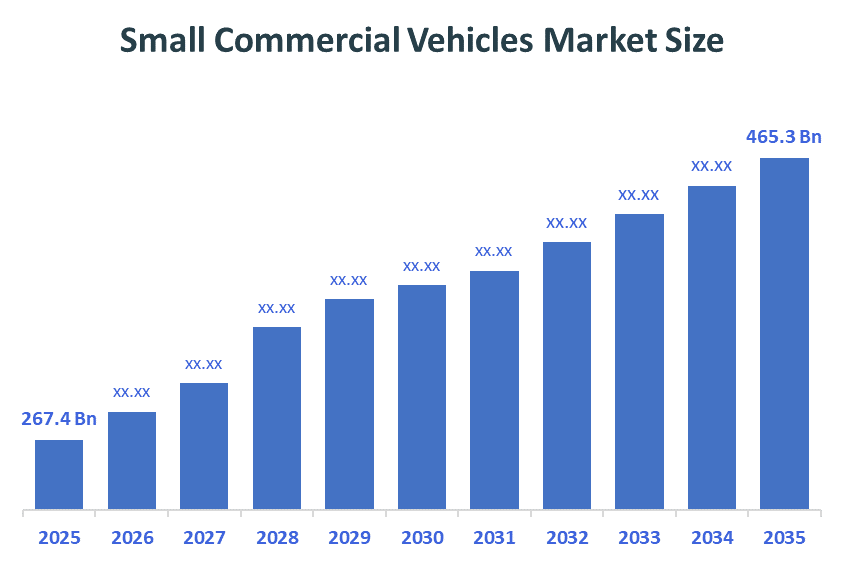
The Small Commercial Vehicles Market Size is foreseen to grow from USD 267.4 billion in 2025 and is projected to reach around USD 465.3 billion by 2035. According to Decision Advisors, a detailed research report on the global small commercial vehicle market provides good opportunities due to increasing demand for last-mile delivery and e-commerce. The global e-commerce market revenues surpassed USD 6 trillion in 2024, driving the demand for efficient logistics vehicles and promoting the fleet electrification, urban mobility solutions, and use of fuel-efficient small commercial vehicles.

Market Snapshot
- Small Commercial Vehicles Market Size (2025): USD 267.4 Billion
- Projected Small Commercial Vehicles Market Size (2035): USD 465.3 Billion
- Small Commercial Vehicles Market Compound Annual Growth Rate (CAGR): 5.7%
- Largest Regional Market: Asia Pacific
- Fastest Growing Region: Europe
- 2nd Largest Region: North America
- Base Year: 2025
- Historical Period: 2021-2024
- Forecast Period: 2026-2035
Market Overview/ Introduction
The global market for small commercial vehicles (SCVs) implies an industry concentrated on lightweight vehicles for logistics, such as vans, pickup trucks, and mini-trucks. The target vehicles can be utilized for freight transportation, passenger transportation, and other last-mile applications. The global small commercial vehicles market is growing significantly due to several factors, including the boom of e-commerce, which is responsible for over 161 billion parcels shipped worldwide in 2024. Moreover, rapid urbanization and industrialization, especially in emerging economies, provide strong support to the market development. Furthermore, increasing fuel costs and tougher emissions standards lead to the growth of the share of electric and hybrid vehicles in the segment. In June 2025, Denmark expanded its electric truck funding programme to DKK 425 million (2025-2026) from DKK 75 million due to oversubscription. The scheme now includes leased vehicles and supports continuous market growth. It also strengthens charging infrastructure and lowers electricity taxes to accelerate the zero-emission freight and green logistics transition.
The development of innovative solutions, including fleet management solutions, autonomous vehicles, and new lightweight materials, contributes to the market growth. In general, supported by infrastructural developments and logistics innovations, the market is forecasted to experience stable growth in the coming years. In January 2026, India is considering expanding the PM E-DRIVE scheme to include N1-category small electric trucks, boosting commercial EV adoption. The move could benefit manufacturers like Tata Motors and Ashok Leyland, accelerating incentives, increasing fleet electrification, and strengthening India’s position in the global electric commercial vehicle market.
Notable Insights: -
- Asia Pacific is anticipated to hold the largest share, approximately 38% of the small commercial vehicles market over the predicted timeframe.
- Europe is expected to grow at the fastest CAGR in the global small commercial vehicles market during the forecast period.
- By vehicle type, the vans segment dominated the market in 2025 with approximately 38% share, and is projected to grow at a substantial CAGR during the forecast period.
- By fuel type, the diesel segment dominated the market in 2025 with approximately 48% share, and is projected to grow at a substantial CAGR during the forecast period.
- The compound annual growth rate of the small commercial vehicles market is 5.7%.
- The market is likely to achieve a valuation of USD 465.3 Billion by 2035.
What is the role of technology in grooming the market?
Technology plays a key role in shaping the global small commercial vehicles (SCVs) market by improving efficiency, safety, and sustainability. Telematics and IoT-based fleet management systems enable real-time tracking, route optimization, and predictive maintenance, reducing operating costs by 10-15%. Electrification is transforming the sector, with electric SCVs lowering fuel and maintenance expenses by up to 30-40% compared to conventional vehicles. Advanced driver assistance systems (ADAS), AI-powered logistics, and autonomous driving technologies enhance delivery accuracy and road safety. Additionally, lightweight materials and aerodynamic vehicle designs improve payload efficiency and energy consumption, supporting the transition toward smart, connected, and eco-friendly urban mobility solutions globally.
Market Drivers
The market is fueled by the fast-paced development of urban transportation logistics, higher involvement of SMEs in logistics activities, and the development of organized retail networks. SMEs constitute almost 90% of all businesses around the world, thus putting more emphasis on cost-effective transportation solutions to ensure efficient deliveries and services. The rise of food delivery services and instant commerce websites, along with annual growth rates exceeding 15% in large economies for online grocery delivery, further reinforces demand for more efficient and compact transportation fleets. The growth in infrastructure development across emerging economies enables more effective road connections and increased utilization of SCVs. Lastly, government initiatives to promote electric vehicles are also contributing to greater use of electric SCVs.
In March 2026, Tier IV and Isuzu Motors unveiled Level 4 autonomous ERGA buses at Nvidia GTC 2026, powered by Nvidia DRIVE AGX Thor (2,000 TFLOPS, ASIL-D compliant). Built on Autoware software, the system enables safe, efficient public transit, addressing Japan’s driver shortage and supporting scalable autonomous mobility across EV and diesel platforms.
Restrain
The small commercial vehicles market worldwide is hindered by issues such as the expensive nature of electric versions at inception, a lack of charging stations, and unpredictable fuel prices. The penetration of electric vehicles within commercial fleet companies is less than 15%, thus limiting their acceptance. Moreover, supply chain problems and a shortage of semiconductors have made vehicles expensive to manufacture.
Competitive Analysis:
The report offers the appropriate analysis of the key organizations/companies involved within the small commercial vehicles market, along with a comparative evaluation primarily based on their product offerings, business overviews, geographic presence, enterprise strategies, segment market share, and SWOT analysis. The report also provides an elaborative analysis focusing on the current news and developments of the companies, which includes product development, innovations, joint ventures, partnerships, mergers & acquisitions, strategic alliances, and others. This allows for the evaluation of the overall competition within the market.
Top Companies in the Small Commercial Vehicles Market
- Ford Motor Company
- Volkswagen AG
- Tata Motors Limited
- Isuzu Motors
- Ashok Leyland Limited
- Daimler AG
- Mahindra & Mahindra Limited
- General Motors
- Renault Group
- Suzuki Motor Corporation
- Piaggio & C. SpA
- Maruti Suzuki India Limited
- Hyundai Motor Company
- Dongfeng Motor Corporation
- Others
Government Initiatives
|
Country |
Key Government Initiatives |
|
Japan |
Japan promotes small commercial vehicles via subsidies, kei vehicle advantages, electric van incentives, green logistics programs, and decarbonization policies supported by METI. |
|
US |
The United States government supports small commercial vehicles through EV tax credits, infrastructure funding, fleet electrification incentives, and emissions regulation programs expansion. |
|
Europe |
In December 2025, the European Commission approved Germany’s €1.6 billion programme to build 1,410 heavy-duty electric truck charging points across 130 motorway sites, accelerating e-truck adoption and supporting EU climate goals. |
Study on the Supply, Demand, Distribution, and Market Environment of the Small Commercial Vehicles Market
The small commercial vehicles (SCVs) market is shaped by rising demand from logistics, e-commerce, and urban mobility sectors, with global parcel volumes exceeding 161 billion shipments in 2024, driving strong fleet expansion. Supply is dominated by Asia-Pacific manufacturers due to cost-effective production and high vehicle output, while demand is increasing rapidly in emerging economies and urban centers. Distribution networks rely heavily on dealership expansion and digital fleet platforms to improve accessibility and after-sales services. Market environment factors include fuel price volatility, stricter emission norms, and EV incentives, with electric SCVs gaining traction as governments push for cleaner transportation and sustainable last-mile delivery solutions.
Price Analysis and Consumer Behaviour Analysis
The global small commercial vehicles (SCVs) market is driven by strong price sensitivity and changing consumer behaviour influenced by urban logistics and e-commerce growth. SCVs are priced between USD 8,000 and 35,000, while electric variants cost 20-40% more due to battery and supply chain expenses. However, they offer up to 30% lower operating costs, improving long-term affordability. Consumer preference is shifting toward total cost of ownership, fleet efficiency, and digital tracking, supported by over 161 billion global parcels in 2024. Logistics firms, SMEs, and startups increasingly adopt leasing models. Environmental concerns and government incentives further accelerate electric SCV adoption globally.
Market Segmentation
The small commercial vehicles market share is classified into vehicle type, fuel type, and end-user.
- The vans segment dominated the market in 2025 with approximately 38% share, and is projected to grow at a substantial CAGR during the forecast period.
Based on the vehicle type, the small commercial vehicles market is divided into vans, pickups, minibuses, and others. Among these, the vans segment dominated the market in 2025 with approximately 38% share, and is projected to grow at a substantial CAGR during the forecast period. The segment dominated the market, driven by strong demand for last-mile delivery, urban logistics, and e-commerce expansion. Vans offer higher cargo capacity, fuel efficiency, and operational flexibility compared to smaller trucks. Growing fleet modernization, rising adoption by logistics companies, and increasing use in passenger transport services further support segment growth, especially in densely populated urban areas.
- The diesel segment accounted for the largest share in 2025 with approximately 48%, and is anticipated to grow at a significant CAGR during the forecast period.
Based on the fuel type, the small commercial vehicles market is divided into diesel, petrol, electric, hybrid, and others. Among these, the diesel segment accounted for the largest share in 2025 with approximately 48%, and is anticipated to grow at a significant CAGR during the forecast period. The segment of the small commercial vehicles market is due to its high fuel efficiency, superior torque, and suitability for heavy-duty operations. Diesel vehicles remain preferred for long-distance logistics and commercial transport. Lower operating costs, established fueling infrastructure, and durability under high load conditions continue to support strong demand across developing and emerging markets globally.
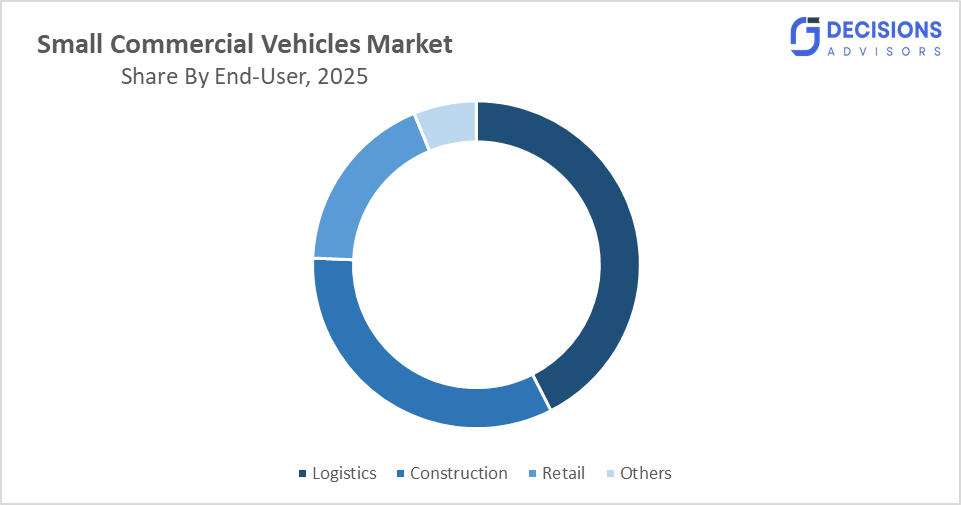
- The logistics segment dominated the market in 2025 with approximately 42% share, and is projected to grow at a substantial CAGR during the forecast period.
Based on the end-user, the small commercial vehicles market is divided into logistics, construction, retail, and others. Among these, the logistics segment dominated the market in 2025 with approximately 42% share, and is projected to grow at a substantial CAGR during the forecast period. The segment led the market, attributed to rapid growth in e-commerce, increasing last-mile delivery demand, and expanding urban distribution networks. Logistics companies rely on small commercial vehicles for cost-efficient, flexible transportation. Rising online retail sales, efficient supply chain requirements, and fleet expansion by courier and delivery service providers continue to drive strong segment growth globally.
Strategies to Implement for Growth of the Market in Non-Leading Regions
- Expand affordable financing, leasing, and government subsidy programs to increase SCV adoption in price-sensitive emerging and rural markets.
- Develop localized manufacturing and assembly plants to reduce costs, improve supply chains, and strengthen regional distribution networks effectively.
- Promote electric SCVs through charging infrastructure development, incentives, and partnerships with logistics companies for last-mile delivery growth.
Regional Segment Analysis of the Small Commercial Vehicles Market
- North America (U.S., Canada, Mexico)
- Europe (Germany, France, U.K., Italy, Spain, Rest of Europe)
- Asia-Pacific (China, Japan, India, Rest of APAC)
- South America (Brazil and the Rest of South America)
- The Middle East and Africa (UAE, South Africa, Rest of MEA)
Asia Pacific is anticipated to hold the largest share, approximately 38% of the small commercial vehicles market over the predicted timeframe.
Asia Pacific is anticipated to hold the largest share, approximately 38% of the small commercial vehicles market over the predicted timeframe. The region dominates the small commercial vehicles market due to rapid urbanization, strong industrial growth, and expanding e-commerce logistics networks. China leads the region with large-scale manufacturing capabilities, extensive delivery networks, and high demand for fleet vehicles. India is witnessing strong growth driven by rising SMEs, last-mile delivery expansion, and infrastructure development. Japan contributes through advanced automotive technology and efficient fleet management systems. Government incentives for electric vehicles and increasing demand for cost-efficient transport solutions further support regional market dominance. In September 2025, the GST Council approved rate rationalisation for the road transport and automobile sector, reducing taxes on vehicles and auto components. The reform is expected to lower prices, boost demand, strengthen MSMEs, enhance logistics efficiency, create jobs, and support cleaner mobility under Make in India and PM Gati Shakti initiatives.
Europe is expected to grow at the fastest CAGR in the small commercial vehicles market during the forecast period.
Europe is expected to grow at the fastest CAGR in the small commercial vehicles market during the forecast period. The region is rapidly growing in the market due to strict emission regulations, rapid electrification, and strong logistics modernization. Germany leads growth with advanced automotive manufacturing and EV innovation. France supports expansion through urban mobility initiatives, while the UK drives demand via booming e-commerce and last-mile delivery services. Government incentives and sustainability goals further accelerate the adoption of electric SCVs across the region. In January 2026, the EU announced that from July 2026, Mobility Package I rules will extend to light commercial vehicles (2.5-3.5 tonnes) in international transport. Drivers must follow strict limits, including 9-10 hours daily driving, 56-hour weekly caps, and mandatory rest periods, increasing compliance costs and operational regulation for logistics firms.
North America is the second largest region in the small commercial vehicles market during the forecast period.
North America is the second largest region in the small commercial vehicles market during the forecast period. The region is growing in the market driven by strong logistics infrastructure, high e-commerce penetration, and increasing fleet modernization. The United States leads regional growth with extensive last-mile delivery networks, advanced vehicle manufacturing, and rising adoption of electric commercial vehicles. Canada supports demand through expanding urban logistics and government incentives for clean transportation. Strong presence of major OEMs, technological advancements, and robust supply chains further strengthen regional market expansion. In February 2026, the U.S. EPA repealed the 2009 Endangerment Finding and vehicle greenhouse gas standards, removing emissions restrictions on gasoline and diesel vehicles. The decision is expected to cut new vehicle prices by around $2,375, reduce regulatory costs, and save small businesses over $27 billion in 10 years, supporting market flexibility and affordability.
Future Market Trends in the Small Commercial Vehicles Market: -
- Rapid electrification of small commercial fleets
Increasing adoption of electric vehicles is driven by emission regulations, fuel savings, and government incentives globally.
- AI-powered fleet management and telematics integration
AI and telematics enable real-time tracking, predictive maintenance, and optimized routing for efficient fleet operations.
- Boom in e-commerce-driven last-mile delivery demand
Expanding online retail increases the need for compact vehicles supporting fast, efficient urban delivery services.
- Shift toward lightweight, fuel-efficient vehicle designs
Manufacturers focus on reducing vehicle weight and improving aerodynamics to enhance fuel efficiency and lower operating costs.
Recent Development
- In June 2026, Dongfeng Automobile launched its OpenVAN autonomous freight mobility brand in Xiangyang, introducing four driverless logistics vehicles developed with Zelos. The platform focuses on city logistics, combining open technology ecosystems and intelligent transport. It aims to improve delivery efficiency, enhance safety, and support lower-emission autonomous urban freight operations.
- In May 2026, Isuzu Motors India introduced a leasing program for the D-MAX S-CAB pickup, enabling fleet expansion with zero down payment and all-inclusive maintenance. Monthly rentals start at ?38,999, offering up to ?1.81 lakh savings over four years. The model reduces ownership costs and supports flexible, cash-flow-friendly logistics operations.
- In April 2026, Ashok Leyland launched Dost and Dost+ XL twin-fuel (CNG + petrol) light commercial vehicles in India. The models offer payloads up to 1,410 kg and driving ranges of 400-500 km, enabling seamless fuel switching. The innovation targets last-mile logistics, reducing operating costs and easing refuelling infrastructure limitations.
- In March 2026, Suzuki launched the all-new e EVERY mini commercial BEV van in Japan, jointly developed with Daihatsu and Toyota. The EV offers a 257 km range (WLTC), silent driving, and advanced safety features. It also provides emergency power supply capability, supporting sustainable and resilient urban commercial mobility solutions.
- In October 2025, Tata Motors Commercial Vehicles began deliveries of the Prima E.55S electric prime-mover to Enviiiro Wheels Mobility in Rajasthan. The zero-emission truck offers up to 350 km range, advanced safety systems, and fast charging. The deployment supports decarbonised freight operations across mining and industrial logistics, strengthening India’s EV transition.
- In April 2024, Daimler India Commercial Vehicles announced the launch of the Next Generation eCanter all-electric light-duty truck in India, marking its entry into the EV commercial segment. The model supports Daimler’s goal of CO?-neutral transport by 2039 in key markets and globally by 2050, advancing India’s commercial vehicle decarbonization strategy.
Market Segment
This study forecasts revenue at global, regional, and country levels from 2020 to 2035. Decision Advisors has segmented the small commercial vehicles market based on the below-mentioned segments:
Small Commercial Vehicles Market, By Vehicle Type
- Vans
- Pickups
- Minibuses
- Others
Small Commercial Vehicles Market, By Fuel Type
- Diesel
- Petrol
- Electric
- Hybrid
- Others
Small Commercial Vehicles Market, By End-User
- Logistics
- Construction
- Retail
- Others
Small Commercial Vehicles Market, By Regional Analysis
- North America
- US
- Canada
- Mexico
- Europe
- Germany
- UK
- France
- Italy
- Spain
- Russia
- Rest of Europe
- Asia Pacific
- China
- Japan
- India
- South Korea
- Australia
- Rest of Asia Pacific
- South America
- Brazil
- Argentina
- Rest of South America
- Middle East & Africa
- UAE
- Saudi Arabia
- Qatar
- South Africa
- Rest of the Middle East & Africa
Frequently Asked Questions (FAQ)
Q.1 How are telematics and IoT technologies improving fleet management and reducing operational costs in SCVs?
A. Telematics and IoT improve SCV fleet efficiency through real-time tracking, predictive maintenance, and route optimization, reducing fuel consumption by 10–15% and lowering overall operational costs while enhancing delivery speed and vehicle utilization.
Q.2 What impact does rising fuel price volatility have on purchasing decisions in the small commercial vehicles market?
A. Rising fuel price volatility significantly influences SCV purchasing decisions by pushing buyers toward fuel-efficient and electric vehicles, with fuel expenses forming nearly 25-35% of total fleet operating costs, increasing demand for cost-stable alternatives.
Q.3 How are government emission regulations influencing the shift toward electric small commercial vehicles globally?
A. Government emission regulations are accelerating EV SCV adoption through strict CO? limits and incentives. Transport contributes nearly 24% of global CO? emissions, driving policies that promote electric fleets and reduce urban pollution levels worldwide.
Q.4 What economic benefits do small businesses gain from adopting affordable small commercial vehicle fleets?
A. Small businesses gain lower delivery costs, improved efficiency, and higher profitability from SCV fleets. Logistics expenses can account for up to 10-15% of business revenue, and efficient vehicles reduce fuel and maintenance costs significantly.
Q.5 How are subscription and leasing models changing ownership patterns in the SCV industry?
Subscription and leasing models are shifting SCV ownership from asset-heavy purchases to flexible usage-based access. Nearly 40% of fleet operators globally prefer leasing models, reducing upfront costs, improving cash flow, and enhancing operational scalability.
Q.6 What challenges are limiting the widespread adoption of electric SCVs in developing economies?
A. Electric SCV adoption in developing economies is limited by high upfront costs, weak charging infrastructure, and battery limitations. EV penetration remains under 20% in emerging markets, restricting large-scale commercial fleet transition.
Q.7 How is sustainability shaping future design and manufacturing trends in the small commercial vehicles market?
A. Sustainability is driving lightweight materials, EV adoption, and energy-efficient designs in SCVs. Transport contributes nearly 24% of global CO? emissions, pushing manufacturers to adopt low-emission production and eco-friendly vehicle technologies worldwide.
Check Licence
Choose the plan that fits you best: Single User, Multi-User, or Enterprise solutions tailored for your needs.
We Have You Covered
- 24/7 Analyst Support
- Clients Across the Globe
- Tailored Insights
- Technology Tracking
- Competitive Intelligence
- Custom Research
- Syndicated Market Studies
- Market Overview
- Market Segmentation
- Growth Drivers
- Market Opportunities
- Regulatory Insights
- Innovation & Sustainability
Report Details
| Scope | Global |
| Pages | 240 |
| Delivery | PDF & Excel via Email |
| Language | English |
| Release | Jun 2026 |
| Access | Download from this page |