
Global Smart Meters Market
 |
Author:
Somesh R
|
Pages:
210
|
Author:
Somesh R
|
Pages:
210
Global Smart Meters Market Size, Share By Product (Electricity Meter, Gas Meter, Water Meter), By End Use (Residential, Commercial, Industrial), By Technology (AMI, AMR), and By Region (North America, Europe, Asia-Pacific, Latin America, Middle East & Africa), Analysis and Forecast 2026-2035.
CAGR
8.33%
REVENUE 2025
USD Billion 40.63
FORECAST 2035
USD Billion 90.44
REPORT COVERAGE
Global
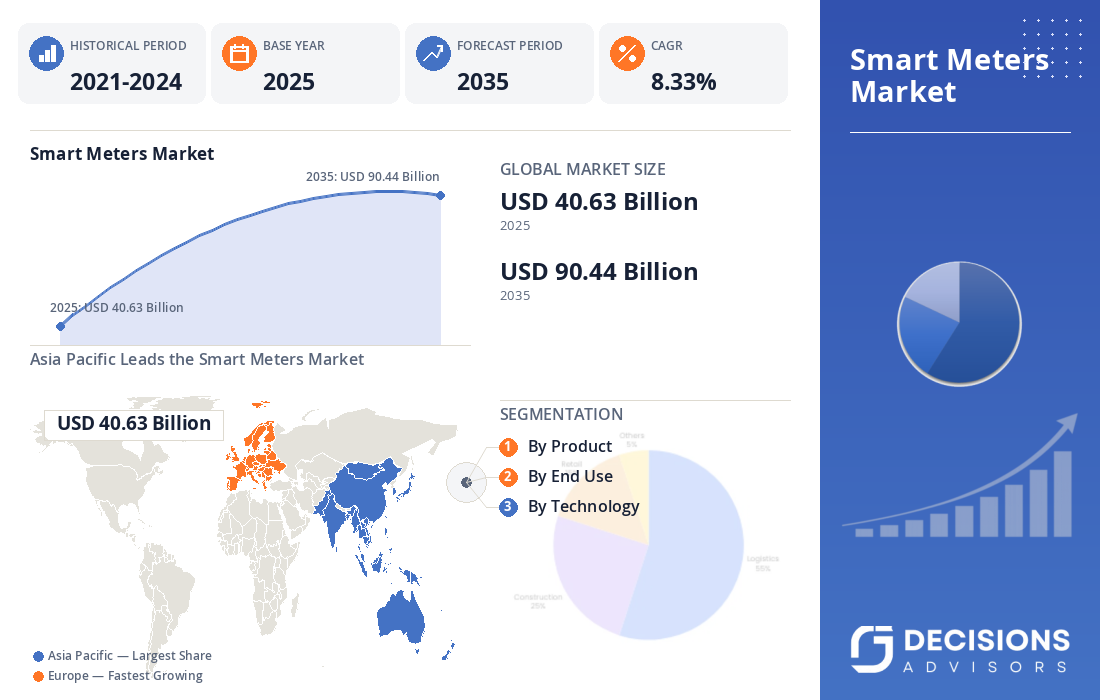
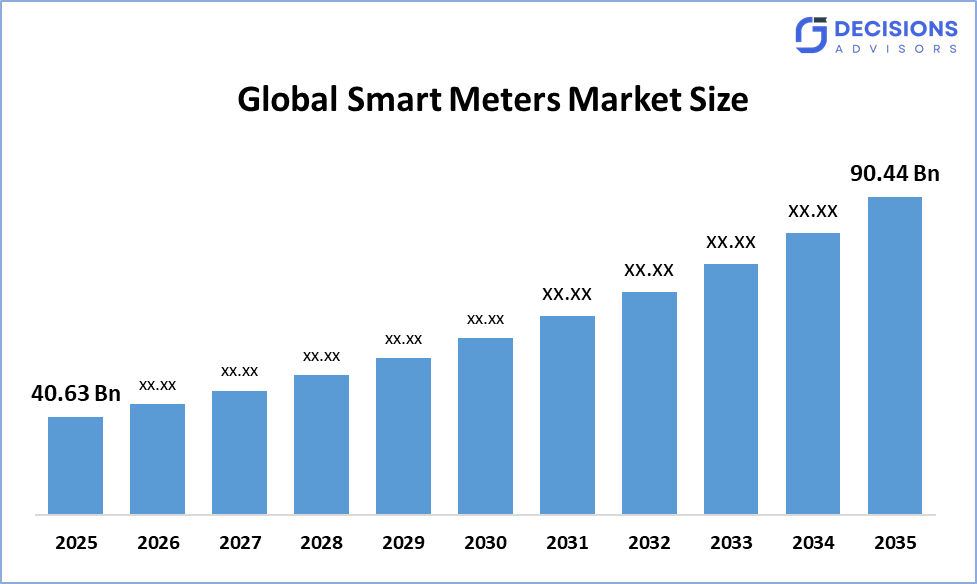
The Global Smart Meters Market Size is predicted to grow from USD 40.63 Billion in 2025 and is likely to reach around USD 90.44 Billion by 2035 with a CAGR of 8.33% . According to Decision Advisors, a detailed research report on the market reflects that the touchless sensing adoption trend dominates the Global Smart Meters Market accounting for approximately 63% of the total share worldwide. Holley Metering Limited leads the market the market with annual revenue of approximately USD 2.5 billion and approx 16% global market share making it a key contributor to global market development and growth dynamics.
Market Snapshot
- Global Smart Meters Market Size (2025): USD 40.63 Billion
- Projected Global Smart Meters Market Size (2035): USD 90.44 Billion
- Global Smart Meters Market Compound Annual Growth Rate (CAGR): 8.33%
- Largest Regional Market: Asia Pacific
- 2nd Largest Region: North America
- Fastest Growing Region: Europe
- Base Year: 2025
- Historical Period: 2021-2024
- Market Forecast Period: 2026-2035
Market Overview/ Introduction
The Global Smart Meters Market refers to the industry that manufactures digital devices that measure energy use and provide detailed, near-real-time data on electricity, gas, and water consumption, enabling two-way communication between consumers and utilities. The market is experiencing strong growth because of the growing focus on preventing power theft, increasing investments in smart grid infrastructure, rising demand for real-time energy monitoring, and government initiatives promoting energy efficiency. Growth in smart grid expansion and growing adoption of advanced metering infrastructure are creating favorable conditions for meter manufacturers. Key companies, including Holley Metering Limited, Honeywell International Inc., Siemens AG, Sensus, and Badger Meter are developing advanced AMI, AMR, and IoT-enabled metering solutions that support accurate billing and grid reliability while achieving high operational efficiency. The market provides utility customers with solutions that combine two-way data exchange with scalable smart grid deployment models that provide continuous monitoring and reduced energy losses. The global market will experience future expansion through the development of AI-powered predictive grid management, blockchain-enabled energy trading, and renewable energy integration.
- India's Revamped Distribution Sector Scheme (RDSS) allocates billions of dollars in budget to install more than 250 million prepaid smart meters across the country, expanding market penetration and infrastructure modernization.
- The U.S. administration backed the installation of smart meters through the Energy Independence and Security Act and the Infrastructure Investment Act, designed to modernize power grid infrastructure and promote smart technologies.
Notable Insights: -
- Asia Pacific dominated the market and is anticipated to hold approximately 34% share of the Global Smart Meters Market over the predicted timeframe.
- Europe is expected to grow at the fastest CAGR in the Global Smart Meters Market, holding approximately 28% of the share during the forecast period.
- By product, the electricity meters segment dominated the market and approximately 50% share in 2025 and is projected to grow at a substantial CAGR during the forecast period
- By end use, residential segment dominated the market and holds approximately 52% share in 2025 and is projected to grow at a substantial CAGR during the forecast period.
- The compound annual growth rate of the Global Smart Meters Market is 8.33%
- The market is likely to achieve a valuation of USD 90.44 Billion by 2035.
Market Drivers
The Global Smart Meters Market experiences growth because of the growing focus on preventing power theft, increasing investments in smart grid infrastructure, and rising demand for real-time energy monitoring. Government initiatives promoting energy efficiency, such as the U.S. Grid 2030 and GridWise programs and India's RDSS scheme, are accelerating large-scale AMI rollouts. Increasing integration of renewable energy sources and distributed energy resources is further boosting demand for advanced two-way metering solutions. The rise of AI-powered analytics and IoT-enabled connectivity is further fuelling adoption of advanced smart meter solutions.
Restrain
The Global Smart Meters Market faces challenges such as high initial deployment and installation costs, including investment in advanced metering infrastructure, communication networks, software platforms, and installation services. These financial barriers can be particularly challenging in developing regions and may delay large-scale implementation, especially among smaller utility providers, along with the need for workforce training during meter replacement.
Competitive Analysis:
The report offers the appropriate analysis of the key organizations/companies involved within the Global Smart Meters Market along with a comparative evaluation primarily based on their product offerings, business overviews, geographic presence, enterprise strategies, segment market share, and SWOT analysis. The report also provides an elaborative analysis focusing on the current news and developments of the companies, which includes product development, innovations, joint ventures, partnerships, mergers & acquisitions, strategic alliances, and others. This allows for the evaluation of the overall competition within the market.
Top Companies in the Global Smart Meters Market
- Holley Metering Limited
- Neptune Technology Group Inc.
- Honeywell International Inc.
- Siemens AG
- Kaifa Technology
- Suntront Technology
- Wasion Group
- Aichi Tokei Denki
- Badger Meter
- Sensus
Government Initiatives
|
Country |
Key Government Initiatives |
|
India |
India launched the Revamped Distribution Sector Scheme (RDSS), allocating billions of dollars to install more than 250 million prepaid smart meters across the country through the Energy Efficiency Services Limited. |
|
United States |
The U.S. administration backed the installation of smart meters through the Energy Independence and Security Act and the Infrastructure Investment Act, designed to modernize power grid infrastructure and promote smart technologies. |
|
United Kingdom |
The UK administration launched a nationwide installation program for all households and established consumer protection policies related to smart meters to facilitate net-zero carbon emission targets through digital power grids. |
Market Segmentation
The Global Smart Meters Market share is classified into product, end use, technology
- The electricity meters segment dominated the market and holds approximately 50% share in 2025 and is projected to grow steadily during the forecast period.
Based on product, the Global Smart Meters Market is divided into Electricity Meter, Gas Meter, and Water Meter. Among these, segment dominates the market and holds approximately 50% share in 2025 due to widespread deployment of smart grid infrastructure and increasing demand for accurate, real-time electricity consumption monitoring. These meters automatically transmit usage data to utility providers, eliminating manual meter readings while improving billing accuracy and operational efficiency. The gas meter segment is observed to be the fastest-growing, driven by increasing investments in digital gas distribution infrastructure and adoption of IoT-enabled metering technologies.
- The residential segment accounted for the largest share of approximately 44% in 2025 and is anticipated to grow at a significant CAGR during the forecast period.
Based on end use, the market is divided into Residential, Commercial, and Industrial. Among these, Residential dominates the market largest share of approximately 44% in 2025, owing to large-scale smart meter deployment programs initiated by utilities and governments worldwide, along with increasing adoption of smart homes and growing consumer awareness regarding energy conservation. The Industrial segment is expected to be the fastest-growing end use segment in the Global Smart Meters Market, driven by rising demand for advanced energy management solutions, load monitoring, and carbon emission tracking across manufacturing facilities.
- The AMI segment accounted for the largest share of approximately 52% in 2025 and is anticipated to grow at a significant CAGR during the forecast period.
Based on technology, the market is divided into AMI and AMR. Among these, AMI dominates the market largest share of approximately 52% due to its ability to provide two-way communication between utilities and consumers, enabling automated meter reading, remote monitoring, outage management, and demand response capabilities. The AMR segment is expected to be the fastest-growing technology segment, driven by increasing adoption among utilities seeking cost-effective digital metering solutions in developing markets undergoing digital transformation.
Regional Segment Analysis of the Global Smart Meters Market
- North America (U.S., Canada, Mexico)?
- Europe (Germany, France, U.K., Italy, Spain, Rest of Europe)
- Asia-Pacific (China, Japan, India, Rest of APAC)
- South America (Brazil and the Rest of South America)?
- The Middle East and Africa (UAE, Saudi Arabia, Rest of MEA)
Asia Pacific dominated the Global Smart Meters Market, holding approximately 34% share in 2025.
Asia Pacific dominated the Global Smart Meters Market, accounting for approximately 34% share in 2025, driven by rapid infrastructure development, smart-grid modernization, and large-scale advanced metering infrastructure (AMI) deployments. Mature markets, including Japan, South Korea, and Australia, continue investing in digital electricity networks, while emerging economies such as India and Southeast Asian countries are accelerating smart-meter adoption to improve grid efficiency, reduce transmission and distribution losses, and strengthen electricity management. China represents the leading smart-meter market in the region, supported by continued smart-grid modernization initiatives led by the State Grid Corporation of China.
Europe is expected to grow at the fastest CAGR in the Global Smart Meters Market holding approximately 28% of the share during the forecast period
Europe is expected to register the fastest CAGR in the Global Smart Meters Market, accounting for approximately 28% share during the forecast period. Growth is supported by ambitious decarbonization targets, favorable regulatory frameworks, and increasing adoption of time-of-use electricity pricing. Rising penetration of distributed energy resources (DERs), including rooftop solar and energy storage, is also driving demand for smart meters capable of accurate, two-way data exchange. The UK, Spain, France, and Italy represent leading markets across the region, supported by large-scale smart-meter deployment programs and grid modernization initiatives. In the UK, government targets for smart-meter installations, alongside the country’s commitment to achieving net-zero emissions by 2050, are expected to further accelerate market growth.
North America is growing notably in the Global Smart Meters Market holding approximately 23% share.
North America is growing notably in the Global Smart Meters Market, accounting for approximately 23% share. Market growth is driven by advanced utility infrastructure, increasing emphasis on energy efficiency, and rising concerns regarding power outages, grid reliability, and electricity theft. Utilities across the region are replacing conventional meters with smart meters to improve operational efficiency, monitoring, and customer services. The U.S. represents a major market, supported by widespread adoption of Advanced Metering Infrastructure (AMI). Utilities increasingly use AMI beyond traditional billing applications, including outage detection and management, voltage monitoring and optimization, demand response, and coordination of distributed energy resources. Continued grid modernization investments and the integration of renewable energy resources are expected to further support smart-meter deployment across North America.
Future Market Trends in Global Smart Meters Market: -
-
- Integration of AI for Predictive Grid Management
Artificial intelligence is significantly enhancing the capabilities of smart meters by enabling advanced data analytics, real-time energy monitoring, and predictive grid management. AI algorithms analyze consumption patterns to forecast energy demand, helping utilities optimize electricity distribution, reduce grid congestion, and prevent overloads.
-
- Growing Adoption of IoT-Enabled Metering Solutions
The integration of the Internet of Things is transforming smart metering by enabling seamless communication between connected devices, sensors, and utility networks. IoT-enabled smart meters provide real-time monitoring, automated data collection, and remote meter management, helping utilities improve operational efficiency and grid reliability.
-
- Emergence of Blockchain for Secure Energy Trading
Blockchain technology is emerging as a promising trend in smart metering due to its ability to improve data security, transparency, and transaction traceability. The technology enables secure peer-to-peer energy trading and helps utilities manage large-scale metering networks more efficiently by creating tamper-resistant records of energy transactions.
-
- Expansion of Renewable Energy Integration and DER Management
The growing deployment of renewable energy systems is increasing the importance of smart meters in modern power networks. Smart meters facilitate the efficient integration of Distributed Energy Resources, such as rooftop solar panels, by accurately measuring both electricity consumption from the grid and excess power supplied back to the grid.
Recent Development
- In October 2025, Aichi Tokei Denki reported plans to expand adoption of smart meters and its Aichi Cloud platform, which supports remote meter reading, leak detection through water-use visualization, and monitoring services.
- In March 2025, Honeywell introduced the NXU Residential Smart Gas Meter, featuring ultrasonic measurement, pressure sensing, remote shutoff capabilities, and connectivity designed to provide utilities with near-real-time operational insights.
Market Segment
This study forecasts revenue at global, regional, and country levels from 2020 to 2035. Decision Advisors has segmented the Global Smart Meters Market based on the below-mentioned segments:
Global Smart Meters Market, By Product
- Electricity Meter
- Gas Meter
- Water Meter
Global Smart Meters Market, By End Use
- Residential
- Commercial
- Industrial
Global Smart Meters Market, By Technology
- AMI
- AMR
Global Smart Meters Market, By Regional Analysis
- North America
- US
- Canada
- Mexico
- Europe
- Germany
- UK
- France
- Italy
- Spain
- Russia
- Rest of Europe
- Asia Pacific
- China
- Japan
- India
- South Korea
- Australia
- Rest of Asia Pacific
- South America
- Brazil
- Argentina
- Rest of South America
- Middle East & Africa
- UAE
- Saudi Arabia
- Qatar
- South Africa
- Rest of the Middle East & Africa
Frequently Asked Questions (FAQ)
Q. What are the driving factors of the smart meters market?
A. The growing demand for smart electricity meters, government initiatives promoting energy efficiency, and increasing investments in smart grid infrastructure are driving the growth of the global smart meters market.
Q. Which region will lead the global smart meters market?
A. Asia Pacific is expected to lead the global smart meters market during the forecast period 2026 to 2035, followed by North America and a fast-growing Europe.
Q. What are the key factors driving the growth of the global smart meters market?
A. The key factors driving the global smart meters market include increasing demand for smart electricity meters, government initiatives supporting energy efficiency, rising investments in smart-grid infrastructure, and the need for improved grid monitoring and energy management.
Q. What are smart meters used for?
A. Smart meters enable automated electricity, gas, or water consumption measurement and provide two-way communication between consumers and utilities, supporting remote meter reading, accurate billing, outage management, and energy monitoring
Check Licence
Choose the plan that fits you best: Single User, Multi-User, or Enterprise solutions tailored for your needs.
We Have You Covered
- 24/7 Analyst Support
- Clients Across the Globe
- Tailored Insights
- Technology Tracking
- Competitive Intelligence
- Custom Research
- Syndicated Market Studies
- Market Overview
- Market Segmentation
- Growth Drivers
- Market Opportunities
- Regulatory Insights
- Innovation & Sustainability
Report Details
| Scope | Global |
| Pages | 210 |
| Delivery | PDF & Excel via Email |
| Language | English |
| Release | Aug 2026 |
| Access | Download from this page |