
Global Smartphone 3D Camera Market
 |
Pages:
200
|
Pages:
200
Global Smartphone 3D Camera Market Size, Share, By Sensor (Time of Flight (TOF), Structured Light, Dual Camera, Others), By Device (Smartphones, Tablets, Wearables, PCs, Others), By Application (Augmented Reality (AR), Virtual Reality (VR), Facial Recognition, Gaming, Others), and By Region (North America, Europe, Asia-Pacific, Latin America, Middle East, and Africa), Analysis and Forecast 2026-2035.
REPORT COVERAGE
Global
Market Snapshot
- Global Smartphone 3D Camera Market Size (2025): USD 4.25 billion
- Projected Global Smartphone 3D Camera Market Size (2035): USD 39.60 billion
- Global Smartphone 3D Camera Market Compound Annual Growth Rate (CAGR): 25.01%
- Largest Regional Market: Asia-Pacific
- Fastest Growing Region: North America
- 3rd Largest Region: Europe
- Base Year: 2025
- Historical Period: 2021–2024
- Forecast Period: 2026–2035
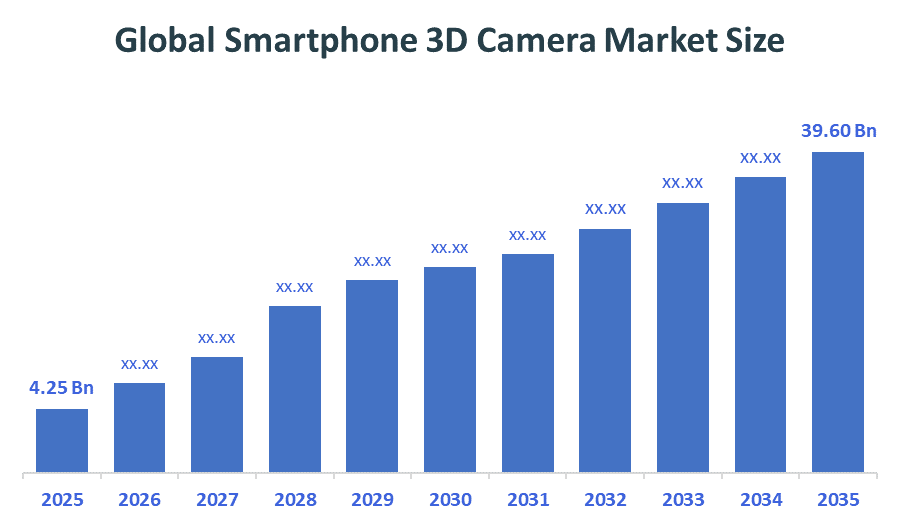
According to Decision Advisors, the Global Smartphone 3D Camera Market Size is expected to grow from USD 4.25 billion in 2025 to USD 39.60 billion by 2035, at a CAGR of 25.01% during the forecast period 2026-2035. The global smartphone 3D camera market is expanding because of the biometric authentication and immersive AR VR applications, and AI-based 3D scanning technology create new user experiences. The increasing need for computational photography and premium content creation drives manufacturers to install advanced depth-sensing systems which help their devices stand out in the worldwide market for high-end smartphones.
Market Overview/ Introduction
The Smartphone 3D Camera functions as a sophisticated imaging system which records depth information together with visual content to achieve accurate three-dimensional object and environment measurements. The systems use Time-of-Flight sensors and stereo vision and structured light technologies to improve their depth acquisition capabilities through enhanced accuracy and speed and increased detail. The global smartphone 3D camera market experiences growth because these technologies enable facial authentication and augmented reality and gaming and e-commerce visualization applications. The increasing need for immersive user experiences together with secure biometric systems drives the adoption of 3D sensing technology which upcoming mobile devices will use as their main competitive advantage. The smartphone 3D camera market is moving from exclusive premium adoption to widespread mid-range deployment because artificial intelligence depth detection technology and miniaturized system design and affordable sensor development are active drivers of this market transition. The development of real-time 2D-to-3D image conversion combined with improved image accuracy now enables businesses to create new applications which include immersive augmented reality shopping experiences and spatial gaming and virtual content production. The future opportunities such as gesture-based interface systems and secure biometric identification methods and the unification of different systems which include augmented reality and virtual reality technologies because 3D sensing technology serves as the fundamental technology for future mobile experiences.
- In United States, the CHIPS and Science Act allocate USD 52 billion for semiconductor manufacturing and R&D, strengthening supply chains and supporting innovation in imaging sensors critical to the global smartphone 3D camera market.
- In China, the “Made in China 2025” initiative is backed by semiconductor investments exceeding USD150-300 billion, strengthening domestic chip and imaging sensor production, and positioning the country as a dominant supplier in the global smartphone 3D camera market.
- In South Korea, a USD 450 billion semiconductor investment plan by 2030 is accelerating production of advanced imaging sensors and chips, strengthening supply chains and innovation within the global smartphone 3D camera market.
Notable Insights: -
- Asia-Pacific holds the largest regional market share, approximately 47.6% in the global smartphone 3D camera market.
- North America is the fastest growing region in the smartphone 3D camera market is propelled by strong demand for premium devices, widespread adoption of facial recognition, and continuous innovation in AR, AI, and advanced imaging technologies.
- By Sensor, the Time of Flight (TOF) segment held a dominant position with 43.2% in terms of market share in 2025.
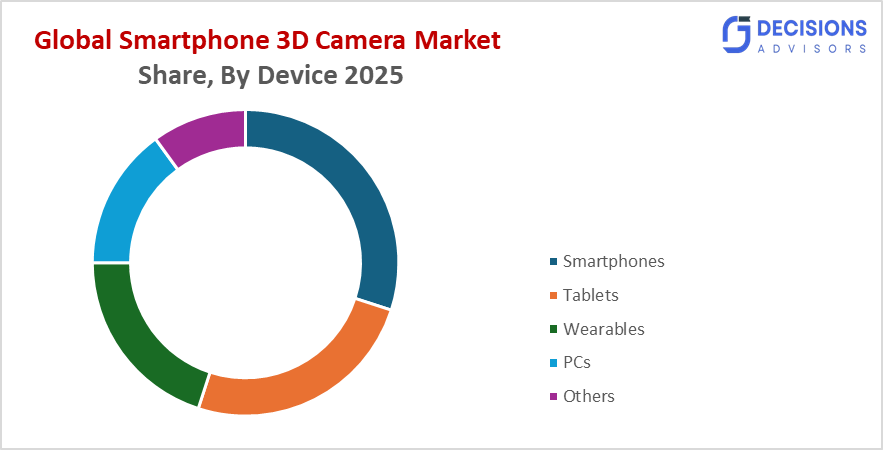
- By Device, Smartphones Segment is the dominating accounting for over 77.5% of the global market share in 2025.
- The compound annual growth rate of the global smartphone 3D camera market is 25.01%.
- The market is likely to achieve a valuation of USD 39.60 billion by 2035.
What is role of technology in grooming the market?
The global smartphone 3D camera market experiences its main transformation through technological advancements because of these improvements turn devices into complete virtual reality systems. The development of depth-sensing technologies such as Time of Flight and structured light enables accurate facial recognition together with AR experiences and spatial mapping. The application of artificial intelligence improves real-time processing capabilities together with scene comprehension and computational photography methods. The advancement of semiconductor technology together with miniaturization techniques now enables lower power usage while delivering enhanced equipment functionality. The combination of 5G technology with cloud computing and edge processing enables efficient data management which establishes 3D cameras as a crucial element for future smartphone models. In Germany, the industry 4.0 initiative is accelerating smart manufacturing through AI and automation, indirectly boosting demand for advanced 3D sensing and imaging technologies in the global smartphone 3D camera market.
How is Recent Developments Helping the Market?
The Global Smartphone 3D Camera Market is witnessing a fundamental transformation because of innovative technology has started to reach all consumer markets instead of staying limited to high-end products. Time-of-Flight sensor technology has developed to provide higher accuracy measurements which require less energy use, enabling manufacturers to integrate this technology into their mid-range smartphone products and create new market opportunities. The combination of AI with imaging technology is establishing new user standards which enable real-time 3D asset creation to make devices more functional. The advanced sensing systems are providing stronger biometric security, which creates higher trust levels for users who conduct mobile transactions. In Switzerland-based MDPI indicates miniaturised 3D camera modules can reduce system size, weight, and power consumption by up to 30%, enabling efficient smartphone integration and accelerating innovation in the global smartphone 3D camera market.
Market Drivers
The Global Smartphone 3D Camera Market is experiencing growth because of both immersive digital experiences and advanced security needs are becoming more common. The increasing use of augmented and virtual reality technology across gaming environments retail spaces and social media networks creates a need for accurate depth-sensing 3D cameras which become essential equipment in developing interactive content. The users are increasingly adopting biometric authentication systems because they want secure access to devices which users prefer to operate through facial recognition and 3D scanning systems. The consumer market demands enhanced photography features which include portrait effects and real-time 3D modelling, which leads manufacturers to develop advanced sensing technologies. The continuous development of Time-of-Flight sensors and artificial intelligence and computational imaging technologies enables better performance at lower costs, which makes multiple device types more accessible to users while driving sustainable growth in the market.
Restrain
The global smartphone 3D camera market experiences significant limitations which arise from expensive costs and intricate design methods. The market for products which use advanced depth-sensing technology starts to limit itself to high-end devices because of the increased material costs that come with using infrared components and custom optical systems. The power consumption requirements together with the space needed for operation create difficulties for the implementation of this technology in modern slim smartphone designs.
Competitive Analysis:
The report offers the appropriate analysis of the key organizations/companies involved within the smartphone 3D camera market, along with a comparative evaluation primarily based on their product of offering, business overviews, geographic presence, enterprise strategies, segment market share, and SWOT analysis. The report also provides an elaborative analysis focusing on the current news and developments of the companies, which includes product development, innovations, joint ventures, partnerships, mergers & acquisitions, strategic alliances, and others. This allows for the evaluation of the overall competition within the market.
Top Companies in Global Smartphone 3D Camera market
- Sony Corporation
- Samsung Electronics
- Apple Inc.
- Infineon Technologies AG
- STMicroelectronics
- Qualcomm Incorporated
- Intel Corporation
- LG Innotek
- OmniVision Technologies
- Himax Technologies
Government Initiatives
|
Country |
Key Government Initiatives |
|
Saudi Arabia |
In Saudi Arabia, the USD500 billion NEOM project under Vision 2030 is accelerating adoption of AI and sensor technologies, indirectly supporting innovation and demand growth in the global smartphone 3D camera market. |
|
Japan |
In Japan, initiatives like Society 5.0 and Connected Industries are accelerating AI and IoT-driven manufacturing, indirectly boosting development of advanced imaging and 3D sensing technologies in the global smartphone 3D camera market. |
|
South Korea |
In South Korea, a KRW 26 trillion ($19 billion) semiconductor support package is strengthening domestic chip and sensor production, accelerating innovation and supply chain resilience in the global smartphone 3D camera market. |
Market Segmentation
The Smartphone 3D Camera Market share is classified into sensor, device, and application
- The Time of Flight (TOF) segment dominated the market in 2024 and is projected to grow at a substantial CAGR of approximately 43.2% during the forecast period.
Based on the sensor, the smartphone 3D camera market is divided into time of flight (TOF), structured light, dual camera, others. Among these, the time of flight (TOF) segment dominated the market in 2024 and is projected to grow at a substantial CAGR of approximately 43.2% during the forecast period. It is because of the system achieves better performance in advanced depth measurement capabilities and its ability to provide real-time environmental data and its seamless operation with multiple devices. The technology maintains its popularity because people use it for facial recognition and AR applications and advanced imaging.
- The Smartphones segment accounted for the largest share in 2024 and is anticipated to grow at a significant CAGR of approximately 77.5% during the forecast period.
Based on the device, the smartphone 3D camera market is divided into smartphones, tablets, wearables, PCs, others. Among these, The Smartphones segment accounted for the largest share in 2024 and is anticipated to grow at a significant CAGR of approximately 77.5% during the forecast period. It is dominating because of the platform serves as the main consumer electronics system which drives development of new imaging technologies. The ongoing development of biometric security and augmented reality and computational photography technologies leads to 3D sensing systems being integrated into smartphones.
- The facial recognition segment dominated the market in 2024, and is projected to grow at a substantial CAGR during the forecast period.
Based on the application, the Smartphone 3D Camera Market is divided into augmented reality (AR), virtual reality (VR), facial recognition, gaming, others. Among these, the Facial Recognition segment dominated the market in 2024, and is projected to grow at a substantial CAGR during the forecast period. The security serves as the main component for device ecosystems. The technology enables quick contactless authentication which users need for unlocking their devices and making payments and accessing applications. The 3D sensing technologies have become standard in both premium and mid-range smartphones due to this technology.
Strategies to Implement for Growth of the Market in Non-Leading Regions
The global smartphone 3D camera market needs non-leading regions to follow a strategy that combines affordable solutions with ecosystem partnerships and local market adaptation. The manufacturers need to develop affordable 3D sensing modules which will help them enter markets that base their buying decisions on price in emerging economies. The adoption process will speed up through partnerships between telecom operators and app developers who will integrate AR and biometric security and imaging functions into common applications. Local assembly and supply chain development will bring down expenses while making products easier for customers to obtain. The consumer awareness campaigns about practical advantages such as secure payments and better photography will enhance acceptance. The governments can support business growth through their digital infrastructure investments which offer advanced component manufacturing incentives to develop 3D camera technologies for a wider audience.
Regional Segment Analysis of the Smartphone 3D Camera Market
- North America (U.S., Canada, Mexico)
- Europe (Germany, France, U.K., Italy, Spain, Rest of Europe)
- Asia-Pacific (China, Japan, India, Rest of APAC)
- South America (Brazil and the Rest of South America)
- The Middle East and Africa (UAE, South Africa, Rest of MEA)
Asia-Pacific is anticipated to hold the largest share of the Smartphone 3D Camera Market over the predicted timeframe. The Asia-Pacific is anticipated to hold the largest share of the smartphone 3D camera market, accounting for approximately 47.6% of total revenue over the forecast period. It is because of the advanced electronics production capabilities together with increased demand for modern mobile technology products. China, South Korea, and Japan lead technological development through their innovative efforts which succeed because more people adopt smartphones and utilize biometric and augmented reality technologies.
North America is expected to grow at a rapid CAGR in the Smartphone 3D Camera Market during the forecast period. The North America market will experience fast growth because it accounts for approximately 62.5% of it is due to the United States market shows high demand for premium devices together with an increasing need for users to adopt facial recognition and augmented reality technologies.
Europe is the 3rd largest region to grow in the Smartphone 3D Camera Market during the region. The Europe region stands as the third biggest area global for the smartphone 3D camera market since it holds approximately 22.8% the strong demand for premium devices and a technology-conscious consumer base. The countries like Germany and France are driving adoption, with increasing integration of biometric security and advanced imaging features across high-end smartphones.
Future Market Trends in Smartphone 3D Camera Market: -
- Expansion into Mid-Range Devices
The development of 3D camera technology has progressed to mid-range smartphones because its essential components have become more affordable. The adoption of ToF sensors through cost-effective module design enables manufacturers to deliver their products to more consumers and achieve higher product distribution which results in market expansion from exclusive high-end products to widespread consumer accessibility.
- Rise of Immersive AR Ecosystems
The increasing use of augmented reality applications in gaming and retail and social media platforms creates a need for accurate depth sensing technology. Smartphones now function as immersive platforms that use real-time environment mapping to enable advanced augmented reality applications which combine digital elements with real-world environments.
- Advancements in Sensor Miniaturisation
The development of miniaturization technology allows current smartphones to use advanced 3D sensing systems which operate successfully in their thinner designs. The use of compact modules which consume less power has resulted in higher operational efficiency for manufacturers, who can now implement advanced imaging systems while preserving their products' lightweight designs and extended operating time.
Recent Development
- In June 2024, companies like Samsung Electronics introduced advanced ToF sensors with 200 MHz modulation, enhancing depth accuracy and processing speed, thereby strengthening performance and innovation in the global smartphone 3D camera market.
- In March 2024, United Arab Emirates advanced its Digital Government Strategy 2025, supporting investments exceeding USD 1 billion in digital infrastructure, indirectly accelerating adoption of AI-driven imaging and 3D sensing technologies in the global smartphone 3D camera market.
Market Segment
This study forecasts revenue at global, regional, and country levels from 2020 to 2035. Decision Advisors has segmented the Smartphone 3D Camera Market based on the above-mentioned segments:
Global Smartphone 3D Camera Market, By Sensor
- Time of Flight (TOF)
- Structured Light
- Dual Camera
- Others
Global Smartphone 3D Camera Market, By Device
- Smartphones
- Tablets
- Wearables
- PCs
- Others
Global Smartphone 3D Camera Market, By Application
- Augmented Reality (AR)
- Virtual Reality (VR)
- Facial Recognition
- Gaming
- Others
Global Smartphone 3D Camera Market, By Regional Analysis
- North America
- US
- Canada
- Mexico
- Europe
- Germany
- UK
- France
- Italy
- Spain
- Russia
- Rest of Europe
- Asia Pacific
- China
- Japan
- India
- South Korea
- Australia
- Rest of Asia Pacific
- South America
- Brazil
- Argentina
- Rest of South America
- Middle East & Africa
- UAE
- Saudi Arabia
- Qatar
- South Africa
- Rest of the Middle East & Africa
Frequently Asked Questions (FAQ)
Q. What is driving the evolution of the smartphone 3D camera market?
A. The market develops through two main forces which include technological advancements and changes in consumer behavior. The market demand for digital experiences which provide complete immersion together with safe authentication and better photographic capabilities is driving manufacturers to adopt advanced 3D sensing technology. AI and AR and depth-mapping technologies now enable smartphones to function as intelligent sensing devices instead of basic communication devices.
Q. Which technologies are leading the smartphone 3D camera market?
A. The Time-of-Flight and structured light technologies deliver accurate depth measurement through their advanced measurement systems. The technologies have become popular because they enable facial authentication and AR experiences to operate in real-time. Continuous innovation increases their operational efficiency, which makes them essential components for developing next-generation smartphones.
Q. What role does artificial intelligence play in this market?
A. The modern 3D camera systems of today rely on artificial intelligence technology which allows them to process information in real time and make automated decisions. AI technology improves image quality while providing facial recognition support and enabling advanced scene understanding and object tracking features. The system needs this integration to achieve its goal of providing uninterrupted high-quality imaging together with security solutions.
Q. How are regional dynamics shaping the market?
A. Asia-Pacific leads due to strong manufacturing capabilities and high smartphone penetration while North America drives innovation through premium device adoption. Europe provides its contribution through technological advancements and regulatory frameworks. Digital infrastructure improvements together with rising consumer awareness are helping emerging regions to achieve progress
Check Licence
Choose the plan that fits you best: Single User, Multi-User, or Enterprise solutions tailored for your needs.
We Have You Covered
- 24/7 Analyst Support
- Clients Across the Globe
- Tailored Insights
- Technology Tracking
- Competitive Intelligence
- Custom Research
- Syndicated Market Studies
- Market Overview
- Market Segmentation
- Growth Drivers
- Market Opportunities
- Regulatory Insights
- Innovation & Sustainability
Report Details
| Scope | Global |
| Pages | 200 |
| Delivery | PDF & Excel via Email |
| Language | English |
| Release | Apr 2026 |
| Access | Download from this page |