
Global Sodium Ion Battery Market
 |
Author:
Somesh R
|
Pages:
210
|
Author:
Somesh R
|
Pages:
210
Global Sodium Ion Battery Market Size, Share, By Technology (Sodium-Sulphur, Sodium-Salt, and Sodium-Air) By Application (Grid-Level Energy Storage, Electric Vehicles, Consumer Electronics, and Industrial Backup) By End User (Automotive, Power Utilities, Electronic Manufacturing, and Telecommunications) and By Region (North America, Europe, Asia-Pacific, Latin America, Middle East and Africa), Analysis and Forecast 2026 - 2035
CAGR
23.5%
REVENUE 2025
USD Billion 0.63
FORECAST 2035
USD Billion 5.2
REPORT COVERAGE
Global
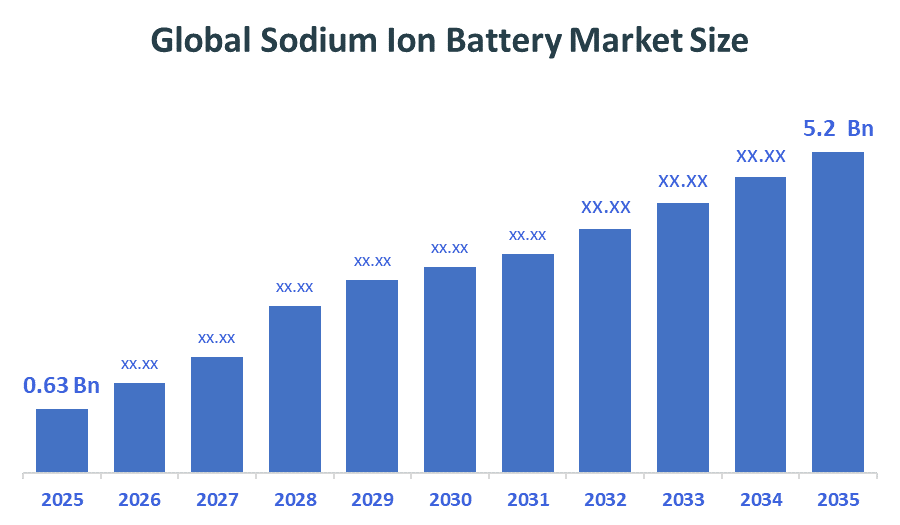
The Global Sodium Ion Battery Market Size was predicted to grow from USD 0.63 billion in 2025 and is projected to reach around USD 5.2 billion by 2035. According to Decision Advisors, a research report on the sodium-ion battery market shows that the sodium-sulphur technology trend dominates the global sodium-ion battery market, holding approximately 40-50% of the total share worldwide. Contemporary Amperex Technology Co., Limited (CATL) leads the market with USD 58 billion in 2025 fiscal annual revenue.
Market Snapshot
- Global Sodium Ion Battery Market Size (2025): USD 0.63 Billion
- Global Sodium Ion Battery Projected Market Size (2035): USD 5.2 Billion
- Global Sodium Ion Battery Compound Annual Growth Rate (CAGR): 23.5%
- Largest Regional Market: Asia-Pacific
- Fastest Growing Region: Europe
- 3rd Largest Region: North America
- Base Year: 2025
- Historical Period: 2021 - 2024
- Forecast Period: 2026 - 2035
Market Overview / Introduction
Sodium-ion battery technologies represent a collection of electrochemical energy storage technologies aimed at the efficient retention of energy for the applications of electric mobility, renewable energy grids, and backup power sources. In addition, the sodium ion batteries act as the transitional stage between lead-acid battery technology and the top-of-the-range lithium-ion batteries, being based on salt-rich raw materials and employing cathode chemistry enabling fast charging cycles while producing negligible environmental impacts. Contemporary sodium ion batteries are distinguished by characteristics including high thermal stability and the capacity to discharge at deep depths, ensuring performance consistency and minimising chances of thermal runaway effects. Sodium-ion batteries used to be a rare laboratory prototype technology, but have now become fully-fledged commercial energy storage devices incorporating a high degree of safety, winter operation capabilities, and the ability to operate in smart grids. The popularity growth of sodium-ion battery technology is associated with the increasing need for sustainable energy storage and energy management at reduced costs, which is relevant for applications in urban transportation and stationary storage facilities. The advantage of sodium ion batteries includes protecting supply chains from the price fluctuations and shortages through utilising inexpensive sodium rather than cobalt or lithium.
- The renewable energy and power utility segments contribute to approximately 55% of the application-based use in the market, driven by the increasing demand for solar energy smoothing, wind farm storage, and the safeguarding of essential digital power hubs.
- The US Department of Energy announced a multi-million-dollar grant for the development of sodium-ion battery supply chains, pushing industries to adopt non-lithium energy systems to meet stricter energy security requirements.
- Sodium-based propulsion technology in the automotive sector is experiencing substantial growth, with a CAGR forecasted to surpass 23% on account of the increasing adoption of low-cost battery packs as part of the advanced generation of budget electric vehicles for providing optimised safety to large-scale fleet operations and light-duty transit.
Notable Insights: -
- Sodium-sulphur modules make up about 48.2% of the total market share of this sector. They have gained a reputation in large-scale stationary storage operations, particularly in utility-scale grids, research laboratories, and heavy industrial processing units.
- About 68.5% of all installations occur in utility grid stations and commercial energy facilities. These investments are stimulated mainly by high levels of investment into energy transition projects and carbon-neutral initiatives because many regions experience lithium supply chain bottlenecks that result in the delay of critical green energy services.
- Applications of sodium ion batteries in the sphere of light electric vehicles account for almost 38.4% of all demand. The rapid development of two-wheelers and three-wheelers, alongside increased worries about lithium price fluctuations in emerging markets, has become one of the main drivers of using these advanced systems.
- About 45.8% of the market value belongs to the Asia-Pacific region in 2026. Many countries within this region, like China and South Korea, invest considerable amounts of money in battery Gigafactories and material science infrastructure in order to address the growing needs of their expanding transport sectors.
- Solid-state sodium batteries show an annual increase above 8.5%. The rise in safety requirements and frequent occurrences of thermal incidents in traditional batteries create conditions that encourage enterprises to invest more money in modular sodium-ion energy solutions.
What is the Role of Technology in Shaping the Market?
The current advancements in technology have seen many innovative developments in the field of energy storage regarding energy density, life cycles, and safety of the process. The modern generation of sodium ion batteries is no longer an experimental prototype, but rather has become a sophisticated electrochemical management system that can operate on its own for long periods due to its ability to use Prussian blue analogues, layered oxide cathodes, and electrolyte management systems.
How are Recent Developments Helping the Market?
Some of the innovations are the use of large capacity hard carbon anode technology, the use of advanced solid-state electrolytes performance, and zero-volt storage capabilities. Such innovations have been very helpful in facilitating the growth of the industry. Some of the innovations have included the designing of battery modules that can protect all types of power needs from very small personal gadgets to big utility-scale storage racks without any problem at all. With the help of intelligent balancing techniques, such innovations will be able to facilitate automatic energy management through electrochemical pressure without any errors from humans or malfunctions of the systems.
Market Drivers
The global demand for sodium-ion batteries is expected to grow due to the growing financial investments by energy companies and governments toward energy sustainability and lithium-free architecture capable of meeting the net-zero objectives in today’s times. Modern sodium-ion batteries have witnessed significant market acceptance due to their various advantages arising from integrating several aspects, such as low-temperature tolerance, rapid charging, and transportation safety into a single effective and economical system. However, the advent of the mass-market electric vehicle category has resulted in a growing requirement for economic energy storage options that will enable the adoption of the shift from the internal combustion engine to electric propulsion systems in economically vulnerable markets, where the deployment of expensive lithium-ion battery technologies has become impractical.
Restraints
The growth of the international market for the sodium ion battery industry is constrained by the difficulties in achieving energy densities comparable to high-nickel lithium-ion cells because of the larger atomic size of sodium and the current early-stage maturity of the supply chain.
Competitive Analysis:
The report offers the appropriate analysis of the key organisations/companies involved within the sodium ion battery market, along with a comparative evaluation primarily based on their product offerings, business overviews, geographic presence, enterprise strategies, segment market share, and SWOT analysis. The report also provides an elaborate analysis focusing on the current news and developments of the companies, which includes product development, innovations, joint ventures, partnerships, mergers & acquisitions, strategic alliances, and others. This allows for the evaluation of the overall competition within the market.
Top 10 Companies in the Global Sodium Ion Battery Market
- Contemporary Amperex Technology Co., Limited (CATL)
- Faradion Limited (Reliance Industries)
- HiNa Battery Technology Co., Ltd.
- Tiamat Energy
- Natron Energy, Inc.
- Altris AB
- AMTE Power plc
- NGK Insulators, Ltd.
- TIAMAT
- Jiangsu Zilong New Energy Technology Co., Ltd.
Government Initiatives
|
Country |
Key Government Initiatives |
|
US |
In alignment with the Department of Energy's domestic battery manufacturing goals for 2026, the federal government has intensified funding for the FOA program. This initiative allocates significant grants to develop sodium-based energy storage to reduce reliance on foreign-sourced lithium. |
|
EU |
The European Battery Alliance has set stricter sustainability targets and introduced the strategic autonomy principle, aiming to increase the share of alternative battery chemistries to more than 15% annually by 2030, significantly influencing sodium ion battery adoption. |
|
India |
In the Union Budget 2026, the Indian government granted Production Linked Incentive (PLI) status to advanced chemistry cells, facilitating a national framework for battery expansion. The government has proposed a 30% grant-eligible support for alternative chemistries like sodium-ion and zinc-air. |
Study on the Supply, Demand, Distribution, and Market Environment
The sodium ion battery industry's success hinges on balancing its capability to function with utmost electrochemical efficiency and the increasing requirement for energy management that is reliable, yet affordable. Sodium-ion battery production is rooted in creating sodium salts and carbon materials that can offer a consistent voltage output without compromising their performance through excessive deterioration compared to the first-generation batteries.
Price Analysis and Consumer Behaviour Analysis
The price of sodium-ion batteries will depend on factors such as energy density, cycle life rating, and discharging capacity. The high-end models that use solid-state and are fitted with advanced battery management systems and thermal management systems will be expensive. Nonetheless, conventional sodium-sulfur batteries and small salt-based batteries designed for stationary applications will be affordable, making them the perfect choice for providing power backup and energy storage solutions at home. It is evident that consumers are leaning towards cost-efficient and safe models in the long run; therefore, manufacturers should focus on products that are autonomous, easily integrated into the grid, and accurately deliver energy over long periods of time.
Market Segmentation
The Global Sodium Ion Battery Market share is classified into technology, application, and end user.
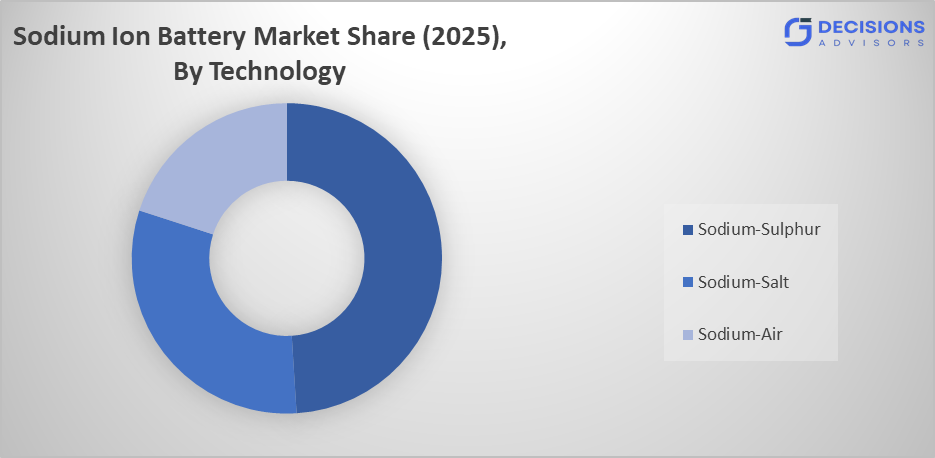
The Sodium-Sulphur segment holds the largest share, contributing approximately 49% of the market in 2025.
Based on the Technology, the global sodium ion battery market is divided into Sodium-Sulphur, Sodium-Salt, and Sodium-Air. Among these, the Sodium-Sulphur segment holds the largest share, contributing approximately 49% of the market in 2025. The reason for this dominance lies in their proven track record in large-scale energy storage and their ability to provide high energy density for stationary applications without consuming excessive amounts of rare materials compared to lithium variants. The sodium-salt and sodium-air represent the other two major segments in this market, but they still remain relevant due to their potential for high safety and theoretical energy capacity.
The Grid-Level Energy Storage segment accounts for the largest share, representing over 58% of the global market in 2025.
Based on the Application, the global sodium-ion battery market is divided into Grid-Level Energy Storage, Electric Vehicles, Consumer Electronics, and Industrial Backup. Among these, the Grid-Level Energy Storage segment accounts for the largest share, representing over 58% of the global market in 2025. These deployments are critical for maintaining the stability of renewable energy grids, improving localised power control, and reducing intermittency-related energy losses through the adoption of modern, large-scale storage equipment. On the other hand, the Electric Vehicles segment has emerged as a rapidly growing sector, thanks to the increasing adoption of micro-mobility solutions and the transition of entry-level EV models for urban commuting.
Power Utilities dominate the global market, accounting for approximately 54% of the total revenue in 2025.
Based on the End User, the global sodium ion battery market is divided into Automotive, Power Utilities, Electronic Manufacturing, and Telecommunications. Among these, Power Utilities dominate the global market, accounting for approximately 54% of the total revenue in 2025. This segment is preferred by operators who require large-scale integrated storage and professional energy engineering services for complex renewable energy infrastructure. The Automotive category is seeing a sharp increase in use, especially in the production of small electric cars and e-scooters, where cost-effective energy storage is required to maintain market competitiveness.
Strategies to Implement for Growth of the Market in Non-Leading Regions
The potential for growth within the sodium ion battery industry in emerging regions could be increased through the deployment of efficient modular storage platforms for local energy developers, as well as local agencies tasked with rural electrification management. Programs aimed at achieving energy independence by governments, coupled with the expansion of electric micro-mobility standards, contribute substantially toward demand within regions with traditional power grids that pose significant challenges to the installation of expensive lithium-based infrastructure. Further support through increasing investments in training local battery technicians, as well as setting up regional assembly facilities, will facilitate the adoption of sustainable power and smart energy solutions.
Regional Segment Analysis of the Global Sodium Ion Battery Market
- North America (U.S., Canada, Mexico)
- Europe (Germany, France, U.K., Italy, Spain, Rest of Europe)
- Asia-Pacific (China, Japan, India, South Korea, Rest of APAC)
- Latin America (Brazil and the Rest of Latin America)
- The Middle East and Africa (UAE, South Africa, Rest of MEA)
Asia-Pacific is projected to be the dominant region over the forecast period. This region is anticipated to witness a growth rate of around 19.50% CAGR, maintaining a dominant market share within the global industry. In 2025, the Asia-Pacific already account for approximately 42.5% of global revenue. This is owing to the fast-developing battery manufacturing infrastructure, coupled with the growing demand for affordable electric mobility in countries such as China and India. Other reasons for the same include greater investments made toward energy storage mandates in the region, state-supported research projects for low-cost cathode materials, and widespread adoption of grid-scale storage strategies.
Europe is expected to be the fastest-growing region for the sodium ion battery market during the forecast period. This region holds approximately 24.5% share of global revenue in 2025, thanks to its highly sophisticated regulatory framework related to the Circular Economy, along with the extensive adoption of alternative chemistries in both green deal goals and high-value industrial energy applications. The largest part of this region’s revenues comes from Germany and the UK, as there is a lot of spending at the corporate level in research and development for high-safety battery modules and local material sourcing.
North America is expected to hold a significant share of the sodium ion battery market during the forecast period. This region holds approximately 26.8% share of global revenue in 2025 and is projected to witness a steady growth rate of around 21.5% CAGR from 2026 to 2035. This is thanks to its highly sophisticated infrastructure related to utility-scale energy storage, along with the extensive adoption of energy-efficient technology in both national security and industrial backup applications. The largest part of this region’s revenues comes from the United States, as there is substantial spending at the federal level, such as the Department of Energy’s LENS Consortium, aimed at accelerating domestic manufacturing capabilities. Other reasons for the same include a focus on supply chain resilience to reduce reliance on imported minerals, strategic pilot projects for military energy storage, and local research partnerships focused on high-power Prussian Blue Analogue (PBA) chemistries for uninterrupted power systems.
Recent Developments
- In September 2025, the energy storage industry faced a significant shift as the U.S. startup Natron Energy announced it would halt operations and cancel its $1.4 billion gigafactory plans in North Carolina.
- In April 2025, CATL officially launched its Naxtra sodium-ion battery during its inaugural Super Tech Day. This breakthrough technology achieved mass-production status for the first time, offering an energy density of up to 175 Wh/kg and the ability to maintain 90% capacity even in extreme temperatures as low as -40°C.
- In March 2025, CATL's Chief Scientist announced the development of a second-generation sodium-ion battery. This upcoming version aims to exceed an energy density of 200 Wh/kg.
- In October 2024, Reliance Industries significantly expanded its green energy portfolio by completing further integration of Faradion Limited, a UK-based leader in non-aqueous sodium-ion technology.
Market Segmentation
This study forecasts revenue at global, regional, and country levels from 2021 to 2035. The Global Sodium Ion Battery Market is segmented based on the following categories:
Global Sodium Ion Battery Market, By Technology
- Sodium-Sulphur
- Sodium-Salt
- Sodium-Air
Global Sodium Ion Battery Market, By Application
- Grid-Level Energy Storage
- Electric Vehicles
- Consumer Electronics
- Industrial Backup
Global Sodium Ion Battery Market, By End User
- Automotive
- Power Utilities
- Electronic Manufacturing
- Telecommunications
Global Sodium Ion Battery Market, By Regional Analysis
- North America
- United States
- Canada
- Mexico
- Europe
- Germany
- United Kingdom
- France
- Italy
- Spain
- Russia
- Rest of Europe
- Asia Pacific
- China
- Japan
- India
- South Korea
- Australia
- Rest of Asia Pacific
- Latin America
- Brazil
- Argentina
- Rest of Latin America
- Middle East & Africa
- United Arab Emirates
- Saudi Arabia
- Qatar
- South Africa
- Rest of Middle East & Africa
Frequently Asked Questions (FAQ)
What is the environmental impact of sodium-ion battery production compared to lithium-ion?
Sodium-ion batteries offer a significantly lower environmental footprint because they eliminate the need for scarce and ecologically damaging materials like cobalt, lithium, and copper. By utilising abundant sodium salts and aluminium current collectors for both electrodes, the production process reduces mining-related carbon emissions and avoids the ethical concerns associated with heavy metal extraction in sensitive regions.
How does the zero-volt storage capability benefit the logistics of sodium-ion batteries?
Unlike lithium-ion batteries, which must be maintained at a specific state of charge to prevent degradation during transit, sodium-ion batteries can be discharged to zero volts for completely safe shipping and long-term storage. This unique characteristic removes the risk of thermal incidents during transport, simplifies international shipping regulations, and significantly reduces logistics costs for manufacturers and distributors.
Can sodium-ion batteries operate effectively in extreme weather conditions?
One of the most vital advantages of this technology is its exceptional thermal resilience, particularly in cold climates where lithium-ion batteries typically lose significant power. Sodium ion systems maintain over 90% of their discharge capacity at temperatures as low as -20°C, making them an ideal choice for energy storage in high-latitude regions and for electric vehicles operating in harsh winter environments.
How do sodium-ion batteries contribute to global energy security?
By transitioning to sodium-based chemistry, nations can decrease their strategic dependency on a handful of countries that control the majority of the world's lithium and cobalt reserves. Since sodium is available globally via common salt, this technology allows for the decentralisation of battery supply chains, enabling countries to build domestic energy storage industries using locally sourced materials.
Check Licence
Choose the plan that fits you best: Single User, Multi-User, or Enterprise solutions tailored for your needs.
We Have You Covered
- 24/7 Analyst Support
- Clients Across the Globe
- Tailored Insights
- Technology Tracking
- Competitive Intelligence
- Custom Research
- Syndicated Market Studies
- Market Overview
- Market Segmentation
- Growth Drivers
- Market Opportunities
- Regulatory Insights
- Innovation & Sustainability
Report Details
| Scope | Global |
| Pages | 210 |
| Delivery | PDF & Excel via Email |
| Language | English |
| Release | Apr 2026 |
| Access | Download from this page |