
South Korea Baler Market
 |
Pages:
210
|
Pages:
210
South Korea Baler Market Size, Share, By Type (Vertical Balers, Horizontal Balers, Automatic Balers), By Application (Waste Management, Recycling Facilities, Manufacturing, Logistics & Warehousing, Retail), By Material Type (Paper, Plastic, Metal, Cardboard), By Region (North America, Europe, Asia-Pacific, Latin America, Middle East, and Africa) Analysis and Forecast 2026 - 2035
REPORT COVERAGE
Country
Market Snapshot
- Market Size (2025): USD 195.79Million
- Projected Market Size (2035): USD 621.1Million
- Compound Annual Growth Rate (CAGR): 12.24%
- Base Year: 2025
- Historical Period: 2021–2025
- Forecast Period: 2026–2035
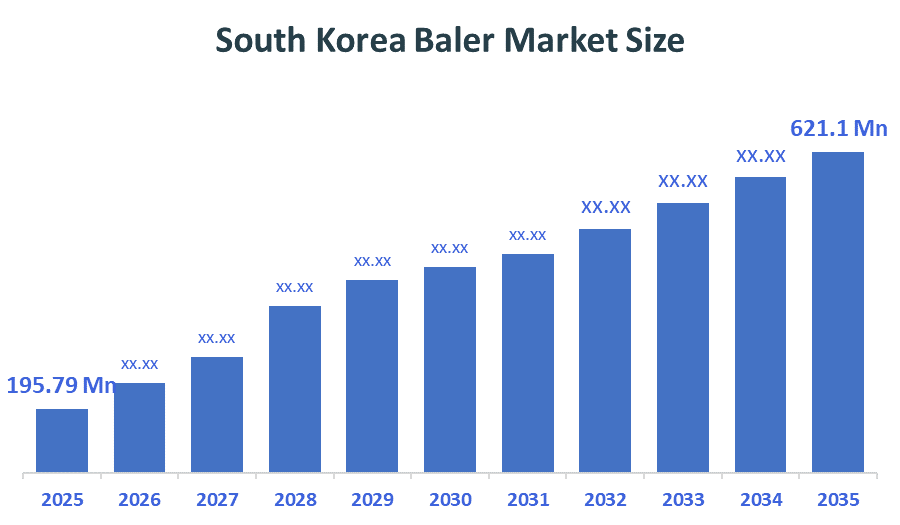
According to Decision Advisors, the South Korea Baler Market Size is expected to grow from USD 640.3Million in 2025 to USD 621.1Million by 2035, at a CAGR of 12.24% during the forecast period 2025-2035. South Korea Baler Market is driven by strong recycling regulations, rapid industrial automation, and increasing adoption of smart waste compaction systems in urban infrastructure and manufacturing hubs.
Market Overview/Introduction
The South Korea Baler Market refers to equipment which compresses recyclable materials into compact bales for storage and transportation and recycling purposes. The systems find application across waste management plants and manufacturing facilities and logistics centers and retail supply chains. The market is expanding because industrial waste production keeps rising and environmental regulations become more stringent and governmental bodies enforce recycling and zero-waste initiatives. Baling systems achieve operational improvements through automation which decreases the need for human labour. The market is controlled by horizontal balers which hold more than 50% market share because they provide high capacity and effective performance for big recycling facilities. Smart balers which use IoT-based monitoring systems achieve efficiency improvements of 25-35% because they enable predictive maintenance and automated compression control. South Korea holds approximately 8% of the Asia-Pacific baler market because advanced recycling systems and strong industrial manufacturing capabilities drive the industry forward.
Notable Insights: -
- By Light Source, the LED Industrial Air Blower held a dominant position with 10.2 % in terms of market share in 2025.
- By technology, waste management is the dominating accounting for over 9.8% of the United Kingdom market share in 2025.
- The compound annual growth rate of the South Korea Baler Market is 12.24%.
- The market is likely to achieve a valuation of USD 621.1Million by 2035.
What is role of Technology in grooming the market?
Technology plays a crucial role in enhancing the efficiency and automation of baler systems. Modern balers equipped with IoT sensors enable real-time monitoring of pressure, bale size, and machine performance, improving operational efficiency by up to 30%, while also enabling data-driven optimization that can increase throughput by 18–22%. Automation and PLC-based control systems reduce manual intervention and increase throughput in recycling facilities. Energy-efficient hydraulic systems have reduced power consumption by nearly 20–25%, while smart fault detection systems help reduce downtime by up to 20%. In addition, AI-enabled analytics platforms are helping operators predict maintenance needs up to 7–10 days in advance, reducing unexpected breakdowns by nearly 15%. Around 40% of large recycling facilities in South Korea have already adopted semi-automatic or fully automatic balers, improving waste handling efficiency and reducing operational costs significantly. Furthermore, adoption of cloud-connected baler systems has grown by approximately 25% in the past few years, enabling centralized monitoring across multi-site recycling operations. Overall system productivity in smart-enabled facilities is estimated to be 20–35% higher compared to traditional setups.
Market Drivers
The South Korean Baler Market experiences growth because of government recycling requirements and rising industrial waste production and increasing environmental sustainability awareness. The South Korean recycling systems handle more than 60% of industrial waste which creates an increased need for balers. The growth of e-commerce and logistics sectors has resulted in higher packaging waste which leads warehouses and distribution centers to implement automated baling systems. The industrial sector is compelled to use compact waste management systems because of strict landfill reduction regulations and circular economy initiatives. The market growth accelerates because of increased automation in both manufacturing and waste management processes.
Restrain
High initial installation costs of advanced automatic balers limit adoption among small and medium-sized enterprises. Maintenance and hydraulic system complexity also increase operational expenses. Integration of automated balers into existing waste management infrastructure can be challenging due to compatibility issues. Additionally, fluctuations in recyclable material prices impact investment decisions in recycling equipment.
Study on the Supply, Demand, Distribution, and Market Environment South Korea Baler Market
The South Korea Baler Market operates through manufacturers, recycling facility operators, distributors, and industrial equipment suppliers. The market generates over USD 450 million annually, driven by strong demand from recycling centers and manufacturing industries. Horizontal balers dominate supply with nearly 50–55% share due to high efficiency and large-scale processing capabilities. Distribution occurs through direct sales, OEM partnerships, and industrial equipment suppliers. Demand is increasing due to rising waste generation, government recycling targets, and adoption of smart waste management systems. Export of baling equipment from South Korea is also growing due to strong engineering capabilities. In addition, domestic demand is supported by a recycling recovery rate exceeding 60% in key urban regions, which continues to drive investments in advanced waste compaction systems. Imports still account for nearly 20–25% of high-end automated baler systems, particularly for AI-enabled and fully automated models. The aftermarket service segment is also expanding, contributing around 15–18% of total market revenue through maintenance, upgrades, and spare parts supply. Furthermore, adoption of energy-efficient balers is rising steadily, with nearly 35% of new installations now focused on low-energy hydraulic systems. The logistics and e-commerce sector is emerging as a fast-growing end-user, contributing to approximately 26% of incremental demand due to increasing packaging waste volumes.
Price Analysis and Healthcare Facilities Behaviour Analysis
Automatic balers cost approximately 30% more than semi-automatic systems due to advanced hydraulics and automation features. The system generates cost savings for businesses because it decreases labour expenses by 27% and enhances overall operational productivity between 20-35% which results in better financial performance during its 5–7-year operational period. Large industrial users account for over 60% of total baler adoption, especially in recycling plants and manufacturing sectors. Automated balers have been adopted by 55% of urban waste processing facilities, while small and medium enterprises still use semi-automatic systems because of their financial limitations. Almost 45% of new recycling infrastructure projects in South Korea now require automated baler systems to be installed as standard equipment. The introduction of IoT-enabled predictive maintenance systems has reduced automatic baler maintenance expenses by 15-20%. The adoption rate in logistics and warehousing centers has increased by approximately 28% because of two factors: rising e-commerce packaging waste and stricter sustainability regulations.
Strategies to Implement for Growth of the Market
The development of energy-efficient compact automatic baler systems by manufacturers will lead to higher adoption rates of their products. AI predictive maintenance systems decrease equipment downtime by 20% while they boost equipment usage through their ability to predict faults and schedule maintenance. Companies are also expanding service networks and offering rental-based equipment models to reduce upfront costs for small businesses, with equipment leasing and subscription-based models increasing adoption by nearly 25–30% among SMEs in urban industrial clusters. Government-sponsored recycling programs promote industrial sector adoption which leads to a 30-35% increase in automatic baler usage at municipal recycling centers. The development of modular baler systems by manufacturers enables them to achieve faster installation times and simpler maintenance procedures. Approximately 43% of new systems now feature IoT-enabled dashboards which provide real-time monitoring capabilities that enhance operational transparency while decreasing unplanned operational interruptions by 10-15%. South Korea's baler equipment exports to Southeast Asian recycling markets have increased by 18-22% according to rising international production demands.
Market Segmentation
The South Korea Baler Market share is classified into light source, application, and end-user
- The horizontal balers dominated the market in 2018, and is projected to grow at a substantial CAGR of approximately 10.2 % during the forecast period.
Based on the type, the South Korea Baler Market is divided into vertical balers, horizontal balers, automatic balers. Among these, the horizontal balers dominated the market in 2018, and is projected to grow at a substantial CAGR of approximately 10.2 % during the forecast period. Horizontal balers dominated due to their high capacity, continuous operation, and automation compatibility. They efficiently handle large industrial waste volumes, integrate with conveyors and IoT systems, reduce labor needs, and lower transport costs, making them ideal for South Korea’s recycling and manufacturing sectors.
- The waste management accounted for the largest share in 2018, and is anticipated to grow at a significant CAGR of approximately 9.8% during the forecast period.
Based on the application, the South Korea Baler Market is divided into waste management, recycling facilities, manufacturing, logistics & warehousing, retail. Among these, the waste management accounted for the largest share in 2018, and is anticipated to grow at a significant CAGR of approximately 9.8% during the forecast period. Waste management dominated due to high municipal waste generation, strict recycling regulations, and landfill reduction policies. It enables efficient waste collection, compaction, and transport, while lowering logistics costs and space usage, making it essential for South Korea’s urban and industrial infrastructure.
- The cardboard segment dominated the market in 2018, and is projected to grow at a substantial CAGR approximately 10.1% during the forecast period.
Based on the material type, the South Korea Baler Market is divided into paper, plastic, metal, cardboard. Among these, the cardboard segment dominated the market in 2018, and is projected to grow at a substantial CAGR approximately 10.1% during the forecast period. Cardboard dominated due to high generation from e-commerce, retail, and logistics packaging waste. It is highly recyclable and cost-effective, making it a priority in recycling programs. Government sustainability policies and strict packaging waste regulations further increase collection and baling demand, supporting efficient storage, transportation, and large-scale recycling operations.
Recent Development
- In March 2025, automation awards and discussions around baler technology occurred globally e.g., KUHN's agricultural baler automation award at FIGAN 2025 in Spain, but nothing specific to South Korean waste/recycling facilities.
- In November 2025: Waste-to-Energy Facility Upgrades in Seongnam City included Valmet delivering a Distributed Control System (DCS) and information management system for a new incineration plant processing up to 500 tonnes of municipal waste daily, improving waste preprocessing efficiency and supporting better integration with upstream baling and sorting systems.
- 2024–2025: Broader smart waste integration in South Korea accelerated with continued deployment of IoT-enabled systems, including smart bins with compaction and AI-based monitoring tools, optimizing recycling operations and improving baler ecosystem efficiency through real-time tracking and automated waste management solutions.
- In March 2025, Supplier activity in South Korea increased focus on modular hydraulic balers with automatic tying and cutting systems, as leading manufacturers expanded customized solutions for recycling centers to enhance efficiency, automation, and operational flexibility in waste processing.
Competitive Analysis
The report offers the appropriate analysis of the key organisations/companies involved within the South Korea Baler Market, along with a comparative evaluation primarily based on their technology offering, business overviews, geographic presence, enterprise strategies, segment market share, and SWOT analysis. The report also provides an elaborative analysis focusing on the current news and developments of the companies, which includes technology development, innovations, joint ventures, partnerships, mergers & acquisitions, strategic alliances, and others. This allows for the evaluation of the overall competition within the market.
Top Key Companies in South Korea Baler Market
- SINOBALER
- HSM GmbH + Co. KG
- CK International
- Marathon Equipment
- Bramidan
- Wastequip
- Shini Plastics Technologies
- Dongfeng Machinery
- Avermann Maschinenfabrik
- International Baler Corporation
- Presona AB
- Tana Oy
- Others
Key Target Audience
- Market Players
- Investors
- End-users
- Government Authorities
- Consulting and Research Firm
- Venture capitalists
- Value-Added Resellers (VARs)
Market Segment
This study forecasts revenue at the South Korea, regional, and country levels from 2020 to 2035. Decision Advisors has segmented the South Korea Baler Market based on the below-mentioned segments
South Korea Baler Market, By type
- Vertical Balers
- Horizontal Balers
- Automatic Balers
South Korea Baler Market, By Application
- Waste Management
- Recycling Facilities
- Manufacturing
- Logistics and Warehousing
- Retail
South Korea Baler Market, By Material Type
- Paper
- Plastic
- Metal
- Cardboard
Frequently Asked Questions (FAQ)
- What is a baler used for in South Korea?
Balers are used to compress recyclable waste materials like paper, plastic, and metal into compact bales for storage and transportation.
- Why are horizontal balers widely used?
They offer high capacity, continuous operation, and are ideal for large-scale recycling facilities.
- Which industries are the major users of balers?
Waste management, manufacturing, logistics, retail, and recycling industries.
- How does government policy affect the market?
Strict recycling regulations and circular economy initiatives drive adoption of advanced baling systems.
- What technologies are shaping the market?
IoT monitoring, automation systems, AI-based predictive maintenance, and energy-efficient hydraulics.
Check Licence
Choose the plan that fits you best: Single User, Multi-User, or Enterprise solutions tailored for your needs.
We Have You Covered
- 24/7 Analyst Support
- Clients Across the Globe
- Tailored Insights
- Technology Tracking
- Competitive Intelligence
- Custom Research
- Syndicated Market Studies
- Market Overview
- Market Segmentation
- Growth Drivers
- Market Opportunities
- Regulatory Insights
- Innovation & Sustainability
Report Details
| Scope | Country |
| Pages | 210 |
| Delivery | PDF & Excel via Email |
| Language | English |
| Release | Apr 2026 |
| Access | Download from this page |