
Global Spatial Light Modulator Market
 |
Author:
Shruti G
|
Pages:
210
|
Author:
Shruti G
|
Pages:
210
Global spatial light modulator Market Size, Share, By Technology (Liquid Crystal Spatial, Light Modulators, Digital Micromirror Devices, Liquid Crystal on Silicon, Microelectromechanical Systems), By Component Type (Hardware, Software and Services), By Application (Projectors, Optical Communication, Displays, Biomedical Applications, and Consumer Electronics) and By Region (North America, Europe, Asia-Pacific, Latin America, Middle East, and Africa), Analysis and Forecast 2026-2035
CAGR
6.71%
REVENUE 2025
USD Billion 4.77
FORECAST 2035
USD Billion 9.13
REPORT COVERAGE
Global
Market Snapshot
- Global Spatial Light Modulator Market Size (2025): USD 4.77 Billion
- Projected Global Spatial Light Modulator Market Size (2035): USD 9.13 Billion
- Global Spatial Light Modulator Compound Annual Growth Rate (CAGR): 6.71%
- Largest Regional Market: Asia Pacific
- Fastest Growing Region: North America
- 3rd Largest Region: Europe
- Base Year: 2025
- Historical Period: 2021–2024
- Forecast Period: 2026–2035
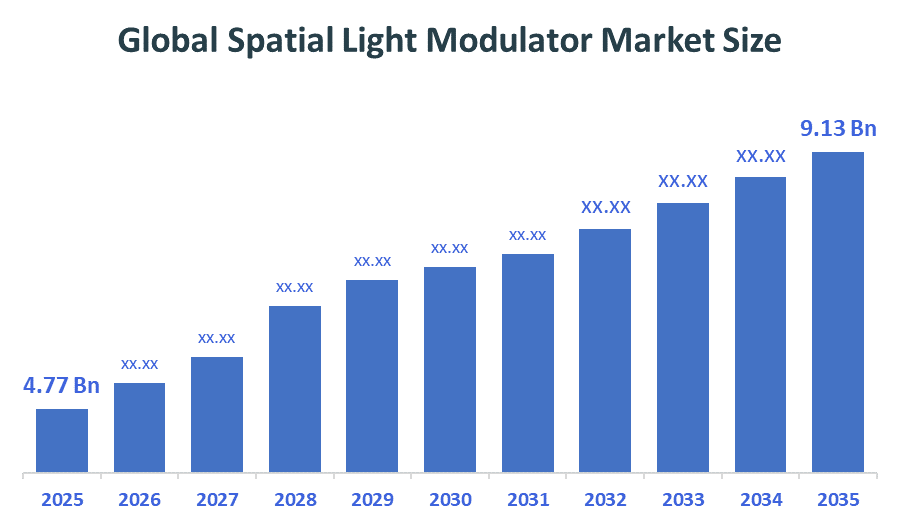
According to Decision Advisors, the Global Spatial Light Modulator Market Size is expected to grow from USD 4.77 Billion in 2025 to USD 9.13 Billion by 2035, at a CAGR of 6.71% during the forecast period 2026-2035. Global spatial light modulator market is expected to experience substantial growth over the forecast period due increasing demand in holography, 3D imaging, optical communication, augmented and virtual reality, and beam shaping applications, supported by rapid advancements in photonics, display technologies, and expanding adoption across defence, healthcare, and consumer electronics sectors.
Market Overview/ Introduction
Spatial light modulator market refers to the global industry focused on devices that control light intensity, phase, or polarization for applications in imaging, holography, optical communication, displays, and scientific research, driven by advancements in photonics and digital optics technologies. A Spatial Light Modulator (SLM) driver is an electronic control system that supplies signals and voltages to modulate each pixel of the SLM, enabling precise control of light phase, intensity, or polarization for applications in holography, displays, and optical systems. Technologies include Liquid Crystal on Silicon (LCoS), Nematic Liquid Crystal, Ferroelectric Liquid Crystal, Digital Micromirror Device (DMD), and MEMS-based modulators, enabling precise control of light phase, intensity, and polarization. Recent developments focus on improving speed, power handling, resolution, efficiency, compactness, and integration with emerging technologies like AI, meta surfaces, and high-power lasers. Government initiatives supporting the spatial light modulator market include programs like National Quantum Mission, promoting quantum photonics research, funding for optical technologies, and “Make in India” policies encouraging domestic manufacturing, innovation, and R&D in photonics, semiconductor, and advanced display technologies across defence, telecom, and scientific sectors.
- The National Quantum Mission (?6,000+ crore, 2023–2031) promotes research in photonics, quantum communication, and optical devices, all of which rely on SLM technologies.
- Programs like Make in India and Digital India promote domestic manufacturing, semiconductor development, and electronics innovation. Since SLMs are part of the optoelectronics and photonics ecosystem, these initiatives support local production capabilities, supply chains, and R&D.
- MEMS-based SLM technology using piezoelectrically actuated silicon-nitride resonant waveguide gratings. Features like >100 MHz modulation speed, >20 dB extinction ratio, and CMOS-compatible fabrication (200 mm wafers) align with cutting-edge SLM development.
Notable Insights: -
- Asia-Pacific holds the largest regional market share approximately 41% in the global Spatial light modulator market.
- North America is the fastest growing region market share approximately 28% in the global Spatial light modulator market.
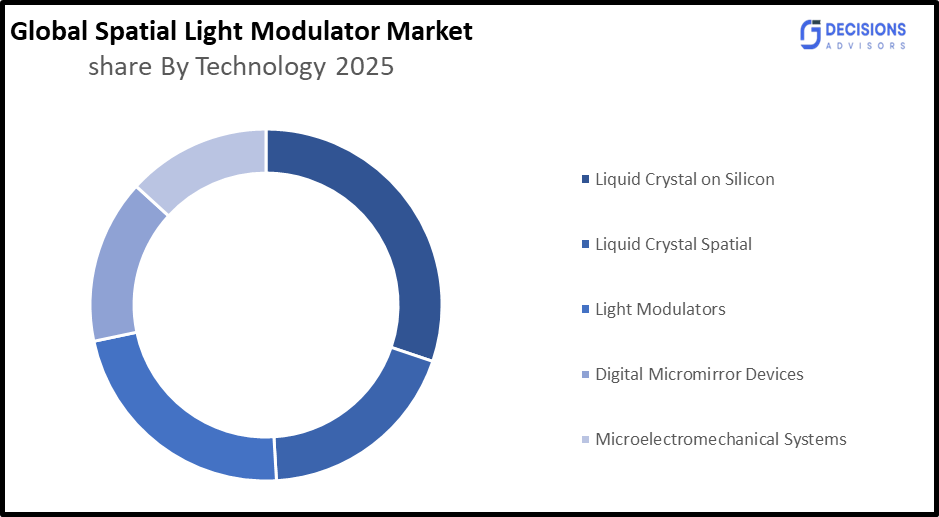
- By technology, the Liquid Crystal on Silicon segment held a dominant position with 42% in terms of market share in 2025.
- By component type, Hardware segment is the dominating accounting for market is approximately 56%.
- By application, displays segment held a dominant position market is approximately 33%.
- The market is likely to achieve a valuation of USD 9.13 Billion by 2035.
What is role of technology in grooming the market?
Technology plays a crucial role in shaping the Spatial Light Modulator market by enabling faster response times, higher resolution, and improved light control. Innovations in liquid crystal, MEMS, and meta surface technologies enhance performance and expand applications in holography, AR/VR, and optical communication. Integration with AI and advanced photonics further accelerates adoption across defence, healthcare, and consumer electronics sectors, driving market growth and continuous product innovation globally.
How is Recent Developments Helping the Market?
Recent developments in Spatial Light Modulators are accelerating market growth by improving speed, resolution, and energy efficiency. Innovations such as meta surface-based SLMs, advanced liquid crystal designs, and MEMS technologies enable real-time holography, enhanced AR/VR experiences, and precise beam control. These advancements expand applications in optical communication, healthcare imaging, and quantum technologies. Increased R&D investments and integration with AI-driven systems further enhance performance, reduce costs, and encourage wider adoption across industrial, defence, and consumer electronics sectors globally.
Market Drivers
The Spatial Light Modulators (SLM) market is driven by multiple technological and industry-specific factors that are accelerating its global adoption. One of the primary drivers is the increasing demand for advanced display technologies, particularly in augmented reality (AR), virtual reality (VR), and holographic imaging, where SLMs enable high-resolution and dynamic light control. Another key driver is the rapid growth of optical communication systems, where SLMs are used for signal modulation, beam steering, and data transmission efficiency. The rising use of SLMs in healthcare applications, including advanced microscopy, biomedical imaging, and laser-based diagnostics, is further supporting market expansion. Technological advancements in Liquid Crystal on Silicon (LCoS), MEMS, and meta surface-based SLMs are improving performance parameters such as response time, resolution, and energy efficiency, making them more suitable for complex applications. Additionally, increasing adoption in defence and aerospace sectors for adaptive optics, laser targeting, and simulation systems is contributing to demand. Growing investments in photonics research, quantum computing, and semiconductor technologies, along with supportive government initiatives and funding programs, are further accelerating innovation and commercialization. Moreover, the expansion of consumer electronics and industrial laser processing applications is creating new growth opportunities, significantly driving the Spatial Light Modulator market globally.
Restrain
The Spatial Light Modulators market faces restraints such as high device costs, complex manufacturing processes, and limited scalability for mass production. Technical challenges including slower response times in some liquid crystal SLMs and sensitivity to environmental conditions also hinder performance. Additionally, high power consumption and integration difficulties with existing systems can limit widespread adoption across certain applications.
Competitive Analysis:
The report offers the appropriate analysis of the key organizations/companies involved within the spatial light modulator market, along with a comparative evaluation primarily based on their Product of offering, business overviews, geographic presence, enterprise strategies, segment market share, and SWOT analysis. The report also provides an elaborative analysis focusing on the current news and developments of the companies, which includes Product development, innovations, joint ventures, partnerships, mergers & acquisitions, strategic alliances, and others. This allows for the evaluation of the overall competition within the market.
Top Companies in Global Spatial light modulator Market
- Hamamatsu Photonics
- HOLOEYE Photonics
- Santec Corporation
- Meadowlark Optics
- Jenoptik AG
- Texas Instruments
- Forth Dimension Displays
- Thorlabs Inc.
- Laser 2000 GmbH
- LightTrans International
- PerkinElmer Inc.
- American Electric Power
Government Initiatives
|
Country |
Key Government Initiatives |
|
US |
In January 2026, the National Quantum Initiative Reauthorization Act of 2026 was introduced to strengthen U.S. leadership in quantum technologies. The bill expands funding for quantum R&D, research centres, and infrastructure across agencies like NIST, NSF, and NASA, supporting advanced optical control systems and photonics. |
|
Germany |
In October 2025, Germany reinforced its Quantum Technologies Action Plan, committing nearly €3 billion by 2026 to advance quantum computing and photonics hardware. |
|
Japan |
In August 2025, Japan’s NEDO Post-5G Program advanced its project on “Accelerating the Development of Quantum Computers toward Industrialization.” Under this initiative, Hamamatsu Photonics was selected for the 2025–2027 phase to develop high-resolution Spatial Light Modulators (SLMs), ultra-high-speed cameras, and laser stabilization technologies in collaboration with RIKEN and AIST. |
Price Analysis and Consumer Behaviour Analysis
Price analysis in the Spatial Light Modulator (SLM) market shows relatively high costs due to advanced materials, precision manufacturing, and limited large-scale production, with prices varying by resolution, speed, and technology type (LCoS, MEMS). Consumer behaviour is primarily driven by performance requirements, reliability, and application-specific needs rather than price sensitivity. Industries such as defence, healthcare, and research prioritize quality and customization. However, increasing competition, technological advancements, and growing demand for AR/VR and optical communication are gradually reducing costs and encouraging broader adoption across commercial and industrial sectors.
Market Segmentation
The Spatial light modulator market share is classified into technology, component type, and application
- The technology segment dominated the market in 2025, and is projected to grow at a substantial CAGR of approximately 42% during the forecast period.
Based on the technology, the Spatial light modulator market is divided into liquid crystal spatial, light modulators, digital micromirror devices, liquid crystal on silicon, microelectromechanical systems. Among these,Liquid Crystal on Silicon (LCoS) dominates the Spatial Light Modulator market, accounting for approximately 41–43% market share. Its leadership is driven by superior resolution, high light efficiency, and precise phase modulation, making it ideal for holography, AR/VR, and optical systems. Increasing adoption in photonics and display technologies further strengthens its market position.
- The component type segment accounted for the largest share in 2025, and is anticipated to grow at a significant CAGR of approximately 56% during the forecast period.
Based on the component type, the spatial light modulator market is divided into hardware, software and services. Among these, the Hardware segment dominates the Spatial Light Modulator market, accounting for approximately 55–60% market share. This is due to the high cost and critical role of physical components such as SLM panels, controllers, and optical modules. Increasing demand for advanced photonics devices in AR/VR, defense, and imaging systems further drives hardware dominance over software and services.
- The application segment dominated the market in 2025, and is projected to grow at a substantial CAGR of approximately 33% during the forecast period.
Based on the service, the Spatial light modulator market is divided into projectors, optical communication, displays, biomedical applications, and consumer electronics. Among these, Displays dominate the Spatial Light Modulator market by application, accounting for approximately 30–34% market share. This dominance is driven by rising demand for high-resolution projection systems, AR/VR devices, and holographic displays. Increasing adoption in consumer electronics and commercial display technologies further strengthens the segment’s leading position globally.
Strategies to Implement for Growth of the Market in Non-Leading Regions
To drive growth of the Spatial Light Modulator (SLM) market in non-leading regions, companies should focus on cost-effective solutions and localized manufacturing to reduce import dependency. Strategic partnerships with regional research institutes and universities can enhance innovation and adoption. Increasing awareness through training programs and industry collaborations is essential. Expanding distribution networks and leveraging digital sales channels can improve accessibility. Government engagement for incentives, subsidies, and favourable policies will support market entry. Additionally, targeting emerging applications such as AR/VR, healthcare imaging, and industrial automation, along with offering customized and scalable solutions, can accelerate adoption and strengthen market presence in developing regions.
Regional Segment Analysis of the Spatial light modulator Market
- North America (U.S., Canada, Mexico)
- Europe (Germany, France, U.K., Italy, Spain, Rest of Europe)
- Asia-Pacific (China, Japan, India, Rest of APAC)
- South America (Brazil and the Rest of South America)
- The Middle East and Africa (UAE, South Africa, Rest of MEA)
Asia Pacific is anticipated to hold the largest share of the Spatial light modulator market over the predicted timeframe.
The Asia Pacific region is anticipated to hold the largest share of the spatial light modulator market, over the predicted timeframe, with strong growth momentum. The region is expected to accounting for approximately 38% to 42% of total market revenue, driven by rapid industrialization and technological advancements. Increasing investments in photonics, semiconductor manufacturing, and display technologies, along with rising demand for AR/VR and optical communication, are fueling market expansion. Countries such as China, Japan, South Korea, and India are key contributors to this sustained regional growth.
North America is expected to grow at a rapid CAGR in the Spatial light modulator market during the forecast period. North America is expected to grow at a rapid CAGR in the spatial light modulator market, holds approximately 25% to 30% market share during the forecast period. The region benefits from strong investments in photonics, defence technologies, and advanced research infrastructure. Increasing adoption of SLMs in AR/VR, aerospace, healthcare imaging, and optical communication further supports growth. Additionally, the presence of leading technology companies and continuous innovation are key factors driving sustained market expansion in North America.
Europe is the 3rd largest region to grow in the Spatial light modulator market during the region. Europe is the third-largest region in the spatial light modulator market, accounting for approximately 20% to 25% of global market revenue, supported by strong research and development activities in photonics and optics. Increasing adoption in industrial automation, healthcare imaging, and scientific research is driving demand. Countries such as Germany, France, and United Kingdom play a key role in advancing technology and market expansion across the region.
Future Market Trends in Global Spatial light modulator Market: -
- Rising Adoption in AR/VR and Holography
Spatial Light Modulators are increasingly used in AR/VR and holographic systems to deliver high-resolution, immersive visual experiences. Their ability to dynamically control light enables real-time image rendering and depth perception. Growing demand for advanced displays in gaming, training, and simulation is accelerating adoption, encouraging manufacturers to develop compact, energy-efficient, and high-speed SLM solutions for next-generation visual technologies.
2. Advancements in Photonics and High-Speed Devices
Technological advancements in photonics are enabling the development of faster, more efficient Spatial Light Modulators with improved response times and resolution. Innovations in LCoS, MEMS, and meta surface technologies are enhancing device performance. These improvements support applications in optical communication, data processing, and beam steering, driving demand for high-speed, low-latency systems across telecom, defence, and research sectors.
3. Expansion in Biomedical Imaging and Laser Applications
Spatial Light Modulators are gaining traction in biomedical imaging, microscopy, and laser-based applications due to their precision in light control. They enable advanced imaging techniques, including 3D imaging and adaptive optics, improving diagnostic accuracy. In industrial settings, SLMs enhance laser processing and material fabrication. Increasing investments in healthcare technologies and laser systems are further boosting market growth and application diversity.
Recent Development
- In February 2026, Nature Nanotechnology reported the Optically Addressed Metasurface SLM (OA-MSLM), featuring sub-micron pixels, optical addressing, and real-time holography, enabling advanced applications in AR/VR, LiDAR, and dynamic multicolour holography.
- In January 2026, Santec Corporation launched a limited-time AOC special offer on Spatial Light Modulators, enhancing accessibility for R&D and industrial users, reflecting growing commercialization and market availability of high-performance SLM products.
- In January 2026, arXiv reported a 10 MHz RIPA Spatial Light Modulator with frequency multiplexing, enabling ultrafast 2D beam control, site-resolved optical pulsing, and quantum wavefront shaping applications.
Market Segment
This study forecasts revenue at global, regional, and country levels from 2021 to 2035. Decision Advisors has segmented the Spatial light modulator market based on the below-mentioned segments:
Global Spatial light modulator Market, By Technology
- Liquid Crystal Spatial
- Light Modulators
- Digital Micromirror Devices
- Liquid Crystal on Silicon
- Microelectromechanical Systems
Global Spatial light modulator Market, By Component Type
- Hardware
- Software
- Services
Global Spatial light modulator Market, By Application
- Projectors
- Optical Communication
- Displays
- Biomedical Applications
- Consumer Electronics
Global Spatial light modulator Market, By Regional Analysis
- North America
- US
- Canada
- Mexico
- Europe
- Germany
- UK
- France
- Italy
- Spain
- Russia
- Rest of Europe
- Asia Pacific
- China
- Japan
- India
- South Korea
- Australia
- Rest of Asia Pacific
- South America
- Brazil
- Argentina
- Rest of South America
- Middle East & Africa
- UAE
- Saudi Arabia
- Qatar
- South Africa
- Rest of the Middle East & Africa
Frequently Asked Questions (FAQ)
1. Question: What are the key environmental impacts associated with manufacturing Spatial Light Modulators?
Answer: The report does not address environmental considerations. Manufacturing SLMs involves complex photonics fabrication, which may generate chemical waste and consume significant energy. Adoption of greener materials, energy-efficient production processes, and recycling strategies could reduce environmental impact.
2. Question: Which emerging startups or small enterprises are driving innovation in the Spatial Light Modulator market?
Answer: The report lists major companies but does not provide insights into emerging startups. New ventures specializing in MEMS-based SLMs, meta surface technologies, or high-speed modulators are increasingly contributing to innovation and niche applications.
3. Question: How are SLM technologies being integrated with artificial intelligence (AI) in real-world applications?
Answer: While AI integration is briefly mentioned, the report does not provide details. AI-enabled SLM systems can optimize real-time beam shaping, holographic rendering, and adaptive optics, improving performance in AR/VR, LiDAR, and quantum experiments.
4. Question: What is the expected impact of raw material shortages on the SLM market growth?
Answer: The report does not discuss supply chain risks. Shortages of specialized optical materials, rare-earth elements, or silicon wafers could temporarily constrain production, increase costs, and affect market expansion, particularly in high-resolution or MEMS-based SLM segments.
5. Question: Are there regional differences in government incentives or subsidies for SLM adoption outside the US, Germany, and Japan?
Answer: The report highlights only the US, Germany, and Japan. Other regions, such as China, South Korea, and the EU, may offer research grants, tax incentives, or industrial subsidies supporting SLM manufacturing and adoption, but specific programs are not detailed in the report.
- Introduction
- Objectives of the Study
- Market Definition
- Research Scope
- Research Methodology and Assumptions
- Executive Summary
- Premium Insights
- Porter’s Five Forces Analysis
- Value Chain Analysis
- Top Investment Pockets
- Market Attractiveness Analysis By Technology
- Market Attractiveness Analysis By Component Type
- Market Attractiveness Analysis By Application
- Market Attractiveness Analysis By Region
- Industry Trends
- Market Dynamics
- Market Evaluation
- Drivers
- Increase in health consciousness
- Restraints
- Strict adherence to regulations required for sugar substitute products
- Opportunities
- Increased investment in R&D activities by manufacturers
- Challenges
5.5.1. Product labeling and claims issues
- Global Spatial Light Modulator Market Analysis and Projection, By Technology
- Segment Overview
- Liquid Crystal Spatial
- Light Modulators
- Digital Micromirror Devices
- Liquid Crystal on Silicon
- Microelectromechanical Systems
- Global Spatial Light Modulator Market Analysis and Projection, By Component Type
- Segment Overview
- Hardware
- Software
- Services
- Global Spatial Light Modulator Market Analysis and Projection, By Application
- Segment Overview
- Projectors
- Optical Communication
- Displays
- Biomedical Applications
- Consumer Electronics
- Global Spatial Light Modulator Market Analysis and Projection, By Regional Analysis
- Segment Overview
- North America
- U.S.
- Canada
- Mexico
- Europe
- Germany
- France
- U.K.
- Italy
- Spain
- Asia-Pacific
- Japan
- China
- India
- South America
- Brazil
- Middle East and Africa
- UAE
- South Africa
- Global Spatial Light Modulator Market-Competitive Landscape
- Overview
- Market Share of Key Players in the Spatial Light Modulator Market
- Global Company Market Share
- North America Company Market Share
- Europe Company Market Share
- APAC Company Market Share
- Competitive Situations and Trends
- Coverage Launches and Developments
- Partnerships, Collaborations, and Agreements
- Mergers & Acquisitions
- Expansions
- Company Profiles
- Hamamatsu Photonics
- Business Overview
- Company Snapshot
- Company Market Share Analysis
- Company Coverage Portfolio
- Recent Developments
- SWOT Analysis
- HOLOEYE Photonics
- Business Overview
- Company Snapshot
- Company Market Share Analysis
- Company Coverage Portfolio
- Recent Developments
- SWOT Analysis
- Santec Corporation
- Business Overview
- Company Snapshot
- Company Market Share Analysis
- Company Coverage Portfolio
- Recent Developments
- SWOT Analysis
- Meadowlark Optics
- Business Overview
- Company Snapshot
- Company Market Share Analysis
- Company Coverage Portfolio
- Recent Developments
- SWOT Analysis
- Jenoptik AG
- Business Overview
- Company Snapshot
- Company Market Share Analysis
- Company Coverage Portfolio
- Recent Developments
- SWOT Analysis
- Texas Instruments
- Business Overview
- Company Snapshot
- Company Market Share Analysis
- Company Coverage Portfolio
- Recent Developments
- SWOT Analysis
- Forth Dimension Displays
- Business Overview
- Company Snapshot
- Company Market Share Analysis
- Company Coverage Portfolio
- Recent Developments
- SWOT Analysis
- Thorlabs Inc.
- Business Overview
- Company Snapshot
- Company Market Share Analysis
- Company Coverage Portfolio
- Recent Developments
- SWOT Analysis
- Laser 2000 GmbH
- Business Overview
- Company Snapshot
- Company Market Share Analysis
- Company Coverage Portfolio
- Recent Developments
- SWOT Analysis
- LightTrans International
- Business Overview
- Company Snapshot
- Company Market Share Analysis
- Company Coverage Portfolio
- Recent Developments
- SWOT Analysis
- PerkinElmer Inc.
- Business Overview
- Company Snapshot
- Company Market Share Analysis
- Company Coverage Portfolio
- Recent Developments
- SWOT Analysis
- American Electric Power
- Business Overview
- Company Snapshot
- Company Market Share Analysis
- Company Coverage Portfolio
- Recent Developments
- SWOT Analysis
- Hamamatsu Photonics
List of Table
- Global Spatial Light Modulator Market, By Technology, 2024-2035(USD Billion)
- Global Liquid Crystal Spatial, Spatial Light Modulator Market, By Region, 2024-2035(USD Billion)
- Global Light Modulators, Spatial Light Modulator Market, By Region, 2024-2035(USD Billion)
- Global Digital Micromirror Devices, Spatial Light Modulator Market, By Region, 2024-2035(USD Billion)
- Global Liquid Crystal on Silicon, Spatial Light Modulator Market, By Region, 2024-2035(USD Billion)
- Global Microelectromechanical Systems, Spatial Light Modulator Market, By Region, 2024-2035(USD Billion)
- Global Spatial Light Modulator Market, By Component Type, 2024-2035(USD Billion)
- Global Hardware, Spatial Light Modulator Market, By Region, 2024-2035(USD Billion)
- Global Software, Spatial Light Modulator Market, By Region, 2024-2035(USD Billion)
- Global Services, Spatial Light Modulator Market, By Region, 2024-2035(USD Billion)
- Global Spatial Light Modulator Market, By Application, 2024-2035(USD Billion)
- Global Projectors, Spatial Light Modulator Market, By Region, 2024-2035(USD Billion)
- Global Optical Communication, Spatial Light Modulator Market, By Region, 2024-2035(USD Billion)
- Global Displays, Spatial Light Modulator Market, By Region, 2024-2035(USD Billion)
- Global Biomedical Applications, Spatial Light Modulator Market, By Region, 2024-2035(USD Billion)
- Global Consumer Electronics, Spatial Light Modulator Market, By Region, 2024-2035(USD Billion)
- North America Spatial Light Modulator Market, By Technology, 2024-2035(USD Billion)
- North America Spatial Light Modulator Market, By Component Type, 2024-2035(USD Billion)
- North America Spatial Light Modulator Market, By Application, 2024-2035(USD Billion)
- U.S. Spatial Light Modulator Market, By Technology, 2024-2035(USD Billion)
- U.S. Spatial Light Modulator Market, By Component Type, 2024-2035(USD Billion)
- U.S. Spatial Light Modulator Market, By Application, 2024-2035(USD Billion)
- Canada Spatial Light Modulator Market, By Technology, 2024-2035(USD Billion)
- Canada Spatial Light Modulator Market, By Component Type, 2024-2035(USD Billion)
- Canada Spatial Light Modulator Market, By Application, 2024-2035(USD Billion)
- Mexico Spatial Light Modulator Market, By Technology, 2024-2035(USD Billion)
- Mexico Spatial Light Modulator Market, By Component Type, 2024-2035(USD Billion)
- Mexico Spatial Light Modulator Market, By Application, 2024-2035(USD Billion)
- Europe Spatial Light Modulator Market, By Technology, 2024-2035(USD Billion)
- Europe Spatial Light Modulator Market, By Component Type, 2024-2035(USD Billion)
- Europe Spatial Light Modulator Market, By Application, 2024-2035(USD Billion)
- Germany Spatial Light Modulator Market, By Technology, 2024-2035(USD Billion)
- Germany Spatial Light Modulator Market, By Component Type, 2024-2035(USD Billion)
- Germany Spatial Light Modulator Market, By Application, 2024-2035(USD Billion)
- France Spatial Light Modulator Market, By Technology, 2024-2035(USD Billion)
- France Spatial Light Modulator Market, By Component Type, 2024-2035(USD Billion)
- France Spatial Light Modulator Market, By Application, 2024-2035(USD Billion)
- U.K. Spatial Light Modulator Market, By Technology, 2024-2035(USD Billion)
- U.K. Spatial Light Modulator Market, By Component Type, 2024-2035(USD Billion)
- U.K. Spatial Light Modulator Market, By Application, 2024-2035(USD Billion)
- Italy Spatial Light Modulator Market, By Technology, 2024-2035(USD Billion)
- Italy Spatial Light Modulator Market, By Component Type, 2024-2035(USD Billion)
- Italy Spatial Light Modulator Market, By Application, 2024-2035(USD Billion)
- Spain Spatial Light Modulator Market, By Technology, 2024-2035(USD Billion)
- Spain Spatial Light Modulator Market, By Component Type, 2024-2035(USD Billion)
- Spain Spatial Light Modulator Market, By Application, 2024-2035(USD Billion)
- Asia Pacific Spatial Light Modulator Market, By Technology, 2024-2035(USD Billion)
- Asia Pacific Spatial Light Modulator Market, By Component Type, 2024-2035(USD Billion)
- Asia Pacific Spatial Light Modulator Market, By Application, 2024-2035(USD Billion)
- Japan Spatial Light Modulator Market, By Technology, 2024-2035(USD Billion)
- Japan Spatial Light Modulator Market, By Component Type, 2024-2035(USD Billion)
- Japan Spatial Light Modulator Market, By Application, 2024-2035(USD Billion)
- China Spatial Light Modulator Market, By Technology, 2024-2035(USD Billion)
- China Spatial Light Modulator Market, By Component Type, 2024-2035(USD Billion)
- China Spatial Light Modulator Market, By Application, 2024-2035(USD Billion)
- India Spatial Light Modulator Market, By Technology, 2024-2035(USD Billion)
- India Spatial Light Modulator Market, By Component Type, 2024-2035(USD Billion)
- India Spatial Light Modulator Market, By Application, 2024-2035(USD Billion)
- South America Spatial Light Modulator Market, By Technology, 2024-2035(USD Billion)
- South America Spatial Light Modulator Market, By Component Type, 2024-2035(USD Billion)
- South America Spatial Light Modulator Market, By Application, 2024-2035(USD Billion)
- Brazil Spatial Light Modulator Market, By Technology, 2024-2035(USD Billion)
- Brazil Spatial Light Modulator Market, By Component Type, 2024-2035(USD Billion)
- Brazil Spatial Light Modulator Market, By Application, 2024-2035(USD Billion)
- The Middle East and Africa Spatial Light Modulator Market, By Technology, 2024-2035(USD Billion)
- The Middle East and Africa Spatial Light Modulator Market, By Component Type, 2024-2035(USD Billion)
- The Middle East and Africa Spatial Light Modulator Market, By Application, 2024-2035(USD Billion)
- UAE Spatial Light Modulator Market, By Technology, 2024-2035(USD Billion)
- UAE Spatial Light Modulator Market, By Component Type, 2024-2035(USD Billion)
- UAE Spatial Light Modulator Market, By Application, 2024-2035(USD Billion)
- South Africa Spatial Light Modulator Market, By Technology, 2024-2035(USD Billion)
- South Africa Spatial Light Modulator Market, By Component Type, 2024-2035(USD Billion)
- South Africa Spatial Light Modulator Market, By Application, 2024-2035(USD Billion)
List of Figures
- Global Spatial Light Modulator Market Segmentation
- Spatial Light Modulator Market: Research Methodology
- Market Size Estimation Methodology: Bottom-Up Approach
- Market Size Estimation Methodology: Top-down Approach
- Data Triangulation
- Porter’s Five Forces Analysis
- Value Chain Analysis
- Top investment pocket in the Spatial Light Modulator Market
- Top Winning Strategies, 2024-2035
- Top Winning Strategies, By Development, 2024-2035(%)
- Top Winning Strategies, By Company, 2024-2035
- Moderate Bargaining power of Buyers
- Moderate Bargaining power of Suppliers
- Moderate Bargaining power of New Entrants
- Low threat of Substitution
- High Competitive Rivalry
- Top Player Positioning, 2024
- Market Share Analysis, 2024
- Restraint and Drivers: Spatial Light Modulator Market
- Spatial Light Modulator Market Segmentation, By Technology
- Spatial Light Modulator Market For Liquid Crystal Spatial, By Region, 2024-2035 ($ Billion)
- Spatial Light Modulator Market For Light Modulators, By Region, 2024-2035 ($ Billion)
- Spatial Light Modulator Market For Digital Micromirror Devices, By Region, 2024-2035 ($ Billion)
- Spatial Light Modulator Market For Liquid Crystal on Silicon, By Region, 2024-2035 ($ Billion)
- Spatial Light Modulator Market For Microelectromechanical Systems, By Region, 2024-2035 ($ Billion)
- Spatial Light Modulator Market Segmentation, By Component Type
- Spatial Light Modulator Market For Hardware, By Region, 2024-2035 ($ Billion)
- Spatial Light Modulator Market For Software, By Region, 2024-2035 ($ Billion)
- Spatial Light Modulator Market For Services, By Region, 2024-2035 ($ Billion)
- Spatial Light Modulator Market Segmentation, By Application
- Spatial Light Modulator Market For Projectors, By Region, 2024-2035 ($ Billion)
- Spatial Light Modulator Market For Optical Communication, By Region, 2024-2035 ($ Billion)
- Spatial Light Modulator Market For Displays, By Region, 2024-2035 ($ Billion)
- Spatial Light Modulator Market For Biomedical Applications, By Region, 2024-2035 ($ Billion)
- Spatial Light Modulator Market For Consumer Electronics, By Region, 2024-2035 ($ Billion)
- Hamamatsu Photonics: Net Sales, 2024-2035 ($ Billion)
- Hamamatsu Photonics: Revenue Share, By Segment, 2024 (%)
- Hamamatsu Photonics: Revenue Share, By Region, 2024 (%)
- HOLOEYE Photonics: Net Sales, 2024-2035 ($ Billion)
- HOLOEYE Photonics: Revenue Share, By Segment, 2024 (%)
- HOLOEYE Photonics: Revenue Share, By Region, 2024 (%)
- Santec Corporation: Net Sales, 2024-2035 ($ Billion)
- Santec Corporation: Revenue Share, By Segment, 2024 (%)
- Santec Corporation: Revenue Share, By Region, 2024 (%)
- Meadowlark Optics: Net Sales, 2024-2035 ($ Billion)
- Meadowlark Optics: Revenue Share, By Segment, 2024 (%)
- Meadowlark Optics: Revenue Share, By Region, 2024 (%)
- Jenoptik AG: Net Sales, 2024-2035 ($ Billion)
- Jenoptik AG: Revenue Share, By Segment, 2024 (%)
- Jenoptik AG: Revenue Share, By Region, 2024 (%)
- Texas Instruments: Net Sales, 2024-2035 ($ Billion)
- Texas Instruments: Revenue Share, By Segment, 2024 (%)
- Texas Instruments: Revenue Share, By Region, 2024 (%)
- Forth Dimension Displays: Net Sales, 2024-2035 ($ Billion)
- Forth Dimension Displays: Revenue Share, By Segment, 2024 (%)
- Forth Dimension Displays: Revenue Share, By Region, 2024 (%)
- Thorlabs Inc.: Net Sales, 2024-2035 ($ Billion)
- Thorlabs Inc.: Revenue Share, By Segment, 2024 (%)
- Thorlabs Inc.: Revenue Share, By Region, 2024 (%)
- Laser 2000 GmbH.: Net Sales, 2024-2035 ($ Billion)
- Laser 2000 GmbH.: Revenue Share, By Segment, 2024 (%)
- Laser 2000 GmbH.: Revenue Share, By Region, 2024 (%)
- LightTrans International: Net Sales, 2024-2035 ($ Billion)
- LightTrans International: Revenue Share, By Segment, 2024 (%)
- LightTrans International: Revenue Share, By Region, 2024 (%)
- PerkinElmer Inc.: Net Sales, 2024-2035 ($ Billion)
- PerkinElmer Inc.: Revenue Share, By Segment, 2024 (%)
- PerkinElmer Inc.: Revenue Share, By Region, 2024 (%)
- American Electric Power: Net Sales, 2024-2035 ($ Billion)
- American Electric Power: Revenue Share, By Segment, 2024 (%)
- American Electric Power: Revenue Share, By Region, 2024 (%)
Check Licence
Choose the plan that fits you best: Single User, Multi-User, or Enterprise solutions tailored for your needs.
We Have You Covered
- 24/7 Analyst Support
- Clients Across the Globe
- Tailored Insights
- Technology Tracking
- Competitive Intelligence
- Custom Research
- Syndicated Market Studies
- Market Overview
- Market Segmentation
- Growth Drivers
- Market Opportunities
- Regulatory Insights
- Innovation & Sustainability
Report Details
| Scope | Global |
| Pages | 210 |
| Delivery | PDF & Excel via Email |
| Language | English |
| Release | Apr 2026 |
| Access | Download from this page |