
Global Spinal Cord Injury Market
 |
Pages:
240
|
Pages:
240
Global Spinal Cord Injury Market Size, Share, By Injury Type (Complete Injury, Incomplete Injury), By Treatment Type (Surgical Intervention, Drug Therapy, Rehabilitation & Physical Therapy, Assistive Devices & Technology, and Regenerative Medicine & Stem Cell Therapy), By End User (Hospitals & Trauma Centers, Rehabilitation Centers, Home Healthcare & Outpatient Services), and By Region (North America, Europe, Asia-Pacific, Latin America, Middle East, and Africa), Analysis and Forecast 2025-2035
REPORT COVERAGE
Global
Market Snapshot
- Market Size (2025): USD 361.2 Million
- Projected Market Size (2035): USD 1561.2 Million
- Compound Annual Growth Rate (CAGR): 15.77%
- Largest Regional Market: North America
- Fastest Growing Region: Asia Pacific
- 2nd Largest Region: Europe
- Base Year: 2025
- Historical Period: 2021–2024
- Forecast Period: 2025–2035
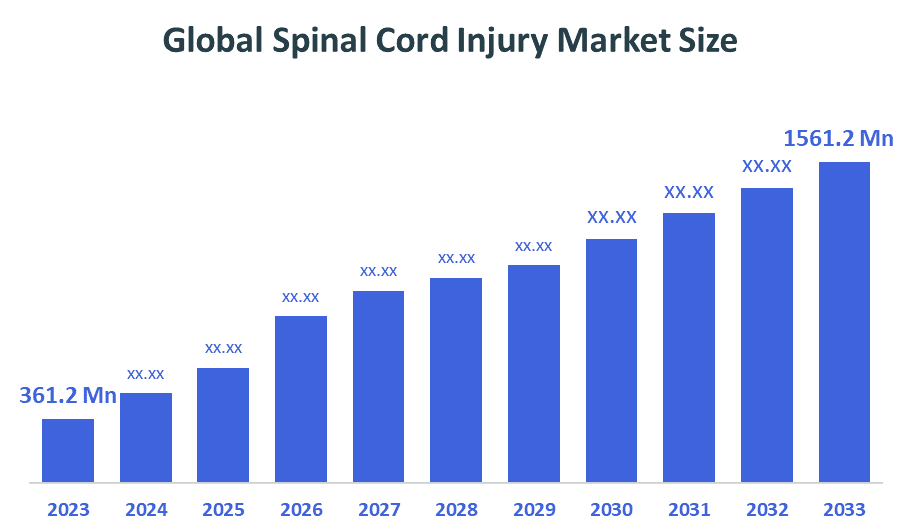
According to Decision Advisors, the Global Spinal Cord Injury Market Size is expected to grow from USD 361.2 million in 2025 to USD 1561.2 million by 2035, at a CAGR of 15.77% during the forecast period 2025-2035. The global spinal cord injury market is projected to grow significantly over the next decade as the incidence rates are increasing because of growing neurostimulation technology usage and regenerative medicine innovations. The advancements in regenerative medicine research have created a major impact on the spinal cord injury market.
Market Overview/ Introduction
The global spinal cord injury (SCI) market refers to the worldwide industry that develops diagnostic and therapeutic, management and rehabilitation solutions for spinal cord injuries, which cause complete or partial loss of motor, sensory and autonomic functions. The spinal cord injury market shows continuous expansion because of increasing traumatic injury cases and ongoing technological progress.
The regenerative medicine field, combined with stem cell therapy, spinal implant technology and exoskeleton development, neurostimulation device advancement and rising demand for long-term care and rehabilitation services and better healthcare access in Asia-Pacific, Latin America and the Middle East and government trauma care development initiatives, all create work possibilities for professionals in the industry.
The Federal Government has announced plans to establish Medical Rehabilitation Centres across Nigeria, with a strong focus on neuro-rehabilitation for persons living with spinal cord injuries. Terebellum and Neurosolv Therapeutics will partner to launch Perineline, a new patented two-part therapy for spinal cord injuries. The drug has attained EMA Orphan Designation, and it is hoped that it will revolutionise the therapeutic treatment and resulting end patient outcomes from spinal cord injuries.
- India’s ASIC Scheme: The Indian government has allocated ?844 crore (2021–2025) to develop specialised spinal injury centres modelled after the Indian Spinal Injuries Centre (ISIC) in New Delhi. Functional centres are currently operating in Jammu and Jaipur.
- Global estimates suggest that in 2021, approximately 15.4 million people were living with SCI.
- WHO serves as the secretariat for the United Nations Decade of Action for Road Safety 2021–2030, aimed at reducing road traffic deaths and injuries by at least 50% by 2030.
Notable Insights: -
- North America holds the largest regional market share, approximately 36% in the global Allergic Rhino Conjunctivitis market.
- Asia Pacific is the fastest-growing region in the global Spinal Cord Injury market.
- By injury type, the incomplete injury segment held a dominant position of over 65% in terms of market share in 2025.
- By treatment type, the rehabilitation & physical therapy segment is the dominating one, accounting for over 37% of the global market share in 2025.
- The compound annual growth rate of the global Spinal Cord Injury market is 15.77%.
- The market is likely to achieve a valuation of USD 1561.2 million by 2035.
What is the role of technology in grooming the market?
Technology plays a crucial role in shaping the global spinal cord injury (SCI) market by the process of developing better methods for diagnosing patients and treating their conditions, and helping them recover, which needs improvement. Advanced imaging technologies such as MRI and CT scans enable early and accurate diagnosis, which leads to treatment success rates that increase by 20 to 30%. The use of neurostimulation devices together with spinal implants has led to better results in patient mobility and functional recovery. The global adoption of robotic rehabilitation systems together with wearable exoskeletons has reached a 15% annual growth rate, which transforms therapy practices. The field of stem cell therapy and regenerative medicine has achieved new treatment options through scientific breakthroughs, which have led to clinical trials that have grown more than 25% during the last ten years. Tele-rehabilitation combined with AI-based monitoring tools enables remote patients to access healthcare services. The SCI market will experience a growth period with a 6 and 8% annual growth rate until the year 2035 because technological advancements drive new innovations, which enhance life quality for people with spinal cord injuries.
Market Drivers
The global spinal cord injury market is driven by the number of traumatic injuries from road accidents and sports activities, and falls have increased specifically in developing regions. The rising number of elderly people in society results in more cases of spinal injuries. The market expansion results from technological progress in spinal implants and neurostimulation devices, and robotic rehabilitation systems which improve treatment effectiveness. The increasing use of regenerative medicine and stem cell therapies creates new possibilities for repairing damaged nerves. The global market growth is being accelerated by three factors, which include expanded healthcare infrastructure and government support programs and awareness initiatives that improve access to treatment and rehabilitation services.
In November 2025, NervGen Pharma Corp., a clinical-stage biopharmaceutical company developing first-in-class neuroreparative therapeutics for spinal cord injury (SCI) and other traumatic and neurologic disorders, today announced expanded CONNECT SCI Study data demonstrating unprecedented durable improvement in function, independence, and quality of life in individuals living with chronic SCI.
Restrain
The main restraints on the global spinal cord injury market include high treatment costs, limited curative options, and regulatory complexities. The market is poised for steady growth as ongoing R&D efforts and technological advancements continue to improve patient outcomes and expand therapeutic possibilities.
Competitive Analysis:
The report offers the appropriate analysis of the key organizations/companies involved within the spinal cord injury market, along with a comparative evaluation primarily based on their product of offering, business overviews, geographic presence, enterprise strategies, segment market share, and SWOT analysis. The report also provides an elaborative analysis focusing on the current news and developments of the companies, which includes product development, innovations, joint ventures, partnerships, mergers & acquisitions, strategic alliances, and others. This allows for the evaluation of the overall competition within the market.
Top Companies in Global Spinal Cord Injury Market
- Medtronic
- Boston Scientific
- Abbott Laboratories
- Stryker Corporation
- Zimmer Biomet Holdings
- NuVasive
- Johnson & Johnson Services
- Globus Medical
- Orthofix Medical
- Integra LifeSciences
Government Initiatives
|
Country |
Key Government Initiatives |
|
India |
The Indian government is funding expanded SCI care infrastructure through schemes under the Rights of Persons with Disabilities Act, 2016, allocating significant budget support (e.g., ?844 crore from 2021–2025) to develop specialized centres for SCI rehabilitation and empowerment of persons with disabilities. |
|
US |
The U.S. supports SCI research and care through federal programs such as the National Institute of Neurological Disorders and Stroke (NINDS) and the Congressionally Directed Medical Research Program (CDMRP) Spinal Cord Injury Research Program, which fund basic and clinical studies into nerve repair and rehabilitation. Additional initiatives, including the SCI Model Systems Program and Department of Veterans Affairs research, aim to improve long?term care and functional outcomes |
|
UK |
Under the National Health Service (NHS), SCI patients receive structured acute care and rehabilitation services. Government?backed rehabilitation standards and healthcare integration ensure ongoing support from acute injury through community reintegration, emphasizing access to multidisciplinary therapy. UK charities and partnerships also support research and prevention outreach. |
Market Segmentation
The spinal cord injury market share is classified into injury type, treatment type, and end user.
- The incomplete injury segment dominated the market in 2025, and is projected to grow at a substantial CAGR of approximately 65% during the forecast period.
Based on the injury type, the spinal cord injury market is divided into complete injury, incomplete injury. Among these, the incomplete injury segment dominated the market in 2025 and is projected to grow at a substantial CAGR of approximately 65% during the forecast period. This dominance is because incomplete injuries, where some sensory or motor function remains below the injury site, are more common than complete injuries. Patients with incomplete injuries have a higher potential for functional recovery, driving demand for rehabilitation therapies, neurostimulation devices, and regenerative treatments.
- The rehabilitation & physical therapy segment accounted for the largest share in 2025, and is anticipated to grow at a significant CAGR of approximately 37% during the forecast period.
Based on the treatment type, the spinal cord injury market is divided into surgical intervention, drug therapy, rehabilitation & physical therapy, assistive devices & technology, and regenerative medicine & stem cell therapy. Among these, the rehabilitation & physical therapy segment accounted for the largest share in 2025 and is anticipated to grow at a significant CAGR of approximately 37% during the forecast period. This dominance is driven by the high prevalence of chronic SCI patients requiring long-term care, the need to restore mobility and functional independence, and broad insurance coverage for rehabilitation services in most regions. While surgical interventions and drug therapies address acute injury, and regenerative medicine is emerging, rehabilitation remains essential for nearly all patients, ensuring continuous demand and sustained market growth globally.
- The blood test segment dominated the market in 2025, and is projected to grow at a substantial CAGR of approximately 50% during the forecast period.
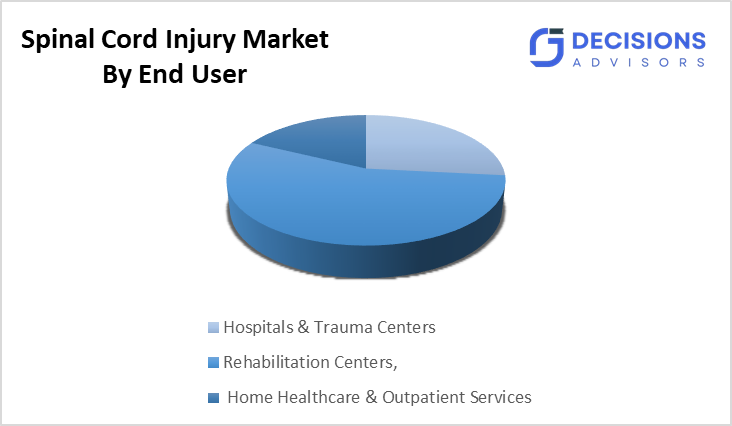
Based on the end user, the spinal cord injury market is divided into hospitals & trauma centers, rehabilitation centers, home healthcare & outpatient services. Among these, the blood test segment dominated the market in 2025 and is projected to grow at a substantial CAGR of approximately 50% during the forecast period. This dominance is due to the acute nature of spinal cord injuries, which require immediate surgical intervention, advanced diagnostics, and critical care that only hospitals and specialized trauma centers can provide. Rehabilitation centers (30%) and home healthcare/outpatient services (~20–25%) support long?term recovery, but initial treatment costs and infrastructure requirements make hospitals the primary revenue driver.
Regional Segment Analysis of the Spinal Cord Injury Market
- North America (U.S., Canada, Mexico)
- Europe (Germany, France, U.K., Italy, Spain, Rest of Europe)
- Asia-Pacific (China, Japan, India, Rest of APAC)
- South America (Brazil and the Rest of South America)
- The Middle East and Africa (UAE, South Africa, Rest of MEA)
North America is anticipated to hold the largest share of the Spinal Cord Injury market over the predicted timeframe.
North America is anticipated to hold the largest share of the spinal cord injury market over the predicted timeframe. North America is the largest region in the global spinal cord injury (SCI) market, accounting for the biggest share of industry revenue. North America controls approximately 36% of the worldwide SCI market, according to industry reports, which estimate its market size. The region's advanced trauma care systems and its substantial healthcare expenditures, with its high rate of adopting new treatment methods, drive market growth. The North American therapeutic segment currently holds 38% of the market share because of its high disease occurrence and established permanent treatment systems, according to 2024 assessments. The United States maintains its dominant position through powerful research systems and effective reimbursement policies, which enable its medical research facilities to create new clinical solutions.
Asia Pacific is expected to grow at a rapid CAGR in the Spinal Cord Injury market during the forecast period. Asia Pacific is poised to be the fastest-growing region in the global Spinal Cord Injury market, accounting for approximately 20% during the forecast period of 2025 to 2035. Asia?Pacific is projected to be the fastest?growing regional market over the next decade. Multiple industry forecasts show that while North America holds the largest market share due to advanced trauma care infrastructure and high healthcare spending, the Asia?Pacific region is growing at the highest compound annual growth rate (CAGR). Specifically, in acute spinal cord injury treatment, the Asia?Pacific is expected to outpace others thanks to rapid urbanization, rising road?traffic injuries, and expanding access to care in countries like China, India, and Southeast Asian nations.
Europe is the 3rd largest region to grow in the Spinal Cord Injury market during the period. Europe is projected to be the 3rd?largest growing region in the global spinal cord injury market due to a combination of strong healthcare infrastructure, steady demand, and above?average investment in treatment technologies. In 2024, the European spinal cord injury treatment market was valued at approximately?USD?2.14?billion, and it is expected to reach around USD?3.01?billion by 2032.
Strategies to Implement for Growth of the Market in Non-Leading Regions
Non-leading regions which include Latin America, Middle East and Africa and South Asia will expand through targeted strategies which include healthcare infrastructure expansion and trauma care development to decrease acute management response times and the training of more than 10000 skilled clinicians and rehabilitation specialists needed to serve each region and the creation of public awareness campaigns which will inform low-income areas about the 5-35% wheelchair accessibility available to people with SCI. Public-private partnerships should receive funding to support advanced diagnostics and devices, which will lead to increased treatment adoption. The use of tele-rehabilitation and mobile health platforms will enable healthcare providers to deliver continuous medical support to underserved areas while achieving better patient outcomes.
Future Market Trends in Global Spinal Cord Injury Market: -
1. Regenerative & Biologic Therapies
Therapies like stem cell?based products and novel biologics aim to promote nerve regeneration, not just symptom management. Clinical activity and investment in next?generation molecules and cell?based platforms are increasing.
2. Neuromodulation & Assistive Technologies
Brain–computer interfaces, wireless neurostimulators, and implantable devices are bridging gaps between injury and functional recovery. These technologies are expected to expand clinical applications and improve patient quality of life.
3. Personalized Rehabilitation
Virtual reality, robotics, and AI?assisted rehabilitation systems are increasingly integrated into SCI care pathways, enhancing recovery outcomes.
Recent Development
In February 2026, a new FDA-approved technology providing more mobility to those who suffer from spinal cord injuries, multiple sclerosis or a stroke has arrived in North Carolina. Rehab center NextStep Raleigh plans to use the device for those with spinal cord injuries, suffering from MS or a stroke
In January 2026, ONWARD Medical announced two additional human implants of its investigational ARC-BC Therapy, bringing the total to seven participants receiving the combined brain-computer interface and implantable spinal cord stimulation system.
In May 2024, Scientists from the universities of Birmingham and Sheffield partnered with NLC Health Ventures for the launch of Midland Pharmaceuticals to focus on the development of a new therapeutic for spinal cord injury and cerebrovascular disease, including stroke.
How is Recent Developments Helping the Market?
The progress made in neurotechnology and rehabilitation research fields drives both market expansion and positive clinical outcomes. The ONWARD ARC-BCI platform, which features brain-spine implants, has allowed multiple paralyzed individuals to achieve voluntary limb control, demonstrating how implantable systems can restore motor abilities. Researchers have developed new organoid models that enable advanced spinal cord injury research through improved drug testing capabilities and faster development of new treatments. The FDA has approved new mobility devices that spinal injury patients can use to improve their daily activities while increasing device usage throughout their communities. The medical exoskeleton market will grow from approximately USD 112 million in 2026 to reach USD 239 million by 2034, resulting in a compound annual growth rate of 9.9% because demand for rehabilitation and mobility assistive technologies continues to increase. The SCI ecosystem benefits from these advancements, which deliver better treatment results and new treatment options and create fresh chances for investment and technological adoption.
Market Segment
This study forecasts revenue at global, regional, and country levels from 2020 to 2035. Decision Advisors has segmented the spinal cord injury market based on the below-mentioned segments:
Global Spinal Cord Injury Market, By Injury Type
- Complete Injury
- Incomplete Injury
Global Spinal Cord Injury Market, By Treatment Type
- Surgical Intervention
- Drug Therapy
- Rehabilitation & Physical Therapy
- Assistive Devices & Technology
- Regenerative Medicine & Stem Cell Therapy
Global Spinal Cord Injury Market, By End User
- Hospitals & Trauma Centers
- Rehabilitation Centers
- Home Healthcare & Outpatient Services
Global Spinal Cord Injury Market, By Regional Analysis
- North America
- US
- Canada
- Mexico
- Europe
- Germany
- UK
- France
- Italy
- Spain
- Russia
- Rest of Europe
- Asia Pacific
- China
- Japan
- India
- South Korea
- Australia
- Rest of Asia Pacific
- South America
- Brazil
- Argentina
- Rest of South America
- Middle East & Africa
- UAE
- Saudi Arabia
- Qatar
- South Africa
- Rest of the Middle East & Africa
Frequently Asked Questions (FAQ)
Q: What types of treatments are included in the market?
A: Treatments include pharmaceuticals (anti?inflammatory and neuroprotective drugs), surgical interventions, assistive medical devices, stem cell and regenerative therapies, and rehabilitation services. Emerging technologies like brain?computer interfaces and virtual rehabilitation are also gaining traction
Q: Who are the key stakeholders in this market?
A: Key stakeholders include pharmaceutical and medical device companies, healthcare providers, rehabilitation centers, research institutions, investors, and regulatory bodies. Collaboration among these groups shapes product development, clinical adoption, and market strategies
Q: What is the role of innovation in this market?
A: Innovation drives market evolution through advanced surgical tools, neuroregenerative therapies, minimally invasive procedures, assistive robotics, and cutting?edge rehabilitation platforms. New drug candidates and neural interface systems aim to improve functional recovery and quality of life.
Check Licence
Choose the plan that fits you best: Single User, Multi-User, or Enterprise solutions tailored for your needs.
We Have You Covered
- 24/7 Analyst Support
- Clients Across the Globe
- Tailored Insights
- Technology Tracking
- Competitive Intelligence
- Custom Research
- Syndicated Market Studies
- Market Overview
- Market Segmentation
- Growth Drivers
- Market Opportunities
- Regulatory Insights
- Innovation & Sustainability
Report Details
| Scope | Global |
| Pages | 240 |
| Delivery | PDF & Excel via Email |
| Language | English |
| Release | Mar 2026 |
| Access | Download from this page |