
Global Stadium Lighting Market
 |
Pages:
210
|
Pages:
210
Global Stadium Lighting Market Size, Share, By Light (Led Lighting, Metal Halide Lighting, Halogen Lighting), By Offering (Lamps and Luminaires, Control Systems, Services), By Solution Set-Up (Indoor, Outdoor), and By Region (North America, Europe, Asia-Pacific, Latin America, Middle East, and Africa), Analysis and Forecast 2026-2035.
REPORT COVERAGE
Global
Market Snapshot
- Global Stadium Lighting Market Size (2025): USD 678.5 million
- Projected Global Stadium Lighting Market Size (2035): USD 1422.2 million
- Global Stadium Lighting Market Compound Annual Growth Rate (CAGR): 7.68%
- Largest Regional Market: North America
- Fastest Growing Region: Asia-Pacific
- 3rd Largest Region: Europe
- Base Year: 2025
- Historical Period: 2021–2024
- Forecast Period: 2026–2035
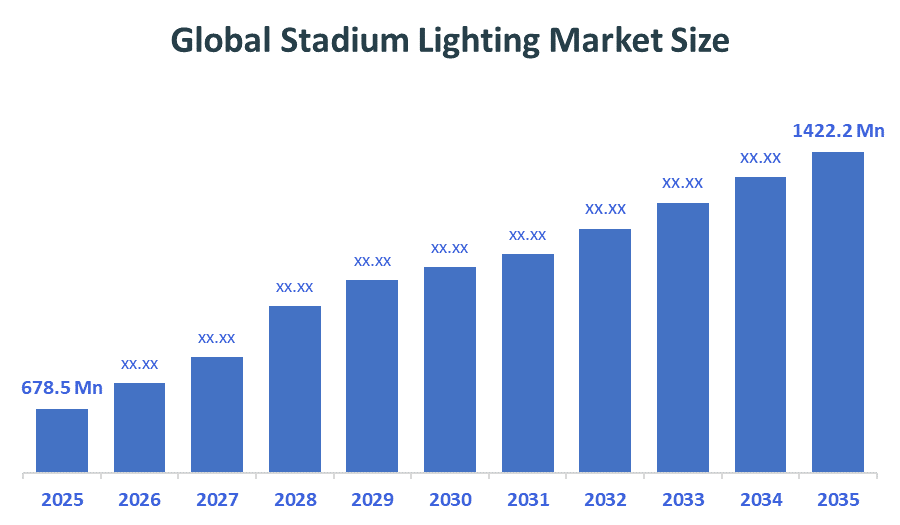
According to Decision Advisors, the Global Stadium Lighting Market Size is expected to grow from USD 678.5 million in 2026 to USD 1422.2 million by 2035, at a CAGR of 7.68% during the forecast period 2026-2035. The global stadium lighting market is influenced by the sports venues now receive higher capital investments which need to meet premium broadcast standards. The implementation of digitally controlled lighting systems has reduced costs while enabling better energy management and increased business worth which makes lighting systems a valuable investment for companies.
Market Overview/ Introduction
The stadium lighting functions as a costly lighting system which provides high light output and accurate colour reproduction and long-lasting performance for extensive sports and entertainment facilities. The global stadium lighting market serves the three main applications which include outdoor mega-stadiums and indoor arenas and broadcast environments that need flicker-free precision. The implementation of smart lighting systems allows venues to achieve better control over operations while reducing energy consumption and providing fans with improved interaction experiences, which transforms lighting systems into essential resources that boost venue efficiency and revenue growth and return on investment. The global stadium lighting market is experiencing change because of the advanced intelligent systems which provide both real-time control and energy management capabilities. The AI-powered adaptive lighting systems together with digital twin simulations, which create virtual replicas of real-time processes, improve both operational performance and maintenance predictions. The growing need for RGB lighting which creates immersive experiences and e-sports lighting solutions produces new income opportunities. The development of solar-powered and hybrid lighting solutions supports sustainability objectives while establishing permanent business development prospects and establishing lighting as an essential technological infrastructure investment.
- The government-backed programs in India, such as Khelo India, are accelerating stadium infrastructure investments exceeding ?3,000 crores, driving demand for energy-efficient LED lighting and supporting over 8% annual growth in the global stadium lighting market.
- The federal guidance in United States, led by GSA and DOE programs, is accelerating LED lighting adoption across public infrastructure, reducing energy consumption by up to 50% and maintenance costs by 20-30%, supporting growth in the global stadium lighting market.
- The government-backed subsidies in Germany under the Kommunalrichtlinie cover up to 40% of LED retrofit costs, with typical grants ranging 25-40%, accelerating energy-efficient stadium upgrades and supporting 6-8% growth in the global stadium lighting market.
Notable Insights: -
- North America holds the largest regional market share, approximately 37.6% in the global stadium lighting market
- Asia-Pacific is the fastest growing region in the Stadium Lighting Market is propelled by development of smart stadiums in China, India, and Southeast Asia proceeds through three main drivers which include rising infrastructure investments and the development of smart stadiums and the growing use of energy-efficient LED lighting technologies.
- By light, the Led Lighting segment held a dominant position with 69.2% in terms of market share in 2025.
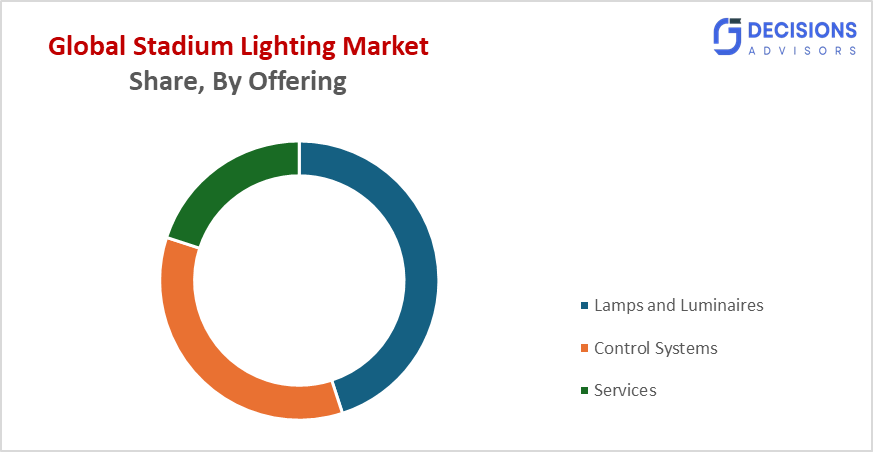
- By Offering, lamps and luminaires Segment is the dominating accounting for over 64.5% of the global market share in 2025.
- The compound annual growth rate of the global Stadium Lighting Market is 7.68%.
- The market is likely to achieve a valuation of USD 1422.2 million by 2035.
What is role of technology in grooming the market?
Technology serves as the main driving force that changes the global stadium lighting industry through its advancements in energy efficiency and operational cost savings and system performance improvements. The combination of advanced LED systems with Internet of Things-based controls and adaptive dimming capabilities enables a 50% reduction in energy consumption while delivering improved lighting accuracy and longer-lasting performance. AI lighting analytics optimize usage patterns together with maintenance schedules which results in decreased total ownership costs. The global shift to high-efficiency lighting technologies is being driven by regulatory frameworks like the EU's Commission Regulation (EU) which establishes mandatory ecodesign standards for light sources.
How is Recent Developments Helping the Market?
Recent developments are significantly improving efficiency and scalability and investment returns in the global stadium lighting market. The transition toward smart LED systems results in decreased operational costs while delivering better lighting performance and system reliability. The implementation of IoT-based controls together with dynamic lighting solutions creates energy-efficient systems which enable continuous monitoring and improve asset utilization. The new technologies create better stadium management systems which provide improved visitor experiences and higher potential to generate revenue thus supporting sustainable development and permanent market growth throughout worldwide sports facilities. The Acuity Brands USD 1.215 billion acquisition of QSC in October 2024 in United States strengthens integration of lighting and audiovisual systems, enhancing smart stadium infrastructure, improving efficiency, and driving innovation-led growth in the global stadium lighting market.
Market Drivers
The global stadium lighting market is undergoing a fundamental change because of the stadiums now shift towards energy-saving solutions that include digital lighting systems. The transition from metal halide lights to LED technology leads to substantial reductions in both lifecycle expenses and energy consumption while enhancing infrastructure investment returns. The implementation of IoT-based smart lighting systems provides organizations with better operational capabilities because of they can monitor their operations in real time while controlling their systems automatically and managing their energy consumption, which supports the development of smart venue management systems. The sports infrastructure development across emerging economies has increased funding, which leads to new facility construction and extensive building restoration projects. The need for environmental sustainability drives organizations to establish new regulations, which restrict their use of outdated energy-intensive equipment while they work to achieve carbon emission reductions. These factors drive increased investments into the global stadium lighting market which leads to faster technology implementation and creates conditions for sustained market expansion. The environmental and planning regulations in United Kingdom requiring up to 30-50% reduction in glare and light trespass are driving adoption of precision LED systems, increasing capital expenditure and supporting 6-8% annual growth in the global stadium lighting market.
Restrain
The global stadium lighting market faces structural constraints because of advanced LED systems and smart controls need substantial upfront investment which budget-constrained venues and municipalities cannot afford. The costs of retrofitting existing systems because of their old technology increase due to the difficulties of installing new systems and connecting them to existing infrastructure. The absence of universal international standards results in procurement problems and system compatibility issues. The operational restrictions which environmental issues create through light pollution and extreme weather conditions limit deployment capabilities. The combination of these factors increases project risks while restricting investment choices and creating delays in market entry despite the existence of strong long-term demand.
Competitive Analysis:
The report offers the appropriate analysis of the key organizations/companies involved within the stadium lighting market, along with a comparative evaluation primarily based on their product of offering, business overviews, geographic presence, enterprise strategies, segment market share, and SWOT analysis. The report also provides an elaborative analysis focusing on the current news and developments of the companies, which includes product development, innovations, joint ventures, partnerships, mergers & acquisitions, strategic alliances, and others. This allows for the evaluation of the overall competition within the market.
Top Companies in Global stadium lighting market
- Signify (Philips Lighting)
- Musco Lighting
- Acuity Brands
- Eaton Corporation
- Cree Lighting
- Zumtobel Group
- Hubbell Incorporated
- LG Electronics
- General Electric
- Panasonic Corporation
Government Initiatives
|
Country |
Key Government Initiatives |
|
US
|
Global reports indicate rising sports infrastructure investments in United States are driving the stadium lighting market, projected to surpass USD 1.8 billion by 2033, with LED adoption supporting 6-8% CAGR globally. |
|
Germany |
Preparations for UEFA EURO 2024 in Germany drove multi-million-dollar stadium upgrades, boosting demand for advanced LED lighting systems and supporting global stadium lighting market growth at a CAGR of 9.84% through 2033. |
|
Japan |
Ajinomoto Stadium in Japan upgraded to over 864 LED floodlights in meet international tournament and 4K/8K broadcasting standards, highlighting infrastructure modernization driving growth in the global stadium lighting market. |
Market Segmentation
The Stadium Lighting Market share is classified into light, offering, and solution set-up
- The Led Lighting segment dominated the market in 2024 and is projected to grow at a substantial CAGR of approximately 10.7% during the forecast period.
Based on the light, the stadium lighting market is divided into led lighting, metal halide lighting, halogen lighting. Among these, the Led Lighting segment dominated the market in 2024 and is projected to grow at a substantial CAGR of approximately 10.7% during the forecast period. It is because of the system provides better energy efficiency which results in reduced operational expenses and delivers superior lighting performance. The system maintains its operational performance through an extended period which leads to reduced maintenance costs. The system achieves widespread use because it works with smart control systems which improve its efficiency.
- The lamps and luminaires segment accounted for the largest share in 2024 and is anticipated to grow at a significant CAGR of approximately 9.1% during the forecast period.
Based on the offering, the stadium lighting market is divided into lamps and luminaires, control systems, and services. Among these, the lamps and luminaires segment accounted for the largest share in 2024 and is anticipated to grow at a significant CAGR of approximately 9.1% during the forecast period. It is dominating because of the main essential part of lighting systems needs this equipment which makes up most of project costs. The company maintains its top revenue position through ongoing system updates which replace old lighting systems with LED fixtures and through increased demand from new stadium development projects.
- The Outdoor segment dominated the market in 2024, and is projected to grow at a substantial CAGR during the forecast period.
Based on the solution set-up, the stadium lighting market is divided into indoor and outdoor. Among these, The Outdoor segment dominated the market in 2024, and is projected to grow at a substantial CAGR during the forecast period. The system demands significant financial resources together with complete infrastructural development. The operational needs of large venues require sufficient light output from multiple lighting fixtures which must be continuously updated to meet current broadcasting requirements.
Strategies to Implement for Growth of the Market in Non-Leading Regions
The implementation of cost-effective financing solutions which include public-private partnerships and leasing systems will help non-leading regions achieve faster development by decreasing the initial expenses required for stadium improvements. The market participants should localize manufacturing and supply chains to lower costs and improve accessibility. The implementation of modular scalable lighting solutions in mid-tier cities will create new business opportunities because of it fulfills previously unmet customer needs. The combination of smart lighting and energy-saving performance contracts creates a solution which enables organizations to recover their costs over an extended period. The sports authorities and event organizers can create infrastructure development opportunities through strategic partnerships while capacity-building programs will help emerging markets enhance their technical skills and operational processes.
Regional Segment Analysis of the Stadium Lighting Market
- North America (U.S., Canada, Mexico)
- Europe (Germany, France, U.K., Italy, Spain, Rest of Europe)
- Asia-Pacific (China, Japan, India, Rest of APAC)
- South America (Brazil and the Rest of South America)
- The Middle East and Africa (UAE, South Africa, Rest of MEA)
North America is anticipated to hold the largest share of the Stadium Lighting Market over the predicted timeframe. The North America is anticipated to hold the largest share of the stadium lighting market, accounting for approximately 37.6% of total revenue over the forecast period. It is because of the development of a mature sports economy together with high infrastructure capital investments and the initial implementation of advanced LED and smart lighting technology enable the sports industry to achieve continuous growth. The combination of successful commercial sports leagues and regular major events provides ongoing funding for upgrades which create dependable revenue streams and support extended investment.
Asia-Pacific is expected to grow at a rapid CAGR in the Stadium Lighting Market during the forecast period. The Asia-Pacific market will experience fast growth because it accounts for approximately 10.2% of it is due to the rising urban infrastructure investments and the increasing spending power of the middle-class on sports activities together with the growing financial support from governments for multi-purpose venues. Cost-sensitive markets are adopting scalable LED solutions, while rising international event hosting drives modernization, creating strong demand momentum and higher capital inflows.
Europe is the 3rd largest region to grow in the Stadium Lighting Market during the region. The Europe region stands as the third biggest area global for the stadium lighting market since it holds approximately 27.2% the existing infrastructure system, which has reached its peak development stage, experiences growth through retrofitting activities instead of new construction projects. The existing sustainability regulations together with energy efficiency requirements drive organizations to adopt LED technology, but budget limitations and extended project execution times restrict their ability to expand operations in comparison to fast-developing markets.
Future Market Trends in Stadium Lighting Market: -
- Increasing Convergence of Lighting with Digital Infrastructure
The lighting systems have become essential parts of complete digital stadium systems which connect to broadcasting systems and security systems and fan engagement systems. The combination of these systems boosts revenue generation because it improves the way spectators experience events and increases advertising opportunities. Stadiums need to develop as modern multifunctional spaces which require lighting systems to function as essential digital resources instead of basic operational tools.
- Rise of Modular and Scalable Lighting Solutions
The manufacturers are creating modular lighting systems which lets them introduce lights to venues in stages while adding new capacity according to specific venue needs. The system decreases initial financial risks while it permits businesses to upgrade their operations when their income begins to rise. The system provides essential benefits to developing markets which face growing demand but limited financial resources to access new markets and maintain their services over time.
- Growth of Multi-Purpose and Hybrid Venue Infrastructure
The evolution of stadiums into multi-use entertainment hubs is reshaping lighting requirements. The need for flexible lighting systems which can accommodate sports events and concerts, and other activities has become more critical. The practice of using advanced lighting technologies which can operate in various situations leads to better stadium performance because it increases usage rates and generates different revenue streams which result in greater financial returns for the facility. The time of the day during which an event occurs influences the choice of specific lighting technologies which shows the contrasting needs of daytime and nighttime activities.
Recent Development
- In June 2024, India’s Wankhede Stadium undertook multi-million-dollar LED floodlight upgrades ahead of international tournaments, accelerating infrastructure modernization and strengthening demand momentum in the global stadium lighting market.
- In October 2023, United Arab Emirates’s Sharjah Cricket Stadium completed a multi-million-dollar LED lighting upgrade using Philips ArenaVision and DMX controls, enhancing broadcast quality and fan engagement, thereby strengthening innovation-driven growth in the global stadium lighting market.
Market Segment
This study forecasts revenue at global, regional, and country levels from 2020 to 2035. Decision Advisors has segmented the stadium lighting market based on the above-mentioned segments:
Global Stadium Lighting Market, By Light
- Led Lighting
- Metal Halide Lighting
- Halogen Lighting
Global Stadium Lighting Market, By Offering
- Lamps and Luminaires
- Control Systems
- Services
Global Stadium Lighting Market, By Solution Set-Up
- Indoor
- Outdoor
Global Stadium Lighting Market, By Regional Analysis
- North America
- US
- Canada
- Mexico
- Europe
- Germany
- UK
- France
- Italy
- Spain
- Russia
- Rest of Europe
- Asia Pacific
- China
- Japan
- India
- South Korea
- Australia
- Rest of Asia Pacific
- South America
- Brazil
- Argentina
- Rest of South America
- Middle East & Africa
- UAE
- Saudi Arabia
- Qatar
- South Africa
- Rest of the Middle East & Africa
Frequently Asked Questions (FAQ)
Q. What is driving the evolution of the smartphone 3D camera market?
A. The advanced lighting systems improve broadcast quality and create better in-stadium experiences which directly boost ticket sales and sponsorship visibility and increase media rights valuation. High-performance illumination enables premium event hosting which generates additional revenue streams while enhancing the financial sustainability of sports facility investments.
Q. How do broadcast requirements reshape lighting investments?
A. The development of ultra-high-definition broadcasting requires stadiums to install lighting systems that provide continuous light output at multiple brightness levels while maintaining consistent light distribution. Stadium operators need to purchase advanced technological systems because the quality of their lighting directly impacts the value of their content and their advertising revenue and their global audience reach.
Q. How does energy pricing impact stadium lighting decisions?
A. The operators are now implementing energy-efficient lighting systems because of rising electricity costs which help them decrease their operational expenses over time. The economic force drives businesses to switch to LED lights which provide energy savings that decrease their expenses and increase their profit margins.
Q. What role does urban development play in stadium lighting demand?
A. The sports infrastructure development now gets incorporated into urban expansion projects which include smart city development plans. The demand for contemporary lighting systems that fulfil aesthetic and practical needs and environmental requirements drives market expansion throughout emerging markets.
Check Licence
Choose the plan that fits you best: Single User, Multi-User, or Enterprise solutions tailored for your needs.
We Have You Covered
- 24/7 Analyst Support
- Clients Across the Globe
- Tailored Insights
- Technology Tracking
- Competitive Intelligence
- Custom Research
- Syndicated Market Studies
- Market Overview
- Market Segmentation
- Growth Drivers
- Market Opportunities
- Regulatory Insights
- Innovation & Sustainability
Report Details
| Scope | Global |
| Pages | 210 |
| Delivery | PDF & Excel via Email |
| Language | English |
| Release | Apr 2026 |
| Access | Download from this page |