
Global Structural Heart Occlusion Devices Market
 |
Author:
Disha B
|
Pages:
289
|
Author:
Disha B
|
Pages:
289
Global Structural Heart Occlusion Devices Market Size, Share, and COVID-19 Impact Analysis, By Type (Left Atrial Appendage (LAA) Occlusion Devices and Atrial Septal Defect (ASD) Occluders), By End-use (Hospitals and Specialty Clinics) and By Region (North America, Europe, Asia-Pacific, Latin America, Middle East, and Africa), Analysis and Forecast 2025 - 2035
CAGR
7.08%
REVENUE 2024
USD Billion 4.1
FORECAST 2035
USD Billion 8.7
REPORT COVERAGE
Global
Global Structural Heart Occlusion Devices Market Size Insights Forecasts to 2035
- The Global Structural Heart Occlusion Devices Market Size Was valued at USD 4.1 Billion in 2024
- The Global Structural Heart Occlusion Devices Market Size is Expected to Grow at a CAGR of around 7.08% from 2025 to 2035
- The Worldwide Structural Heart Occlusion Devices Market Size is Expected to Reach USD 8.7 Billion by 2035
- Asia Pacific is expected to Grow the fastest during the forecast period.
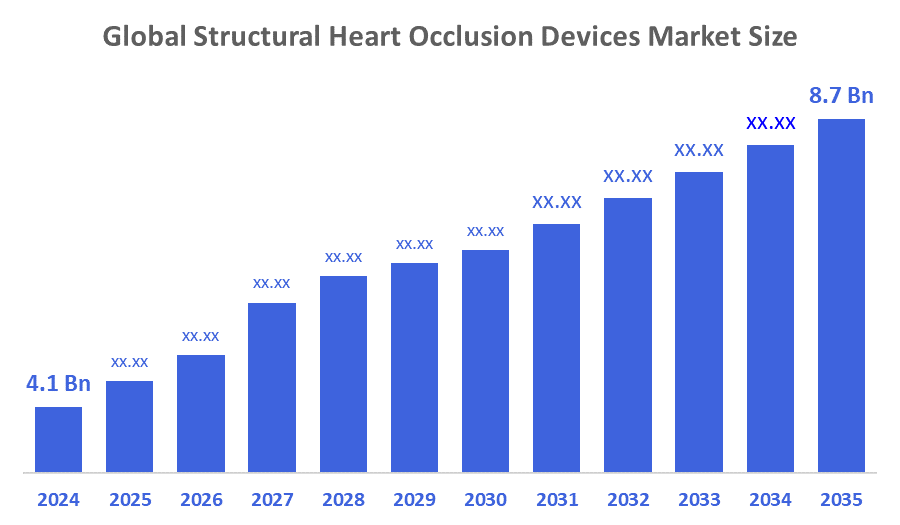
According to a Research Report Published by Decisions Advisors and Consulting, The Global Structural Heart Occlusion Devices Market Size was worth around USD 4.1 Billion in 2024 and is predicted to Grow to around USD 8.7 Billion by 2035 with a compound annual growth rate (CAGR) of 7.08% from 2025 to 2035. The global structural heart occlusion devices market will undoubtedly see new opportunities in the future, such as bringing the product to more areas in developing countries, making the technology for occluders that are both bioabsorbable and of the flexible type, and the use of AI for better imaging and procedural planning in hospitals which will in turn lead to improved patient outcomes. More patients with heart problems and the increase in the number of minimally invasive procedures are also factors that would contribute to the growth of the market.
Market Overview
The global structural heart occlusion devices market encompasses the international industry that is focused on the manufacturing and distribution of medic-engineered devices utilized for sealing off the abnormal openings within the heart, namely, atrial septal defects, ventricular septal defects, and left atrial appendage. The devices have extensive application in preventing blood clots, strokes, and other major cardiac complications through non-invasive methods. The market is expected to witness an upward growth trend due to the aforementioned reasons along with the rise in the number of people with congenital and acquired heart diseases, the fast-growing elderly population, and the increased use of catheter-based interventions. Also, there are benefits from the developments in device materials and imaging guidance technology in terms of improved safety and better treatment outcomes. On top of that, global market growth is supported by government healthcare initiatives, reimbursement policies, and infrastructure investments in cardiac care.
Report Coverage
This research report categorizes the structural heart occlusion devices market based on various segments and regions, forecasts revenue growth, and analyzes trends in each submarket. The report analyses the key growth drivers, opportunities, and challenges influencing the structural heart occlusion devices market. Recent market developments and competitive strategies such as expansion, type launch, development, partnership, merger, and acquisition, have been included to draw the competitive landscape in the market. The report strategically identifies and profiles the key market players and analyses their core competencies in each sub-segment of the structural heart occlusion devices market.
Driving Factors
The market's main factors are the increasing number of congenital heart defects and atrial septal defects, alongside a rise in the elderly population and a shift towards minimally invasive heart surgeries. New device designs, better imaging techniques and catheter-based delivery systems, plus greater awareness of early cardiac treatment have also been propping up global market growth.
Restraining Factors
The global market expansion is significantly hampered by the high costs of devices and procedures, the potential complications like migration or thrombosis of the device, the long process of regulatory approvals, the lack of specialists with required skills, and the difficulties in getting reimbursed in the case of emerging markets.
Market Segmentation
The structural heart occlusion devices market share is classified into type and end-use.
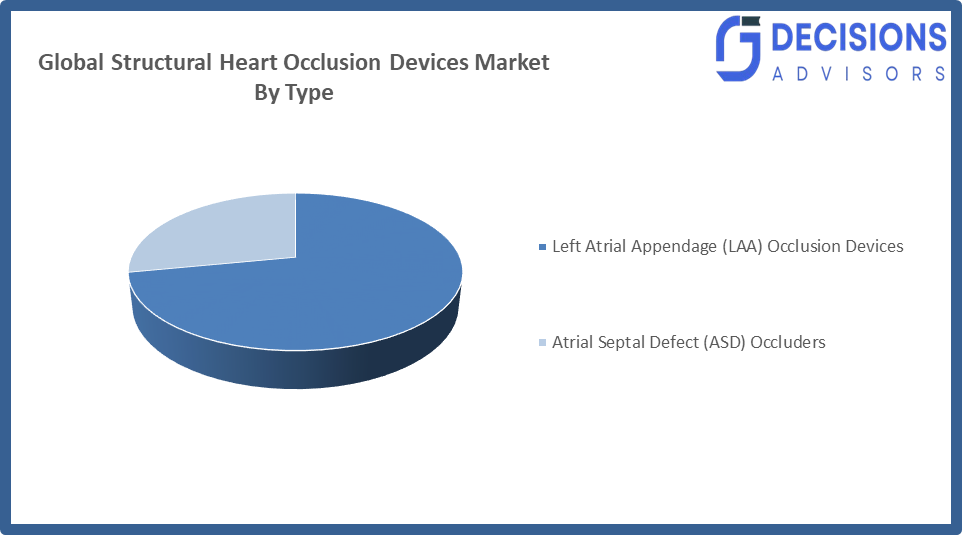
- The left atrial appendage (LAA) occlusion devices segment accounted for the largest share in 2024 and is anticipated to grow at a significant CAGR during the forecast period.
Based on the type, the structural heart occlusion devices market is divided into left atrial appendage (LAA) occlusion devices and atrial septal defect (ASD) occluders. Among these, the left atrial appendage (LAA) occlusion devices segment accounted for the largest share in 2024 and is anticipated to grow at a significant CAGR during the forecast period. Atrial fibrillation (AF) has become more common and is considered to be a leading reason for stroke. Non-valvular atrial fibrillation patients are particularly vulnerable to thrombus formation in the left atrial appendage, which can migrate to the brain and result in strokes. An article published in Structural Heart in January 2025 reviewed the state of the art in left atrial appendage occlusion (LAAO) and concluded that it is a very effective method to prevent stroke in patients with atrial fibrillation. Generally, the initial results of LAAO are that it is very promising to substitute oral anticoagulants or, at times, to practice LAAO in combination with other structural heart treatments.
- The hospitals segment accounted for the highest market revenue in 2024 and is anticipated to grow at a significant CAGR during the forecast period.
Based on the end-use, the structural heart occlusion devices market is divided into hospitals and specialty clinics. Among these, the hospitals segment accounted for the highest market revenue in 2024 and is anticipated to grow at a significant CAGR during the forecast period. Hospitals are the main reason for the growth of the structural heart occlusion device industry as they have a large patient base and a continuous flow of patients who need these interventions. The increase in the number of patients suffering from atrial fibrillation and heart valve diseases has increased the demand for effective treatment solutions in hospitals. In the March 2025 issue, the Journal of Perinatology released a study addressing the management of patent ductus arteriosus (PDA) in preterm infants born at 23 to 32 weeks’ gestation. The study indicated that the use of pharmacotherapy, particularly acetaminophen, was increasing and that over the period of 12 years, there was a transition from surgical ligation to transcatheter PDA closure.
Regional Segment Analysis of the Structural Heart Occlusion Devices Market
- North America (U.S., Canada, Mexico)
- Europe (Germany, France, U.K., Italy, Spain, Rest of Europe)
- Asia-Pacific (China, Japan, India, Rest of APAC)
- South America (Brazil and the Rest of South America)
- The Middle East and Africa (UAE, South Africa, Rest of MEA)
North America is anticipated to hold the largest share of the structural heart occlusion devices market over the predicted timeframe.
North America is anticipated to hold the largest share of the structural heart occlusion devices market over the predicted timeframe. One of the key factors that led to the continuous market expansion in the region. The major global players in the medical device market, the highly qualified heart specialists, and the large-scale adoption of less invasive surgeries are the other factors that contribute to the market growth in the region.
Asia Pacific is expected to grow at a rapid CAGR in the structural heart occlusion devices market during the forecast period. The market for structural heart occlusion devices in Asia Pacific is growing mainly due to rapid device innovations and increasing stroke prevention initiatives. The March 2025 editorial in JACC Asia dealt with the milestones and challenges in left atrial appendage occlusion (LAAO) as a stroke prevention method for patients with atrial fibrillation. Despite safety improvements with the introduction of new devices, the problems of peridevice leakage and thrombus formation at the device site still pose a great threat. The quest for a perfect LAA occluder continues with the new generation of devices showing potential for complication reduction.
Competitive Analysis:
The report offers the appropriate analysis of the key organizations/companies involved within the structural heart occlusion devices market, along with a comparative evaluation primarily based on their type of offering, business overviews, geographic presence, enterprise strategies, segment market share, and SWOT analysis. The report also provides an elaborative analysis focusing on the current news and developments of the companies, which includes type development, innovations, joint ventures, partnerships, mergers & acquisitions, strategic alliances, and others. This allows for the evaluation of the overall competition within the market.
List of Key Companies
- Abbott
- Boston Scientific Corporation
- Occlutech
- Lifetech Scientific
- Medtronic
- W. L. Gore & Associates
- Lepu Medical Technology (Beijing)Co., Ltd
- Emtree Medical (Cardia Inc.)
- Biosense Webster (Johnson & Johnson)
- PFM Medical GMBH
- Others
Key Target Audience
- Market Players
- Investors
- End-users
- Government Authorities
- Consulting and Research Firm
- Venture capitalists
- Value-Added Resellers (VARs)
Recent Development
- In August 2025: A safety alert linked to Boston Scientific’s Watchman heart implant had reported 120 serious injuries and 17 deaths, which potentially hurt its sales in the structural heart occlusion market and opened opportunities for competitors as patients sought safer alternatives.
Market Segment
This study forecasts revenue at global, regional, and country levels from 2020 to 2035. Decisions Advisors has segmented the structural heart occlusion devices market based on the below-mentioned segments:
Global Structural Heart Occlusion Devices Market, By Type
- Left Atrial Appendage (LAA) Occlusion Devices
- Atrial Septal Defect (ASD) Occluders
Global Structural Heart Occlusion Devices Market, By End-use
- Hospitals
- Specialty Clinics
Global Structural Heart Occlusion Devices Market, By Regional Analysis
- North America
- US
- Canada
- Mexico
- Europe
- Germany
- UK
- France
- Italy
- Spain
- Russia
- Rest of Europe
- Asia Pacific
- China
- Japan
- India
- South Korea
- Australia
- Rest of Asia Pacific
- South America
- Brazil
- Argentina
- Rest of South America
- Middle East & Africa
- UAE
- Saudi Arabia
- Qatar
- South Africa
- Rest of the Middle East & Africa
Frequently Asked Questions (FAQ)
- What is the CAGR of the structural heart occlusion devices market over the forecast period?
A: The global structural heart occlusion devices market is projected to expand at a CAGR of 7.08% during the forecast period.
- What is the market size of the structural heart occlusion devices market?
A: The global structural heart occlusion devices market size is estimated to grow from USD 4.1 billion in 2024 to USD 8.7 billion by 2035, at a CAGR of 7.08% during the forecast period 2025-2035.
- Which region holds the largest share of the structural heart occlusion devices market?
A: North America is anticipated to hold the largest share of the structural heart occlusion devices market over the predicted timeframe.
- Who are the top 10 companies operating in the global structural heart occlusion devices market?
A: Abbott, Boston Scientific Corporation, Occlutech, Lifetech Scientific, Medtronic, W. L. Gore & Associates, Lepu Medical Technology (Beijing)Co., Ltd, Emtree Medical (Cardia Inc.), Biosense Webster (Johnson & Johnson), PFM Medical GMBH, and Others.
- What are the market trends in the structural heart occlusion devices market?
A: The main movements in the structural heart occlusion devices market are the greater acceptance of minimally invasive procedures, the creation of bioabsorbable and flexible occluders, the increase in the occurrence of structural heart disease, and the increase in funding for high-tech cardiac devices.
Check Licence
Choose the plan that fits you best: Single User, Multi-User, or Enterprise solutions tailored for your needs.
We Have You Covered
- 24/7 Analyst Support
- Clients Across the Globe
- Tailored Insights
- Technology Tracking
- Competitive Intelligence
- Custom Research
- Syndicated Market Studies
- Market Overview
- Market Segmentation
- Growth Drivers
- Market Opportunities
- Regulatory Insights
- Innovation & Sustainability
Report Details
| Scope | Global |
| Pages | 289 |
| Delivery | PDF & Excel via Email |
| Language | English |
| Release | Jan 2026 |
| Access | Download from this page |