
Global Terahertz Components and Systems Market
 |
Author:
Achal E
|
Pages:
240
|
Author:
Achal E
|
Pages:
240
Global Terahertz Components and Systems Market Size, Share, By Component Type(Terahertz Sources, Terahertz Detectors, Terahertz Waveguides), By Application (Medical Imaging, Security Screening, Non-Destructive Testing, Communication Systems, Others), By End-User Industry (Healthcare, Aerospace and Defense, Telecommunications, Industrial, Others), and By Region (North America, Europe, Asia-Pacific, Latin America, Middle East, and Africa), Analysis and Forecast 2026-2035
CAGR
15.05%
REVENUE 2025
USD Billion 0.62
FORECAST 2035
USD Billion 2.52
REPORT COVERAGE
Global
Market Snapshot
- Global Terahertz Components and Systems Market Size (2025): USD 0.62 billion
- Projected Global Terahertz Components and Systems Market Size (2035): USD 2.52 billion
- Global Terahertz Components and Systems Market Compound Annual Growth Rate (CAGR): 15.05%
- Largest Regional Market: North America
- Fastest Growing Region: Asia-Pacific
- 3rd Largest Region: Europe
- Base Year: 2025
- Historical Period: 2021–2024
- Forecast Period: 2026–2035
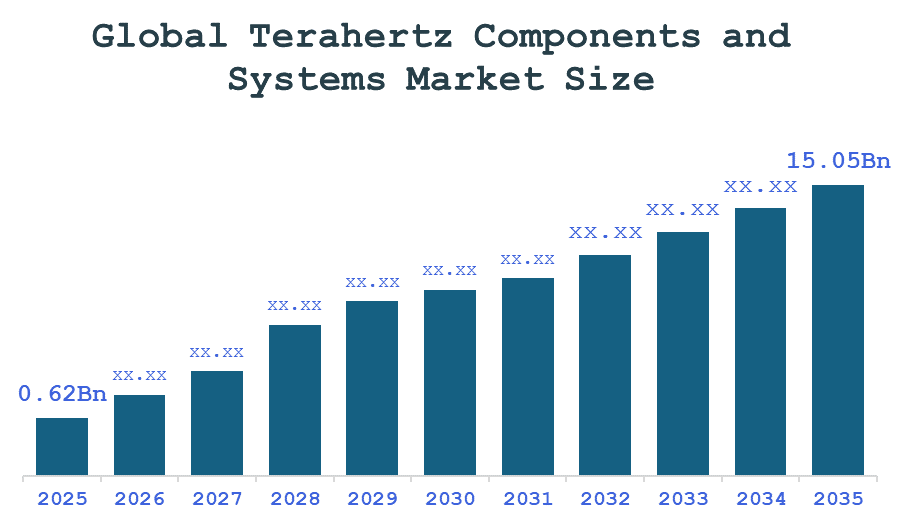
According to Decision Advisors, the Global Terahertz Components and Systems Market Size is expected to grow from USD 0.62 billion in 2025 to USD 2.52 billion by 2035, at a CAGR of 15.05% during the forecast period 2026-2035. The terahertz components and systems market currently experiences strategic development because of the sub-THz frequencies have become important for 6G research projects. The commercial development has strengthened because the industrial stakeholders now use advanced material inspection technologies and healthcare and security sectors focus on non-invasive imaging and high-precision screening.
Market Overview/ Introduction
The terahertz technology, which operates between 0.1 and 10 THz frequency range, serves as an essential technology for advanced sensing applications because of its ability to penetrate materials without causing ionization. The technology demonstrates its value through its use in security surveillance and medical diagnostics and pharmaceutical analysis and industrial non-destructive testing which together enhance product availability and increase market interest for all terahertz components and systems. The global market for terahertz components and systems is expanding because of new developments in three areas which include real-time multispectral imaging and compact room-temperature sources and miniaturized on-chip architectures. The combination of artificial intelligence with current systems results in improved analytical accuracy while new possibilities emerge for 6G communication systems and medical diagnostic tools and Industry 4.0 applications. The use of terahertz-enabled sensing technology has become more popular for autonomous navigation purposes which demonstrates its ongoing value in both commercial and technological fields.
- In United States, the global terahertz components and systems market demonstrates strong economic potential, valued near USD 0.7 billion in 2024 and projected to surpass USD 6 billion by 2034, driven by defense investments, 6G research, and expanding imaging and sensing applications.
- In United States, the global terahertz components and systems market advances through defense-driven innovation, with projects valued around USD 1.25 million focusing on terahertz imaging radar for contactless concealed weapons detection, strengthening security applications and commercial scalability.
Notable Insights: -
- North America holds the largest regional market share, approximately 41.2% in the global terahertz components and systems Market.
- Asia-Pacific is the fastest growing region in the Terahertz Components and Systems Market is propelled by increased funding for semiconductor research and development and 6G technology development and expanding industrial and military technology deployment in major economic areas.
- By component, the Terahertz Detectors segment held a dominant position with 43.1% in terms of market share in 2025.
- By application, security screening Segment is the dominating accounting for over 35.2% of the global market share in 2025.
- The compound annual growth rate of the global terahertz components and systems market is 15.05%.
- The market is likely to achieve a valuation of USD 2.52 billion by 2035.
What is role of technology in grooming the market?
Technology serves as the primary economic driving force which propels global growth in the terahertz components and systems market by increasing commercial development and boosting financial return efficiencies. The field of semiconductor manufacturing has made progress through its development of photonic integration technology alongside new techniques for processing high-frequency signals which now allow for more affordable performance improvements and wider technology application. The development of 6G research projects together with artificial intelligence signal processing systems and miniature device designs will make it possible to implement solutions throughout the defense sector and healthcare industry and industrial testing environments. The enhancement of source and detector sensitivity betterment results in data accuracy improvements which enable the application of advanced use cases. The combination of these innovations attracts institutional investments while creating unique competitive advantages which drive system growth to establish terahertz technology as a key enabling technology for future communication and sensing systems.
How is Recent Developments Helping the Market?
The global terahertz components and systems market is experiencing strong growth through its recent developments which boost both innovation speed and product readiness for commercial use. The development of photonic integration together with high-frequency electronics and compact system design is enhancing performance efficiency while creating new opportunities for system applications. The demand for 6G research and biomedical imaging and security screening applications has increased across multiple sectors. The combination of increased public and private research and development funding together with industry partnerships has created better technology transfer pathways while making it easier for businesses to enter the market and achieve large-scale operations. The market gains from these developments which create competitive advantages while driving economic growth in advanced sensing and communication systems. In United Kingdom, the global terahertz components and systems market is advancing through industrial inspection innovations, with systems like TeraCota 3500 enabling real-time, high-precision, non-contact EV battery coating measurement, improving manufacturing efficiency and supporting scalable commercialization across advanced mobility sectors.
Market Drivers
The global terahertz components and systems market exists because of the investors are putting more money into high-frequency communication systems which include pre-commercial 6G networks that use terahertz frequencies to achieve extremely high data transmission speeds. The defense and homeland security expenditures are accelerating deployment of non-invasive imaging and surveillance systems which create increased demand for these technologies in the public sector. The industrial sector uses terahertz-based non-destructive testing to evaluate semiconductor and aerospace material and electric vehicle battery performance because of precision manufacturing has become the new standard. The healthcare facilities are starting to use non-ionizing high-resolution diagnostic methods. The combination of photonics and advanced semiconductor technology with signal processing systems has resulted in lower costs for each performance unit while making it easier to scale operations. Government research funding together with industry partnerships is helping companies create new products which will lead to market growth in developed nations and developing markets.
Restrain
The global terahertz components and systems market faces some structural constraints because of high capital expenses for specialized sources and detectors prevent cost-sensitive companies from purchasing these products. The need to connect existing industrial and communication networks with new systems creates both longer deployment times and increased chances of operational failure. The system encounters efficiency problems in long-distance applications because of its fundamental technical restrictions which include atmospheric signal loss and limited transmission distance. The total cost of ownership increases while scalability gets restricted and commercialization progress slows down which leads to decreased market demand.
Competitive Analysis:
The report offers the appropriate analysis of the key organizations/companies involved within the global terahertz components and systems market, along with a comparative evaluation primarily based on their product of offering, business overviews, geographic presence, enterprise strategies, segment market share, and SWOT analysis. The report also provides an elaborative analysis focusing on the current news and developments of the companies, which includes product development, innovations, joint ventures, partnerships, mergers & acquisitions, strategic alliances, and others. This allows for the evaluation of the overall competition within the market.
Top Companies in Global Terahertz Components and Systems Market
- Advantest Corporation
- TeraView Limited
- TOPTICA Photonics AG
- HÜBNER GmbH & Co. KG
- Luna Innovations Incorporated
- Menlo Systems GmbH
- TeraSense Group Inc.
- Microtech Instruments Inc.
- Bruker Corporation
- Thorlabs, Inc.
Government Initiatives
|
Country |
Key Government Initiatives |
|
Japan |
In Japan, the global terahertz components and systems market is advancing through innovations by Fujitsu Limited, NTT Corporation, and NEC Corporation, achieving 100 Gbps transmission in 100-300 GHz bands, accelerating 6G commercialization and high-frequency communication infrastructure development.
|
|
US |
In United States, the global terahertz components and systems market benefits from defense-backed investments, as the Department of Defense allocated USD 600 million for 5G experimentation across five military sites, indirectly advancing next-generation wireless and terahertz technology ecosystems. |
|
US |
In United States, the global terahertz components and systems market is supported by foundational investments, as the National Science Foundation allocated USD 42.4 million under the FuSe2 program, strengthening semiconductor innovation and indirectly advancing terahertz technology development. |
Market Segmentation
The Terahertz Components and Systems Market share is classified into component, application, and end-user industry
- The Terahertz detectors segment dominated the market in 2024 and is projected to grow at a substantial CAGR of approximately 21.1% during the forecast period.
Based on the component, the terahertz components and systems market is divided into terahertz sources, terahertz detectors, terahertz waveguides Among these,the Terahertz Detectors segment dominated the market in 2024 and is projected to grow at a substantial CAGR of approximately 21.1% during the forecast period. It is because of the demand for security screening and medical imaging, and industrial sensing applications demonstrates strong growth, these systems require exact signal detection and data collection to achieve optimal operational efficiency.
- The security screening segment accounted for the largest share in 2024 and is anticipated to grow at a significant CAGR of approximately 21.2% during the forecast period.
Based on the application, the terahertz components and systems market is divided into medical imaging, security screening, non-destructive testing, communication systems, others. Among these, the security screening segment accounted for the largest share in 2024 and is anticipated to grow at a significant CAGR of approximately 21.2% during the forecast period. It is dominating because of the heightened defense expenditure and public safety investments. The funding enables airports and border control points and critical infrastructure sites to use non-invasive detection systems.
- The Aerospace and Defense segment dominated the market in 2024, and is projected to grow at a substantial CAGR during the forecast period.
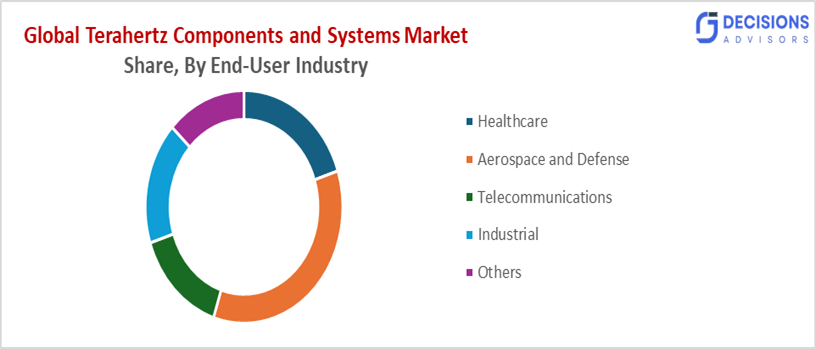
Based on the end-user industry, the terahertz components and systems market is divided into healthcare, aerospace and defense, telecommunications, industrial, others. Among these, the aerospace and defense segment dominated the market in 2024, and is projected to grow at a substantial CAGR during the forecast period. The government spends large amounts of money on advanced surveillance systems and security screening technologies and high-frequency communication systems which creates ongoing need for precise terahertz-based sensing and imaging systems.
Strategies to Implement for Growth of the Market in Non-Leading Regions
The global terahertz components and systems market need specific economic strategies which focus on developing local value creation methods and reducing costs to expand its market presence in non-leading regions. The governments should provide financial support to domestic manufacturing through subsidy programs and tax policies which will help decrease their reliance on imported products. The creation of regional innovation clusters which connect academic institutions and startup companies with industrial partners will create a better environment for technology transfer. In public-private partnerships can reduce investment risks for early-stage projects while standardized regulatory frameworks enable companies to enter new markets with greater efficiency. The development of human capital needs two essential components which include skill development programs for photonics and high-frequency electronics fields.
Regional Segment Analysis of the Terahertz Components and Systems Market
- North America (U.S., Canada, Mexico)
- Europe (Germany, France, U.K., Italy, Spain, Rest of Europe)
- Asia-Pacific (China, Japan, India, Rest of APAC)
- South America (Brazil and the Rest of South America)
- The Middle East and Africa (UAE, South Africa, Rest of MEA)
North America is anticipated to hold the largest share of the Terahertz Components and Systems Market over the predicted timeframe. The North America is anticipated to hold the largest share of the terahertz components and systems market, accounting for approximately 39.2% of total revenue over the forecast period. It is because of security screening and medical imaging and high-speed communication technologies have already been adopted and because the existing regulations provide necessary support. security screening and medical imaging and high-speed communication technologies have already been adopted and because the existing regulations provide necessary support.
Asia-Pacific is expected to grow at a rapid CAGR in the Terahertz Components and Systems Market during the forecast period. The Asia-Pacific market will experience fast growth because it accounts for approximately 23.1% of it is due to the increasing semiconductor manufacturing investments, growing 6G research programs, and the expanding use of technology in industrial and healthcare sectors drive market growth. The combination of government support and technological progress and rising electronics demand drives market development throughout the scheduled time frame.
Europe is the 3rd largest region to grow in the Terahertz Components and Systems Market during the region. The Europe region stands as the third biggest area global for the Terahertz Components and Systems Market since it holds approximately 22.8% the strategic partnerships and innovation policies and established technology infrastructure. The region depends on three main factors for its healthcare system, which include dedicated public funding and advanced photonics research facilities and rising usage of photonics technology in medical and security and industrial settings.
Future Market Trends in Terahertz Components and Systems Market: -
1. Convergence with 6G Communication Infrastructure
The terahertz components and systems market is experiencing growing integration with 6G networks because ultra-high-frequency bands provide new data transmission capabilities. Telecom operators and technology firms are accelerating their spending on terahertz-based prototypes which they consider essential for building future hyper-connected digital systems that require high data capacity.
2. Expansion of Semiconductor and Photonics Integration
The terahertz components gain their primary growth potential through their integration with advanced semiconductor systems and photonics technologies. The combination of new chip design methods and material science progress enables systems to achieve better performance while decreasing their operational difficulties, which results in energy-efficient compact solutions that meet the demands of high-frequency applications used in telecommunications and aerospace and precision manufacturing industries.
3. Growing Defense and Homeland Security Applications
The defense and homeland security agencies are increasing their use of terahertz systems which they use for surveillance and threat detection and imaging applications. The technology enables strategic advantages through its capacity to penetrate materials without using ionizing radiation. The high-value segment will experience sustained demand because of rising geopolitical tensions and ongoing security modernization programs.
Recent Development
- In October 2025, (U.S., U.K., Japan-based firms), industry reports valued the global terahertz market at USD 1.09 billion in 2025, highlighting key players such as Advantest Corporation, Luna Innovations, TeraView Limited, and TOPTICA Photonics as dominant innovators driving competitive intensity and technological advancement
In March 2025, Germany, HÜBNER GmbH & Co. KG advanced terahertz imaging and spectroscopy systems, aligning with a global market valued at USD 808.78 million in 2025, driven by rising demand for high-resolution sensing and industrial quality control applications.
Market Segment
This study forecasts revenue at global, regional, and country levels from 2020 to 2035. Decision Advisors has segmented the terahertz components and systems market based on the above-mentioned segments:
Global Terahertz Components and Systems Market, By Component Type
- Terahertz Sources
- Terahertz Detectors
- Terahertz Waveguides
Global Terahertz Components and Systems Market, By Application
- Medical Imaging
- Security Screening
- Non-Destructive Testing
- Communication Systems
- Others
Global Terahertz Components and Systems Market, By End-User Industry
- Healthcare
- Aerospace and Defense
- Telecommunications
- Industrial
- Others
Global Terahertz Components and Systems Market, By Regional Analysis
- North America
- US
- Canada
- Mexico
- Europe
- Germany
- UK
- France
- Italy
- Spain
- Russia
- Rest of Europe
- Asia Pacific
- China
- Japan
- India
- South Korea
- Australia
- Rest of Asia Pacific
- South America
- Brazil
- Argentina
- Rest of South America
- Middle East & Africa
- UAE
- Saudi Arabia
- Qatar
- South Africa
- Rest of the Middle East & Africa
Frequently Asked Questions (FAQ)
Q. Which region dominates the global terahertz market?
A. North America dominates the worldwide market through its superior research facilities and its commitment to defense spending and its early adoption of new technologies. The region accounted for a significant share, driven by established industry players and continuous innovation in terahertz-based communication and imaging systems
Q. What are the major challenges facing the market?
A. The main obstacles to progress in this field arise from three challenges which include high equipment costs, technical difficulties of terahertz generation and insufficient market understanding. The technology faces adoption challenges because these two factors specifically impact small and medium enterprises despite its ability to deliver substantial benefits across industrial and scientific fields.
Q. What are the key drivers fueling market growth?
A. The expansion of the market depends on two main factors which include progress in terahertz generation and detection technologies and the growing use of these technologies in non-destructive testing and medical imaging applications. Terahertz waves enable high-resolution analysis without using ionizing radiation which leads to their increasing adoption in essential industries that require both operational efficiency and enhanced safety standards worldwide.
Q. What impact does terahertz technology have on the pharmaceutical industry?
A. The pharmaceutical industry uses terahertz systems to perform accurate non-destructive testing for drug quality control. The technology enables real-time analysis of coating thickness and chemical composition which results in improved manufacturing accuracy and regulatory compliance and enhanced product reliability for highly controlled production environments.
- Introduction
- Objectives of the Study
- Market Definition
- Research Scope
- Research Methodology and Assumptions
- Executive Summary
- Premium Insights
- Porter’s Five Forces Analysis
- Value Chain Analysis
- Top Investment Pockets
- Market Attractiveness Analysis By Component Type
- Market Attractiveness Analysis By Application
- Market Attractiveness Analysis By End-User Industry
- Market Attractiveness Analysis By Region
- Industry Trends
- Market Dynamics
- Market Evaluation
- Drivers
- Increase in health consciousness
- Restraints
- Strict adherence to regulations required for sugar substitute products
- Opportunities
- Increased investment in R&D activities by manufacturers
- Challenges
5.5.1. Product labeling and claims issues
- Global Terahertz Components and Systems Market Analysis and Projection, By Component Type
- Segment Overview
- Terahertz Sources
- Terahertz Detectors
- Terahertz Waveguides
- Global Terahertz Components and Systems Market Analysis and Projection, By Application
- Segment Overview
- Medical Imaging
- Security Screening
- Non-Destructive Testing
- Communication Systems
- Others
- Global Terahertz Components and Systems Market Analysis and Projection, By End-User Industry
- Segment Overview
- Healthcare
- Aerospace and Defense
- Telecommunications
- Industrial
- Others
- Global Terahertz Components and Systems Market Analysis and Projection, By Regional Analysis
- Segment Overview
- North America
- U.S.
- Canada
- Mexico
- Europe
- Germany
- France
- U.K.
- Italy
- Spain
- Asia-Pacific
- Japan
- China
- India
- South America
- Brazil
- Middle East and Africa
- UAE
- South Africa
- Global Terahertz Components and Systems Market-Competitive Landscape
- Overview
- Market Share of Key Players in the Terahertz Components and Systems Market
- Global Company Market Share
- North America Company Market Share
- Europe Company Market Share
- APAC Company Market Share
- Competitive Situations and Trends
- Coverage Launches and Developments
- Partnerships, Collaborations, and Agreements
- Mergers & Acquisitions
- Expansions
- Company Profiles
- Advantest Corporation
- Business Overview
- Company Snapshot
- Company Market Share Analysis
- Company Coverage Portfolio
- Recent Developments
- SWOT Analysis
- TeraView Limited
- Business Overview
- Company Snapshot
- Company Market Share Analysis
- Company Coverage Portfolio
- Recent Developments
- SWOT Analysis
- TOPTICA Photonics AG
- Business Overview
- Company Snapshot
- Company Market Share Analysis
- Company Coverage Portfolio
- Recent Developments
- SWOT Analysis
- HÜBNER GmbH & Co. KG
- Business Overview
- Company Snapshot
- Company Market Share Analysis
- Company Coverage Portfolio
- Recent Developments
- SWOT Analysis
- Luna Innovations Incorporated
- Business Overview
- Company Snapshot
- Company Market Share Analysis
- Company Coverage Portfolio
- Recent Developments
- SWOT Analysis
- Menlo Systems GmbH
- Business Overview
- Company Snapshot
- Company Market Share Analysis
- Company Coverage Portfolio
- Recent Developments
- SWOT Analysis
- TeraSense Group Inc.
- Business Overview
- Company Snapshot
- Company Market Share Analysis
- Company Coverage Portfolio
- Recent Developments
- SWOT Analysis
- Microtech Instruments Inc.
- Business Overview
- Company Snapshot
- Company Market Share Analysis
- Company Coverage Portfolio
- Recent Developments
- SWOT Analysis
- Bruker Corporation
- Business Overview
- Company Snapshot
- Company Market Share Analysis
- Company Coverage Portfolio
- Recent Developments
- SWOT Analysis
- Thorlabs, Inc.
- Business Overview
- Company Snapshot
- Company Market Share Analysis
- Company Coverage Portfolio
- Recent Developments
- SWOT Analysis
- Advantest Corporation
List of Table
- Global Terahertz Components and Systems Market, By Component Type, 2024-2035(USD Billion)
- Global Terahertz Sources, Terahertz Components and Systems Market, By Region, 2024-2035(USD Billion)
- Global Terahertz Detectors, Terahertz Components and Systems Market, By Region, 2024-2035(USD Billion)
- Global Terahertz Waveguides, Terahertz Components and Systems Market, By Region, 2024-2035(USD Billion)
- Global Terahertz Components and Systems Market, By Application, 2024-2035(USD Billion)
- Global Medical Imaging, Terahertz Components and Systems Market, By Region, 2024-2035(USD Billion)
- Global Security Screening, Terahertz Components and Systems Market, By Region, 2024-2035(USD Billion)
- Global Non-Destructive Testing, Terahertz Components and Systems Market, By Region, 2024-2035(USD Billion)
- Global Communication Systems, Terahertz Components and Systems Market, By Region, 2024-2035(USD Billion)
- Global Others, Terahertz Components and Systems Market, By Region, 2024-2035(USD Billion)
- Global Terahertz Components and Systems Market, By End-User Industry, 2024-2035(USD Billion)
- Global Healthcare, Terahertz Components and Systems Market, By Region, 2024-2035(USD Billion)
- Global Aerospace and Defense, Terahertz Components and Systems Market, By Region, 2024-2035(USD Billion)
- Global Telecommunications, Terahertz Components and Systems Market, By Region, 2024-2035(USD Billion)
- Global Industrial, Terahertz Components and Systems Market, By Region, 2024-2035(USD Billion)
- Global Others, Terahertz Components and Systems Market, By Region, 2024-2035(USD Billion)
- North America Terahertz Components and Systems Market, By Component Type, 2024-2035(USD Billion)
- North America Terahertz Components and Systems Market, By Application, 2024-2035(USD Billion)
- North America Terahertz Components and Systems Market, By End-User Industry, 2024-2035(USD Billion)
- U.S. Terahertz Components and Systems Market, By Component Type, 2024-2035(USD Billion)
- U.S. Terahertz Components and Systems Market, By Application, 2024-2035(USD Billion)
- U.S. Terahertz Components and Systems Market, By End-User Industry, 2024-2035(USD Billion)
- Canada Terahertz Components and Systems Market, By Component Type, 2024-2035(USD Billion)
- Canada Terahertz Components and Systems Market, By Application, 2024-2035(USD Billion)
- Canada Terahertz Components and Systems Market, By End-User Industry, 2024-2035(USD Billion)
- Mexico Terahertz Components and Systems Market, By Component Type, 2024-2035(USD Billion)
- Mexico Terahertz Components and Systems Market, By Application, 2024-2035(USD Billion)
- Mexico Terahertz Components and Systems Market, By End-User Industry, 2024-2035(USD Billion)
- Europe Terahertz Components and Systems Market, By Component Type, 2024-2035(USD Billion)
- Europe Terahertz Components and Systems Market, By Application, 2024-2035(USD Billion)
- Europe Terahertz Components and Systems Market, By End-User Industry, 2024-2035(USD Billion)
- Germany Terahertz Components and Systems Market, By Component Type, 2024-2035(USD Billion)
- Germany Terahertz Components and Systems Market, By Application, 2024-2035(USD Billion)
- Germany Terahertz Components and Systems Market, By End-User Industry, 2024-2035(USD Billion)
- France Terahertz Components and Systems Market, By Component Type, 2024-2035(USD Billion)
- France Terahertz Components and Systems Market, By Application, 2024-2035(USD Billion)
- France Terahertz Components and Systems Market, By End-User Industry, 2024-2035(USD Billion)
- U.K. Terahertz Components and Systems Market, By Component Type, 2024-2035(USD Billion)
- U.K. Terahertz Components and Systems Market, By Application, 2024-2035(USD Billion)
- U.K. Terahertz Components and Systems Market, By End-User Industry, 2024-2035(USD Billion)
- Italy Terahertz Components and Systems Market, By Component Type, 2024-2035(USD Billion)
- Italy Terahertz Components and Systems Market, By Application, 2024-2035(USD Billion)
- Italy Terahertz Components and Systems Market, By End-User Industry, 2024-2035(USD Billion)
- Spain Terahertz Components and Systems Market, By Component Type, 2024-2035(USD Billion)
- Spain Terahertz Components and Systems Market, By Application, 2024-2035(USD Billion)
- Spain Terahertz Components and Systems Market, By End-User Industry, 2024-2035(USD Billion)
- Asia Pacific Terahertz Components and Systems Market, By Component Type, 2024-2035(USD Billion)
- Asia Pacific Terahertz Components and Systems Market, By Application, 2024-2035(USD Billion)
- Asia Pacific Terahertz Components and Systems Market, By End-User Industry, 2024-2035(USD Billion)
- Japan Terahertz Components and Systems Market, By Component Type, 2024-2035(USD Billion)
- Japan Terahertz Components and Systems Market, By Application, 2024-2035(USD Billion)
- Japan Terahertz Components and Systems Market, By End-User Industry, 2024-2035(USD Billion)
- China Terahertz Components and Systems Market, By Component Type, 2024-2035(USD Billion)
- China Terahertz Components and Systems Market, By Application, 2024-2035(USD Billion)
- China Terahertz Components and Systems Market, By End-User Industry, 2024-2035(USD Billion)
- India Terahertz Components and Systems Market, By Component Type, 2024-2035(USD Billion)
- India Terahertz Components and Systems Market, By Application, 2024-2035(USD Billion)
- India Terahertz Components and Systems Market, By End-User Industry, 2024-2035(USD Billion)
- South America Terahertz Components and Systems Market, By Component Type, 2024-2035(USD Billion)
- South America Terahertz Components and Systems Market, By Application, 2024-2035(USD Billion)
- South America Terahertz Components and Systems Market, By End-User Industry, 2024-2035(USD Billion)
- Brazil Terahertz Components and Systems Market, By Component Type, 2024-2035(USD Billion)
- Brazil Terahertz Components and Systems Market, By Application, 2024-2035(USD Billion)
- Brazil Terahertz Components and Systems Market, By End-User Industry, 2024-2035(USD Billion)
- The Middle East and Africa Terahertz Components and Systems Market, By Component Type, 2024-2035(USD Billion)
- The Middle East and Africa Terahertz Components and Systems Market, By Application, 2024-2035(USD Billion)
- The Middle East and Africa Terahertz Components and Systems Market, By End-User Industry, 2024-2035(USD Billion)
- UAE Terahertz Components and Systems Market, By Component Type, 2024-2035(USD Billion)
- UAE Terahertz Components and Systems Market, By Application, 2024-2035(USD Billion)
- UAE Terahertz Components and Systems Market, By End-User Industry, 2024-2035(USD Billion)
- South Africa Terahertz Components and Systems Market, By Component Type, 2024-2035(USD Billion)
- South Africa Terahertz Components and Systems Market, By Application, 2024-2035(USD Billion)
- South Africa Terahertz Components and Systems Market, By End-User Industry, 2024-2035(USD Billion)
List of Figures
- Global Terahertz Components and Systems Market Segmentation
- Terahertz Components and Systems Market: Research Methodology
- Market Size Estimation Methodology: Bottom-Up Approach
- Market Size Estimation Methodology: Top-down Approach
- Data Triangulation
- Porter’s Five Forces Analysis
- Value Chain Analysis
- Top investment pocket in the Terahertz Components and Systems Market
- Top Winning Strategies, 2024-2035
- Top Winning Strategies, By Development, 2024-2035(%)
- Top Winning Strategies, By Company, 2024-2035
- Moderate Bargaining power of Buyers
- Moderate Bargaining power of Suppliers
- Moderate Bargaining power of New Entrants
- Low threat of Substitution
- High Competitive Rivalry
- Top Player Positioning, 2024
- Market Share Analysis, 2024
- Restraint and Drivers: Terahertz Components and Systems Market
- Terahertz Components and Systems Market Segmentation, By Component Type
- Terahertz Components and Systems Market For Terahertz Sources, By Region, 2024-2035 ($ Billion)
- Terahertz Components and Systems Market For Terahertz Detectors, By Region, 2024-2035 ($ Billion)
- Terahertz Components and Systems Market For Terahertz Waveguides, By Region, 2024-2035 ($ Billion)
- Terahertz Components and Systems Market For <<Sub1_se4>>, By Region, 2024-2035 ($ Billion)
- Terahertz Components and Systems Market For <<Sub1_se5>>, By Region, 2024-2035 ($ Billion)
- Terahertz Components and Systems Market Segmentation, By Application
- Terahertz Components and Systems Market For Medical Imaging, By Region, 2024-2035 ($ Billion)
- Terahertz Components and Systems Market For Security Screening, By Region, 2024-2035 ($ Billion)
- Terahertz Components and Systems Market For Non-Destructive Testing, By Region, 2024-2035 ($ Billion)
- Terahertz Components and Systems Market For Communication Systems, By Region, 2024-2035 ($ Billion)
- Terahertz Components and Systems Market For Others, By Region, 2024-2035 ($ Billion)
- Terahertz Components and Systems Market Segmentation, By End-User Industry
- Terahertz Components and Systems Market For Healthcare, By Region, 2024-2035 ($ Billion)
- Terahertz Components and Systems Market For Aerospace and Defense, By Region, 2024-2035 ($ Billion)
- Terahertz Components and Systems Market For Telecommunications, By Region, 2024-2035 ($ Billion)
- Terahertz Components and Systems Market For Industrial, By Region, 2024-2035 ($ Billion)
- Terahertz Components and Systems Market For Others, By Region, 2024-2035 ($ Billion)
- Advantest Corporation: Net Sales, 2024-2035 ($ Billion)
- Advantest Corporation: Revenue Share, By Segment, 2024 (%)
- Advantest Corporation: Revenue Share, By Region, 2024 (%)
- TeraView Limited: Net Sales, 2024-2035 ($ Billion)
- TeraView Limited: Revenue Share, By Segment, 2024 (%)
- TeraView Limited: Revenue Share, By Region, 2024 (%)
- TOPTICA Photonics AG: Net Sales, 2024-2035 ($ Billion)
- TOPTICA Photonics AG: Revenue Share, By Segment, 2024 (%)
- TOPTICA Photonics AG: Revenue Share, By Region, 2024 (%)
- HÜBNER GmbH & Co. KG: Net Sales, 2024-2035 ($ Billion)
- HÜBNER GmbH & Co. KG: Revenue Share, By Segment, 2024 (%)
- HÜBNER GmbH & Co. KG: Revenue Share, By Region, 2024 (%)
- Luna Innovations Incorporated: Net Sales, 2024-2035 ($ Billion)
- Luna Innovations Incorporated: Revenue Share, By Segment, 2024 (%)
- Luna Innovations Incorporated: Revenue Share, By Region, 2024 (%)
- Menlo Systems GmbH: Net Sales, 2024-2035 ($ Billion)
- Menlo Systems GmbH: Revenue Share, By Segment, 2024 (%)
- Menlo Systems GmbH: Revenue Share, By Region, 2024 (%)
- TeraSense Group Inc.: Net Sales, 2024-2035 ($ Billion)
- TeraSense Group Inc.: Revenue Share, By Segment, 2024 (%)
- TeraSense Group Inc.: Revenue Share, By Region, 2024 (%)
- Microtech Instruments Inc.: Net Sales, 2024-2035 ($ Billion)
- Microtech Instruments Inc.: Revenue Share, By Segment, 2024 (%)
- Microtech Instruments Inc.: Revenue Share, By Region, 2024 (%)
- Bruker Corporation.: Net Sales, 2024-2035 ($ Billion)
- Bruker Corporation.: Revenue Share, By Segment, 2024 (%)
- Bruker Corporation.: Revenue Share, By Region, 2024 (%)
- Thorlabs, Inc.: Net Sales, 2024-2035 ($ Billion)
- Thorlabs, Inc.: Revenue Share, By Segment, 2024 (%)
- Thorlabs, Inc.: Revenue Share, By Region, 2024 (%)
Check Licence
Choose the plan that fits you best: Single User, Multi-User, or Enterprise solutions tailored for your needs.
We Have You Covered
- 24/7 Analyst Support
- Clients Across the Globe
- Tailored Insights
- Technology Tracking
- Competitive Intelligence
- Custom Research
- Syndicated Market Studies
- Market Overview
- Market Segmentation
- Growth Drivers
- Market Opportunities
- Regulatory Insights
- Innovation & Sustainability
Report Details
| Scope | Global |
| Pages | 240 |
| Delivery | PDF & Excel via Email |
| Language | English |
| Release | Apr 2026 |
| Access | Download from this page |