
Global Terahertz Radiation Device Market
 |
Author:
Shruti G
|
Pages:
210
|
Author:
Shruti G
|
Pages:
210
Global Terahertz Radiation Device Market Size, Share, By Type (Terahertz Time-Domain Spectroscopy, Terahertz Imaging Systems, Terahertz Sensors), By Application (Medical Imaging, Security Screening, Telecommunications, Non-Destructive Testing), By Component (Laser Sources, Detectors, Optical Components, Data Processing Units), and By Region (North America, Europe, Asia-Pacific, Latin America, Middle East, and Africa), Analysis and Forecast 2026-2035.
CAGR
14.85%
REVENUE 2025
USD Billion 1.3
FORECAST 2035
USD Billion 5.19
REPORT COVERAGE
Global
Market Snapshot
- Global Terahertz Radiation Device Market Size (2025): USD 1.30 Billion
- Projected Global Terahertz Radiation Device Market Size (2035): USD 5.19 Billion
- Global Terahertz Radiation Device Market Compound Annual Growth Rate (CAGR): 14.85%
- Largest Regional Market: North America
- Fastest Growing Region: Asia-Pacific
- 3rd Largest Region: Europe
- Base Year: 2025
- Historical Period: 2021-2024
- Forecast Period: 2026-2035
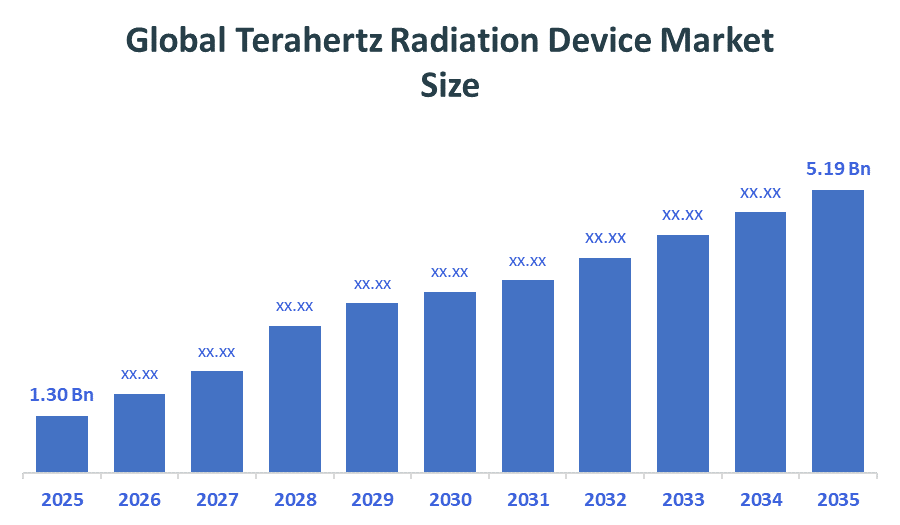
According to Decision Advisors, the Global Terahertz Radiation Device Market Size is expected to grow from USD 1.30 billion in 2025 to USD 5.19 billion by 2035, at a CAGR of 14.85% during the forecast period 2026-2035. The global terahertz radiation device market is experiencing growth because of the demand for ultra-high-frequency communication systems which work with the upcoming 6G technologies continues to increase. The market for non-destructive testing solutions which use terahertz technology is expanding, precision-based industries require these systems to achieve advanced diagnostic capabilities and improve their operational performance.
Market Overview/ Introduction
The terahertz radiation devices operate within the 0.1 to 10 THz frequency range which enables them to generate advanced waves and detect them and control their performance through modulation. The global terahertz radiation device market has various systems that security screening and medical diagnostics and industrial non-destructive testing and pharmaceutical quality control, use but these systems also serve as vital components for building ultra-high-speed communication networks that support next-generation 6G infrastructure. The market is experiencing innovative developments through technologies which include AI-driven spectroscopy and advanced semiconductor inspection systems together with precise battery performance measurements that improve industrial productivity. The market will experience continuous growth because it will benefit from two main sources which include advanced telecom systems that use terahertz frequencies for high-speed connectivity and the growing demand for biomedical diagnostic tools and non-destructive testing methods.
- The U.S. Department of Defense allocated $600 million for 5G experimentation, strengthening high-frequency spectrum capabilities and indirectly supporting innovation in terahertz technologies, thereby contributing to growth in the global terahertz radiation device market.
- The National Science Foundation in the United States, with Intel Corporation and Samsung, invested $42.4 million in semiconductor R&D, supporting high-frequency innovation and driving growth in the global terahertz radiation device market.
- In Japan, Advantest Corporation leverages terahertz-based TDR systems with top-class signal quality to analyze advanced packages like 2.5D/3D ICs, enhancing precision diagnostics and driving high-value innovation in the global terahertz radiation device market.
Notable Insights: -
- North America holds the largest regional market share, approximately 38.9% in the global terahertz radiation device market.
- Asia-Pacific is the fastest growing region in the terahertz radiation device market is supported by development of semiconductor production facilities in China and Japan and South Korea together with the growth of 6G research funding and the widespread use of state-of-the-art imaging and sensing technologies in industrial and defense applications drive this trend.
- By type, the terahertz imaging systems segment held a dominant position with 45.2% in terms of market share in 2025.
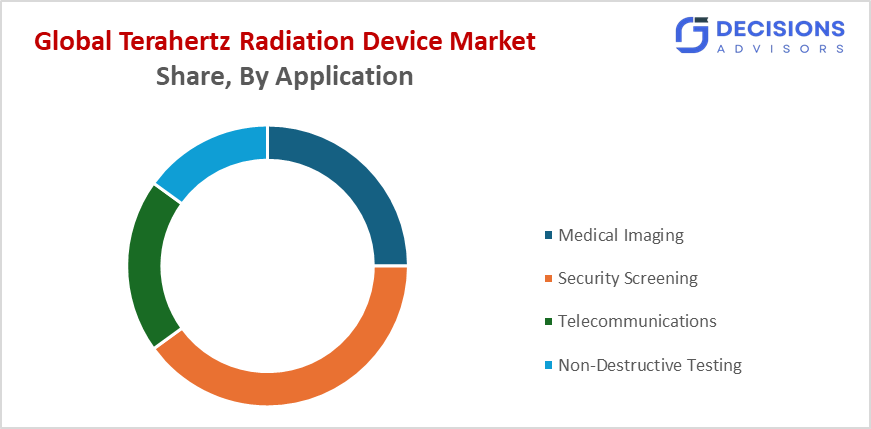
- By Application, security screening segment is the dominating accounting for over 36.5% of the global market share in 2025.
- The compound annual growth rate of the global terahertz radiation device market is 14.85%.
- The market is likely to achieve a valuation of USD 5.19 billion by 2035.
What is role of technology in grooming the market?
The technology serves as the main driving force which develops the worldwide market for terahertz radiation devices through its power to enhance system performance while enabling smaller device designs and bringing high-frequency technologies into the commercial market. The field of semiconductor engineering along with photonics integration and signal processing research have achieved both cost reductions and better system performance. The combination of AI-based imaging analytics with ultra-fast data transmission for beyond-5G and 6G networks and precise spectroscopy tools creates new possibilities for use in security and healthcare and industrial domains. The development of material science and chip-scale integration technologies has led to better system performance which enables greater market expansion and attracts more funding while establishing permanent growth for the terahertz ecosystem.
In the United States, terahertz imaging systems operating at 525 GHz with 125 GHz bandwidth demonstrate strong clinical potential in burn and corneal diagnostics, supporting increased federal R&D funding and accelerating innovation within the global terahertz radiation device market.
How is Recent Developments Helping the Market?
Recent technological developments create substantial benefits for the global terahertz radiation device market expansion results from modern which increase device performance while decreasing costs and creating additional applications. The demand for ultra-high-frequency components has grown because of the 6G wireless prototypes now deliver data speeds of up to 1.2 Tbps. The development of compact room-temperature terahertz modules which provide 18% cost savings has opened new commercial opportunities for portable medical and security devices. The graphene-based detectors deliver 30% higher sensitivity which helps improve detection accuracy in semiconductor and optoelectronic devices. The combination of these innovations creates faster industrial adoption which drives strategic investments and strengthens the market's growth prospects.
Market Drivers
The global terahertz radiation device market is experiencing growth because multiple industries require precise diagnostic tools and advanced communication systems. The terahertz non-destructive testing methods enable industrial applications to identify defects in high-value materials which include the composites and ceramics thereby increasing operational efficiency and decreasing failures. The healthcare facilities use terahertz waves to create safe high-resolution imaging systems which enable early disease detection and pharmaceutical analysis that lead to improved clinical results. The increasing security demands for airports and public facilities drive the need for terahertz screening systems which detect hidden threats. The shift to 6G networks drives the need for terahertz frequencies because they provide a solution to spectrum limitations and enable extremely fast data transfers.
Restrain
The global terahertz radiation device market faces structural constraints because of the high capital requirements and operational difficulties which arise from its complex system operations. The high initial costs which are required to buy specialized THz systems create barriers for their adoption especially for small businesses and mid-sized companies. The need for extensive system customization together with legacy infrastructure integration problems creates additional deployment costs and requires extra time for implementation.
Competitive Analysis:
The report offers the appropriate analysis of the key organizations/companies involved within the global Terahertz Radiation Device Market, along with a comparative evaluation primarily based on their product of offering, business overviews, geographic presence, enterprise strategies, segment market share, and SWOT analysis. The report also provides an elaborative analysis focusing on the current news and developments of the companies, which includes product development, innovations, joint ventures, partnerships, mergers & acquisitions, strategic alliances, and others. This allows for the evaluation of the overall competition within the market.
Top Companies in Global Terahertz Radiation Device Market
- Advantest Corporation
- HÜBNER GmbH & Co. KG
- TeraView Limited
- TOPTICA Photonics AG
- Menlo Systems GmbH
- Luna Innovations Incorporated
- Terasense Group Inc.
- Microtech Instrument Inc.
- EMCORE Corporation
- Bruker Corporation
Government Initiatives
|
Country |
Key Government Initiatives |
|
US |
In the United States, terahertz technology operating within 0.1-y10 THz frequency range is increasingly used in biomedical imaging due to its non-ionizing and non-invasive properties, enabling high-resolution diagnostics and driving demand in the global terahertz radiation device market. |
|
Japan |
In Japan, regulatory initiatives such as SaMD frameworks supported by the Pharmaceuticals and Medical Devices Agency are accelerating digital health innovation, strengthening advanced diagnostic ecosystems and indirectly driving demand in the global terahertz radiation device market. |
|
|
Market Segmentation
The Terahertz Radiation Device Market share is classified into type, application, and component
- The terahertz imaging systems segment dominated the market in 2024 and is projected to grow at a substantial CAGR of approximately 22.8% during the forecast period.
Based on the type, the terahertz radiation device market is divided into terahertz time-domain spectroscopy, terahertz imaging systems, terahertz sensors. Among these, the terahertz imaging systems segment dominated the market in 2024 and is projected to grow at a substantial CAGR of approximately 22.8% during the forecast period. It is because of the strong commercial potential in its security and healthcare and industrial inspection markets. The company achieves its main business success through its technology which enables high-resolution and non-invasive analysis that has become widely used in the expanding terahertz technology market.
- The security screening segment accounted for the largest share in 2024 and is anticipated to grow at a significant CAGR of approximately 20.2% during the forecast period.
Based on the application, the terahertz radiation device market is divided into medical imaging, security screening, telecommunications, non-destructive testing. Among these, the security screening segment accounted for the largest share in 2024 and is anticipated to grow at a significant CAGR of approximately 20.2% during the forecast period. It is dominating because it needs to improve security measures while developing better infrastructure systems. The system generates income through its ability to detect hidden threats without using invasive methods which enables it to achieve exact measurements of concealed dangers.
- The detectors segment dominated the market in 2024, and is projected to grow at a substantial CAGR during the forecast period.
Based on the component, the terahertz radiation device market is divided into laser sources, detectors, optical components, data processing units. Among these, the detectors segment dominated the market in 2024, and is projected to grow at a substantial CAGR during the forecast period. The system depends on the vital systems which perform crucial tasks for both signal detection and system performance enhancement throughout all its imaging and sensing and spectroscopy operations.
Strategies to Implement for Growth of the Market in Non-Leading Regions
The global terahertz radiation device market in non-leading regions requires a combination of policy support, cost optimization, and ecosystem development. The governments should adopt financial incentives such as subsidies, tax benefits, and public-private partnerships to decrease entry barriers for businesses. The local manufacturing sector together with supply chains needs strengthening because it will create cost reductions and better product availability. The technical training and research institution investment is necessary to create qualified workforce needed for various fields. The implementation of pilot projects in healthcare and security and industrial testing will showcase their real-world benefits while speeding up product market entry. The establishment of strategic partnerships with global technology companies will enable organizations to exchange knowledge and expand their market presence in regional areas.
Regional Segment Analysis of the global terahertz radiation device market
- North America (U.S., Canada, Mexico)
- Europe (Germany, France, U.K., Italy, Spain, Rest of Europe)
- Asia-Pacific (China, Japan, India, Rest of APAC)
- South America (Brazil and the Rest of South America)
- The Middle East and Africa (UAE, South Africa, Rest of MEA)
North America is anticipated to hold the largest share of the terahertz radiation device market over the predicted timeframe. The North America is anticipated to hold the largest share of the terahertz radiation device market, accounting for approximately 38.5% of total revenue over the forecast period. It is because of the advanced semiconductor infrastructure together with the existing defense sector requirements, which makes the region a suitable base for operating capacity. The region established itself as a major revenue generator because it adopted imaging and spectroscopy technologies early while its regulatory frameworks supported market development in security screening, healthcare diagnostics, and next-generation wireless communication systems.
Asia-Pacific is expected to grow at a rapid CAGR in the terahertz radiation device market during the forecast period. The Asia-Pacific market will experience fast growth because it accounts for approximately 26.2% of it is due to the semiconductor production network expansion, and public-private funding for advanced imaging technology research. The Asia-Pacific region experiences high demand because its cost-effective production facilities and rising defense needs and security requirements and greater healthcare diagnostic usage create increased market need.
Europe is the 3rd largest region to grow in the Terahertz Radiation Device Market during the region. The Europe region stands as the third biggest area global for the Terahertz Radiation Device Market since it holds approximately 23.1% the main factors such as precision engineering abilities and our compliance with security and healthcare regulations. The company experiences steady growth because of its strategic investments and international research projects which create new business opportunities.
Future Market Trends in Terahertz Radiation Device Market: -
- Financial-Grade Terahertz Authentication Infrastructure
The terahertz-based authentication systems which will use unique material signatures to replace existing digital security methods in financial systems. The implementation of ultra-secure verification systems will transform existing anti-counterfeiting methods by enhancing security for banking operations and currency authentication and high-value asset protection.
- Circular Economy Integration via Terahertz Sorting Systems
The terahertz technology will play a crucial role in future recycling systems because it enables waste materials to be separated at their molecular structure. The systems work through terahertz technology to achieve three objectives by increasing material recovery rates and decreasing industrial waste discharge while supporting circular economy practices which better match global resource efficiency standards and sustainability requirements.
- Terahertz-Driven Atmospheric Intelligence Systems
The terahertz devices as essential instruments for decoding atmospheric data which leads to the creation of hyper-local climate intelligence. The systems will enable predictive agriculture and disaster mitigation and carbon monitoring through their ability to detect molecular-level environmental changes which will make terahertz technologies part of international sustainability efforts and climate-risk management systems.
Recent Development
- In July 2024, TicWave Solutions GmbH, Germany, introduced silicon-based terahertz devices, enhancing industrial accessibility. Such developments are reinforcing commercialization momentum and accelerating adoption, positioning the global terahertz radiation device market for sustained technological expansion and competitive innovation.
- In March 2024, Cambridge Terahertz, United States, demonstrated AI-enabled concealed weapons detection systems using terahertz imaging, strengthening security applications and accelerating adoption of non-ionizing imaging technologies within the global terahertz radiation device market.
Market Segment
This study forecasts revenue at global, regional, and country levels from 2020 to 2035. Decision Advisors has segmented the terahertz radiation device market based on the above-mentioned segments:
Global Terahertz Radiation Device Market, By Type
- Terahertz Time-Domain Spectroscopy
- Terahertz Imaging Systems
- Terahertz Sensors
Global Terahertz Radiation Device Market, By Application
- Medical Imaging
- Security Screening
- Telecommunications
- Non-Destructive Testing
Global Terahertz Radiation Device Market, By Component
- Laser Sources
- Detectors
- Optical Components
- Data Processing Units
Global Terahertz Radiation Device Market, By Regional Analysis
- North America
- US
- Canada
- Mexico
- Europe
- Germany
- UK
- France
- Italy
- Spain
- Russia
- Rest of Europe
- Asia Pacific
- China
- Japan
- India
- South Korea
- Australia
- Rest of Asia Pacific
- South America
- Brazil
- Argentina
- Rest of South America
- Middle East & Africa
- UAE
- Saudi Arabia
- Qatar
- South Africa
- Rest of the Middle East & Africa
Frequently Asked Questions (FAQ)
Q. How is the terahertz radiation device market evolving within the broader deep-tech economy?
A. The market is moving from its research stage to its initial commercial stage because deep-tech investment patterns have reached their next development phase. The combination of rising venture capital funding with interindustry partnerships has turned terahertz technologies into commercial products which now function as essential components of high-value innovation systems and permanent strategic technology plans.
Q. How are industrial inspection applications redefining demand patterns?
A. The industrial sectors are increasingly leveraging terahertz systems for non-destructive testing and quality assurance, particularly in aerospace and electronics manufacturing. The implementation of terahertz devices enables production processes to achieve higher accuracy while reducing defects, which makes these devices essential for precision-based industrial transformation and operational efficiency enhancements.
Q. How is regulatory alignment influencing market expansion?
A. The terahertz spectrum use and associated safety standards need more time to develop their complete regulatory frameworks. The current policy environment will create two benefits by decreasing operational risks and attracting private investment while providing smoother cross-border technology implementation. The market development process will speed up because of these changes which will create a more organized worldwide market entry system.
Q. What role do advanced materials play in shaping future competitiveness?
A. The material innovation through graphene and compound semiconductors will create new pathways for increasing device efficiency and production capacity. The new technology will decrease signal loss and increase performance limits which will allow manufacturers to develop new applications while decreasing expenses and establishing unique market advantages in international markets.
Check Licence
Choose the plan that fits you best: Single User, Multi-User, or Enterprise solutions tailored for your needs.
We Have You Covered
- 24/7 Analyst Support
- Clients Across the Globe
- Tailored Insights
- Technology Tracking
- Competitive Intelligence
- Custom Research
- Syndicated Market Studies
- Market Overview
- Market Segmentation
- Growth Drivers
- Market Opportunities
- Regulatory Insights
- Innovation & Sustainability
Report Details
| Scope | Global |
| Pages | 210 |
| Delivery | PDF & Excel via Email |
| Language | English |
| Release | Apr 2026 |
| Access | Download from this page |