
Global Thorium Fuel Market
 |
Author:
Aditya G
|
Pages:
245
|
Author:
Aditya G
|
Pages:
245
Global Thorium Fuel Market Size, Share, By Product Type (Blended Fuels, and Self-Sustaining Fuels), By Fuel Forms (Solid Fuel, and Liquid Fuel), By Application (Nuclear Power Generation, Nuclear Propulsion, and Others), and By Region (North America, Europe, Asia-Pacific, Latin America, Middle East, and Africa), Analysis and Forecast 2026-2035.
CAGR
9.35%
REVENUE 2025
USD Million 285.7
FORECAST 2035
USD Million 698.3
REPORT COVERAGE
Global
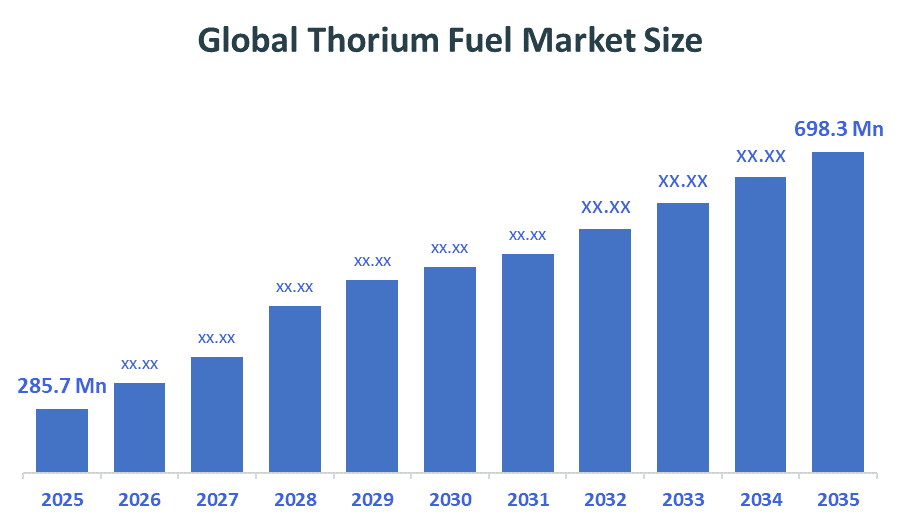
The Global Thorium Fuel Market Size is anticipated to grow from USD 285.7 million in 2025 and is expected to reach around USD 698.3 million by 2035. According to Decision Advisors, a comprehensive research report on the thorium fuel market highlights that advanced reactor technologies, particularly Molten Salt Reactors (MSRs), dominate the global landscape, accounting for nearly 35–40% of the total market share due to their enhanced safety, higher efficiency, and reduced radioactive waste generation. The market remains innovation-driven, with key industry participants such as General Electric, Mitsubishi Heavy Industries, and ThorCon Power playing a crucial role in advancing thorium-based nuclear technologies.
Market Snapshot
- Global Thorium Fuel Market Size (2025): USD 285.7 million
- Projected Global Thorium Fuel Market Size (2035): USD 698.3 million
- Global Thorium Fuel Market Compound Annual Growth Rate (CAGR): 9.35%
- Largest Regional Market: North America
- Fastest Growing Region: Asia-Pacific
- 3rd Largest Region: Europe
- Base Year: 2025
- Historical Period: 2021-2024
- Forecast Period: 2026-2035
Market Overview/ Introduction
The Global Thorium Fuel Market is gaining significant traction as a key segment of the advanced nuclear energy market, driven by increasing demand for clean, sustainable, and efficient power generation. The market involves the development and utilization of thorium-based nuclear fuels in advanced reactor technologies such as molten salt reactors (MSRs) and small modular reactors (SMRs). Thorium enables the production of uranium-233, offering superior fuel efficiency, enhanced safety, and reduced long-lived radioactive waste compared to conventional fuels. Growing investments, supportive government policies, and rising focus on energy security and decarbonization are accelerating adoption. Major countries such as India and China are leading innovation, creating strong future opportunities and driving long-term growth in the global thorium fuel market.
- In April 2026, India’s Prototype Fast Breeder Reactor (PFBR) at Kalpakkam achieved first criticality, marking entry into the second stage of its nuclear program and strengthening the long-term pathway toward thorium utilization, positively influencing the global thorium fuel market outlook.
- In August 2025, Bhabha Atomic Research Centre conducted a molten fuel salt criticality experiment, advancing Molten Salt Reactor (MSR) technology and strengthening thorium fuel development, boosting long-term growth prospects in the global thorium fuel market and next-generation nuclear energy solutions.
- In November 2025, China announced plans for a 14,000-container cargo ship powered by a 200 MWt thorium-based molten salt reactor, expanding maritime nuclear innovation and strengthening long-term growth opportunities in the global thorium fuel market and sustainable shipping energy solutions.
Notable Insights: -
- North America holds the largest regional market share, approximately 37.3% in the global Thorium Fuel market.
- By product type, the blended fuel segment held a dominant position with 23% in terms of market share in 2025.
- By fuel form, solid fuel segment is the dominating accounting for over 54% of the global market share in 2025.
- The compound annual growth rate of the global Thorium Fuel market is 9.35%.
- The market is likely to achieve a valuation of USD 698.3 Million by 2035.
What is role of technology in grooming the market?
Technology plays a critical role in advancing the global thorium fuel market, driving innovation across advanced nuclear energy systems and fuel cycle development. Breakthroughs in molten salt reactors (MSRs), which account for over 55% of thorium reactor research focus, are enhancing efficiency, passive safety, and low-pressure operation. Advanced fuel fabrication, reprocessing technologies, and AI-driven reactor monitoring are improving fuel utilization and reducing radioactive waste. Additionally, development of corrosion-resistant materials and digital simulation tools is strengthening reactor performance and reliability. Key countries such as India and China are accelerating investments in these technologies, reinforcing innovation, scalability, and long-term growth in the global thorium fuel market.
Market Drivers
The global thorium fuel market is gaining significant momentum, driven by the rising demand for clean, reliable, and sustainable energy solutions. Nuclear power currently contributes nearly 10% of global electricity generation, reinforcing the need for safer and more efficient fuel alternatives. Thorium offers 3–4 times higher fuel efficiency than conventional uranium, positioning it as a key resource for next-generation nuclear technologies. Increasing investments in advanced reactors, particularly molten salt reactors (MSRs), are accelerating innovation and deployment. Furthermore, strong government support and strategic initiatives in countries such as India and China, combined with abundant thorium reserves, are driving sustained growth and long-term expansion in the global thorium fuel market.
Restrain
The global thorium fuel market faces several restraining factors despite its strong long-term growth potential. High capital investment requirements, with advanced nuclear reactor projects often exceeding USD 5–8 billion per unit, remain a significant barrier. Additionally, complex reactor design and limited commercial deployment hinder widespread adoption.
Competitive Analysis:
The report offers the appropriate analysis of the key organizations/companies involved within the global thorium fuel market, along with a comparative evaluation primarily based on their product of offering, business overviews, geographic presence, enterprise strategies, segment market share, and SWOT analysis. The report also provides an elaborative analysis focusing on the current news and developments of the companies, which includes product development, innovations, joint ventures, partnerships, mergers & acquisitions, strategic alliances, and others. This allows for the evaluation of the overall competition within the market.
Top Companies in Global Thorium Fuel Market
- China National Nuclear Corporation (CNNC)
- Flibe Energy
- ThorCon Power
- Clean Core Thorium Energy (CCTE)
- TerraPower
- Thor Energy
- Copenhagen Atomics
- Terrestrial Energy
- Lightbridge Corporation
- Moltex Energy
- General Atomics
- Ultra Safe Nuclear Corporation (USNC)
- Seaborg Technologies
- Westinghouse Electric Company
Government Initiatives
|
Country |
Key Government Initiatives |
|
US |
The U.S. Department of Energy is advancing the global thorium fuel market through strong support for advanced reactor R&D, including collaborations between Flibe Energy and Savannah River National Laboratory. These initiatives accelerate molten salt reactor (MSR) and thorium fuel cycle development, strengthening innovation, public-private partnerships, and long-term growth opportunities in next-generation nuclear energy technologies. |
|
China |
National Energy Administration supports molten salt reactors (MSRs) for enhanced safety and low water usage, enabling deployment in arid regions and strengthening growth in the global thorium fuel market through next-generation nuclear energy innovation. |
|
|
|
Market Segmentation
The Global Thorium Fuel Market share is classified into product type, fuel form, and application
- The blended fuels segment dominated the market in 2024 and is projected to grow at a substantial CAGR of approximately 23% during the forecast period.
Based on the product type, the thorium fuel market is divided into blended fuels, and self-sustaining fuels. Among these, the blended fuels segment dominated the market in 2025 and is projected to grow at a substantial CAGR of approximately 23% during the forecast period. They facilitate a gradual adoption of thorium technology by utilities, serving as a "starter" to kick off the thorium fuel cycle without necessitating a complete overhaul of current infrastructure.
- The solid fuel segment accounted for the largest share in 2024 and is anticipated to grow at a significant CAGR of approximately 54% during the forecast period.
Based on the fuel form, the thorium fuel market is divided into solid fuel, and liquid fuel. Among these, the solid fuel segment accounted for the largest share in 2025 and is anticipated to grow at a significant CAGR of approximately 54% during the forecast period. Solid fuels like thorium dioxide ceramics or thorium-based mixed oxides (MOX) dominate the market because they are compatible with existing nuclear infrastructure and are based on proven technology.
- The nuclear power generation segment dominated the market in 2024, and is projected to grow at a substantial CAGR of approximately 63% during the forecast period.
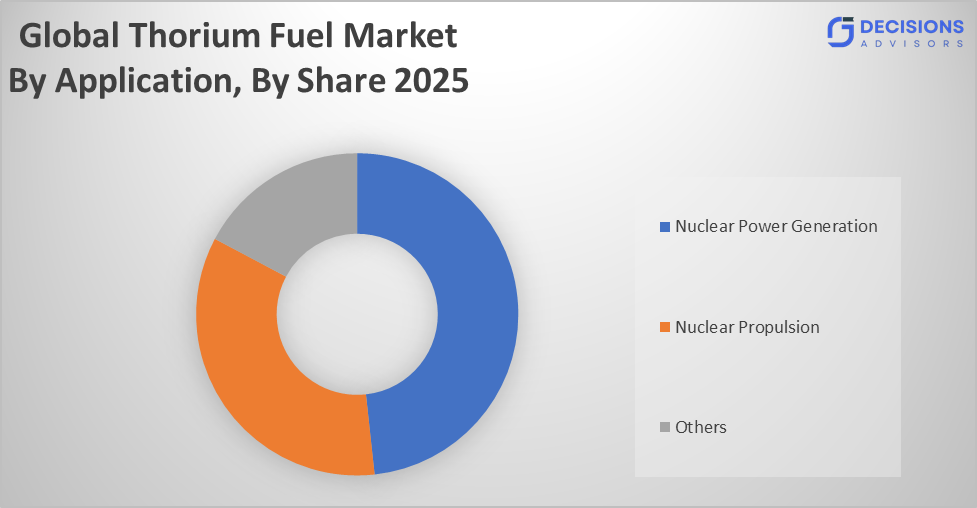
Based on the application, the thorium fuel market is divided into nuclear power generation, nuclear propulsion, and others. Among these, the nuclear power generation segment dominated the market in 2025, and is projected to grow at a substantial CAGR of approximately 63% during the forecast period. A significant driving force is the pressing demand for clean energy to achieve climate goals, leading to substantial investments by governments and utilities in thorium as a low-carbon substitute for conventional uranium.
Regional Segment Analysis of the Global Thorium Fuel Market
- North America (U.S., Canada, Mexico)
- Europe (Germany, France, U.K., Italy, Spain, Rest of Europe)
- Asia-Pacific (China, Japan, India, Rest of APAC)
- South America (Brazil and the Rest of South America)
- The Middle East and Africa (UAE, South Africa, Rest of MEA)
North America is anticipated to hold the largest share of the thorium fuel market over the predicted timeframe. North America is expected to dominate the global thorium fuel market, holding approximately 30% market share and growing at a CAGR of 9% during the forecast period. The United States leads regional growth, supported by strong nuclear research funding, advanced reactor development, and increasing investments in molten salt reactors (MSRs). This leadership strengthens North America’s position in the global thorium fuel market, driven by innovation in next-generation nuclear energy and clean fuel technologies.
Asia-Pacific is expected to grow at a rapid CAGR in the thorium fuel market during the forecast period. Asia-Pacific is projected to witness the fastest growth in the global thorium fuel market, registering a CAGR of approximately 12% during the forecast period and accounting for nearly 42% market share. Countries such as China and India are driving regional expansion through strong nuclear energy investments, advanced molten salt reactor (MSR) development, and abundant thorium reserves. This rapid growth reinforces Asia-Pacific’s strategic importance in the global thorium fuel market, supported by rising energy demand and next-generation clean nuclear technologies.
Europe are the 3rd largest region to grow in the thorium fuel market during the region. Europe is expected to rank as the third-largest region in the global thorium fuel market, holding approximately 22% market share and expanding at a CAGR of 8.5% during the forecast period. Key countries such as United Kingdom, France, and Norway are driving growth through advanced nuclear research, molten salt reactor (MSR) development, and strong clean energy policies. This positions Europe as a significant contributor to innovation, sustainability, and long-term expansion in the global thorium fuel market.
Future Market Trends in Global Thorium Fuel Market: -
- Advancements in Advanced Nuclear Technology: The market is propelled by developments in molten-salt reactors and high-temperature gas-cooled reactors, which offer greater safety and efficiency compared to conventional reactors.
- Regional Leadership (Asia-Pacific): Owing to their substantial domestic thorium reserves, India and China are at the forefront of development. India's BARC has created small reactors, emphasizing the emphasis on next-gen energy systems.
- Increasing Investment and Commercialization: More than 10 businesses are working on thorium technology, and venture funding has risen by 48% since 2022. The market is shifting towards pilot projects, and thorium is expected to account for 15% of global nuclear capacity by 2033.
Recent Developments
- In April 2026, Canadian Nuclear Laboratories partnered with Clean Core Thorium Energy to fabricate ANEEL (thorium + HALEU) fuel bundles for CANDU and PHWR reactors, advancing demonstration-stage deployment and strengthening global thorium fuel market growth through scalable, near-term nuclear fuel innovation.
- In August 2024, ThorCon signed agreements to develop a 500 MW thorium-based floating molten salt reactor in Indonesia, advancing MSR commercialization and strengthening long-term growth prospects in the global thorium fuel market and clean nuclear energy deployment.
Market Segment
This study forecasts revenue at global, regional, and country levels from 2020 to 2035. Decision Advisors has segmented the global thorium fuel market based on the above-mentioned segments:
Global Thorium Fuel Market, By Product Type
- Blended Fuels
- Self-Sustaining Fuels
Global Thorium Fuel Market, By Fuel Form
- Solid Fuel
- Liquid Fuel
Thorium Fuel Market, By Application
- Nuclear Power Generation
- Nuclear Propulsion
- Others
Thorium Fuel Market, By Regional Analysis
- North America
- US
- Canada
- Mexico
- Europe
- Germany
- UK
- France
- Italy
- Spain
- Russia
- Rest of Europe
- Asia Pacific
- China
- Japan
- India
- South Korea
- Australia
- Rest of Asia Pacific
- South America
- Brazil
- Argentina
- Rest of South America
- Middle East & Africa
- UAE
- Saudi Arabia
- Qatar
- South Africa
- Rest of the Middle East & Africa
Frequently Asked Questions (FAQ)
1. How do molten salt reactors (MSRs) influence the growth of the global thorium fuel market?
Molten salt reactors (MSRs) play a transformative role in the global thorium fuel market by enabling efficient thorium utilization and enhanced reactor safety. Operating at low pressure with passive cooling systems, MSRs reduce accident risks while improving fuel efficiency. Their compatibility with thorium fuel cycles accelerates commercialization, making them a key driver for next-generation nuclear energy and long-term market expansion.
2. What are the key technological advantages of thorium over conventional uranium fuel in nuclear reactors?
Thorium offers significant advantages over uranium, including up to 3–4 times higher fuel efficiency, reduced long-lived radioactive waste, and improved safety characteristics. It produces uranium-233 as a fissile material, enabling a more sustainable fuel cycle. These benefits make thorium a strategic alternative for advanced nuclear systems and a critical component of future clean energy transitions.
3. Why is Asia-Pacific emerging as the fastest-growing region in the global thorium fuel market?
Asia-Pacific is witnessing rapid growth due to strong government investments, abundant thorium reserves, and aggressive nuclear energy expansion strategies. Countries like China and India are leading advancements in molten salt reactors (MSRs) and thorium-based fuel cycles. Increasing energy demand and decarbonization goals further accelerate regional adoption and market growth.
4. What are the major challenges restraining the commercialization of thorium-based nuclear fuel?
The global thorium fuel market faces challenges such as high capital costs, complex reactor development, and limited commercial deployment. Advanced nuclear projects often require investments exceeding USD 5-8 billion, while regulatory approvals and licensing processes remain lengthy. Additionally, the lack of a mature thorium fuel supply chain and competition from established uranium technologies hinder rapid adoption.
5. How are government initiatives shaping the future of the global thorium fuel market?
Government initiatives play a crucial role in accelerating the global thorium fuel market through funding, policy support, and R&D collaborations. For example, the U.S. Department of Energy supports advanced reactor development, while China’s National Energy Administration promotes molten salt reactors for enhanced safety and efficiency. These initiatives foster innovation, public-private partnerships, and long-term market growth.
Check Licence
Choose the plan that fits you best: Single User, Multi-User, or Enterprise solutions tailored for your needs.
We Have You Covered
- 24/7 Analyst Support
- Clients Across the Globe
- Tailored Insights
- Technology Tracking
- Competitive Intelligence
- Custom Research
- Syndicated Market Studies
- Market Overview
- Market Segmentation
- Growth Drivers
- Market Opportunities
- Regulatory Insights
- Innovation & Sustainability
Report Details
| Scope | Global |
| Pages | 245 |
| Delivery | PDF & Excel via Email |
| Language | English |
| Release | Apr 2026 |
| Access | Download from this page |