
Global Thorium Reactor Market
 |
Author:
Mayuri S
|
Pages:
240
|
Author:
Mayuri S
|
Pages:
240
Global Thorium Reactor Market Size, Share, By Reactor Type (Molten Salt Reactors (MSR), Liquid Fluoride Thorium Reactors (LFTR), High-Temperature Gas-Cooled Reactors (HTGR), Heavy Water Reactors (HWR), Liquid Metal Reactors (LMR), Accelerator Driven Systems (ADS)), By Fuel Cycle (Thorium-Uranium (Th-U233) Fuel Cycle, Hybrid Fuel Systems, Breeder Reactor Systems), By Application (Electricity Generation, Industrial Applications, Research and Development, Off-grid), and By Region (North America, Europe, Asia-Pacific, Latin America, Middle East, and Africa), Analysis and Forecast 2026-2035.
CAGR
2.06%
REVENUE 2025
USD Million 460.1
FORECAST 2035
USD Million 564.1
REPORT COVERAGE
Global
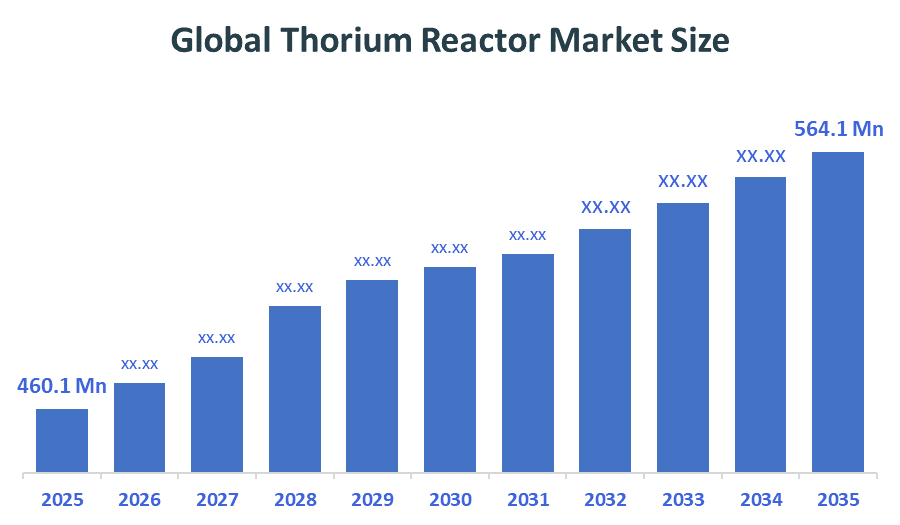
The Global Thorium Reactor Market Size is Expected to grow from USD 460.1 million in 2025 and is expected to reach around USD 564.1 million by 2035. According to Decision Advisors, a detailed evaluation highlights molten salt reactor (MSR) as the leading driver of the global thorium reactor market, holding an evaluated 55-68% share globally. TerraPower reflects a significant market standing, achieving close to USD 50 Million in revenue and securing an estimated 10-15% global share, influencing market dynamics and strategic orientation on an international scale.
Market Snapshot
- Global Thorium Reactor Market Size (2025): USD 460.1 million
- Projected Global Thorium Reactor Market Size (2035): USD 564.1 million
- Global Thorium Reactor Market Compound Annual Growth Rate (CAGR): 2.06%
- Largest Regional Market: Asia-Pacific
- Fastest Growing Region: Europe
- 3rd Largest Region: Middle East & Africa
- Base Year: 2025
- Historical Period: 2021-2024
- Forecast Period: 2026-2035
Market Overview/ Introduction
The global thorium reactor market focuses on nuclear systems which use thorium-232 as fertile fuel that transforms into fissile uranium-233 through neutron absorption. The reactors function as power plants which use modular systems to generate electricity and produce energy for industrial processes that require high temperatures and for seawater desalination. The marine propulsion systems and closed fuel cycles of these systems enable waste reduction which helps nuclear energy systems achieve long-term energy security, sustainable energy practices, and worldwide power generation resource diversification. The innovation advancements which include molten salt designs, passive safety system, and accelerator-driven subcritical technologies that improve both operational control and fuel efficiency. The market currently opens paths to future development through its modular deployment, medical isotope production, and industrial application. In thorium-based systems will support next-generation nuclear technologies because they provide scalable and secure and resource-efficient power solutions which will help meet decarbonization targets.
- In India, the global thorium reactor market push, led by Department of Atomic Energy, is gaining traction with investments exceeding USD 1 million in advanced reactors and fuel cycles, reinforcing long-term clean energy security and strategic nuclear leadership.
- In China’s push in the global thorium reactor market, backed by over USD 500 million investment in molten salt reactor programs, underscores its long-term commercialization strategy, strengthening clean energy ambitions and positioning China as a key innovator.
- Europe’s push in the global thorium reactor market is accelerating, with the European Innovation Council backing projects like Th-MSR through €2.5 million grants and up to €15 million equity, strengthening innovation across Europe
Notable Insights: -
- Asia-Pacific holds the largest regional market share, approximately 43.7% in the global thorium reactor market.
- Europe is the fastest growing region in the thorium reactor market supported by the combination of European Innovation Council funding plus strong policy support together with decarbonization targets leads to increasing investment in advanced nuclear research and development.
- By reactor type, the molten salt reactors (MSR) segment held a dominant position with 42.1% in terms of market share in 2025.
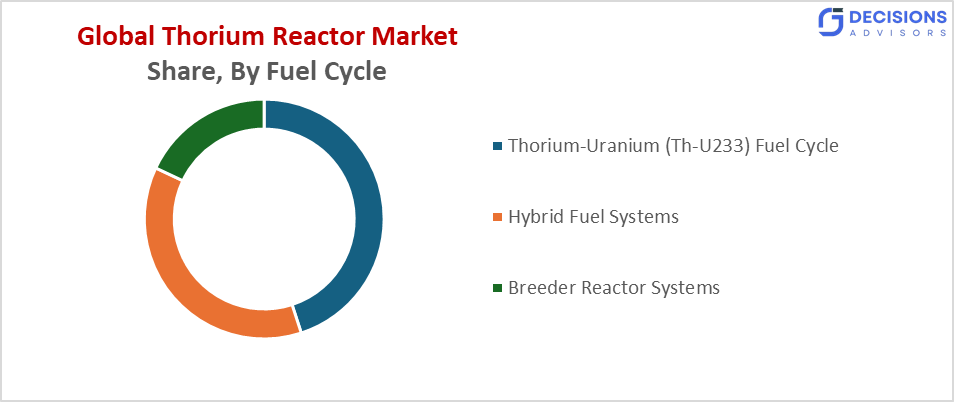
- By fuel cycle, thorium-uranium (Th-U233) fuel cycle segment is the dominating accounting for over 51.2% of the global market share in 2025.
- The compound annual growth rate of the global thorium reactor market is 2.06%.
- The market is likely to achieve a valuation of USD 564.1 million by 2035.
What is role of technology in grooming the market?
Technology is creating a new market for thorium reactors which now functions as a reliable investment base instead of its previous status as an experimental technology. The combination of molten salt chemistry breakthroughs with digital twin simulation technology and artificial intelligence reactor control systems is reducing development time while making safety testing more affordable for projects. The modular engineering together with factory-built systems has reduced capital expenses while materials science advancements have enabled reactors to operate safely at extreme temperatures for longer periods of time. The Bhabha Atomic Research Centre together with the European Innovation Council funding platform has created new technologies which enable faster commercial development of products while improving fuel efficiency and establishing thorium as an essential component of future sustainable energy systems.
How is Recent Developments Helping the Market?
Recent developments are converting the global thorium reactor market from a research narrative into an investable pathway. The pilot-scale milestones in China and sustained programmatic progress in India are de-risking technology assumptions and improving policy confidence. Prototype validation and supply-chain formation receive financial support through three specific capital flow mechanisms which include grants, blended finance, and venture participation. Regulatory sandboxes and cross-border collaborations work together to reduce approval times while establishing common safety standards. China’s global thorium reactor momentum strengthened as the Shanghai Institute of applied physics achieved thorium fuel loading, enabling U-233 production, improving fuel efficiency by over 20%, and advancing closed fuel cycle performance. The developments combine to enhance project bankability while they speed up the time needed to build demonstration plants and establish thorium systems as trustworthy partners in long-term clean energy systems.
Market Drivers
The global thorium reactor market is being propelled by a convergence of structural energy shifts and technology-led confidence. The policymakers make energy choices because of net-zero commitments require them to look for energy sources which can provide continuous power instead of using intermittent renewable sources. The countries like India and the United States hold vast thorium reserves which establish thorium as the most secure energy source for future power needs. The public and regulators now accept molten salt systems because they provide safety features which enable low-pressure operation and generate less harmful waste material. The Bhabha Atomic Research Centre and other institutions are making progress with funding and pilot programs while governments secure financial resources. The thorium has evolved from a strategic concept to become a fundamental element in the development of next-generation nuclear economics through simultaneous progress in reactor design, digital monitoring, and materials engineering.
Restrain
The global thorium reactor market experiences structural challenges which restrict its ability to grow during the upcoming period. The private investors remain unwilling to invest in initial project phases because of high capital requirements which exceed standard nuclear power costs by 20-40%. The current situation of the fuel supply chain and reprocessing system remains unproven because essential components have not reached maturity, which creates execution risks that differ from the existing uranium system. The pilot-to-commercial transition process faces delays because of the regulatory constraints, which include extended licensing periods and mandatory fuel qualification tests, create obstacles for development. The development process incurs extended costs and time delays due to the engineers need to create new materials to address high-temperature molten salt corrosion problems. In the nuclear safety technology advancements have not built public trust in nuclear safety, which creates obstacles for policy development it hinders approval processes and blocks international large-scale commercialization.
Competitive Analysis:
The report offers the appropriate analysis of the key organizations/companies involved within the global thorium reactor market, along with a comparative evaluation primarily based on their product of offering, business overviews, geographic presence, enterprise strategies, segment market share, and SWOT analysis. The report also provides an elaborative analysis focusing on the current news and developments of the companies, which includes product development, innovations, joint ventures, partnerships, mergers & acquisitions, strategic alliances, and others. This allows for the evaluation of the overall competition within the market.
Top Companies in Global Thorium Reactor Market
- Terrestrial Energy
- Moltex Energy
- ThorCon Power
- Flibe Energy
- Copenhagen Atomics
- Kairos Power
- TerraPower
- Elysium Industries
- Transatomic Power
- General Atomics
- Westinghouse Electric Company
- Rolls-Royce SMR
- China National Nuclear Corporation
- Babcock & Wilcox
- MAN Energy Solutions
Government Initiatives
|
Country |
Key Government Initiatives |
|
China |
China’s global thorium reactor market momentum advanced after its Gobi Desert reactor achieved thorium-to-uranium conversion in 2025, improving fuel efficiency by over 25%, enhancing burn-up rates, and strengthening closed fuel cycle viability for scalable clean energy deployment. |
|
US |
The United States is advancing the global thorium reactor market through next-generation reactors that enhance safety by over 30%, reduce long-lived waste by nearly 50%, and improve fuel utilization efficiency, strengthening sustainable nuclear deployment. |
|
|
Market Segmentation
The thorium reactor market share is classified into reactor, fuel cycle, and application
- The molten salt reactors (MSR) segment dominated the market in 2024 and is projected to grow at a substantial CAGR of approximately 9.1% during the forecast period.
Based on the reactor type, the thorium reactor market is divided into molten salt reactors (MSR), liquid fluoride thorium reactors (LFTR), high-temperature gas-cooled reactors (HTGR), heavy water reactors (HWR), liquid metal reactors (LMR), accelerator driven systems (ADS). Among these, the molten salt reactors (MSR) segment dominated the market in 2024 and is projected to grow at a substantial CAGR of approximately 9.1% during the forecast period. It is because of the system provides secure operation through its safety features which exceed conventional standards while achieving optimal thermal performance and supporting thorium fuel cycle operations. The system achieves its highest level of operational security through safety features which surpass conventional safety standards.
- The thorium-uranium (Th-U233) fuel cycle segment accounted for the largest share in 2024 and is anticipated to grow at a significant CAGR of approximately 10.1% during the forecast period.
Based on the fuel cycle, the thorium reactor market is divided into thorium-uranium (Th-U233) fuel cycle, hybrid fuel systems, breeder reactor systems. Among these, the thorium-uranium (Th-U233) fuel cycle segment accounted for the largest share in 2024 and is anticipated to grow at a significant CAGR of approximately 10.1% during the forecast period. It is dominating because of the company achieves three key outcomes through its Indian and Chinese operations which include attaining better fuel efficiency and decreasing permanent waste while establishing operational bases. The company serves as a crucial partner in developing advanced nuclear power systems which will drive future energy transitions toward sustainable solutions.
- The electricity generation segment dominated the market in 2024, and is projected to grow at a substantial CAGR during the forecast period.
Based on the application, the thorium reactor market is divided into electricity generation, industrial applications, research and development, off grid. Among these, the electricity generation segment dominated the market in 2024, and is projected to grow at a substantial CAGR during the forecast period. It is because of the growing need for low-carbon baseload power together with grid reliability and energy security will increase demand for thorium-based power systems which governments now promote as a sustainable solution for their energy transition plans.
Strategies to Implement for Growth of the Market in Non-Leading Regions
The global thorium reactor market requires a capital-light partnership-driven method to achieve growth in non-leading regions. The governments should use blended finance models which combine concessional funding and export credit and private capital to reduce risks associated with first-of-a-kind projects. The combination of regulatory fast-tracks and standardized licensing together with International Atomic Energy Agency frameworks will shorten approval processes. Strategic technology transfer agreements with leaders such as India and China will accelerate capability building. The development of modular manufacturing ecosystems through investment and workforce training initiatives will establish local supply chains while decreasing expenses and making emerging markets competitive centers for upcoming nuclear technology implementation.
Regional Segment Analysis of the Global Thorium Reactor Market
- North America (U.S., Canada, Mexico)
- Europe (Germany, France, U.K., Italy, Spain, Rest of Europe)
- Asia-Pacific (China, Japan, India, Rest of APAC)
- South America (Brazil and the Rest of South America)
- The Middle East and Africa (UAE, South Africa, Rest of MEA)
Asia-Pacific is anticipated to hold the largest share of the thorium reactor market over the predicted timeframe. The Asia-Pacific is anticipated to hold the largest share of the thorium reactor market, accounting for approximately 42.4% of total revenue over the forecast period. It is because of nuclear energy expansion through policy support and reactor technology development which operates under budget constraints has established the region as a key driver for upcoming low-carbon energy systems.
Europe is expected to grow at a rapid CAGR in the thorium reactor market during the forecast period. The Europe market will experience fast growth because it accounts for approximately 10.1% of it is due to the combination of policy-driven decarbonization targets and European Innovation Council funding and increasing investment in advanced nuclear technologies enables the organization to enhance its capabilities for developing next-generation clean energy technologies.
Middle East and Africa are the 3rd largest region to grow in the thorium reactor market during the region. The The Middle East and Africa region stands as the third biggest area global for the thorium reactor market since it holds approximately 8.2% the energy sector needs to establish better energy sources which will support its long-term plans to develop sustainable power facilities. The region will become more important for advanced reactor development and clean energy transition efforts because both its nuclear power capacity and its policy backing will increase.
Future Market Trends in Global Thorium Reactor Market: -
1. Rise of Modular and Factory-Built Reactor Ecosystems
The industrialization of reactor manufacturing is expanding through the development of modular systems which factory-built systems. The method provides two advantages by shortening construction time and decreasing capital expenses while achieving consistent standards throughout different markets. Countries such as China are actively advancing modular thorium-compatible designs which will establish market patterns that enable repeated deployment of systems which can grow at the same rate as renewable energy infrastructure.
2. Strategic Localization of Fuel Cycles and Supply Chains
The nations are developing local thorium fuel cycles which will decrease their need for uranium imports while they build their energy independence. India and other countries are developing their own abilities to process fuel and design nuclear reactors. The current trend is developing regional technology ecosystems which will facilitate technology transfer while nuclear energy systems change to use more decentralized and robust supply networks.
3. Evolving Regulatory Frameworks and Accelerated Licensing Models
The regulators are developing new licensing methods and testing facilities to evaluate advanced reactor technologies. The process now takes less time for approval while supporting the development of new ideas. International organizations like the International Atomic Energy Agency help to establish safety standards which enable international projects and financial investments to proceed.
Recent Development
- In January 2026, China advanced the global thorium reactor market by launching a hybrid PWR-HTGR project, enhancing thermal efficiency by over 20% and enabling integrated power-heat output, strengthening next-generation nuclear deployment strategies.
- In April 2026, India advanced the global thorium reactor market as BHAVINI’s 500 MWe PFBR at Kalpakkam achieved criticality, enhancing breeding efficiency by over 30% and enabling U-233 generation for future thorium-based reactors.
- In April 2026, South Korea advanced the global thorium reactor market as Saeul Unit 3 achieved criticality, improving generation efficiency by over 15% and strengthening next-generation nuclear capacity and regional energy security.
- In April 2026, United States advanced the global thorium reactor market as Idaho National Laboratory initiated thorium-HALEU fuel testing, achieving over 60 GWd/t burnup potential and enhancing compatibility with existing reactor infrastructure.
- In November 2025, South Africa advanced the global thorium reactor market by reviving its PBMR program, improving modular reactor efficiency by over 15% and strengthening capabilities in advanced small modular reactor development and fuel innovation.
Market Segment
This study forecasts revenue at global, regional, and country levels from 2020 to 2035. Decision Advisors has segmented the thorium reactor market based on the above-mentioned segments:
Global Thorium Reactor Market, By Reactor Type
- Molten Salt Reactors (MSR)
- Liquid Fluoride Thorium Reactors (LFTR)
- High-Temperature Gas-Cooled Reactors (HTGR)
- Heavy Water Reactors (HWR)
- Liquid Metal Reactors (LMR)
- Accelerator Driven Systems (ADS)
Global Thorium Reactor Market, By Fuel Cycle
- Thorium-Uranium (Th-U233) Fuel Cycle
- Hybrid Fuel Systems
- Breeder Reactor Systems
Global Thorium Reactor Market, By Application
- Electricity Generation
- Industrial Applications
- Research and Development
- Off grid
Global Thorium Reactor Market, By Regional Analysis
- North America
- US
- Canada
- Mexico
- Europe
- Germany
- UK
- France
- Italy
- Spain
- Russia
- Rest of Europe
- Asia Pacific
- China
- Japan
- India
- South Korea
- Australia
- Rest of Asia Pacific
- South America
- Brazil
- Argentina
- Rest of South America
- Middle East & Africa
- UAE
- Saudi Arabia
- Qatar
- South Africa
- Rest of the Middle East & Africa
Frequently Asked Questions (FAQ)
Q. Why is thorium considered a strategic fuel alternative?
A. The molten salt reactors and liquid fluoride thorium reactors are redefining the technological frontier of the global thorium reactor market. These systems enable higher thermal efficiency, passive safety features, and flexible fuel cycles. Additionally, digital monitoring and advanced materials engineering are enhancing reactor durability. Such innovations are accelerating the transition from experimental frameworks toward commercially viable reactor designs in the coming decade.
Q. What role do governments play in market development?
A. The global thorium reactor market depends on government involvement to develop its operations. Public funding together with regulatory frameworks and long-term nuclear strategies supports the establishment of pilot projects and demonstration plants. The European Innovation Council provides grants and equity support to institutions which use these resources to create innovative solutions that advance research into nuclear technologies toward practical application.
Q. How is the private sector influencing market growth?
A. The business involvement in the global thorium reactor market brings new methods of innovation and funding solutions which create a more flexible market. Startups and advanced nuclear firms are focusing on modular reactor designs and scalable production. The United States private sector partners with national laboratories to speed up both fuel development and reactor testing programs.
Q. What is the long-term outlook for the market?
A. The global thorium reactor market shows a positive long-term forecast but maintains a status of uncertain future development. The commercial use of developments at present will take time but pilot operations and new regulations create positive market momentum. The declining costs and advancing technology of thorium reactors will become an essential part of renewable energy systems because they offer reliable base load electricity in a decarbonized worldwide energy system.
Check Licence
Choose the plan that fits you best: Single User, Multi-User, or Enterprise solutions tailored for your needs.
We Have You Covered
- 24/7 Analyst Support
- Clients Across the Globe
- Tailored Insights
- Technology Tracking
- Competitive Intelligence
- Custom Research
- Syndicated Market Studies
- Market Overview
- Market Segmentation
- Growth Drivers
- Market Opportunities
- Regulatory Insights
- Innovation & Sustainability
Report Details
| Scope | Global |
| Pages | 240 |
| Delivery | PDF & Excel via Email |
| Language | English |
| Release | Apr 2026 |
| Access | Download from this page |