
Global Tuberous Sclerosis Complex Market
 |
Pages:
210
|
Pages:
210
Global Tuberous Sclerosis Complex Market Size, Share, By Drug Class (Antiepileptic Drugs, Benzodiazepines, Adrenocorticotropic Agents, mTOR Kinase Inhibitors, and Others), By Route of Administration (Oral, Injectable and Topical), By End User (Hospitals, Clinics, Ambulatory Surgical Centers, and Others), and By Region (North America, Europe, Asia-Pacific, Latin America, Middle East, and Africa), Analysis and Forecast 2025 ? 2035
REPORT COVERAGE
Global
Market Snapshot
- Market Size (2025): USD 764.2 Million
- Projected Market Size (2035): USD 6820.6 Million
- Compound Annual Growth Rate (CAGR): 24.47%
- Largest Regional Market: North America
- Fastest Growing Region: Asia Pacific
- 2nd Largest Region: Europe
- Base Year: 2025
- Historical Period: 2021–2024
- Forecast Period: 2025–2035
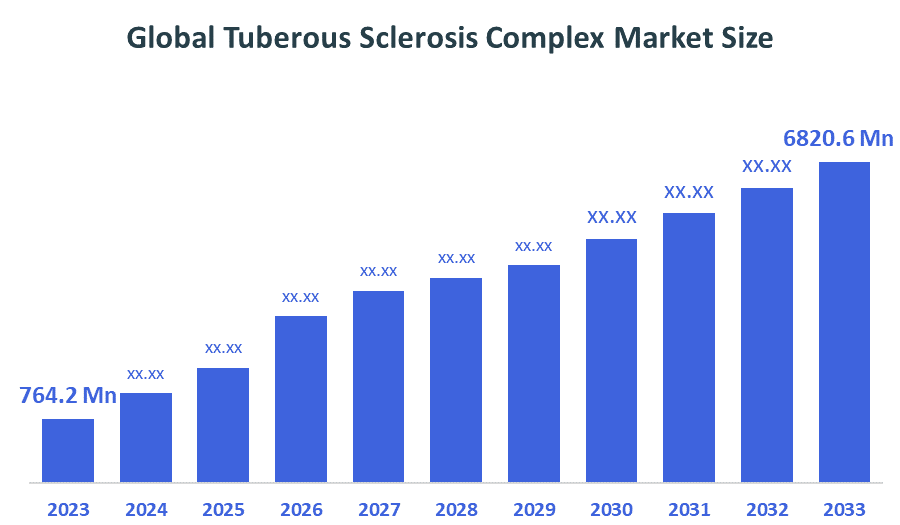
According to Decision Advisors, the Global Tuberous Sclerosis Complex Market Size is expected to grow from USD 764.2 million in 2025 to USD 6820.6 million by 2035, at a CAGR of 24.47% during the forecast period 2025-2035. The global tuberous sclerosis complex market is driven by the treatment and studies in innovative health interventions and recent drug approvals for the treatment of tuberous sclerosis complex.
Market Overview/ Introduction
The tuberous sclerosis complex market refers to the global industry involved in the development, production, and commercialization of therapies for TSC, a rare genetic disorder that causes benign tumors in multiple organs such as the brain, kidneys, heart, and skin. The market includes mTOR inhibitors, surgical interventions, diagnostic tools, and supportive care solutions, which medical professionals use to treat symptoms and enhance patient well-being. The growth is powered by government programs and rising research funding for rare diseases, and the launch of new medications, which include everolimus.
The continuous development of healthcare facilities, with rising health awareness in developing countries, creates an attractive market expansion opportunity. The increasing occurrence of TSC, with the need for better treatment options, will drive demand for new medical therapies because doctors now have better knowledge of the condition.
Marinus Pharmaceuticals, Inc. announced the completion of its global Phase 3 TrustTSC trial by finishing recruitment for its study, which tests oral ganaxolone as a treatment for tuberous sclerosis complex (TSC) seizures in both adults and children.
- DiRx, which operates a digital pharmacy platform that provides access to affordable generic medicines, established a partnership with TSC Alliance, which is a nonprofit organization dedicated to finding a cure for tuberous sclerosis complex (TSC) and improving the lives of affected individuals, in May 2022.
- The research results from preclinical studies and clinical studies show potential for direct application in the clinical diagnosis, prognosis assessment and treatment development of TSC. The single principal investigator funding limit allows for total project costs of $1.6 million, while the partner principal investigator funding option permits total project costs of 1.9 million.
Notable Insights: -
- North America holds the largest regional market share in the global tuberous sclerosis complex market.
- Asia Pacific is the fastest-growing region in the global tuberous sclerosis complex market.
- By drug class, the mTOR kinase inhibitors segment held a dominant position in market share in 2025.
- By route of administration, the oral segment is the dominating one in global market share in 2025.
- The compound annual growth rate of the global tuberous sclerosis complex market is 24.47%.
- The market is likely to achieve a valuation of USD 6820.6 million by 2035.
What is the role of technology in grooming the market?
Technology plays a crucial role in shaping the tuberous sclerosis complex market. The organization develops new diagnostic methods and treatment strategies while managing patient care. The advanced diagnostic tools, which include next-generation genetic sequencing, MRI and AI-assisted imaging systems, enable medical professionals to identify TSC at an early stage, which leads to better treatment results. The field of therapeutics receives a major transformation through biotechnology innovations, which bring mTOR inhibitors and personalized medicine solutions that deliver targeted treatments with increased effectiveness to patients. Digital health platforms, with telemedicine systems, improve patient monitoring capabilities and treatment follow-up processes while supporting remote therapy adherence, especially in isolated areas that lack access to healthcare services. The electronic health records system enables healthcare professionals to make clinical decisions based on actual patient data. Pharmaceutical companies use AI and big data analytics to discover new drug candidates and improve their clinical trials, and forecast market developments. The combination of technological advancements drives research progress while it enhances patient outcomes and increases healthcare accessibility which establishes technology as the main factor that propels expansion and operational efficiency in the worldwide TSC market.
Market Drivers
The global tuberous sclerosis complex market is driven by the growing awareness of tuberous sclerosis complex among healthcare providers and patients, together with improved diagnostic tools, which have resulted in better early diagnosis rates. The rising TSC prevalence has created a demand for effective diagnostic methods and targeted treatment options for this rare genetic disorder, which affects multiple body systems. The field of disease management has experienced a transformational change through advanced therapeutics, which include mTOR inhibitors that now create opportunities for research and development funding. The combination of healthcare professional knowledge and patient information, with genetic testing and imaging diagnostic progress, permits earlier identification of medical conditions. The combination of government support and regulatory incentives in major markets like the US, UK, China, and India for rare diseases and orphan drugs creates a faster process for drug approvals and clinical research activities.
Restrain
The tuberous sclerosis complex market is hindered by the high expenses of biological treatments and orphan drugs create financial difficulties. The market potential for these treatments suffers from restricted reimbursement options that exist in specific areas. The prolonged administration of mTOR inhibitors together with specific tuberous sclerosis complex treatments results in immune suppression and metabolic complications as their negative effects.
Competitive Analysis:
The report offers the appropriate analysis of the key organizations/companies involved within the tuberous sclerosis complex market, along with a comparative evaluation primarily based on their product of offering, business overviews, geographic presence, enterprise strategies, segment market share, and SWOT analysis. The report also provides an elaborative analysis focusing on the current news and developments of the companies, which includes product development, innovations, joint ventures, partnerships, mergers & acquisitions, strategic alliances, and others. This allows for the evaluation of the overall competition within the market.
Top Companies in Global Tuberous Sclerosis Complex Market
- Novartis AG
- Nobelpharma Co., Ltd.
- Jazz Pharmaceuticals plc
- GW Pharmaceuticals plc
- Takeda Pharmaceutical Company Limited
- Pfizer Inc.
- F. Hoffmann-La Roche Ltd
- AbbVie Inc.
- AstraZeneca plc
- Sanofi S.A.
Government Initiatives
|
Country |
Key Government Initiatives |
|
US |
Strong support through rare disease policies, FDA orphan drug designations, and funding for clinical research, encouraging faster drug approvals and innovation |
|
UK |
Organizations like the Tuberous Sclerosis Association promote research funding, patient support, and collaboration with healthcare systems. |
|
China |
Government reforms and incentives for orphan drugs, along with expanding healthcare access, are boosting diagnosis and treatment rates. |
Market Segmentation
The tuberous sclerosis complex market share is classified into drug class, route of administration, and end user.
- The mTOR kinase inhibitors segment dominated the market in 2025, and is projected to grow at a substantial CAGR during the forecast period.
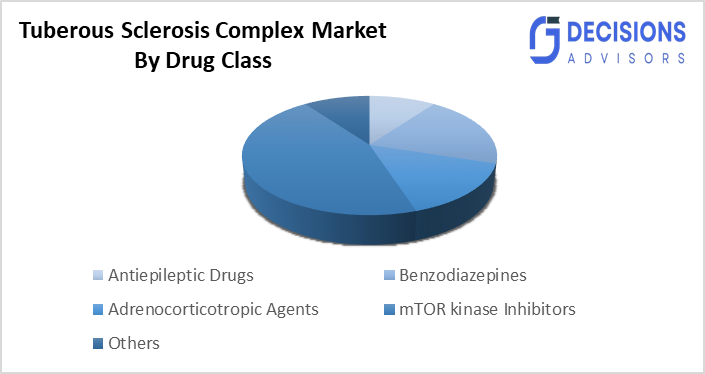
Based on drug class, the tuberous sclerosis complex market is divided into antiepileptic drugs, benzodiazepines, adrenocorticotropic agents, mTOR kinase inhibitors, and others. Among these, the mTOR kinase inhibitors segment dominated the market in 2025 and is projected to grow at a substantial CAGR during the forecast period. The growth of the segment is driven by the targeted mechanism of their treatment approach, which restores mTOR pathway function, which has been disrupted in patients. The drug everolimus provides effective treatment for multiple TSC symptoms, which include tumors and seizures. This treatment approach provides greater therapeutic advantages than using antiepileptics and benzodiazepines to treat symptoms. This treatment approach has become more popular because it delivers better results than existing symptomatic treatments.
- The oral segment accounted for the largest share in 2025, and is anticipated to grow at a significant CAGR during the forecast period.
Based on the route of administration, the tuberous sclerosis complex market is divided into oral, injectable and topical. Among these, the oral segment accounted for the largest share in 2025 and is anticipated to grow at a significant CAGR during the forecast period. The segment dominates the market due to widespread use of oral mTOR inhibitors like everolimus. The segmental growth is driven by the drugs that provide complete body treatment, which doctors can administer easily while patients receive continuous treatment for their medical condition. The oral therapies package has higher patient compliance, with strong clinical effectiveness, which makes it the most popular treatment option that doctors prescribe more than injectable and topical treatments.
- The hospitals segment dominated the market in 2025, and is projected to grow at a substantial CAGR during the forecast period.
Based on the end user, the tuberous sclerosis complex market is divided into hospitals, clinics, ambulatory surgical centers, and others. Among these, the hospitals segment dominated the market in 2025 and is projected to grow at a substantial CAGR during the forecast period. The segmental growth is driven by elements needed for TSC treatment are advanced diagnostic tools, specialized treatment facilities, and multidisciplinary care teams. TSC requires hospitals to provide continuous monitoring and complex medical management, which includes both neurology and oncology services. This need for specialized treatment leads to increased patient preference and treatment volume at hospitals.
Regional Segment Analysis of the Tuberous Sclerosis Complex Market
- North America (U.S., Canada, Mexico)
- Europe (Germany, France, U.K., Italy, Spain, Rest of Europe)
- Asia-Pacific (China, Japan, India, Rest of APAC)
- South America (Brazil and the Rest of South America)
- The Middle East and Africa (UAE, South Africa, Rest of MEA)
North America is anticipated to hold the largest share of the tuberous sclerosis complex market over the predicted timeframe.
North America is anticipated to hold the largest share of the tuberous sclerosis complex market over the predicted timeframe. This dominance is driven by advanced healthcare infrastructure and high healthcare expenditures, combined with its significant presence of major pharmaceutical firms and its ability to identify and treat rare diseases at an early stage. The region receives benefits from its regulatory systems and its orphan drug programs, which help to speed up the process of drug development and market introduction. Continuous product development and product authorization processes serve as the primary element that drives expansion in this area. The U.S. FDA approved mTOR inhibitors, which include everolimus and cannabidiol-based therapies, to provide better treatment results. In August 2024, Upsher-Smith launched TORPENZ, which provides additional treatment alternatives for TSC patients. North America maintains its dominant market position through these innovations, which operate together with effective clinical research and reimbursement systems.
Asia Pacific is expected to grow at a rapid CAGR in the tuberous sclerosis complex market during the forecast period. The Asia-Pacific region will achieve its highest growth rate through its healthcare system improvements, rising awareness of rare diseases and increased diagnostic capabilities in China, Japan and India. The market expansion received a boost from the 2024 product launch of TORPENZ, which functions as an mTOR inhibitor that helps TSC patients control their tumor growth and seizure symptoms. The development shows that researchers now focus their attention on creating targeted treatment methods. The region experiences faster treatment access because of rising government programs, higher healthcare investments, and the growing number of clinical research studies. The healthcare system in India needs advanced treatments because many patients do not have access to important medical services, and doctors now diagnose diseases at an earlier stage. The Asia-Pacific region has developed into a primary growth center which results from innovation and better access to healthcare and the growing presence of pharmaceutical companies.
Europe is the 2nd largest region to grow in the tuberous sclerosis complex market during the period. Europe follows because of its well-established healthcare systems and growing focus on rare diseases. The region benefits from increasing awareness, supportive regulatory frameworks, and ongoing clinical research in countries like Germany, France, and the UK. The increasing number of patient registries, combined with better access to diagnostic tests and treatment options, leads to continuous development in the industry.
Strategies to Implement for Growth of the Market in Non-Leading Regions
To drive growth of the tuberous sclerosis complex market in non-leading regions, companies should focus on targeted strategies supported by data. The implementation of increased awareness programs will result in a 20 to 30% improvement in early detection, which subsequently boosts treatment uptake. The orphan drug market needs both partnerships and orphan drug incentives because it is expected to achieve a market value of USD 541 billion by 2032. The introduction of affordable pricing, with telemedicine and local clinical trials, will create better access to services while speeding up their implementation in those areas. Pharmaceutical companies need to establish differential pricing methods while working with governments to enhance reimbursement systems and patient support programs, which will result in lower treatment costs. Local healthcare provider organizations and non-governmental organizations (NGOs) can establish partnerships to increase their capacity for delivering healthcare services and supporting patients.
Future Market Trends in Global Tuberous Sclerosis Complex Market: -
1. Shift Toward Targeted & Disease-Modifying Therapies
The TSC market is shifting toward targeted and disease-modifying therapies, particularly mTOR inhibitors like everolimus and sirolimus. Emerging treatments, including gene-based and cannabidiol therapies, aim to address underlying causes rather than symptoms. This trend enhances treatment efficacy, improves patient outcomes, and drives innovation in precision medicine for long-term disease management globally.
2. Growing Drug Development & Orphan Drug Support
Growing drug development in Tuberous Sclerosis Complex is supported by orphan drug designations, offering incentives like tax benefits and faster approvals. Increasing investments from pharmaceutical and biotech companies are accelerating innovation, expanding clinical pipelines, and improving access to novel therapies, ultimately driving market growth and enhancing treatment options for this rare disease.
3. Rising Awareness & Early Diagnosis
Rising awareness of Tuberous Sclerosis Complex, supported by advocacy programs and improved healthcare education, is driving early diagnosis. Advancements in genetic testing and imaging technologies enable quicker detection, especially in infants and children. This leads to timely intervention, better disease management, increased treatment adoption, and overall growth in the global TSC market.
Recent Development
In January 2026, Biocon Pharma Limited, a wholly owned subsidiary of the company, received approval from the U.S. Food and Drug Administration for its ANDA for Everolimus Tablets for Oral Suspension. Everolimus Tablets for Oral Suspension are indicated for the treatment of adult and pediatric patients aged 1 year and older with Tuberous Sclerosis Complex (TSC) who have Subependymal Giant Cell Astrocytoma (SEGA) and for the adjunctive treatment of adult and pediatric patients aged 2 years and older with TSC-associated partial-onset seizures
In October 2024, GRIN Therapeutics Inc., a leader in the development of therapies to treat serious neurodevelopmental disorders, announced initiation of the Astroscape study, the Company's global open-label clinical trial of radiprodil, an investigational, selective and potent negative allosteric modulator of the N-methyl-D-aspartate receptor subtype 2B (NR2B or GluN2B), for the treatment of tuberous sclerosis complex (TSC) and focal cortical dysplasia (FCD) type II.
How is Recent Developments Helping the Market?
The tuberous sclerosis complex market experiences substantial progress through the development of targeted therapies, which include mTOR inhibitors, and has enhanced disease management by providing tumor growth control and complication reduction. The introduction of cannabidiol-based treatments for drug-resistant epilepsy, with ongoing clinical trials, has created new options for treatment. Genetic research and precision medicine have reached a point where they enable the development of treatments that change disease progression, and remote multidisciplinary care systems boost patient health results. The combination of these innovations leads to market expansion while they make treatments available to patients all over the world.
Market Segment
This study forecasts revenue at global, regional, and country levels from 2020 to 2035. Decision Advisors has segmented the tuberous sclerosis complex market based on the below-mentioned segments:
Global Tuberous Sclerosis Complex Market, By Drug Class
- Antiepileptic Drugs
- Benzodiazepines
- Adrenocorticotropic Agents
- mTOR Kinase Inhibitors
- Others
Global Tuberous Sclerosis Complex Market, By Route of Administration
- Oral
- Injectable
- Topical
Global Tuberous Sclerosis Complex Market, By End User
- Hospitals
- Clinics
- Ambulatory Surgical Centers
- Others
Global Tuberous Sclerosis Complex Market, By Regional Analysis
- North America
- US
- Canada
- Mexico
- Europe
- Germany
- UK
- France
- Italy
- Spain
- Russia
- Rest of Europe
- Asia Pacific
- China
- Japan
- India
- South Korea
- Australia
- Rest of Asia Pacific
- South America
- Brazil
- Argentina
- Rest of South America
- Middle East & Africa
- UAE
- Saudi Arabia
- Qatar
- South Africa
- Rest of the Middle East & Africa
Frequently Asked Questions (FAQ).
Q: What are the key opportunities in the TSC market?
A: Opportunities include development of novel mTOR inhibitors and gene therapies, early diagnosis through advanced genetic testing, collaborations between pharma and research institutions, and market expansion in emerging regions. Government orphan drug policies in the US, UK, China, and India also support innovation and wider treatment adoption.
Q: How do government initiatives impact the TSC market?
A: Government initiatives enhance growth through rare disease policies, orphan drug incentives, funding for clinical research, and awareness campaigns. Countries like the US, UK, China, and India are improving diagnosis, treatment access, and patient support, which drives both market penetration and the adoption of advanced therapies.
Q: How is technology impacting the TSC market?
A: Technological advancements in genetic testing, imaging, and AI-driven diagnostics are improving early detection and treatment planning. Innovations in drug delivery systems, personalized medicine, and gene therapy are also enhancing patient outcomes, making the market more efficient and expanding growth opportunities worldwide.
Check Licence
Choose the plan that fits you best: Single User, Multi-User, or Enterprise solutions tailored for your needs.
We Have You Covered
- 24/7 Analyst Support
- Clients Across the Globe
- Tailored Insights
- Technology Tracking
- Competitive Intelligence
- Custom Research
- Syndicated Market Studies
- Market Overview
- Market Segmentation
- Growth Drivers
- Market Opportunities
- Regulatory Insights
- Innovation & Sustainability
Report Details
| Scope | Global |
| Pages | 210 |
| Delivery | PDF & Excel via Email |
| Language | English |
| Release | Apr 2026 |
| Access | Download from this page |