
UK Gel Battery Market
 |
Author:
Rahul B
|
Pages:
210
|
Author:
Rahul B
|
Pages:
210
UK Gel Battery Market Size, Share, By Type (Pure Gel Battery, Hybrid Gel Battery), By Application (Renewable Energy Storage, Telecommunications, Electric Mobility, Industrial Backup Power, Healthcare and Emergency Systems, Others), and By End-User (Residential, Commercial, Industrial, Utilities), Analysis and Forecast 2026 ? 2035
CAGR
10.8%
REVENUE 2025
USD Billion 1.98
FORECAST 2035
USD Billion 5.52
REPORT COVERAGE
Country
The UK Gel Battery Market includes gel-based lead-acid batteries provides maintenance-free operation, safe usage and high-performance energy storage for use in automotive, renewable energy, industrial and backup systems. Market growth is driven by rising renewable energy adoption, industrial electrification and demand for reliable batteries which operate over extended periods and provide better deep-discharge performance and improved cycle life. The market expansion receives support from government incentives that include subsidies for solar and wind installations and grants for off-grid storage and regulations that promote eco-friendly and recyclable batteries. Leading companies such as Exide Technologies and Trojan Battery invest in R&D to create advanced gel formulations and long-lasting deep-cycle batteries and environmentally-friendly manufacturing methods while they establish partnerships to expand their market presence. The maintenance-free operation, extended lifespan, deep-cycle capabilities, safety features and temperature resilience of gel batteries make them attractive to various industries. The UK Gel Battery Market will experience significant growth until 2035 because of ongoing technological progress, backing from regulations and increasing demand for renewable energy and backup systems.
Market Snapshot
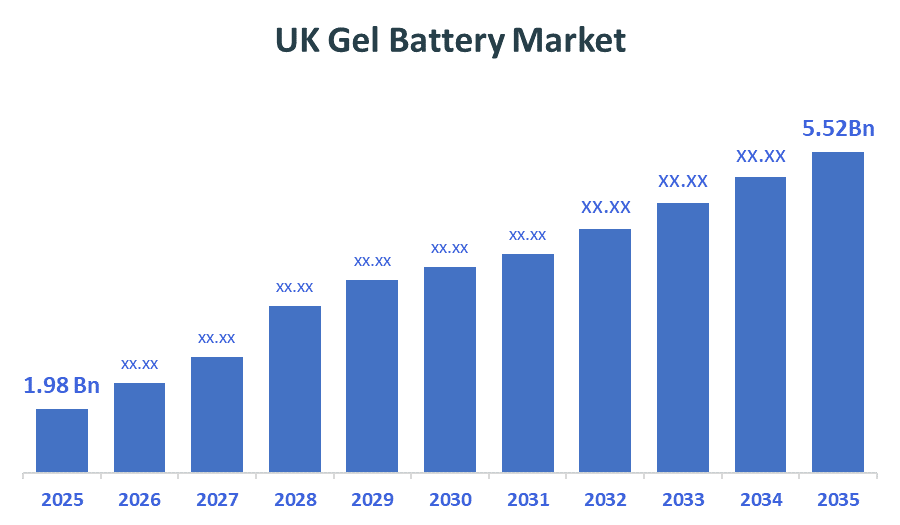
- UK Gel Battery Market Size (2025): USD 1.98 Billion
- Projected UK Gel Battery Market Size (2035): USD 5.52 Billion
- Compound Annual Growth Rate (CAGR): 10.8%
- Base Year: 2025
- Historical Period: 2021–2024
- Forecast Period: 2026–2035
Notable Insights: -
- By type, the pure gel battery segment held a dominant position with 48% in terms of market share in 2025.
- By end-user, the industrial segment is the dominating accounting for over 54% of the UK market share in 2025.
- The compound annual growth rate of the UK gel battery market is 10.8%.
- The market is likely to achieve a valuation of USD 5.52 Billion by 2035.
What is role of technology in grooming the market?
Technological innovations in UK gel batteries, such as advanced electrolyte gels, improved separators, and enhanced deep-cycle capabilities, boost energy efficiency, safety, and lifespan. Smart battery management systems, automated production, and AI-based quality monitoring optimize performance, minimize defects, and ensure regulatory compliance. These advancements drive adoption across automotive, renewable energy, and industrial sectors, supporting reliable, maintenance-free, and high-performance energy storage solutions, thereby strengthening overall market growth and positioning the UK gel battery market for significant expansion through 2035.
Market Drivers
The UK Gel Battery Market is growing due to rising demand for maintenance-free, durable, and safe batteries that customers need for automotive, industrial and renewable energy applications. The expansion of solar and wind installations creates a higher demand for gel batteries which perform at high levels, while regulatory and sustainability initiatives support environmentally friendly production of recyclable materials. Technological advancements enable gel batteries to achieve better deep-discharge performance, extended cycle life and higher reliability, leading to safer operation in various usage scenarios. The combination of these factors enables market growth while supporting the sustained development of the UK gel battery industry, which will experience major market growth through 2035 in renewable energy storage, industrial power backup and automotive markets.
Restrain
The UK gel battery market faces challenges from high production costs due to energy-intensive manufacturing and reliance on imported raw materials. Competition from lithium-ion and other advanced battery technologies pressures market share, while stringent environmental and safety regulations increase compliance costs. These factors require manufacturers to optimize processes, invest in sustainable materials, and improve efficiency to remain competitive. Addressing these constraints is essential for maintaining profitability, ensuring regulatory compliance, and supporting continued adoption of gel batteries across automotive, industrial, and renewable energy sectors.
Strategies to Implement for Growth of the Market
To fuel growth in the UK gel battery market, companies should focus on developing advanced gel battery technologies with improved cycle life, safety, and deep-discharge performance. Expanding offerings for renewable energy, automotive, and industrial applications addresses growing demand. Implementing automation, AI-driven quality control, and energy-efficient manufacturing enhances production efficiency, consistency, and sustainability. Strategic partnerships with distributors, renewable energy firms, and industrial solution providers strengthen market reach and application-specific solutions. Targeting high-margin niches, including off-grid storage, backup power, and specialty industrial uses, supports profitability. Continuous innovation, sustainability focus, and market diversification collectively drive long-term growth and competitive advantage.
Study on the Supply, Demand, Distribution, and Market Environment
The UK Gel battery market’s supply is driven by domestic production of high-quality gel batteries, complemented by imported premium lead and gel components. Rising demand stems from automotive, renewable energy, industrial, and backup power sectors, with increased adoption in solar and wind energy storage. Distribution channels include wholesalers, direct B2B sales, and e-commerce platforms, ensuring efficient market reach. Market dynamics are shaped by technological advancements in gel formulations, enhanced deep-cycle performance, and energy-efficient, environmentally compliant manufacturing processes. These factors collectively support reliable supply, meet growing demand, and foster a sustainable, competitive, and expanding market environment.
Price Analysis and Consumer Behaviour Analysis
Average gel battery prices in the UK reflect fluctuations in raw material, energy, and production costs. In 2023, imported lead-acid gel batteries averaged approximately USD 260 per unit, rising about 8% year-on-year due to higher global lead and energy prices. Export prices were slightly lower, around USD 245 per unit, indicating competitive positioning for UK manufacturers. Price sensitivity influences adoption across renewable energy, industrial, and automotive sectors, with high-quality gel batteries commanding premium margins. These trends highlight the impact of input costs and market dynamics on pricing strategies, purchase decisions, and overall profitability in the gel battery market.
Market Segmentation
The UK gel battery market share is classified into type, application and end-user.
- The pure gel battery segment dominated the market in 2025, and is projected to grow at a substantial CAGR of approximately 48% during the forecast period.
Based on the type, the UK gel battery market is divided into pure gel battery and hybrid gel battery. Among these, the pure gel battery segment dominates the market in 2025, and is projected to grow at a substantial CAGR of approximately 48% during the forecast period. This is driven by higher adoption in renewable energy, automotive, and industrial applications due to its maintenance-free operation, safety, and longer cycle life compared to hybrid gel batteries.
- The renewable energy storage segment dominated the market in 2025, and is projected to grow at a substantial CAGR during the forecast period.
Based on the application, the UK gel battery market is divided into renewable energy storage, telecommunications, electric mobility, industrial backup power, healthcare and emergency systems, and others. Among these, the renewable energy storage segment dominated the market in 2025, and is projected to grow at a substantial CAGR during the forecast period. The growth is driven by increasing solar and wind energy installations, which require reliable, deep-cycle, and maintenance-free batteries for consistent power supply and storage.
- The industrial segment accounted for the largest share in 2025, and is anticipated to grow at a significant CAGR of approximately 54% during the forecast period.
Based on the end-user, the UK gel battery market is divided into residential, commercial, industrial, and utilities. Among these, the industrial segment accounted for the largest share in 2025, and is anticipated to grow at a significant CAGR of approximately 54% during the forecast period. This is because industries require high-capacity, durable, and maintenance-free energy storage solutions for backup power, uninterrupted operations, and critical system support, making industrial applications the dominant end-user segment over residential, commercial, and utility sectors
Recent Development
- In October 2025, Exide Technologies launched its GEL PRO series in the UK, designed for deep-discharge applications with up to 90?% safe depth of discharge, high vibration resistance, and extended lifecycle, targeting industrial and renewable energy storage solutions
- In April 2025, Exide Technologies launched the ES450 Exide G40 Marine Gel Leisure Battery in the UK, featuring maintenance-free gel technology, high vibration resistance, and 12?V/40?Ah capacity, targeting marine, motorhome, and leisure energy storage applications.
Competitive Analysis
The report offers the appropriate analysis of the key organisations/companies involved within the UK Gel Battery Market, along with a comparative evaluation primarily based on their product offering, business overviews, geographic presence, enterprise strategies, segment market share, and SWOT analysis. The report also provides an elaborative analysis focusing on the current news and developments of the companies, which includes product development, innovations, joint ventures, partnerships, mergers & acquisitions, strategic alliances, and others. This allows for the evaluation of the overall competition within the market.
Top Key Companies in UK Gel Battery Market
• Exide Technologies
• GS Yuasa / Yuasa Battery
• EnerSys (Sonnenschein)
• Trojan Battery Company
• FIAMM
• Victron Energy
• MK Battery
• PowerQ
• TAB Battery UK
Key Target Audience
- Market Players
- Investors
- End-users
- Government Authorities
- Consulting and Research Firm
- Venture capitalists
- Value-Added Resellers (VARs)
Market Segmen
This study forecasts revenue at the India, regional, and country levels from 2020 to 2035. Decision Advisors has segmented the UK gel battery market based on the below-mentioned segments
UK Gel Battery Market, By Type
- Pure Gel Battery
- Hybrid Gel Battery
UK Gel Battery Market, By Application
- Renewable Energy Storage
- Telecommunications
- Electric Mobility
- Industrial Backup Power
- Healthcare and Emergency Systems
- Others
UK Gel Battery Market, By End-User
- Residential
- Commercial
- Industrial
- Utilities
Frequently Asked Questions (FAQ)
Q. How are gel batteries supporting renewable energy adoption in the UK?
Gel batteries provide reliable, deep-cycle energy storage for solar and wind installations, ensuring stable power output and reducing grid dependency while offering maintenance-free operation suitable for residential and commercial renewable setups.
Q. Can gel batteries be recycled in the UK?
Yes. UK recycling programs collect end-of-life lead-acid gel batteries. Specialized facilities recover lead, plastics, and electrolytes, reducing environmental impact and complying with EU and UK waste directives.
Q. What makes gel batteries preferable over standard lead-acid batteries?
Gel batteries resist vibration, prevent acid leakage, operate maintenance-free, and tolerate deep discharges, making them suitable for industrial, renewable, and critical backup applications.
Q. Are gel batteries compatible with electric mobility solutions in the UK?
Yes. Gel batteries can be used in small electric vehicles, e-bikes, and mobility scooters, offering consistent power output, safety, and reduced maintenance requirements compared to flooded lead-acid alternatives.
Check Licence
Choose the plan that fits you best: Single User, Multi-User, or Enterprise solutions tailored for your needs.
We Have You Covered
- 24/7 Analyst Support
- Clients Across the Globe
- Tailored Insights
- Technology Tracking
- Competitive Intelligence
- Custom Research
- Syndicated Market Studies
- Market Overview
- Market Segmentation
- Growth Drivers
- Market Opportunities
- Regulatory Insights
- Innovation & Sustainability
Report Details
| Scope | Country |
| Pages | 210 |
| Delivery | PDF & Excel via Email |
| Language | English |
| Release | Apr 2026 |
| Access | Download from this page |