
Global Ultrasound AI Market
 |
Author:
David J
|
Pages:
287
|
Author:
David J
|
Pages:
287
Global Ultrasound AI Market Size, Share, and COVID-19 Impact Analysis, By Component (Hardware, and Software), By Application (Radiology, Urology, Obstetrics & Gynaecology), and By Region (North America, Europe, Asia-Pacific, Latin America, Middle East, and Africa), Analysis and Forecast 2025 - 2035
CAGR
23.44%
REVENUE 2024
USD Billion 1.75
FORECAST 2035
USD Billion 17.74
REPORT COVERAGE
Global
Global Ultrasound AI Market Size Insights Forecasts to 2035
- The Global Ultrasound AI Market Size Was Estimated at USD 1.75 Billion in 2024
- The Market Size is Expected to Grow at a CAGR of around 23.44 % from 2025 to 2035
- The Worldwide Ultrasound AI Market Size is Expected to Reach USD 17.74 Billion by 2035
- Europe is expected to Grow the fastest during the forecast period.
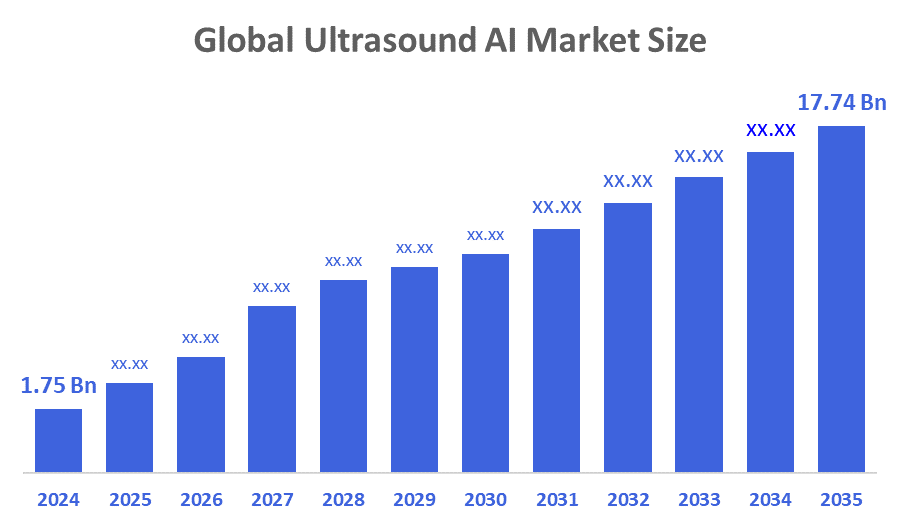
According to a Research Report Published by Decisions Advisors and Consulting, The Global Ultrasound AI Market Size was worth around USD 1.75 Billion in 2024 and is predicted to Grow to around USD 17.74 Billion by 2035 with a compound annual growth rate (CAGR) of 23.44% from 2025 to 2035. Some of the major factors leading to the market growth have been the increasing demand for accurate and early disease diagnosis, rapid growth in imaging volumes, as well as government initiatives and regulatory support. Besides, an automated AI-driven analysis can be very helpful in locating the faint anomalies that will largely be missed during a manual review.
Market Overview
The global market for ultrasound AI encompasses a wide range of ultrasound imaging devices that incorporate Artificial Intelligence into their clinical uses. The driving force behind growth in the Ultrasound AI market is an increasing demand for precision-based early disease detection, which has become increasingly important as the number of cases of chronic disease increases, including cancer, cardiovascular diseases (CVD), and neurological disorders. AI is particularly effective at detecting subtle abnormalities that may otherwise have been missed using traditional manual review methods. In addition, significant advances in technology, such as deep learning, computer vision, and machine learning, are making automated image segmentation possible and improving the efficiency of anomaly detection and quantitative analysis of ultrasound images, thereby reducing the total time to acquire an ultrasound image and minimising operator errors because less-experienced clinicians will be able to acquire better quality imaging data. All of the above factors are driving growth in the Ultrasound AI industry, including the current shortages of qualified radiologists and sonographers; the rapidly increasing use of point-of-care ultrasound to provide timely diagnostic services in remote areas; government initiatives to develop and promote the application of ultrasound in various clinical areas; regulatory opportunities for the approval of novel and innovative technologies for ultrasound; and the increasing emphasis on the cost-effectiveness of healthcare service delivery.
Philips announced a major investment of over $150 million in the United States to expand manufacturing and R&D for AI-powered healthcare technologies, including advanced ultrasound systems. This move strengthens its U.S. footprint, supports local production, and creates new skilled jobs while enhancing innovation in diagnostic and treatment solutions.
BrightHeart, a Paris-based medtech startup, has raised €11 million in a Series A round to expand its FDA-cleared prenatal ultrasound AI platform across the U.S. and Europe. The funding will accelerate commercialisation, product innovation, and support OB-GYNs in detecting congenital heart defects (CHD) with expert-level accuracy.
Report Coverage
This research report categorises the ultrasound AI market based on various segments and regions, forecasts revenue growth, and analyzes trends in each submarket. The report analyses the key growth drivers, opportunities, and challenges influencing the ultrasound AI market. Recent market developments and competitive strategies, such as expansion, product launch, development, partnership, merger, and acquisition, have been included to draw the competitive landscape in the market. The report strategically identifies and profiles the key market players and analyzes their core competencies in each sub-segment of the ultrasound AI market.
Driving Factors
The market for ultrasound AI is driven by the growing need for accurate early disease identification in the appearance of chronic illnesses, including cancer, neurological problems, and cardiovascular diseases, where AI is excellent at identifying minute abnormalities missed by human reviewers. Automation of picture segmentation, anomaly identification, and quantitative analysis is made possible by technological advancements in machine learning, deep learning, and computer vision. This reduces scan times, minimises operator errors, and helps less experienced physicians. In addition to government initiatives, regulatory clearances, and cost-efficiency pushes in healthcare delivery, the rapid use of point-of-care ultrasound (POCUS) for real-time diagnostics in distant locations and shortages of qualified radiologists and sonographers further accelerate expansion.
Restraining Factors
The market for ultrasound AI is constrained by a number of constraints, including high implementation costs, regulatory obstacles, data privacy issues, a shortage of qualified workers, and difficulties integrating with the current healthcare infrastructure.
Market Segmentation
The ultrasound AI market share is classified into component, and application.
- The hardware segment accounted for the largest market share in 2024 and is projected to grow at a substantial CAGR over the forecast period.
Based on the component, the ultrasound AI market is segmented into hardware, and software. Among these, the hardware segment accounted for the largest market share in 2024 and is projected to grow at a substantial CAGR over the forecast period. These technologies lessen the need for post-processing software by enabling real-time image capturing, automatic analysis, and quicker reporting. AI integration reduces operator variability, improves image quality, and increases anomaly detection accuracy.
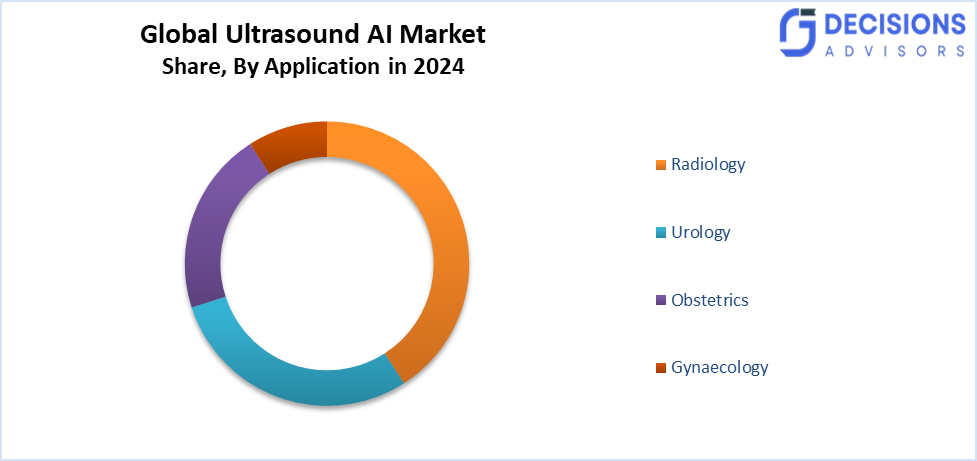
- The radiology segment accounted for the highest share in 2024 and is anticipated to grow at a significant CAGR during the forecast period.
Based on the application, the ultrasound AI market is differentiated into radiology, urology, obstetrics & gynaecology. Among these, the radiology segment accounted for the highest share in 2024 and is anticipated to grow at a significant CAGR during the forecast period. This segment growth is increasing due to cardiovascular diseases becoming more common. AI automates valve quantification, strain analysis, and ejection fraction computation. Furthermore, deep learning models are more sensitive in identifying irregularities in regional wall movements.
Regional Segment Analysis of the Ultrasound AI Market
- North America (U.S., Canada, Mexico)
- Europe (Germany, France, U.K., Italy, Spain, Rest of Europe)
- Asia-Pacific (China, Japan, India, Rest of APAC)
- South America (Brazil and the Rest of South America)
- The Middle East and Africa (UAE, South Africa, Rest of MEA)
Asia Pacific is anticipated to hold the largest share of the ultrasound AI market over the predicted timeframe.
Asia Pacific is anticipated to hold the largest share of the ultrasound AI market over the predicted timeframe. The leading drivers for this increase are due to the growing amount of money spent on healthcare, increased use of Artificial Intelligence in healthcare applications, and the increasing prevalence of chronic diseases. Countries such as China, Japan, South Korea, and India are driving innovation in this area through government support of AI healthcare initiatives. In addition to these government-backed efforts, partnerships between major players in the ultrasound AI marketplace also foster rapid growth.
The ultrasound AI market in India is expected to experience significant growth as a result of a high number of individuals with hypertension being diagnosed, the Indian government promoting healthcare initiatives through funding, and the rapid development of new technologies. There is also a significant amount of increasing adoption of the technology by healthcare providers throughout the country. The ultrasound AI market in Japan is also anticipated to grow at a rapid pace, driven by the rapid advancements in technology, the increasing number of individuals aged 65 years and older, increasing healthcare spending, and increasing use of artificial intelligence in healthcare applications.
Europe is projected to grow at a rapid CAGR in the ultrasound AI market during the forecast period. Growth in the European ultrasound AI market will be driven by a number of factors, including the large-scale implementation of AI technologies across the healthcare system and investments from both government and private organisations.
The UK's AI adoption in medical imaging has been supported by NHS England via various digital health initiatives and funding schemes, along with introducing regulatory "sandboxes" that allow for the testing of new technologies before full-scale deployment. GPs and hospitals that utilise PACS (Picture Archiving and Communications System) and EHR (Electronic Health Record) systems will benefit from the integration of ultrasound AI, as they will be able to scale their business operations much quicker than traditional ultrasound providers.
The ongoing efforts of the German government to promote the integration of AI into Germany's nationwide health system, as well as the inclusion of AI technologies into health insurance policies, are also driving continued growth within this sector.
Competitive Analysis:
The report offers the appropriate analysis of the key organizations/companies involved within the ultrasound AI market, along with a comparative evaluation primarily based on their product offering, business overviews, geographic presence, enterprise strategies, segment market share, and SWOT analysis. The report also provides an elaborative analysis focusing on the current news and developments of the companies, which includes product development, innovations, joint ventures, partnerships, mergers & acquisitions, strategic alliances, and others. This allows for the evaluation of the overall competition within the market.
List of Key Companies
- Caption Care
- Clarius
- EchoNous Inc.
- FUJIFILM Corporation
- GE Healthcare
- iCardio.ai
- Koios Medical
- Koninklijke Philips N.V.
- SamsungHealthcare.com
- Siemens Healthineers
- Sonio SAS (a SAMSUNG Company)
- UltraSight
- Others
Key Target Audience
- Market Players
- Investors
- End-users
- Government Authorities
- Consulting and Research Firm
- Venture capitalists
- Value-Added Resellers (VARs)
Recent Development
- In October 2025, Samsung launched the R20 Ultrasound System, a next-generation platform powered by advanced AI and its Crystal Architecture, designed to deliver superior image clarity, diagnostic accuracy, and workflow efficiency for general imaging applications. The R20 improves workflow productivity and enriches the clinical experience with its ergonomic design and AI-driven automation solutions.
- In August 2025, GE HealthCare launched the Vivid Pioneer, its most advanced AI-powered cardiovascular ultrasound system, combining ultra-premium imaging with adaptive AI tools to improve diagnostic confidence, speed, and workflow efficiency. The system received both CE Mark and U.S. FDA 510(k) clearance, marking a major milestone in cardiovascular imaging.
- In April 2025, Philips launched new FDA-cleared AI software for its cardiovascular ultrasound systems (EPIQ CVx and Affiniti CVx), introducing industry-first automated tools for heart wall motion scoring and fully automated 3D quantification of mitral regurgitation volumes. These innovations aim to speed up cardiac ultrasound analysis, improve diagnostic confidence, and enhance workflow efficiency for clinicians worldwide.
- In January 2025, Samsung Medison unveiled the Z20, a premium AI-powered Ob-Gyn ultrasound system, at the Society for Maternal-Fetal Medicine (SMFM) 2025 in Denver. The Z20 introduces advanced AI tools like Live ViewAssist, automatic anatomical labelling, and real-time quality evaluation to improve diagnostic accuracy, especially for high-BMI patients, while also enhancing clinician ergonomics and workflow efficiency.
Market Segment
This study forecasts revenue at global, regional, and country levels from 2020 to 2035. Decisions Advisors has segmented the ultrasound AI market based on the below-mentioned segments:
Global Ultrasound AI Market, By Component
- Hardware
- Software
Global Ultrasound AI Market, By End Use
- Radiology
- Urology
- Obstetrics
- Gynecology
Global Ultrasound AI Market, By Regional Analysis
- North America
- US
- Canada
- Mexico
- Europe
- Germany
- UK
- France
- Italy
- Spain
- Russia
- Rest of Europe
- Asia Pacific
- China
- Japan
- India
- South Korea
- Australia
- Rest of Asia Pacific
- South America
- Brazil
- Argentina
- Rest of South America
- Middle East & Africa
- UAE
- Saudi Arabia
- Qatar
- South Africa
- Rest of the Middle East & Africa
Frequently Asked Questions (FAQ)
- What is the current size of the Global Ultrasound AI Market?
The market was valued at USD 1.75 billion in 2024.
- What is the projected market size by 2035?
It is expected to reach USD 17.74 billion by 2035.
- What is the CAGR for the forecast period?
The market is projected to grow at a CAGR of 23.44% from 2025 to 2035.
- Which region holds the largest market share?
Asia Pacific is anticipated to hold the largest share during the forecast period.
- Which region is expected to grow the fastest?
Europe is projected to grow at the fastest CAGR.
- What are the main market segments by component?
The market is segmented into Hardware and Software, with Hardware holding the largest share in 2024.
- Which application segment leads the market?
Radiology accounted for the highest share in 2024 and is expected to grow significantly.
- What drives growth in the Ultrasound AI Market?
Key drivers include demand for early disease detection, AI advancements in image analysis, radiologist shortages, and government support.
Check Licence
Choose the plan that fits you best: Single User, Multi-User, or Enterprise solutions tailored for your needs.
We Have You Covered
- 24/7 Analyst Support
- Clients Across the Globe
- Tailored Insights
- Technology Tracking
- Competitive Intelligence
- Custom Research
- Syndicated Market Studies
- Market Overview
- Market Segmentation
- Growth Drivers
- Market Opportunities
- Regulatory Insights
- Innovation & Sustainability
Report Details
| Scope | Global |
| Pages | 287 |
| Delivery | PDF & Excel via Email |
| Language | English |
| Release | Feb 2026 |
| Access | Download from this page |