
United Kingdom Anti-Rheumatics Market
 |
Author:
Disha B
|
Pages:
210
|
Author:
Disha B
|
Pages:
210
United Kingdom Anti-Rheumatics Market Size, Share, By Drug Class (Non-steroidal Anti-Inflammatory Drugs, Disease-Modifying Anti-Rheumatic Drugs, Corticosteroids, Uric Acid Drugs), By Indication (Rheumatoid Arthritis, Osteoarthritis, Psoriatic Arthritis, Ankylosing Spondylitis), By End User (Hospitals, Specialty Clinics, Homecare Settings), Analysis and Forecast 2026 ? 2035
CAGR
3.97%
REVENUE 2025
USD Billion 5.25
FORECAST 2035
USD Billion 7.75
REPORT COVERAGE
Country
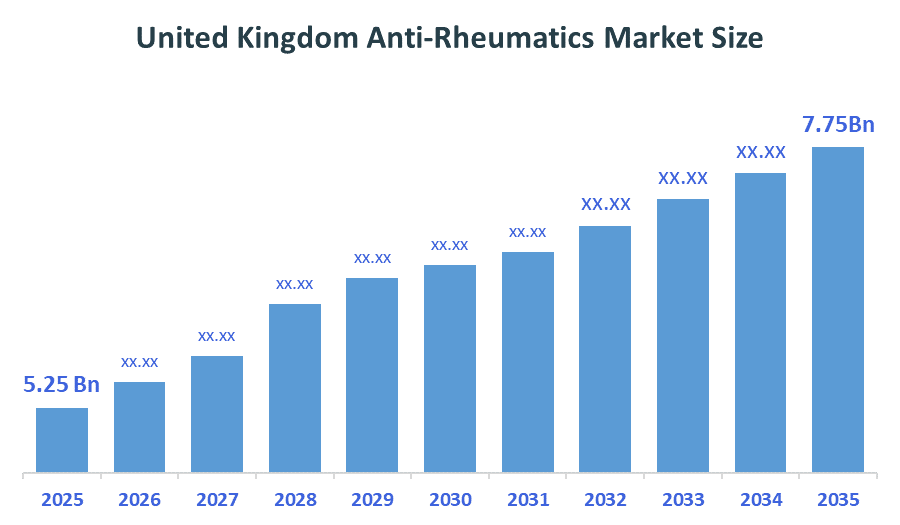
The United Kingdom anti-rheumatic market size is forecast to grow from approximately USD 5.25 Billion in 2025 to around USD 7.75 Billion by 2035. According to Decision Advisors, a detailed research report on the anti-rheumatics market indicates that the rising adoption of biologics and biosimilars trend dominates the market, accounting for approximately 40-45% of the total share in the United Kingdom. AbbVie Inc. leads the market with an estimated 20% United Kingdom market share. The company's annual revenue of approximately USD 54 billion is making it one of the most influential forces shaping industry trends and overall market growth.
Market Snapshot
- United Kingdom Anti-Rheumatics Market size (2025): USD 5.25 Billion
- Projected United Kingdom Anti-Rheumatics Market Size (2035): USD 7.75 Billion
- United Kingdom Anti-Rheumatics Market Compound Annual Growth Rate (CAGR): 3.97%
- Base Year: 2025
- Historical Period: 2021–2024
- Forecast Period: 2026–2035
Market Overview/Introduction
The United Kingdom anti-rheumatic market encompasses the pharmaceutical and biological drug sectors, which focus on preventing, treating, and managing rheumatoid arthritis, osteoarthritis, and ankylosing spondylitis. Anti-rheumatics comprise medications that include disease-modifying anti-rheumatic drugs (DMARDs) and biologics, and nonsteroidal anti-inflammatory drugs (NSAIDs) that work to decrease inflammation and provide pain relief while protecting against disease advancement. The market experiences continuous growth because of increasing disease cases, a growing elderly demographic, and better diagnostic capabilities. The market holds future growth potential through personalized medicine development and biosimilar introduction, and advanced biologic treatments that target particular immune system pathways. The United Kingdom market will experience increased growth and innovative development because of rising healthcare spending, continuous research activities, and government policies that provide assistance.
- The UK government, through the NHS, implements the Best Practice Tariff to ensure early diagnosis and rapid initiation of treatment. This scheme incentivizes hospitals financially to meet clinical standards, improving outcomes and increasing anti-rheumatic drug adoption.
- The UK government’s long-term NHS strategy emphasizes improved patient access, community-based care, and early intervention for chronic conditions like arthritis. It supports better availability of advanced therapies, including biologics and DMARDs, thereby positively influencing the anti-rheumatics market growth.
Notable Insights: -
- The disease-modifying anti-rheumatic drugs segment dominated the market in 2025 and holds the largest market share, accounting for approximately 45% during the forecast period.
- The rheumatoid arthritis segment dominated the market in 2025 and holds the largest market share, accounting for approximately 40% during the forecast period.
- The hospitals segment dominated the market in 2025 and holds the largest market share, accounting for approximately 50% during the forecast period.
- The compound annual growth rate of the United Kingdom Anti-Rheumatics Market is 3.97%.
- The market is likely to achieve a valuation of USD 7.75 Billion by 2035.
What is the role of technology in grooming the market?
Technology plays a crucial role in shaping and advancing the United Kingdom anti-rheumatics market by improving diagnosis, treatment efficiency, and patient outcomes. Advanced biologics manufacturing and biosimilar development by companies like Pfizer Inc. and AbbVie Inc. have enhanced drug accessibility while reducing costs. Digital health tools, including telemedicine and remote monitoring systems, enable continuous patient management and early intervention, particularly through platforms integrated with the National Health Service. Artificial intelligence and data analytics are increasingly used for early diagnosis, personalized treatment planning, and predicting disease progression. Additionally, innovations in drug delivery systems, such as self-injectable biologics, improve patient adherence and convenience. Overall, technology is driving a shift toward precision medicine, cost efficiency, and value-based healthcare, significantly strengthening market growth and patient-centric care.
Market Drivers
The UK anti-rheumatic market is growing because rheumatoid arthritis and other autoimmune disorders are becoming more common, there is a growing need for effective long-term treatments, and the National Health Service provides strong support for healthcare. Companies like Pfizer Inc. and Eli Lilly and Company are making progress in biologics and targeted therapies, which are making treatments more effective and giving more people access to them. Also, more people are becoming aware of the importance of early diagnosis and treatment, and favorable reimbursement policies are encouraging timely intervention. The growing use of biosimilars is also lowering costs and increasing market penetration, which helps the market grow as a whole.
Restrain
The United Kingdom anti-rheumatics market faces restraints due to high costs of biologics from companies like AbbVie Inc., strict pricing controls by the National Health Service, and regulatory hurdles. Additionally, supply chain disruptions, biosimilar competition, and limited patient access to advanced therapies hinder overall market growth and adoption.
Study on the Supply, Demand, Distribution, and Market Environment of the United Kingdom Anti-Rheumatics Market
The United Kingdom anti-rheumatics market operates within a highly regulated and globally dependent supply chain, where raw materials and active pharmaceutical ingredients are largely sourced from countries like China and India before being manufactured and distributed through complex networks. Supply is managed centrally by the National Health Service and the Department of Health and Social Care, ensuring continuity through procurement frameworks and shortage mitigation strategies. Demand is steadily rising due to the increasing prevalence of rheumatoid arthritis and greater adoption of disease-modifying anti-rheumatic drugs (DMARDs), which dominate treatment usage. Distribution occurs via hospital pharmacies, community pharmacies, and specialized care channels, with most drugs being prescription-based. The market environment is shaped by pricing pressures, regulatory controls, and frequent supply disruptions caused by global events, manufacturing issues, and logistics constraints, making resilience and efficient coordination critical to maintaining patient access and treatment continuity.
Price Analysis and Consumer Behaviour Analysis
The United Kingdom anti-rheumatics market exhibits a tiered pricing structure influenced by high-cost biologics, biosimilars, and conventional therapies. Premium-priced biologics from firms like AbbVie Inc. and Johnson & Johnson dominate costs, while increasing biosimilar adoption is driving price competition and cost containment under the National Health Service. Consumer behavior is largely guided by physician prescriptions, clinical effectiveness, and reimbursement availability. Patients show growing preference for advanced biologics offering long-term disease control and fewer side effects, despite higher list prices. However, due to NHS coverage, price sensitivity remains moderate. Additionally, awareness of early diagnosis and treatment is rising, encouraging timely therapy initiation and adherence. Demand for personalized and targeted treatments is increasing, reflecting a shift toward value-based and outcome-driven healthcare decisions.
Market Segmentation
The United Kingdom Anti-Rheumatics Market Share is classified into component, application, and end user
- The disease-modifying anti-rheumatic drugs segment dominated the market in 2025 and holds the largest market share, accounting for approximately 45% during the forecast period.
Based on the component, the anti-rheumatics market is divided into non-steroidal anti-inflammatory drugs, disease-modifying anti-rheumatic drugs, corticosteroids, and uric acid drugs. Among these, the disease-modifying anti-rheumatic drugs segment dominated the market in 2025 and holds the largest market share, accounting for approximately 45% during the forecast period. The disease-modifying anti-rheumatic drugs segment is driven by its ability to slow or halt disease progression rather than just relieve symptoms. Growing adoption of biologics and targeted therapies, rising rheumatoid arthritis prevalence, and strong clinical guidelines in the United Kingdom supporting early and aggressive treatment significantly drive sustained demand and market share growth.
- The rheumatoid arthritis segment dominated the market in 2025 and holds the largest market share, accounting for approximately 40% during the forecast period.
Based on the deployment, the anti-rheumatics market is divided into rheumatoid arthritis, osteoarthritis, psoriatic arthritis, and ankylosing spondylitis. Among these, the rheumatoid arthritis segment dominated the market in 2025 and holds the largest market share, accounting for approximately 40% during the forecast period. The rheumatoid arthritis segment in the U.K. is attributed to its high prevalence and chronic nature, requiring long-term treatment. Increased awareness, early diagnosis, and widespread use of advanced therapies such as biologics and DMARDs drive demand. Additionally, strong healthcare support in the United Kingdom ensures consistent patient access to effective treatment options.
- The hospitals segment dominated the market in 2025 and holds the largest market share, accounting for approximately 50% during the forecast period.
Based on the end user, the anti-rheumatics market is divided into Hospitals, specialty clinics, and homecare settings. Among these, the hospitals segment dominated the market in 2025 and holds the largest market share, accounting for approximately 50% during the forecast period. The hospitals segment in the U.K. is driven by access to advanced diagnostic facilities, specialist rheumatologists, and the ability to administer complex biologic therapies requiring clinical supervision. Higher patient inflow, availability of multidisciplinary care, and strong reimbursement frameworks in the United Kingdom further support hospitals as the primary treatment setting for rheumatic diseases.
Recent Development
- In November 2025, a market analysis report highlighted that key pharmaceutical companies including Cyxone, Taiho Pharmaceutical, AstraZeneca, Eli Lilly and Company, Rise Therapeutics, TNF Pharmaceuticals, and UCB, were actively advancing pipeline therapies for rheumatoid arthritis across major markets, including the United Kingdom.
- In October 2025, a UK-based biotech funding announcement highlighted that many rheumatoid arthritis patients still relied on standard-of-care treatments, including methotrexate combined with TNF inhibitors, reinforcing the continued clinical importance of established biologics in the UK treatment landscape.
Competitive Analysis
The report offers the appropriate analysis of the key organisations/companies involved within the United Kingdom Anti rheumatics market, along with a comparative evaluation primarily based on their product offering, business overviews, geographic presence, enterprise strategies, segment market share, and SWOT analysis. The report also provides an elaborative analysis focusing on the current news and developments of the companies, which includes product development, innovations, joint ventures, partnerships, mergers & acquisitions, strategic alliances, and others. This allows for the evaluation of the overall competition within the market.
Top Key Companies in the United Kingdom Anti-Rheumatics Market
- Pfizer Inc.
- AbbVie Inc.
- Bristol-Myers Squibb Company
- Johnson & Johnson
- Eli Lilly and Company
- Others
Key Target Audience
- Market Players
- Investors
- End-users
- Government Authorities
- Consulting and Research Firm
- Venture capitalists
- Value-Added Resellers (VARs)
Market Segment
This study forecasts revenue at the United Kingdom, regional, and country levels from 2020 to 2035. Spherical Insights has segmented the United Kingdom Anti-Rheumatics Market based on the below-mentioned segments
United Kingdom Anti-Rheumatics Market, By Drug Class
- Non-steroidal Anti-Inflammatory Drugs
- Disease-Modifying Anti-Rheumatic Drugs
- Corticosteroids
- Uric Acid Drugs
United Kingdom Anti-Rheumatics Market, By Indication
- Rheumatoid Arthritis
- Osteoarthritis
- Psoriatic Arthritis
- Ankylosing Spondylitis
United Kingdom Anti-Rheumatics Market, By End User
- Hospitals
- Specialty Clinics
- Homecare Settings
Frequently Asked Questions (FAQ)
Q. How is biosimilar competition influencing the United Kingdom anti-rheumatics market?
A. Biosimilar competition is significantly reshaping the UK anti-rheumatics market by reducing treatment costs and expanding patient access. As patents for leading biologics expire, biosimilars are entering the market with comparable efficacy at lower prices. This shift is encouraging the National Health Service to adopt cost-effective procurement strategies, thereby improving affordability and increasing overall treatment adoption.
Q. What impact does an aging population have on the anti-rheumatics market in the United Kingdom?
A. The aging population in the United Kingdom is a major factor driving market growth, as older individuals are more prone to chronic conditions such as osteoarthritis and rheumatoid arthritis. This demographic trend is increasing long-term demand for anti-rheumatic drugs, particularly for sustained disease management and pain relief therapies.
Q. How are regulatory frameworks affecting drug approvals in the UK anti-rheumatics market?
A. Regulatory bodies like the Medicines and Healthcare products Regulatory Agency play a crucial role in ensuring drug safety, efficacy, and quality. Strict approval processes and pricing regulations can delay market entry but also ensure high treatment standards, influencing how quickly new biologics and therapies reach patients.
Q. What role do specialty clinics play in the UK anti-rheumatics treatment ecosystem?
A. Specialty clinics are becoming increasingly important in delivering targeted care for rheumatic diseases. These clinics offer expert diagnosis, personalized treatment plans, and monitoring of advanced therapies such as biologics. They complement hospital services by reducing patient load and enabling more focused, outpatient-based management of chronic conditions.
Check Licence
Choose the plan that fits you best: Single User, Multi-User, or Enterprise solutions tailored for your needs.
We Have You Covered
- 24/7 Analyst Support
- Clients Across the Globe
- Tailored Insights
- Technology Tracking
- Competitive Intelligence
- Custom Research
- Syndicated Market Studies
- Market Overview
- Market Segmentation
- Growth Drivers
- Market Opportunities
- Regulatory Insights
- Innovation & Sustainability
Report Details
| Scope | Country |
| Pages | 210 |
| Delivery | PDF & Excel via Email |
| Language | English |
| Release | Apr 2026 |
| Access | Download from this page |