
United Kingdom Converter Modules Market
 |
Author:
Omkar J
|
Pages:
210
|
Author:
Omkar J
|
Pages:
210
United Kingdom Converter Modules Market Size, Share, By Product (AC/DC Power Conversion, DC-DC Converters, Isolated Converters, Non-Isolated Converters, DC-AC Converters, Others), By Application (IT and Telecommunications, Consumer Electronics, Automotive, Industrial, Healthcare, Aerospace and Defense, Renewable Energy), By Control Type (Digital Control, Mixed-Signal Control), By Region (North America, Europe, Asia-Pacific, Latin America, Middle East, and Africa) Analysis and Forecast 2026-2035
CAGR
8.71%
REVENUE 2025
USD Million 745.4
FORECAST 2035
USD Million 1718.4
REPORT COVERAGE
Country
Market Snapshot
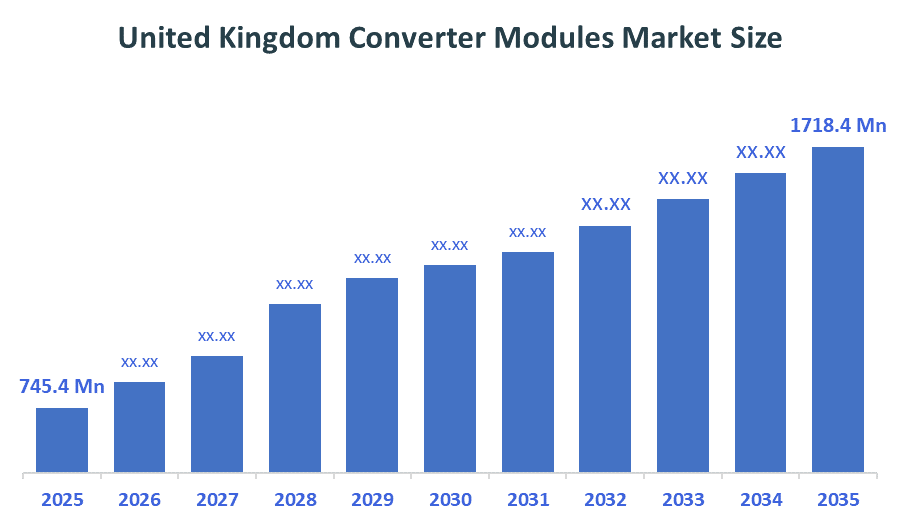
- Market Size (2025): USD 745.4 Million
- Projected Market Size (2035): USD 1718.4 Million
- Compound Annual Growth Rate (CAGR): 8.71%
- Base Year: 2025
- Historical Period: 2021–2025
- Forecast Period: 2026–2035
Market Overview/Introduction
The United Kingdom Converter Modules Market includes advanced HVAC systems which power conversion systems to control temperature and humidity and maintain energy efficiency in residential and commercial and industrial structures. The market experiences growth because people need energy-efficient cooling systems and the UK carbon emission regulations become stricter and urban areas expand and smart homes with IoT technology become more common. The current market trends show businesses using inverter technology and AI climate control systems and IoT sensors which provide 35% energy savings and predictive maintenance functions. The field of technology development works toward creating compressors with high efficiency and refrigerants that have required low GWP and automatic control technologies. The primary market potential exists through green building expansion and existing building retrofitting and smart city development projects. The UK market witnesses faster adoption of advanced low-carbon HVAC systems and converter module systems because electricity prices and sustainability regulations drive demand for these technologies.
- In January 2024, The UK “Driving the Electric Revolution (DER)” initiative supports development of Power Electronics, Machines and Drives (PEMD), accelerating innovation in high-efficiency converter modules for industrial, renewable energy, and smart HVAC applications.
- In august 2025, UK CFD scheme supports offshore wind and solar projects by providing price stability, accelerating renewable deployment, and driving demand for power electronic converter modules like inverters and DC-AC systems for efficient grid integration.
Notable Insights: -
- By product, the AC/DC power conversion held a dominant position with 8% in terms of market share in 2025.
- By application, industrial is the dominating accounting for over 8% of the United Kingdom market share in 2025.
- The compound annual growth rate of the United Kingdom Converter Modules Market is 8.71%.
- The market is likely to achieve a valuation of USD 1718.4Million by 2035.
What is role of Technology in grooming the market?
The UK converter modules market experiences its main transformation through technological advancements. The combination of inverter compressors and Internet of Things IoT technology and smart thermostats enable users to achieve energy savings that reach 35% of their total electricity consumption. The AI-based cooling optimization system enables users to modify temperature settings throughout the day. Smart connectivity features have become standard components in almost 30 to 35% of modern systems. The implementation of advanced refrigerants together with variable speed compressors and automated building management systems (BMS) delivers environmental benefits while enhancing system performance. The adoption of these technologies enables businesses to achieve UK net-zero targets and comply with energy efficiency regulations thus powering the growth of contemporary HVAC systems.
Market Drivers
Multiple key factors drive the United Kingdom Converter Modules Market which includes increasing demand for energy-saving cooling systems and United Kingdom carbon emission standards together with energy efficiency regulations that promote advanced HVAC system installation. The market keeps expanding because smart home technology and Internet of Things building systems enable customers to choose better climate control systems which operate through digital connections. Urban areas expand quickly while more people choose to live in apartments which creates a higher need for small yet powerful cooling systems. The market grows stronger because commercial spaces including offices, retail centers and healthcare establishments continue to expand their physical presence. The high cost of electricity drives customers to choose inverter systems which provide both long-term cost savings and better energy performance. The residential sector leads the market with its share of total consumption reaching almost 55%.
Restrain
The United Kingdom Converter Modules Market faces several restraints that may limit its growth potential. High installation and maintenance costs of advanced HVAC systems make adoption difficult for both price-sensitive consumers and small businesses. The complex integration of VRF/VRV systems in older buildings further restricts widespread deployment because existing infrastructures need extensive system changes. Retrofitting challenges in aging UK buildings also increase overall project costs and installation time. The market experiences stability issues because equipment utilization becomes inconsistent during seasonal demand fluctuations. High electricity costs in the UK discourage residential sectors from using air conditioning systems which results in slower market growth.
Study on the Supply, Demand, Distribution, and Market Environment United Kingdom Converter Modules Market
The UK market operates through a strong distribution network of OEMs, wholesalers, HVAC contractors, and EPC companies. The requirement emerges from residential housing needs together with commercial building needs and industrial infrastructure needs. European countries control the majority of supply because their manufacturing capabilities are highly developed, while domestic demand for high-efficiency systems relies on imported products. The total distribution system receives approximately 28% of its sales from online HVAC sales and B2B procurement. The demand for smart buildings together with energy-efficient infrastructure continues to grow throughout urban areas. The market generates substantial recurring revenue from after-sales services and maintenance contracts and retrofit projects. Product accessibility and installation efficiency improved through strategic partnerships between manufacturers and local installation contractors. The growing use of digital procurement platforms enables businesses to optimize their supply chain activities which results in shorter lead times and better visibility of product costs. The increasing government incentives for low-carbon buildings together with smart energy systems drive higher demand for advanced HVAC solutions in both new building projects and renovation work.
Price Analysis and Healthcare Facilities Behaviour Analysis
The UK Converter Modules Market for split AC units presents an affordable solution which ranges from USD 400 to 900 as its most common choice for home use in small urban houses and apartments. The price of inverter-based and smart AC systems starts at USD 1,200 and reaches USD 3,500 because these systems offer advanced IoT connectivity and AI temperature control and better energy efficiency. The installation costs of VRF/VRV systems which serve major commercial buildings and hospitals and retail establishments can reach more than USD 10,000 because these systems require complicated setups and multiple zone cooling systems. Energy-efficient systems deliver long-term benefits which include 30 to 40% energy savings and reduced electricity charges and decreased maintenance expenses and better operational outcomes yet customers choose these systems despite their higher upfront costs. The residential and commercial markets continue to adopt this solution because it offers significant cost savings for both sectors.
Strategies to Implement for Growth of the Market
The United Kingdom Converter Modules Market can achieve strong growth through targeted strategies which focus on efficiency and sustainability and smart building integration. The manufacturing industry needs to focus on creating inverter-based converter modules which operate with high efficiency and meet the UK's strict carbon emission standards. The implementation of IoT-enabled HVAC systems will enable better real-time building monitoring and predictive maintenance and energy saving measures in both residential and commercial spaces. The HVAC industry needs to upgrade its existing systems through retrofitting solutions which provide compact converter systems that work with aging equipment in UK buildings. The construction industry and real estate development sector can establish strategic partnerships to enable early HVAC system installation for advanced technologies in smart building initiatives. The residential sector will see faster adoption of energy-efficient solutions through increased government partnerships and energy efficiency incentive programs. Consumer awareness programs about long-term energy savings which demonstrate 30 to 40% savings will drive more customers toward inverter-based system solutions. The distribution network expansion together with improved after-sales service capabilities will support continuous market growth in both urban and semi-urban areas.
Market Segmentation
The United Kingdom Converter Modules Market share is classified into product type, technology, and end-user
- The AC/DC power conversion dominated the market in 2018, and is projected to grow at a substantial CAGR of approximately 8 % during the forecast period.
Based on the product, the United Kingdom converter modules market is divided into ac/dc power conversion, dc-dc converters, isolated converters, non-isolated converters, dc-ac converters, others. Among these, the AC/DC power conversion dominated the market in 2018, and is projected to grow at a substantial CAGR of approximately 8 % during the forecast period. The system serves HVAC applications by transforming electrical grid power into reliable operational energy which supports both air conditioning units and compressors and inverter-based systems. The market segment will experience growth at a compound annual growth rate of 8% throughout the forecast period because of enhanced adoption rates of inverter-driven HVAC systems and growing need for energy-efficient cooling systems and the UK government's implementation of electricity consumption reduction policies for residential and commercial buildings.
- The industrial accounted for the largest share in 2018, and is anticipated to grow at a significant CAGR of approximately 8% during the forecast period.
Based on the application, the United Kingdom converter modules market is divided into IT and telecommunications, consumer electronics, automotive, industrial, healthcare, aerospace and defence, renewable energy. Among these, the industrial accounted for the largest share in 2018, and is anticipated to grow at a significant CAGR of approximately 8% during the forecast period. The industrial sector will experience growth with a compound annual growth rate between 8% during the projected period because manufacturing facilities adopt more automated systems and demand energy efficient HVAC systems increases and the United Kingdom enforces strict carbon emission standards for industrial operations. The demand for converter modules in industrial HVAC applications increases because organizations invest in smart factory technology and advanced climate control systems for their buildings.
- The digital control segment dominated the market in 2018, and is projected to grow at a substantial CAGR approximately 9% during the forecast period.
Based on the control type, the United Kingdom converter modules market is divided into digital control,
and mixed-signal control. Among these, the digital control segment dominated the market in 2018, and is projected to grow at a substantial CAGR approximately 9% during the forecast period. Digital control systems operate as essential components for both residential spaces and commercial spaces because their operational capabilities include real-time system observation and energy efficiency management and they connect with Internet of Things-based building management systems. This practice results in better system efficiency and substantial decrease in energy use. The segment is projected to grow at a CAGR of approximately 9% during the forecast period which is driven by growing use of smart HVAC systems and UK energy efficiency regulations and increasing need for automated climate control systems in contemporary buildings.
Recent Development
- In May 2025, Silanna Semiconductor launched the Plural™ Data Converter Series featuring over 150 factory-configurable ADC variants, enabling flexible high-density data conversion for industrial and communications applications, enhancing precision, scalability, and integration in advanced electronic systems.
- In April 2025, Navitas Semiconductor and Great Wall Power introduced a 2.5 kW GaN-based DC-DC converter featuring ultra-high-power density and efficiency, targeting AI data centers and high-performance power conversion applications.
- In April 2025, Delta Electronics supplied automotive DC-DC converter solutions for electric vehicle powertrains in collaboration with BMW-related EV system partners, enhancing energy efficiency, compact design, and high-performance power management in EV applications.
- In March 2025, Amber Semiconductor introduced a 50V-to-0.8V DC-DC converter solution for AI data center applications, enabling vertical power delivery, higher efficiency, and reduced power loss in advanced high-density computing systems.
Competitive Analysis
The report offers the appropriate analysis of the key organisations/companies involved within the United Kingdom Converter Modules Market, along with a comparative evaluation primarily based on their technology offering, business overviews, geographic presence, enterprise strategies, segment market share, and SWOT analysis. The report also provides an elaborative analysis focusing on the current news and developments of the companies, which includes technology development, innovations, joint ventures, partnerships, mergers & acquisitions, strategic alliances, and others. This allows for the evaluation of the overall competition within the market.
Top Key Companies in United Kingdom Converter Modules Market
- Delta Electronics Inc.
- STMicroelectronics
- Renesas Electronics Corporation
- Texas Instruments Incorporated
- ABB Ltd.
- Flex Ltd.
- Murata Manufacturing Co. Ltd
- RECOM Power GmbH
- TDK Corporation
- Vicor Corporation
- Others
Key Target Audience
- Market Players
- Investors
- End-users
- Government Authorities
- Consulting and Research Firm
- Venture capitalists
- Value-Added Resellers (VARs)
Market Segment
This study forecasts revenue at the India, regional, and country levels from 2020 to 2035. Decision Advisors has segmented the United Kingdom Converter Modules Market based on the below-mentioned segments
United Kingdom Converter Modules Market, By Product
- AC/DC Power Conversion
- DC-DC Converters
- Isolated Converters
- Non-Isolated Converters
- DC-AC Converters (Inverters)
- Others
United Kingdom Converter Modules Market, By Application
- IT and Telecommunications
- Consumer Electronics
- Automotive
- Industrial
- Healthcare
- Aerospace & Defense
- Renewable Energy
United Kingdom Converter Modules Market, By Control Type
- Digital Control
- Mixed-Signal Control
Frequently Asked Questions (FAQ)
1. How are UK net-zero targets influencing converter module design in HVAC systems?
UK net-zero targets are pushing manufacturers to develop high-efficiency converter modules that reduce power loss in HVAC systems and support low-carbon building operations.
2. Why are converter modules becoming critical in smart building HVAC ecosystems in the UK?
Converter modules enable real-time power optimization, allowing HVAC systems to adjust cooling loads dynamically based on occupancy and environmental data.
3. How does building age in the UK affect demand for advanced converter modules?
Older UK buildings require retrofitting-compatible converter modules, increasing demand for compact, flexible, and low-disruption HVAC power solutions.
4. What role do converter modules play in reducing HVAC lifecycle costs?
They improve energy efficiency and reduce compressor stress, lowering maintenance frequency and total HVAC operational costs over time.
5. How is electrification of heating systems impacting converter module adoption?
The shift toward electric heating and cooling systems increases dependency on efficient converter modules for stable voltage regulation and energy conversion.
6. Why is digital control gaining preference in UK HVAC converter modules?
Digital control allows precise energy management, predictive maintenance, and integration with smart building platforms, improving HVAC system intelligence.
Check Licence
Choose the plan that fits you best: Single User, Multi-User, or Enterprise solutions tailored for your needs.
We Have You Covered
- 24/7 Analyst Support
- Clients Across the Globe
- Tailored Insights
- Technology Tracking
- Competitive Intelligence
- Custom Research
- Syndicated Market Studies
- Market Overview
- Market Segmentation
- Growth Drivers
- Market Opportunities
- Regulatory Insights
- Innovation & Sustainability
Report Details
| Scope | Country |
| Pages | 210 |
| Delivery | PDF & Excel via Email |
| Language | English |
| Release | Apr 2026 |
| Access | Download from this page |