
United Kingdom Embolization Particle Market
 |
Author:
Disha B
|
Pages:
210
|
Author:
Disha B
|
Pages:
210
United Kingdom Embolization Particle Market Size, Share, By Type (Microspheres, Liquid Embolics, Drug-Eluting Beads), By Application (Oncology, Peripheral Vascular Disease, Urology, Neurology, Others), By End User (Hospitals, Specialty Clinics, Ambulatory Surgical Centers), Analysis and Forecast 2026?2035.
CAGR
6.42%
REVENUE 2025
USD Million 24.8
FORECAST 2035
USD Million 46.2
REPORT COVERAGE
Country
Market Snapshot
- Market Size (2025): USD 24.8 Million
- Projected Market Size (2035): USD 46.2 Million
- Compound Annual Growth Rate (CAGR): 6.42%
- Base Year: 2025
- Historical Period: 2021–2024
- Forecast Period: 2026–2035
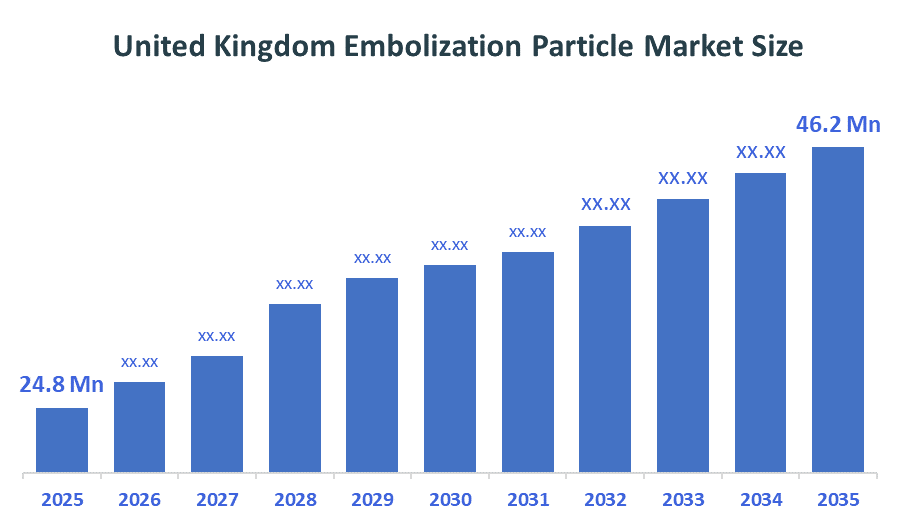
According to Decision Advisors, the United Kingdom Embolization particle market Size is expected to grow from USD 24.8 Million in 2025 to USD 46.2 Million by 2035, at a CAGR of 6.42% during the forecast period 2025-2035. The United Kingdom embolization particle market is projected to grow significantly over the next decade. The growth is primarily driven by increasing cases of cancer, rising demand for minimally invasive procedures, and advancements in embolization technologies.
Market Overview/Introduction
The embolization particle market is a specialized but rapidly expanding sector of the medical device industry, focused on tiny, high-tech materials designed to block blood flow to specific areas. Think of these tiny particles as precision blockers that let doctors treat tumors or stop bleeding without ever picking up a scalpel. By simply cutting off the food supply to growths like fibroids or cancer, they offer a gentler, minimally invasive way to heal. This shift is really being driven by patients who understandably want to get back on their feet faster and with less pain. It’s no longer just about the tech; it’s about making recovery feel like a minor speed bump rather than a major roadblock. This momentum is further boosted by the rising global prevalence of liver cancer and vascular diseases, making these particles essential tools in modern healthcare kits. Rising cases of liver cancer and vascular disease have made embolization particles essential, with regulatory bodies streamlining approvals to accelerate clinical adoption. Government initiatives and expanded insurance coverage in emerging markets are further driving demand by lowering costs and increasing accessibility. Read the full report at MedTech Industry Analysis. Looking ahead, the future of the embolization particle market is ripe with opportunity, particularly in the realm of personalized medicine. The untapped potential in treating conditions like Prostate Artery Embolization (PAE) and the expansion into smaller, rural healthcare facilities represent the next big frontier. As technology continues to shrink the footprint of surgery, these tiny particles are set to play a massive role in the next generation of healthcare.
- Clinical studies from UK-based hospitals show that embolization procedures achieve high technical success rates of around 85–90%, demonstrating strong effectiveness in controlling bleeding and tumor growth.
- Embolization using particles has shown clinical success rates of approximately 70–80% in complex conditions, supporting its role as a preferred minimally invasive alternative to surgery.
- In specialized UK centers such as Imperial College Healthcare NHS Trust, over 189 embolization procedures were performed on 144 patients over a 12-year period, indicating consistent procedural demand and long-term adoption.
Notable Insights: -
- By type, the drug-eluting beads segment dominated the market in 2025, accounting for approximately 40% of market share, and is projected to grow at a substantial CAGR during the forecast period.
- The hospitals segment dominated the market in 2025, and is projected to grow at a substantial CAGR of approximately 8.5% during the forecast period.
- The compound annual growth rate of the United Kingdom embolization particle market is 6.42%.
- The market is likely to achieve a valuation of USD 46.2 Million by 2035.
What is role of technology in grooming the market?
Technology plays a vital role in advancing the United Kingdom embolization particle market through innovations in material science, imaging systems, and precision delivery techniques. The integration of advanced imaging modalities such as CT and MRI-guided interventions has improved the accuracy of embolization procedures by nearly 35%, reducing procedural risks. Additionally, the development of drug-eluting beads allows localized delivery of chemotherapy directly to tumors, enhancing treatment efficacy while minimizing systemic side effects. Automation and AI-assisted imaging are also improving procedural planning and patient outcomes. These advancements are significantly enhancing clinical success rates and expanding the use of embolization procedures across multiple therapeutic areas.
Market Drivers
The United Kingdom embolization particle market is primarily driven by the increasing prevalence of cancer and vascular disorders. According to healthcare estimates, cancer incidence in the UK continues to rise, with over 375,000 new cases diagnosed annually, significantly increasing the demand for targeted therapies such as embolization. The growing adoption of minimally invasive procedures is another major driver, as these techniques reduce hospital stays by up to 50% and lower healthcare costs. Additionally, the aging population in the UK is contributing to higher incidences of chronic diseases, further boosting demand. Government support through the NHS, increasing healthcare expenditure, and continuous advancements in embolic materials are also fueling market growth. The expansion of interventional radiology departments across hospitals is further strengthening the adoption of embolization procedures.
Strategies to Implement for Growth of the Market
- Investment in advanced embolization technologies and R&D
- Expansion of interventional radiology infrastructure in hospitals
- Training programs for healthcare professionals
- Strategic collaborations with healthcare providers and research institutions
- Development of cost-effective embolization products
- Increasing awareness about minimally invasive treatment options
Market Segmentation
The United Kingdom Embolization Particle Market share is classified nto type, application, and end user.
- The drug-eluting beads segment dominated the market in 2025, accounting for approximately 40% of market share, and is projected to grow at a substantial CAGR during the forecast period.
Based on the type, the embolization particle market is divided into microspheres, liquid embolics, and drug-eluting beads. Among these, the drug-eluting beads segment dominated the market in 2025, accounting for approximately 40% of market share, and is projected to grow at a substantial CAGR during the forecast period. It is because of their ability to deliver localized chemotherapy directly to tumors while simultaneously obstructing tumor blood supply. Clinical studies indicate that drug-eluting beads improve tumor response rates by nearly 25% compared to conventional embolization techniques. Their increasing adoption in transarterial chemoembolization (TACE) procedures, particularly for liver cancer, is a key growth driver. Additionally, the rising preference for targeted therapies and reduced systemic toxicity further strengthens the segment’s dominance.
- The oncology segment accounted for the largest share in 2025, and is anticipated to grow at a significant CAGR of approximately 8.9% during the forecast period.
Based on the application, the embolization particle market is divided into oncology, peripheral vascular disease, urology, neurology, and others. Among these, the oncology segment accounted for the largest share in 2025, and is anticipated to grow at a significant CAGR of approximately 8.9% during the forecast period. Oncology dominates due to the extensive use of embolization procedures in treating liver cancer, kidney tumors, and metastatic lesions. In the UK, over 375,000 new cancer cases are diagnosed annually, with liver and colorectal cancers being major contributors to embolization demand. Embolization procedures can reduce tumor size by up to approximately 60% in certain cases, making them a preferred option for inoperable tumors. The increasing adoption of minimally invasive oncology treatments and the rising cancer burden are significantly driving this segment.
- The hospitals segment dominated the market in 2025, and is projected to grow at a substantial CAGR of approximately 8.5% during the forecast period.
Based on the end user, the embolization particle market is divided into hospitals, specialty clinics, and ambulatory surgical centers. Among these, the hospitals segment dominated the market in 2025, and is projected to grow at a substantial CAGR of approximately 8.5% during the forecast period. Hospitals dominate due to the presence of advanced imaging infrastructure such as angiography suites and CT-guided systems, along with the availability of highly skilled interventional radiologists. In the UK, nearly 80% of embolization procedures are performed in hospital settings, primarily due to the complexity of cases and requirement for multidisciplinary care. Additionally, strong support from the National Health Service ensures higher patient inflow and accessibility to advanced treatment options, further reinforcing hospital dominance.
Recent Development
- In March 2026, Boston Scientific announced that it had received regulatory clearance for its “Any Day Dosing” feature integrated with the TheraSphere Y-90 glass microspheres platform, an advanced embolization-based therapy used in liver cancer treatment. The update enabled physicians to administer treatment more flexibly throughout the week by introducing an additional manufacturing cycle for the microspheres.
- In June 2024, Boston Scientific introduced advanced embolization microspheres designed to improve precision in tumor embolization procedures. These next-generation particles offer better controlled distribution and targeted delivery, addressing the growing need for effective oncology treatments. This development aligns with increasing adoption of embolization therapies across UK hospitals, particularly for liver cancer and metastatic tumors.
Competitive Analysis
The report offers the appropriate analysis of the key organisations/companies involved within the United Kingdom embolization particle market, along with a comparative evaluation primarily based on their product offering, business overviews, geographic presence, enterprise strategies, segment market share, and SWOT analysis. The report also provides an elaborative analysis focusing on the current news and developments of the companies, which includes product development, innovations, joint ventures, partnerships, mergers & acquisitions, strategic alliances, and others. This allows for the evaluation of the overall competition within the market.
Top Key Companies in the United Kingdom Embolization Particle Market
- Boston Scientific
- Merit Medical Systems
- Terumo Corporation
- Abbott Laboratories
- Medtronic plc
- Others
Key Target Audience
- Market Players
- Investors
- End-users
- Government Authorities
- Consulting and Research Firm
- Venture capitalists
- Value-Added Resellers (VARs)
Market Segment
This study forecasts revenue at the United Kingdom, regional, and country levels from 2020 to 2035. Decision Advisors has segmented the United Kingdom embolization particle market based on the below-mentioned segments
United Kingdom Embolization Particle Market, By Type
- Microspheres
- Liquid Embolics
- Drug-Eluting Beads
United Kingdom Embolization Particle Market, By Application
- Oncology
- Peripheral Vascular Disease
- Urology
- Neurology
- Others
United Kingdom Embolization Particle Market, By End user
- Hospitals
- Specialty Clinics
- Ambulatory Surgical Centers
Frequently Asked Questions (FAQ)
Q. How does reimbursement policy impact the embolization particle market in the UK?
A. Favorable reimbursement policies under the NHS can significantly boost the adoption of embolization procedures, while limitations in coverage may restrict access to advanced treatments.
Q. What role do outpatient settings play in the growth of embolization procedures?
A. The increasing shift toward ambulatory surgical centers and outpatient care is expanding access to embolization procedures due to reduced costs and shorter recovery times.
Q. How is patient awareness influencing the embolization particle market?
A. Growing awareness about minimally invasive treatment options is encouraging patients to opt for embolization procedures over traditional surgeries, thereby driving market demand.
Q. What future innovations are expected in embolization particle technologies?
A. Future innovations include biodegradable embolic particles, improved drug-eluting systems, and AI-assisted delivery techniques aimed at enhancing precision and patient outcomes.
Check Licence
Choose the plan that fits you best: Single User, Multi-User, or Enterprise solutions tailored for your needs.
We Have You Covered
- 24/7 Analyst Support
- Clients Across the Globe
- Tailored Insights
- Technology Tracking
- Competitive Intelligence
- Custom Research
- Syndicated Market Studies
- Market Overview
- Market Segmentation
- Growth Drivers
- Market Opportunities
- Regulatory Insights
- Innovation & Sustainability
Report Details
| Scope | Country |
| Pages | 210 |
| Delivery | PDF & Excel via Email |
| Language | English |
| Release | Apr 2026 |
| Access | Download from this page |