
United Kingdom Radio Frequency Identification in Pharmaceuticals Market
 |
Author:
Disha B
|
Pages:
210
|
Author:
Disha B
|
Pages:
210
United Kingdom Radio frequency identification in pharmaceuticals market Size, Share, By Component (Tags, Readers, Software), By Application (Drug Tracking, Inventory Management, Anti-Counterfeiting, Supply Chain Optimization), By End User (Pharmaceutical Manufacturers, Hospitals, Pharmacies, Logistics Providers), Analysis and Forecast 2026 ? 2035.
CAGR
8.62%
REVENUE 2025
USD Million 214.6
FORECAST 2035
USD Million 490.5
REPORT COVERAGE
Country
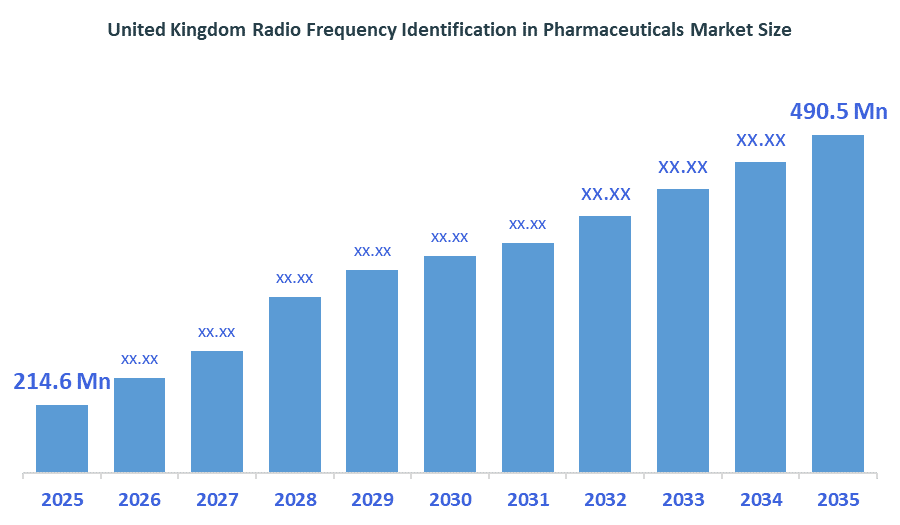
The United Kingdom Radio Frequency Identification in Pharmaceuticals Market size is forecast to grow from approximately USD 214.6 million in 2025 to around USD 490.5million by 2035. According to Decision Advisors, a detailed research report on the radio frequency identification in pharmaceuticals market indicates that the drug tracking and anti-counterfeiting trend dominates the market, accounting for approximately 32-38% of the total share in the United Kingdom. Avery Dennison Corporation leads the market with an estimated 16% United Kingdom market share. The company's annual revenue of approximately USD 8-9 billion is making it one of the most influential forces shaping industry trends and overall market growth.
Market Snapshot
- United Kingdom Radio Frequency Identification in Pharmaceuticals Market size (2025): USD 214.6 Million
- Projected United Kingdom Radio Frequency Identification in Pharmaceuticals Market Size (2035): USD 490.5 Million
- United Kingdom Radio Frequency Identification in Pharmaceuticals Market Compound Annual Growth Rate (CAGR): 8.62%
- Base Year: 2025
- Historical Period: 2021–2024
- Forecast Period: 2026–2035
Market Overview/Introduction
The United Kingdom Radio Frequency Identification in Pharmaceuticals Market refers to all about using cutting-edge tracking and identification technologies to make drugs safer. The system uses radio waves to automatically find and follow pharmaceutical products through all of their stages of production, processing, distribution, and sale. The market is growing quickly because people are worried about fake drugs, there are strict rules that must be followed, and supply chain management needs to be done well. Digital health systems, the Internet of Things (IoT), and blockchain technologies all offer big chances for the future. These technologies make it possible to monitor things in real time and make things clearer. The market expansion and innovation process receives additional momentum from government initiatives that support digital transformation in healthcare and from stricter serialization regulations.]
- The NHS initiative promotes GS1 standards for tracking people, places, and products through AIDC technologies. While it initially focused on barcode-based systems, it also supports RFID as an optional technology, with selective adoption for asset tracking and high-value pharmaceutical applications.
- The Innovative Devices Access Pathway (IDAP) is a £10 million UK government scheme that accelerates the development and NHS adoption of transformative medical technologies. It provides regulatory and clinical
- support through key agencies. While not RFID-specific, it supports advanced tracking and smart medication technologies that improve patient safety and operational efficiency.
Notable Insights: -
- The tags segment dominated the market in 2025 and holds the largest market share, accounting for approximately 44% during the forecast period.
- The drug tracking segment dominated the market in 2025 and holds the largest market share, accounting for approximately 35% during the forecast period.
- The pharmaceutical manufacturers segment dominated the market in 2025 and holds the largest market share, accounting for approximately 41% during the forecast period.
- The compound annual growth rate of the United Kingdom Radio Frequency Identification in Pharmaceuticals Market is 8.62%.
- The market is likely to achieve a valuation of USD 8110.9Million by 2035.
What is the role of technology in grooming the market?
Technology plays a transformative role in shaping the United Kingdom radio frequency identification in pharmaceuticals market by enabling real-time tracking, improved inventory accuracy, and enhanced patient safety. Radio frequency identification in pharmaceutical market systems integrated with IoT platforms allows continuous monitoring of drug movement across the supply chain, reducing losses and ensuring authenticity. Advanced analytics and cloud-based software help pharmaceutical companies optimize logistics, forecast demand, and prevent stockouts. Automation in warehouses and hospitals improves operational efficiency and minimizes human errors. Additionally, blockchain integration enhances data security and traceability, ensuring compliance with regulatory standards. These technological advancements are significantly improving transparency, efficiency, and reliability across the pharmaceutical ecosystem.
Market Drivers
The United Kingdom RFID in the pharmaceuticals market exists because people want to stop counterfeit drugs and protect secure drug distribution. The government requires serialization and traceability, which leads companies to implement RFID technology. The pharmaceutical industry experiences growth because its supply chains become more complex and its need for efficient inventory management systems increases. The system capabilities and adoption process receive improvements through technological advancements, which include IoT integration and cloud-based platforms. The demand for RFID tracking solutions increases as hospitals build new facilities and develop their digital healthcare systems to improve patient safety and operational efficiency.
Restrain
The United Kingdom Radio Frequency Identification in Pharmaceuticals Market faces restraints due to high initial implementation costs and integration challenges with existing legacy systems. Small and medium-sized enterprises may find adoption financially burdensome. Additionally, concerns related to data security, privacy, and standardization hinder widespread deployment. Technical limitations such as signal interference and infrastructure requirements also pose operational challenges.
Study on the Supply, Demand, Distribution, and Market Environment of the United Kingdom Radio Frequency Identification in Pharmaceuticals Market
The United Kingdom Radio Frequency Identification in Pharmaceuticals Market demonstrates a structured ecosystem driven by technological adoption and regulatory compliance. On the supply side, technology providers and manufacturers offer radio frequency identification tags, readers, and software solutions, supported by continuous innovation and R&D investments. Demand is fueled by pharmaceutical companies, hospitals, and logistics providers seeking improved traceability and inventory control. Distribution channels include direct sales, system integrators, and technology partners, ensuring seamless deployment across supply chains. The market environment is influenced by government regulations, healthcare digitalization initiatives, and increasing focus on patient safety, which collectively drive adoption while maintaining strict compliance standards.
Price Analysis and Consumer Behaviour Analysis
Price analysis in the United Kingdom radio frequency identification in pharmaceuticals market is influenced by technology costs, system integration expenses, and regulatory compliance requirements. While initial deployment costs are relatively high, long-term benefits such as reduced losses and improved efficiency justify investments. Pricing varies based on component type, scale of implementation, and customization needs. Consumer behavior is largely driven by organizational requirements rather than individual preferences, with pharmaceutical companies prioritizing compliance, efficiency, and risk reduction. Hospitals and pharmacies increasingly adopt radio frequency identification systems to enhance operational workflows and patient safety. Growing awareness about supply chain transparency and counterfeit prevention is further encouraging adoption across the market.
Market Segmentation
The United Kingdom Radio Frequency Identification in Pharmaceuticals Market Share is classified into component, application, and end user
- The tags segment dominated the market in 2025 and holds the largest market share, accounting for approximately 44% during the forecast period.
Based on the component, the radio frequency identification in pharmaceuticals market is divided into tags, readers, and software. Among these, the tags segment dominated the market in 2025 and holds the largest market share, accounting for approximately 44% during the forecast period. The tags segment is driven by the extensive use of radio frequency identification tags for tracking individual drug units and packages. Their cost-effectiveness, scalability, and compatibility with automated systems make them essential for pharmaceutical supply chains.
- The drug tracking segment dominated the market in 2025 and holds the largest market share, accounting for approximately 35% during the forecast period.
Based on the application, the radio frequency identification in pharmaceuticals market is divided into Drug tracking, inventory management, anti-counterfeiting, and supply chain optimization. Among these, the drug tracking segment dominated the market in 2025 and holds the largest market share, accounting for approximately 35% during the forecast period. The drug tracking segment in the U.K. is attributed to rising concerns over fake drugs and stringent regulatory requirements. Radio frequency identification technology ensures product authenticity and enhances patient safety, driving its widespread adoption.
- The pharmaceutical manufacturers segment dominated the market in 2025 and holds the largest market share, accounting for approximately 41% during the forecast period.
Based on the end user, the radio frequency identification in pharmaceuticals market is divided into pharmaceutical manufacturers, hospitals, pharmacies, and logistics providers. Among these, the pharmaceutical manufacturers segment dominated the market in 2025 and holds the largest market share, accounting for approximately 41% during the forecast period. The pharmaceutical manufacturers segment in the U.K. is driven by their need for large-scale tracking, regulatory compliance, and efficient supply chain management. Adoption of radio frequency identification systems helps manufacturers ensure product integrity and streamline operations.
Recent Development
- In March 2026, pharmaceutical companies increasingly adopted UHF RFID-enabled smart packaging solutions to enable real-time tracking of drugs from manufacturing to dispensing. The shift enhanced supply chain visibility, improved inventory management, and strengthened anti-counterfeiting measures across pharmaceutical distribution networks.
- In March 2026, a UK-based consortium involving GlaxoSmithKline received over £7 million in funding from Innovate UK and the Department of Health and Social Care to advance sustainable pharmaceutical manufacturing and improve supply chain efficiency.
- In January 2025, Avery Dennison announced that it would showcase a specialized RFID-enabled authentication solution for pre-filled syringes at Pharmapack 2025. The solution aimed to enhance traceability, enable unit-level tracking, and improve pharmaceutical supply chain security and patient safety.
Competitive Analysis
The report offers the appropriate analysis of the key organisations/companies involved within the United Kingdom Radio Frequency Identification in Pharmaceuticals Market, along with a comparative evaluation primarily based on their product offering, business overviews, geographic presence, enterprise strategies, segment market share, and SWOT analysis. The report also provides an elaborative analysis focusing on the current news and developments of the companies, which includes product development, innovations, joint ventures, partnerships, mergers & acquisitions, strategic alliances, and others. This allows for the evaluation of the overall competition within the market.
Top Key Companies in the United Kingdom Radio Frequency Identification in Pharmaceuticals Market
- Avery Dennison Corporation
- Zebra Technologies Corporation
- Impinj Inc.
- CCL Industries (Smartrac)
- HID Global Corporation
- Others
Key Target Audience
- Market Players
- Investors
- End-users
- Government Authorities
- Consulting and Research Firm
- Venture capitalists
- Value-Added Resellers (VARs)\\
Market Segment
This study forecasts revenue at the United Kingdom, regional, and country levels from 2020 to 2035. Spherical Insights has segmented the United Kingdom radio frequency identification in pharmaceuticals market based on the below-mentioned segments
United Kingdom Radio Frequency Identification in Pharmaceuticals Market, By Component
- Tags
- Readers
- Software
United Kingdom Radio Frequency Identification in Pharmaceuticals Market, By Application
- Drug Tracking
- Inventory Management
- Anti-Counterfeiting
- Supply Chain Optimization
United Kingdom Radio Frequency Identification in Pharmaceuticals Market, By End User
- Pharmaceutical Manufacturers
- Hospitals
- Pharmacies
- Logistics Providers
Frequently Asked Questions (FAQ)
Q. How is regulatory compliance impacting the United Kingdom RFID in pharmaceuticals market?
A. Regulatory compliance is driving adoption of RFID systems as pharmaceutical companies must ensure drug traceability and authenticity. Serialization requirements and anti-counterfeiting regulations are encouraging companies to invest in advanced tracking technologies, supporting market growth.
Q. What role does RFID play in improving pharmaceutical supply chains?
A. RFID enhances supply chain efficiency by enabling real-time tracking, reducing errors, and improving inventory management. It ensures transparency and minimizes losses, leading to better operational performance and patient safety.
Q. How is digital transformation influencing market growth?
A. Digital transformation, including IoT and cloud integration, is expanding RFID capabilities, enabling data-driven decision-making and automation. This is significantly improving efficiency and driving widespread adoption across pharmaceutical operations.
Q. What challenges affect RFID adoption in the pharmaceutical sector?
A. High implementation costs, integration complexities, and data security concerns are major challenges. Additionally, technical limitations and lack of standardization can slow down adoption, particularly among smaller organizations.
Check Licence
Choose the plan that fits you best: Single User, Multi-User, or Enterprise solutions tailored for your needs.
We Have You Covered
- 24/7 Analyst Support
- Clients Across the Globe
- Tailored Insights
- Technology Tracking
- Competitive Intelligence
- Custom Research
- Syndicated Market Studies
- Market Overview
- Market Segmentation
- Growth Drivers
- Market Opportunities
- Regulatory Insights
- Innovation & Sustainability
Report Details
| Scope | Country |
| Pages | 210 |
| Delivery | PDF & Excel via Email |
| Language | English |
| Release | Apr 2026 |
| Access | Download from this page |