
United Kingdom Stills Disease Treatment Market
 |
Author:
David J
|
Pages:
210
|
Author:
David J
|
Pages:
210
United Kingdom Stills disease treatment market Size, Share, By Drug Type (Non-Steroidal Anti-Inflammatory Drugs, Corticosteroids, Disease-Modifying Anti-Rheumatic Drugs, Biologics), By Route of Administration (Oral, Injectable), and By End Users (Hospitals, Specialty rheumatology clinics, Home Care), Analysis and Forecast 2026 - 2035
CAGR
7.65%
REVENUE 2025
USD Million 606.43
FORECAST 2035
USD Million 1267.0
REPORT COVERAGE
Country
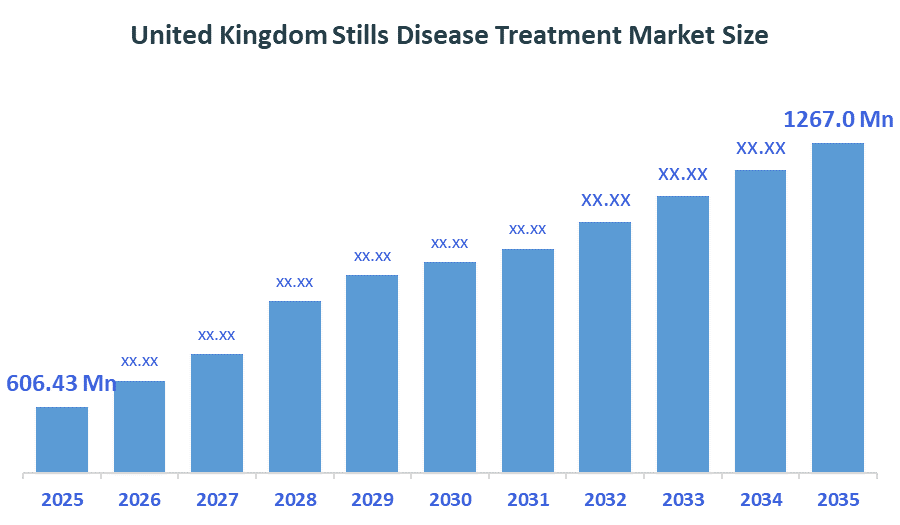
The United Kingdom stills disease treatment market size is forecast to grow from approximately USD 606.43 Million in 2025 to around USD 1267.0Million by 2035. According to Decision Advisors, a detailed research report on the stills disease treatment market indicates that the biologics adoption trend dominates the market, accounting for approximately 50% of the total share in the United Kingdom. F. Hoffmann-La Roche Ltd leads the market with an estimated 15-20% United Kingdom market share. The company's annual revenue of approximately USD 74 billion is making it one of the most influential forces shaping industry trends and overall market growth.
Market Snapshot
- United Kingdom Stills Disease Treatment Market Size (2025): USD 606.43 Million
- Projected United Kingdom Stills Disease Treatment Market Size (2035): USD 1267.0 Million
- United Kingdom Stills Disease Treatment Market Compound Annual Growth Rate (CAGR): 7.65%
- Base Year: 2025
- Historical Period: 2021–2024
- Forecast Period: 2026–2035
Market Overview/Introduction
The United Kingdom Still’s disease treatment market refers to the healthcare sector focused on diagnosing, managing, and treating Still’s disease within the United Kingdom, a rare inflammatory autoimmune disorder. Still’s disease treatment involves the use of anti-inflammatory drugs, corticosteroids, and advanced biologics such as IL-1 and IL-6 inhibitors to control systemic inflammation and prevent complications. Future opportunities include expanding biologic therapies, personalized medicine, and AI-driven drug development to improve treatment outcomes. Market growth is driven by rising disease awareness, improved diagnostic capabilities, increasing adoption of targeted biologics, and strong support from the National Health Service. Additionally, ongoing clinical research and innovation in rare disease therapeutics are expected to further accelerate market expansion.
- The United Kingdom Rare Diseases Framework improves diagnosis, treatment access, and care coordination for rare conditions like Still’s disease. It promotes early diagnosis through genomics, supports specialist care, and strengthens collaboration across NHS systems, ensuring better access to advanced biologics and improving long-term patient outcomes.
- The NHS Genomic Medicine Service supports the precision diagnosis of autoimmune and rare inflammatory diseases like Still’s disease. It enables genomic testing, improving identification of disease subtypes and guiding biologic treatment selection, ultimately supporting personalized therapy decisions within the NHS system.
Notable Insights: -
- The biologics segment dominated the market in 2025 and holds the largest market share, accounting for approximately 50% during the forecast period.
- The injectable segment dominated the market in 2025 and holds the largest market share, accounting for approximately 68% during the forecast period.
- The hospitals segment dominated the market in 2025 and holds the largest market share, accounting for approximately 74% during the forecast period.
- The compound annual growth rate of the United Kingdom Stills Disease Treatment Market is 7.65%.
- The market is likely to achieve a valuation of USD 1267.0 Million by 2035.
What is the role of technology in grooming the market?
Technology plays a crucial role in shaping the United Kingdom Still’s disease treatment market by improving diagnosis, treatment precision, and patient monitoring. Advanced imaging techniques and biomarker-based diagnostics enable earlier and more accurate detection of this rare autoimmune condition. The use of biologic engineering and recombinant DNA technology has led to the development of targeted therapies such as IL-1 and IL-6 inhibitors, enhancing treatment effectiveness. Digital health platforms and electronic health records supported by the National Health Service improve patient tracking and care coordination. Additionally, AI-driven drug discovery accelerates innovation and reduces development time for new therapies.
Market Drivers
The United Kingdom Stills Disease Treatment Market is primarily fuelled by increasing awareness and improved diagnosis of rare autoimmune disorders, leading to earlier and more accurate identification of patients. The growing adoption of targeted biologic therapies, particularly IL-1 and IL-6 inhibitors, has significantly enhanced treatment outcomes and boosted demand. Supportive reimbursement policies from the National Health Service further encourage patient access to advanced treatments. Additionally, ongoing research and development activities, rising healthcare expenditure, and advancements in precision medicine are accelerating innovation. The presence of established pharmaceutical companies and expanding clinical trials also contributes to sustained market growth.
Restrain
The United Kingdom stills disease treatment market faces restraints due to high cost of biologic therapies, limiting widespread access despite reimbursement support from the National Health Service. Additionally, limited patient population, delayed diagnosis, and stringent regulatory approval processes hinder rapid market expansion and treatment adoption.
Study on the Supply, Demand, Distribution, and Market Environment of the United Kingdom Stills Disease Treatment Market
The study of supply, demand, distribution, and market environment in the United Kingdom Still’s disease treatment market reflects a specialized rare disease ecosystem. Supply is primarily driven by global pharmaceutical companies manufacturing targeted biologic therapies and anti-inflammatory drugs. Demand is gradually increasing due to improved awareness, earlier diagnosis, and growing adoption of advanced biologics for disease management. Distribution is largely hospital-centric, supported by the National Health Service, ensuring controlled access to high-cost biologic treatments. The market environment is shaped by strict regulatory frameworks, centralized NHS procurement systems, reimbursement policies, and continuous innovation in rare autoimmune disease therapies.
Price Analysis and Consumer Behaviour Analysis
Price analysis in the United Kingdom Still’s disease treatment market highlights the premium cost of biologic therapies, particularly IL-1 and IL-6 inhibitors, due to their complex development and manufacturing processes. However, National Health Service reimbursement policies help regulate pricing and improve patient access to these advanced treatments. Consumer behaviour is primarily physician-driven, with treatment decisions guided by rheumatology specialists. Patients increasingly prefer targeted biologic therapies due to their effectiveness in controlling inflammation and reducing disease complications. Additionally, there is growing emphasis on long-term disease management, adherence to therapy, and preference for treatments with improved safety profiles.
Market Segmentation
The United Kingdom stills disease treatment market share is classified into drug type, route of administration, and end user.
- The biologics segment dominated the market in 2025 and holds the largest market share, accounting for approximately 50% during the forecast period.
Based on the drug type, the stills disease treatment market is divided into non-steroidal anti-inflammatory drugs, corticosteroids, disease-modifying anti-rheumatic drugs, and biologics. Among these, the biologics segment dominated the market in 2025 and holds the largest market share, accounting for approximately 50% during the forecast period. The biologics segment is driven by strong efficacy in targeting IL-1 and IL-6 inflammatory pathways. Drugs like anakinra and tocilizumab are widely used in refractory cases. NHS support for advanced therapies and improved diagnosis of rare autoimmune conditions further accelerates biologics adoption.
- The injectable segment dominated the market in 2025 and holds the largest market share, accounting for approximately 68% during the forecast period.
Based on the route of administration, the stills disease treatment market is divided into Oral and Injectable. Among these, the injectable segment dominated the market in 2025 and holds the largest market share, accounting for approximately 68% during the forecast period. The injectable segment in the U.K. market is growing because biologics used in Still’s disease require subcutaneous or intravenous delivery. These drugs offer faster and more controlled immune response modulation compared to oral drugs. Hospital-based administration under specialist supervision also increases preference for injectables in acute and chronic disease management.
- The hospitals segment dominated the market in 2025 and holds the largest market share, accounting for approximately 74% during the forecast period.
Based on the end user, the stills disease treatment market is divided into hospitals, specialty rheumatology clinics, and home care. Among these, the hospitals segment dominated the market in 2025 and holds the largest market share, accounting for approximately 74% during the forecast period. The hospitals segment in the U.K. is driven by centralized treatment of rare diseases like Still’s disease in the UK. Specialist rheumatology departments manage diagnosis, biologic infusion, and long-term monitoring. NHS hospital infrastructure and availability of advanced biologic therapies make hospitals the primary care setting compared to clinics or homecare services.
Recent Development
- In March 2026, Regeneron Pharmaceuticals Inc. announced progress in clinical research related to cytokine-targeting therapies, strengthening its position in rare inflammatory disease treatment and supporting innovation in biologic drug development.
- In May 2025, Novartis AG expanded its immunology research pipeline, focusing on advanced biologic therapies targeting inflammatory pathways relevant to rare autoimmune diseases, including Still’s disease.
Competitive Analysis
The report offers the appropriate analysis of the key organisations/companies involved within the United Kingdom stills disease treatment market, along with a comparative evaluation primarily based on their product offering, business overviews, geographic presence, enterprise strategies, segment market share, and SWOT analysis. The report also provides an elaborative analysis focusing on the current news and developments of the companies, which includes product development, innovations, joint ventures, partnerships, mergers & acquisitions, strategic alliances, and others. This allows for the evaluation of the overall competition within the market.
Top Key Companies in the United Kingdom Stills Disease Treatment Market
- Novartis AG
- Pfizer Inc.
- F. Hoffmann-La Roche Ltd
- Swedish Orphan Biovitrum AB
- Regeneron Pharmaceuticals Inc.
- Others
Key Target Audience
- Market Players
- Investors
- End-users
- Government Authorities
- Consulting and Research Firm
- Venture capitalists
- Value-Added Resellers (VARs)
Market Segment
This study forecasts revenue at the United Kingdom, regional, and country levels from 2020 to 2035. Decision Advisor has segmented the United Kingdom stills disease treatment market based on the below-mentioned segments
United Kingdom Stills Disease Treatment Market, By Drug Type
- Non-Steroidal Anti-Inflammatory Drugs
- Corticosteroids
- Disease-Modifying Anti-Rheumatic Drugs
- Biologics
United Kingdom Stills Disease Treatment Market, By Route of Administration
- Oral
- Injectable
United Kingdom Stills Disease Treatment Market, By End User
- Hospitals
- Specialty rheumatology clinics
- Home Care
Frequently Asked Questions (FAQ)
Q. How does NHS procurement influence the Still’s disease treatment market in the UK?
A. The National Health Service plays a crucial role through centralized procurement and reimbursement frameworks. It negotiates pricing for high-cost biologics, ensuring wider patient access while maintaining cost efficiency. This system supports equitable distribution of advanced therapies across hospitals and strengthens overall market stability.
Q. Why are biologic therapies important in the treatment of Still’s disease?
A. Biologic therapies target specific inflammatory pathways such as IL-1 and IL-6, which are central to Still’s disease progression. These treatments are highly effective in patients who do not respond to conventional therapies, improving disease control, reducing complications, and enhancing quality of life.
Q. What are the key challenges in diagnosing Still’s disease in the UK?
A. Still’s disease is a rare and complex condition with symptoms that overlap with other inflammatory disorders, often leading to delayed diagnosis. Limited awareness and lack of specific diagnostic markers can further complicate early detection, although advances in genomic medicine and biomarker research are improving diagnostic accuracy.
Q. How is personalized medicine influencing the Still’s disease treatment market?
A. Personalized medicine is enabling more targeted treatment approaches by using patient-specific clinical and genetic information. This helps clinicians select the most effective biologic therapy, optimize treatment outcomes, and reduce trial-and-error prescribing, thereby improving overall patient care within the NHS system.
Check Licence
Choose the plan that fits you best: Single User, Multi-User, or Enterprise solutions tailored for your needs.
We Have You Covered
- 24/7 Analyst Support
- Clients Across the Globe
- Tailored Insights
- Technology Tracking
- Competitive Intelligence
- Custom Research
- Syndicated Market Studies
- Market Overview
- Market Segmentation
- Growth Drivers
- Market Opportunities
- Regulatory Insights
- Innovation & Sustainability
Report Details
| Scope | Country |
| Pages | 210 |
| Delivery | PDF & Excel via Email |
| Language | English |
| Release | Apr 2026 |
| Access | Download from this page |