
United Kingdom Womens Health Therapeutics Market
 |
Author:
David J
|
Pages:
240
|
Author:
David J
|
Pages:
240
United Kingdom Womens Health Therapeutics Market Size, Share, By Drug Class (Hormonal Therapies, Non-hormonal Therapies, Biologics), By Indication (Menopause, Endometriosis, Polycystic Ovary Syndrome (PCOS), Osteoporosis, Uterine Fibroids, Contraception, Infertility), By End User (Hospitals, Clinics, Specialty Centers, Homecare Settings), Analysis and Forecast 2026-2035
CAGR
4.61%
REVENUE 2025
USD Million 2430.1
FORECAST 2035
USD Million 3815.2
REPORT COVERAGE
country
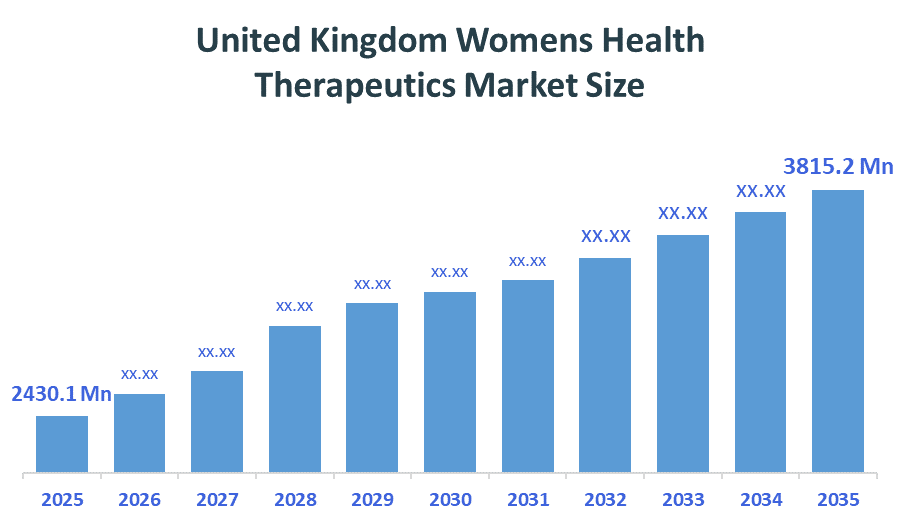
The United Kingdom Womens health therapeutics market size is forecast to grow from approximately USD 2,430.1 million in 2025 to around USD 3815.2 million by 2035. According to Decision Advisors, a detailed research report on the womens health therapeutics market indicates that the contraceptive therapies trend dominates the market, accounting for approximately 29.8-35% of the total share in the United Kingdom. Bayer AG leads the market with an estimated 15% United Kingdom market share. The company's annual revenue of approximately USD 50-52 billion is making it one of the most influential forces shaping industry trends and overall market growth.
Market Snapshot
- United Kingdom Womens Health Therapeutics Market size (2025): USD 2,430.1 Million
- Projected United Kingdom Womens Health Therapeutics Market Size (2035): USD 3815.2 Million
- United Kingdom Womens Health Therapeutics Market Compound Annual Growth Rate (CAGR): 4.61%
- Base Year: 2025
- Historical Period: 2021–2024
- Forecast Period: 2026–2035
Market Overview/Introduction
The United Kingdom Women’s Health Therapeutics Market develops, produces, and sells medical products that treat health issues that specifically affect women in the United Kingdom. Women’s Health Therapeutics includes all medical products that treat diseases that only or mainly affect women through their pharmaceutical and biological, and hormone therapy systems. The market is experiencing significant growth because people now understand gender-based health needs better, there are more chronic gynecological disorders, and the government provides different support programs. The future will bring new business potential through customized medicine and digital health solutions and new advanced biologics, which will address existing medical deficiencies. The research funding expansion, together with better healthcare access, is driving both market growth and ongoing innovation.
- The 10-year government strategy (launched in 2022 and being renewed) aimed at improving women’s health outcomes, addressing inequalities, and enhancing access to treatments across areas such as menopause, fertility, and reproductive health. It focuses on research expansion, better care pathways, and patient-centered healthcare delivery.
- The government is investing in local women’s health hubs across Integrated Care Systems (ICSs) to improve access to diagnostics, contraception, menopause care, and other services. These hubs integrate primary and specialist care, including virtual consultations.
- The UK government has enhanced the NHS Health Check program by including menopause-related assessments, enabling early identification and treatment of hormonal and age-related conditions affecting women.
Notable Insights: -
- The hormonal therapies segment dominated the market in 2025 and holds the largest market share, accounting for approximately 48% during the forecast period.
- The contraception segment dominated the market in 2025 and holds the largest market share, accounting for approximately 34% during the forecast period.
- The hospitals segment dominated the market in 2025 and holds the largest market share, accounting for approximately 46% during the forecast period.
- The compound annual growth rate of the United Kingdom Womens Health Therapeutics Market is 4.61%.
- The market is likely to achieve a valuation of USD 3815.2 Million by 2035.
What is the role of technology in grooming the market?
Technology plays a transformative role in shaping the United Kingdom women’s health therapeutics market by enhancing diagnosis, treatment, and patient engagement. Digital health platforms and telemedicine services integrated with the National Health Service enable remote consultations, improving access to care, especially for sensitive conditions like reproductive and mental health. Advanced data analytics and AI-driven tools support early detection of diseases such as breast cancer, endometriosis, and hormonal disorders, leading to timely interventions. Innovations in drug development, including biologics and personalized medicine, are improving treatment efficacy and reducing side effects. Additionally, wearable devices and mobile health apps are empowering women to monitor health parameters, boosting preventive care. Electronic health records and e-prescriptions further streamline treatment delivery, enhancing efficiency and overall healthcare outcomes.
Market Drivers
The United Kingdom women’s health therapeutics market exists because more people know about female health conditions, which include menopause, endometriosis, and fertility disorders. The National Health Service, together with women’s health strategies, receives government support to make essential treatments more available to patients. The rising cases of chronic conditions, which include osteoporosis and hormonal imbalances, create a need for prolonged medical treatment. The market experiences growth through advancements in drug development, which include hormone therapies and biologics. Digital health platforms, together with telemedicine services, create better patient engagement and access, while healthcare expenditure and research investments drive market innovation and expansion.
Restrain
The United Kingdom women’s health therapeutics market faces restraints due to strict pricing and reimbursement regulations under the National Health Service, limiting profitability for manufacturers. Additionally, high development costs, regulatory hurdles, and periodic drug shortages hinder timely access, while social stigma and under diagnosis of certain conditions continue to restrict overall treatment adoption.
Study on the Supply, Demand, Distribution, and Market Environment of the United Kingdom Women’s Health Therapeutics Market
The United Kingdom women’s health therapeutics market demonstrates a structured ecosystem shaped by public healthcare dominance and evolving demand dynamics. On the supply side, pharmaceutical companies ensure steady availability of hormonal therapies, contraceptives, and fertility drugs through strong R&D pipelines and regulatory approvals, although periodic medicine shortages and limited manufacturing capacity create constraints. Demand is driven by a large female population, rising prevalence of conditions such as menopause, PCOS, and endometriosis, and increasing awareness leading to early diagnosis and treatment adoption. Distribution is primarily managed through hospitals, clinics, retail pharmacies, and rapidly expanding online pharmacies integrated with digital health services. The market environment is heavily influenced by NHS reimbursement policies, government health strategies, and pricing regulations, which ensure accessibility but may limit rapid adoption of high-cost innovative therapies.
Price Analysis and Consumer Behaviour Analysis
Price analysis in the United Kingdom women’s health therapeutics market is largely influenced by the publicly funded healthcare system, where pricing is regulated and controlled through reimbursement frameworks and cost-effectiveness assessments. This results in moderate and standardized drug pricing, limiting excessive price fluctuations while ensuring accessibility. However, high R&D and regulatory compliance costs keep certain advanced therapies relatively expensive. Consumer behavior is shaped by physician recommendations, clinical guidelines, and NHS coverage rather than brand-driven purchasing. Women increasingly prefer convenient, discreet, and digital access to treatments, including online pharmacies and telehealth services. Additionally, rising awareness of menopause, fertility, and reproductive health is driving proactive healthcare-seeking behavior, leading to consistent demand for prescription-based and preventive therapeutics across different age groups.
Market Segmentation
The United Kingdom Womens Health Therapeutics Market Share is classified into drug class, indication, and end user
The hormonal therapies segment dominated the market in 2025 and holds the largest market share, accounting for approximately 48% during the forecast period.
Based on the drug class, the womens health therapeutics market is divided into hormonal therapies, non-hormonal therapies, and biologics. Among these, the hormonal therapies segment dominated the market in 2025 and holds the largest market share, accounting for approximately 48% during the forecast period. The hormonal therapies segment is driven by their widespread use in managing menopause, contraception, and hormonal imbalance disorders. High prescription rates, strong clinical efficacy, and broad availability through the National Health Service support their adoption. Additionally, continuous advancements in hormone replacement therapies and growing awareness among women further drive this segment’s leading market share.
- The contraception segment dominated the market in 2025 and holds the largest market share, accounting for approximately 34% during the forecast period.
Based on the indication, the womens health therapeutics market is divided into menopause, endometriosis, polycystic ovary syndrome (PCOS), osteoporosis, uterine fibroids, contraception, and infertility. Among these, the contraception segment dominated the market in 2025 and holds the largest market share, accounting for approximately 34% during the forecast period. The contraception segment in the U.K. is attributed to strong government initiatives promoting reproductive health and family planning. Easy accessibility, subsidized or free contraceptive services under the National Health Service, and increasing awareness about birth control options contribute significantly. Moreover, the availability of diverse contraceptive methods ensures consistent demand, making it the dominant segment in the market.
- The hospitals segment dominated the market in 2025 and holds the largest market share, accounting for approximately 46% during the forecast period.
Based on the end user, the womens health therapeutics market is divided into hospitals, clinics, specialty centers, and homecare settings. Among these, the hospitals segment dominated the market in 2025 and holds the largest market share, accounting for approximately 46% during the forecast period. The hospitals segment in the U.K. is driven by the market as they serve as primary centers for diagnosis, treatment, and management of complex women’s health conditions. The presence of advanced healthcare infrastructure, skilled professionals, and access to specialized therapies within hospital settings drives patient preference. Support from the National Health Service further strengthens hospital-based treatment adoption across the UK.
Recent Development
- In December 2025, the third cohort of the Innovate UK Biomedical Catalyst Accelerating FemTech programme was launched, selecting 10 innovative women’s health solutions. The initiative, delivered by the Health Innovation Network South London in partnership with DigitalHealth.London aimed to advance technologies improving women’s health outcomes across the United Kingdom.
- In November 2025, Innovate UK supported the launch of the third cohort of the Biomedical Catalyst Femtech Accelerator, strengthening the UK women’s health innovation ecosystem. The programme, delivered in collaboration with the Health Innovation Network South London and Digital Health. London provided structured funding, mentorship, and expert-led support to selected femtech innovators aimed at improving women’s health outcomes.
- In February 2025, Adalvo, in collaboration with Wyntra, launched its first women’s health treatment in the United Kingdom, targeting endometriosis. The therapy aimed to improve access to care for a condition affecting nearly 10% of women of reproductive age. This launch marked a significant milestone in expanding women’s health portfolios and enhancing treatment availability in the UK market.
- In January 2024, MSD (Merck & Co.) strengthened its ongoing collaborative working approach with the National Health Service (NHS) in the United Kingdom by supporting multiple patient-centered healthcare projects across oncology and other specialty areas. The company worked in partnership with NHS trusts to improve cancer care pathways, enhance early diagnosis, and optimize treatment delivery through joint working models.
Competitive Analysis
The report offers the appropriate analysis of the key organisations/companies involved within the United Kingdom women’s health therapeutics market, along with a comparative evaluation primarily based on their product offering, business overviews, geographic presence, enterprise strategies, segment market share, and SWOT analysis. The report also provides an elaborative analysis focusing on the current news and developments of the companies, which includes product development, innovations, joint ventures, partnerships, mergers & acquisitions, strategic alliances, and others. This allows for the evaluation of the overall competition within the market.
Top Key Companies in the United Kingdom Women’s Health Therapeutics Market
- Pfizer Inc.
- Bayer AG
- AbbVie Inc.
- GlaxoSmithKline plc
- Theramex
- Others
Key Target Audience
- Market Players
- Investors
- End-users
- Government Authorities
- Consulting and Research Firm
- Venture capitalists
- Value-Added Resellers (VARs)
Market Segment
This study forecasts revenue at the United Kingdom, regional, and country levels from 2020 to 2035. Spherical Insights has segmented the United Kingdom women’s health therapeutics market based on the below-mentioned segments
United Kingdom Women’s Health Therapeutics Market, By Drug Class
- Hormonal Therapies
- Non-hormonal Therapies
- Biologics
United Kingdom Women’s Health Therapeutics Market, By Indication
- Menopause
- Endometriosis
- Polycystic Ovary Syndrome (PCOS)
- Osteoporosis
- Uterine Fibroids
- Contraception
- Infertility
United Kingdom Women’s Health Therapeutics Market, By End User
- Hospitals
- Clinics
- Specialty Centers
- Homecare Settings
Frequently Asked Questions (FAQ)
Q. How is the aging female population impacting the United Kingdom women’s health therapeutics market?
A. The aging female population in the United Kingdom is significantly increasing demand for therapies related to menopause, osteoporosis, and hormonal disorders. As life expectancy rises, more women require long-term treatment and preventive care, driving sustained demand for hormone replacement therapies and bone health medications, thereby supporting overall market growth.
Q. What role do regulatory bodies play in shaping the United Kingdom women’s health therapeutics market?
A. Regulatory bodies such as the Medicines and Healthcare products Regulatory Agency ensure the safety, quality, and efficacy of therapeutics. Their strict approval processes and compliance requirements maintain high healthcare standards but can also extend product launch timelines, influencing innovation speed and market entry strategies for pharmaceutical companies.
Q. How is increasing focus on fertility treatments influencing market dynamics?
A. Rising infertility rates and delayed pregnancies are boosting demand for fertility treatments in the United Kingdom. Increased awareness, improved assisted reproductive technologies, and broader access to fertility services are encouraging more women to seek treatment, thereby expanding the infertility therapeutics segment within the overall market.
Q. What impact does digital pharmacy growth have on the women’s health therapeutics market?
A. The expansion of online pharmacies and e-prescription services is improving accessibility and convenience for women seeking treatments. Digital platforms allow discreet purchasing and remote consultations, especially for sensitive conditions, thereby enhancing treatment adherence and widening the reach of therapeutics across urban and rural populations.
Check Licence
Choose the plan that fits you best: Single User, Multi-User, or Enterprise solutions tailored for your needs.
We Have You Covered
- 24/7 Analyst Support
- Clients Across the Globe
- Tailored Insights
- Technology Tracking
- Competitive Intelligence
- Custom Research
- Syndicated Market Studies
- Market Overview
- Market Segmentation
- Growth Drivers
- Market Opportunities
- Regulatory Insights
- Innovation & Sustainability
Report Details
| Scope | country |
| Pages | 240 |
| Delivery | PDF & Excel via Email |
| Language | English |
| Release | Apr 2026 |
| Access | Download from this page |