
United States E-House Market
 |
Author:
Achal E
|
Pages:
210
|
Author:
Achal E
|
Pages:
210
United States E House Market Size, Share, By Type (Mobile E Houses, Semi Mobile E Houses, and Fixed E Houses), By Component (Switchgear, Transformers, UPS Systems, Control Panels, Busway Systems, HVAC Systems, and Other Electrical Components), By Application (Oil and Gas, Mining, Power Utilities, Transportation, Renewable Energy, and Other Industrial Applications), Analysis and Forecast 2026-2035
CAGR
6.24%
REVENUE 2025
USD Million 532.4
FORECAST 2035
USD Million 975.23
REPORT COVERAGE
country
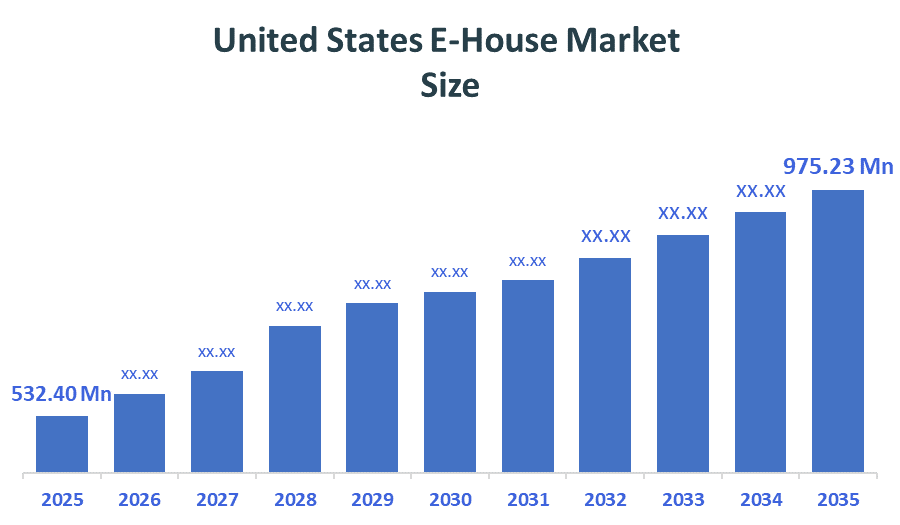
The United States E-House Market Size is projected to grow from USD 532.40 Million in 2025 and is expected to reach approximately USD 975.23 Million by 2035, expanding at a CAGR of 6.24%. According to Decision Advisors, analysis of the US E-House market shows that the rising demand for integrated power solutions across the oil and gas, mining, and renewable energy sectors is emerging as a dominant trend. Key industry players, including global leaders like ABB, are driving innovation in mobile and fixed E-house configurations, with an annual revenue reported to be ?13,203 crores, making them essential contributors to the modernisation of the US electrical infrastructure and industrial application market.
Market Snapshot
- US E-House Market Size (2025): USD 532.40 Million
- US E-House Projected Market Size (2035): USD 975.23 Million
- US E-House Compound Annual Growth Rate (CAGR): 6.24%
- Base Year: 2025
- Historical Period: 2021-2024
- Forecast Period: 2026-2035
Market Overview/Introduction
The United States E-House market involves the production and installation of integrated modular power substations used in heavy industrial and utility sectors. These prefabricated units house essential switchgear and control systems, ensuring compliance with strict safety and operational standards. E-Houses are in high demand because they protect expensive downstream components like transformers and drives from environmental hazards while reducing on-site installation risks. The market includes various modular designs and value-added systems featuring intelligent climate control and power management software. Current trends focus on technological advancements such as fire suppression and thermal insulation for sensitive hardware. Modular power solutions have become especially popular in the renewable energy sector for rapid deployment in remote locations. The traditional method of on-site electrical room construction has evolved into factory-tested systems that ensure immediate reliability and faster project completion across the United States.
- In 2025, demand for generation step-up transformers in the United States increased by over 270% compared to 2019 levels, pushing utilities to adopt prefabricated e-house solutions to reduce installation time and manage supply shortages.
- Between 2025 and 2030, US grid investment is expected to rise by approximately 23%, driven by increasing electricity demand from data centres and electrification, directly supporting the expansion of e-house-based substations.
Notable Insights: -
- By type, the mobile e-houses segment leads the market with over 50% share, driven by high flexibility and fast deployment across industrial and energy projects.
- By component, switchgear dominates due to its critical role in power control and protection within modular substations.
- The US e-house market is projected to grow at around 6% CAGR through 2035, reaching nearly USD 975 million, driven by demand for modular and rapid power infrastructure solutions.
What is the Role of Technology in Grooming the Market?
One of the main reasons behind the complexity in the USA’s E-House market lies in the combination of state-of-the-art precision engineering, together with the Internet of Things-based monitoring systems. The main tendency consists in using the latest innovations like smart modular substations, which offer maximum operational safety thanks to automation and advanced digital controls. The latest innovations involve designing the structures according to 3D modelling, along with using special heat-proof sealant, providing optimal climate conditions inside the substation. The efficiency of output is ensured by using intelligent switchgear combined with power quality monitoring.
Market Drivers
The factors that would facilitate the expansion of the E-House market in the U.S. consist of the upgrading of the electrical grid system of the country and the change towards energy-efficient infrastructure. The reason for this is the increasing demand for quickly installed power solutions because of the quick expansion of the renewable energy industry and the data centres. Since the high-tech sector has some unique needs for power stability for the server farms and energy sources, the demand for premium quality modules will be constant. Moreover, the advanced R&D of the country enables local manufacturers to upgrade ordinary modules into highly efficient smart power houses.
Restraints
Though technology plays a significant role, some challenges arise as a result of the advent of decentralised energy sources and fast-paced compact power modules, which are extensively utilised in light industrial processes. One such challenge could be the increasing intricacy and expenditure involved in obtaining electrical certification and compliance with emerging regulations for prefabricated buildings.
Supply, Demand, Distribution, and Market Environment
In the United States, the E-House is considered a mature industrial good that relies heavily on specific engineering considerations. The components used to manufacture the goods come from companies that deal with high-grade steel and electrical equipment. Manufacturing of the goods normally occurs in industrial centres located in the Midwestern and Southern states of the nation. On the other hand, the demand for the good remains consistent, mainly driven by the utility, mining, and petroleum sectors.
Price Analysis and Consumer Behaviour
Price analysis demonstrates a clear hierarchy where basic modular enclosures have standard pricing while highly specialised units featuring advanced cooling and automated power management command premium rates. Despite the higher cost of these advanced systems compared to traditional on-site construction, buyers view them as strategic assets rather than simple expenses. Purchasing behaviour in the US shows that industrial operators prioritise certifications, durability, and energy-saving capabilities. Consumers increasingly prefer systems that offer high energy efficiency and integrated wireless communication for seamless building management system connectivity.
Market Segmentation
The US E-House market is categorised by type, component, voltage level, and application.
The Fixed E-Houses segment dominated the market in 2025 and is projected to grow at a steady CAGR of approximately 6.0% during the forecast period.
Based on the type, the E-House market is divided into Mobile E-Houses, Semi-Mobile E-Houses, and Fixed E-Houses. Among these, the fixed E-Houses segment dominated the market in 2025 and is projected to grow at a steady CAGR of approximately 6.0% during the forecast period. Such domination is related to the necessity of having permanent centres for power distribution that guarantee the highest level of protection for the delicate electronic components. Such structures have a lot of demands on the American market, as they can be used to fulfil the needs of the corporations dealing with massive power loads. The innovations in the field of modular engineering and efficient heat management have been promptly implemented in the US plants as they comply with the required IEEE/NEMA specifications.
The Switchgear and control panels segment dominated the market in 2025 and is projected to grow at a steady CAGR of approximately 5.9% during the forecast period.
Based on the component, the E-House market is divided into Switchgear, Transformers, UPS Systems, Control Panels, Busway Systems, HVAC Systems, and Other Electrical Components. Among these, the switchgear and control panels segment dominated the market in 2025 and is projected to grow at a steady CAGR of approximately 5.9% during the forecast period. This form of domination relates to the critical importance of protection of the circuit and its centralised control using the modules. The modules are in great demand in the American premium power market since they offer the necessary features that make it possible to manage electricity effectively. This has made it possible for advanced technological features such as digital twinning to be used in the components.
The Power Utilities application segment accounted for the largest share in 2025 and is anticipated to grow at a significant CAGR of approximately 6.8% during the forecast period.
Based on the application, the E-House market is divided into Oil and Gas, Mining, Power Utilities, Transportation, Renewable Energy, and Other Industrial Applications. Among these, the power utilities application segment accounted for the largest share in 2025 and is anticipated to grow at a significant CAGR of approximately 6.8% during the forecast period. The introduction of E-House during the modernization and distribution process of the electrical grid becomes necessary, since it would be vital to have a system without any complex or costly installation processes in terms of utilities; after considering the strict safety and reliability requirements of the nation’s electrical grid in addition to the increasing demand for technology in smart cities. One of the causes of the growing opportunities in the market will be the growth of the renewable energy sector in the United States, together with the implementation of prefabricated power systems.
Recent Developments
- In early 2026, US utilities reported that electricity demand from data centres could contribute nearly 50% of total power demand growth by 2030, accelerating investments in modular substations and prefabricated e-house solutions for faster grid expansion.
- In December 2025, major grid equipment manufacturers, including Hitachi Energy and Siemens, announced combined investments exceeding USD 1 billion in US-based electrical infrastructure facilities to address rising demand for transformers and modular substations, directly supporting e-house deployment.
- In 2025, the US electric house market was valued at around USD 532.40 million and is projected to reach approximately USD 975.23 million by 2035, driven by increasing adoption in utilities, oil and gas, and renewable energy projects requiring rapid and scalable power infrastructure.
Competitive Analysis
The report offers the appropriate analysis of the key organisations/companies involved within US E-house market, along with a comparative evaluation primarily based on their product offering, business overviews, geographic presence, enterprise strategies, segment market share, and SWOT analysis. The report also provides an elaborate analysis focusing on the current news and developments of the companies, which includes product development, innovations, joint ventures, partnerships, mergers & acquisitions, strategic alliances, and others. This allows for the evaluation of the overall competition within the market.
Top Key Companies in the US E-House Market
- ABB Ltd.
- Schneider Electric SE
- Siemens AG
- Eaton Corporation plc
- General Electric (GE)
- Powell Industries, Inc.
- Emerson Electric Co.
- AZZ Inc.
- WEG S.A.
- Rittal GmbH and Co. KG
- Vertiv Holdings Co.
- Delta Star, Inc.
- Others
Key Target Audience
- Market Players
- Investors
- End-users
- Government Authorities
- Consulting and Research Firm
- Venture capitalists
- Value-Added Resellers (VARs)
Market Segmentation
This study forecasts revenue at the national level from 2021 to 2035. The report segmented the US E-House Market based on the following segments:
US E-House Market, By Type
- Fixed E-Houses
- Mobile E-Houses
- Semi-Mobile E-Houses
US E-House Market, By Component
- Switchgear
- Transformers
- UPS Systems
- Control Panels
- Busway Systems
- HVAC Systems
- Other Electrical Components
US E-House Market, By Application
- Power Utilities
- Oil and Gas
- Mining
- Renewable Energy
- Transportation
- Other Industrial Applications
Frequently Asked Questions (FAQ)
How is the demand for integrated power solutions driving the US E-House market?
The emphasis on reducing on site construction time and the prevention of installation errors serves as an adequate source of motivation to drive the industry forward. The need for E-Houses due to their ability to provide a factory tested and controlled environment for sensitive electrical equipment plays a crucial role in enhancing the importance of modular infrastructure.
Why is the United States a leading market for E-House technology?
The dominance of the US lies in its excellence in advanced industrial engineering and strict safety environments, which has been made possible due to the presence of large energy and data center clusters in regions like Texas and Virginia. This has been coupled with the focus on producing high grade prefabricated units, together with the fact that the US is well known for its rigorous adherence to IEEE and NEMA standards.
What is the role of smart monitoring technology and how does it help growth?
It allows the distribution units to accurately detect and manage power fluctuations or microscopic technical faults through optimized digital control systems. It assists in increasing the operational uptime of the network to ensure that industrial operations can easily comply with stringent reliability requirements while at the same time maintaining the energy efficiency of the entire power distribution system.
What is the role of advanced HVAC and cooling technology in the market?
The recent trend is towards automated climate control systems, which result in internal environments that lack temperature spikes and have become highly appreciated within the global data center and high voltage utility industries. It not only enhances the life cycle of the internal switchgear but also makes the equipment easier to maintain and validate during peak load cycles.
How do National Electrical Code (NEC) standards impact the 2035 forecast?
The industrial policies of high-tech manufacturing zones emphasize the transition to power systems that do not contain any safety vulnerabilities and are fully integrated. This, combined with government support of modernized energy infrastructure, ensures that by 2035, the shift towards smart and fully compliant modular power supply chains will have already taken place. Continued growth will be ensured through the adoption of new international standards in prefabricated electrical house production.
Check Licence
Choose the plan that fits you best: Single User, Multi-User, or Enterprise solutions tailored for your needs.
We Have You Covered
- 24/7 Analyst Support
- Clients Across the Globe
- Tailored Insights
- Technology Tracking
- Competitive Intelligence
- Custom Research
- Syndicated Market Studies
- Market Overview
- Market Segmentation
- Growth Drivers
- Market Opportunities
- Regulatory Insights
- Innovation & Sustainability
Report Details
| Scope | country |
| Pages | 210 |
| Delivery | PDF & Excel via Email |
| Language | English |
| Release | Apr 2026 |
| Access | Download from this page |