
United States Electric Soldering Iron Gun Market
 |
Author:
Shruti G
|
Pages:
210
|
Author:
Shruti G
|
Pages:
210
United States Electric Soldering Iron Gun Market Size, Share, By Product Type (Electric Soldering Irons, Soldering Guns, Cordless Soldering Tools, and Temperature-Controlled Soldering Stations), By Application (Electronics Repair, Electrical Work, Automotive Repair, and Industrial Manufacturing), By End Use (Residential, Commercial, and Industrial), and By Distribution Channel (Online Retail and Offline Retail), Analysis and Forecast 2026 to 2035.
CAGR
7.26%
REVENUE 2025
USD Billion 1.29
FORECAST 2035
USD Billion 2.6
REPORT COVERAGE
Country
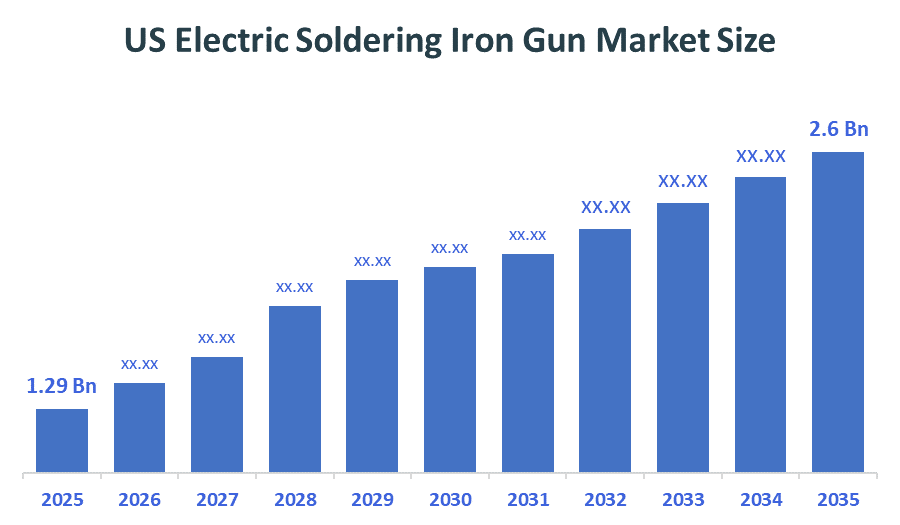
The United States Electric Soldering Iron Gun Market Size is projected to grow from USD 1.29 Billion in 2025 and is expected to reach approximately USD 2.6 Billion by 2035, expanding at a CAGR of 7.26%. According to Decision Advisors, analysis of the US electric soldering iron gun market shows that the rising demand for precision electronics, coupled with the surge in DIY maker culture and consumer electronics repair, is emerging as a dominant trend. Key industry players, including global leaders like Apex Tool Group (Weller), are driving innovation in temperature-controlled and cordless configurations, with the parent company reporting annual revenues of approximately USD 1.3 Billion, making them one of the top contributors for market growth.
Market Snapshot
- US Electric Soldering Iron Gun Market Size (2025): USD 1.29 Billion
- Projected Market Size (2035): USD 2.6 Billion
- Compound Annual Growth Rate (CAGR): 7.26%
- Base Year: 2025
- Historical Period: 2021-2024
- Forecast Period: 2026-2035
Market Overview/Introduction
The United States Electric Soldering Iron Gun Market entails the development and application of sophisticated thermal joining components for the regulation of heat delivery in various electronic assemblies. Such equipment is crucial for effective use of assembly lines since they employ advanced techniques like microprocessor temperature control, rapid thermal recovery, or digital calibration methods to attain the desired level of heat according to the specifications stipulated by industrial standards and aerospace guidelines. Their high popularity results from the fact that these systems have been instrumental in ensuring extended lives of sensitive components, lowering rework rates, and functioning as an interface system of thermal management in high performance electronics. The market features classic corded guns, portable cordless and battery powered modules, alongside advanced stations with built-in sensors and smart display features. The products' high popularity is attributed to initiatives geared towards reshoring electronics manufacturing and cutting down electronic waste through efficient repair.
Market trend for soldering systems in the US involves the quick acceptance of IoT-based equipment, where universal soldering systems capable of managing the thermal demands of new miniaturised drivers are developed. Precision assembly solutions have become popular, especially in the automotive and aerospace sectors, where soldering systems are installed in order to ensure the reliability of critical infrastructure as well as create human-centred ergonomic designs.
- In January 2026, Hakko introduced the new FM-2026 N2 soldering iron with advanced nitrogen atmosphere compatibility, improving integration with lead-free soldering processes in North America.
- In November 2025, the release of upgraded smart heating standards improved the professional tool ecosystem in the US, enhancing compatibility of soldering guns with connected industrial monitoring platforms.
Notable Insights
- The US electric soldering iron gun market is expected to grow at a CAGR of approximately 7.26% from 2025 to 2035, driven by strong demand for high precision electronics and government initiatives focused on domestic chip production and supply chain resilience.
- By technology, temperature-controlled soldering guns are gaining higher adoption due to their compatibility with lead-free alloys and ability to deliver consistent thermal performance with reduced component damage.
- By end use, the electronics manufacturing segment holds a dominant position, supported by growing aerospace defense activities and rising consumer focus on durable and repairable electronic devices.
What is the Role of Technology in Grooming the Market?
The key reasons for the increasing complexity of the US electric soldering iron gun market are the application of advanced precision engineering in tandem with digital control technologies. The key trend of development in this market refers to the creation of the smart soldering ecosystem featuring a high degree of reliability because of the use of microprocessor-based heating in compliance with the US requirements for ESD safety. Advanced technological innovations include, among other solutions, the application of universal heating cartridges and rapid recovery units to deliver advanced thermal management and peak power efficiency in industrial and laboratory areas. The output quality is usually guaranteed by means of automatic sleep modes and digital offset temperature protection.
Market Drivers
The driving forces behind the growth of the electric soldering iron gun market in the United States are the upgrading of existing telecommunications infrastructure and the development of efficient electric vehicle (EV) management technologies. Among the major factors contributing to the market equilibrium is the increasing desire to have personalised manufacturing solutions because of the rapid increase in the market share of wearable devices and intricate medical electronics. The unique demands of the aerospace sector, which require programmable thermal profiles and human-centric tool geometry, guarantee that the premium segment will have steady consumer interest. Additionally, the United States features advanced research and development facilities enabling local manufacturers to convert ordinary heating tools into premium smart control devices.
Restraints
While the technology holds great importance, there are certain possible challenges that may arise because of the development of automated selective soldering robots. One of the possible challenges could be the increased complexity and cost of meeting UL safety certifications and other environmental requirements regarding the handling of specialized solder fumes and energy consumption standards.
Study on the Supply, Demand, Distribution, and Market Environment
As far as soldering iron guns for the US market is concerned, this product is perceived to be mature, since it is regarded as an essential product for manufacturing and repair purposes and has high dependence on electronic engineering. As regards the sources of production for this product’s components, the components are provided by alloy producers and specialized ceramic heater manufacturers, where this product is assembled in major industrial hubs. Speaking about the product’s demands, it is worth saying that its demands are stable because of the requirements coming from the technology sector basics, as well as automotive and defense contractors.
Price Analysis and Consumer Behaviour Analysis
The findings from the price-based analysis show that the market involves the existence of hierarchy, in which ordinary hobbyist guns are priced at constant rates, but highly developed smart soldering stations, cordless professional units, and particular high wattage industrial guns are expensive because of their complex nature. Despite being expensive compared to basic hand tools, consumers view them as assets in their hands and not just products for consumption. In the case of US purchases, it is evident that buyers focus greatly on thermal stability and ergonomic features. For the consumers, it is better to purchase systems that are highly effective in terms of tip longevity and heat up time. Furthermore, there is another segment of consumers that are interested in utilizing the soldering hub that communicates wirelessly with manufacturing execution systems.
Market Segmentation
The US electric soldering iron gun market is categorised by product type, technology, and end-use industry.
The soldering guns’ segment dominated the market in 2025 and is projected to grow at a steady CAGR of approximately 7.9% during the forecast period.
Based on the type, the market is divided into Electric Soldering Irons, Soldering Guns, Cordless Soldering Tools, and Temperature-Controlled Soldering Stations. Among these, the soldering guns’ segment dominated the market in 2025 and is projected to grow at a steady CAGR of approximately 7.9% during the forecast period. This kind of domination is associated with the need for rapid heating in heavy-duty repair and the versatility of tools in industrial environments. These kinds of devices have high demand in the US premium-level automotive and aerospace sector because they can meet the requirements of modern technicians looking for high power and rapid recovery solutions. Modern technologies of digital temperature feedback and ergonomic grips have quickly been introduced into American manufacturing facilities to follow the necessary OSHA and safety standards.
The cordless and digital control technology segment dominated the market in 2025 and is projected to grow at a substantial CAGR of approximately 9.6% during the forecast period.
Based on technology and power source, the market is divided into Corded Guns, Cordless/Battery Powered, Analogue Temperature Control, and Digital Smart Control. Among these, the cordless and digital control technology segment dominated the market in 2025 and is projected to grow at a substantial CAGR of approximately 9.6% during the forecast period. In actual fact, it is because of the efficiency and effectiveness of these designs in terms of portability, coupled with stringent compliance to lead-free soldering requirements, that makes the digital and wireless segments the most efficient designs to bear with the complex thermal loads associated with today’s modern electronics. While traditional corded designs have been maintaining presence in the basic DIY market segment due to their cost-effective nature, the shift toward mobile field repair within the telecommunications and automotive industry still makes the modern digital segments the giants of the market structure.
The industrial and automotive application segment accounted for the largest share in 2025 and is anticipated to grow at a significant CAGR of approximately 7.5% during the forecast period.
Based on the end-use industry, the market is divided into Residential, Commercial, and Industrial. Among these, the industrial and automotive application segment accounted for the largest share in 2025 and is anticipated to grow at a significant CAGR of approximately 7.5% during the forecast period. The integration of advanced soldering guns in the process of electronic control unit (ECU) assembly and battery management systems becomes inevitable due to the need for thermal precision and high reliability in demanding environments, following the stringent safety regulations of the country with regard to product durability, coupled with the rising demand for domestic high-tech production. Among the factors responsible for the increase in potential is the emergence of green energy initiatives in the United States, as well as the adoption of advanced electronic repair systems.
The online retail segment is witnessing rapid expansion and is anticipated to grow at a significant CAGR of approximately 9.2% during the forecast period.
Based on the distribution channel, the market is divided into Online Retail and Offline Retail. Among these, the online retail segment is witnessing rapid expansion and is anticipated to grow at a significant CAGR of approximately 9.2% during the forecast period. The integration of advanced e-commerce platforms in the process of professional tool procurement and industrial supply chain management becomes inevitable due to the need for technical specification comparison and global brand accessibility in competitive environments, following the shifting purchasing patterns of the country with regard to logistics efficiency, coupled with the rising demand for specialised precision soldering equipment. Among the factors responsible for the increase in potential is the emergence of digital marketplace initiatives in the United States, as well as the adoption of advanced virtual procurement systems for small-scale workshops and independent technicians.
Recent Developments
- In March 2026, major tool manufacturers such as Weller and Hakko expanded their professional portfolios in the US, focusing on IoT-enabled soldering solutions integrated with data logging systems to improve quality control by up to 30 to 40%.
- In August 2025, the US electronics market continued transitioning toward advanced materials, with lead-free solder adoption exceeding 68% of total manufacturing usage, supported by regulatory push toward sustainable electronics.
- In January 2025, the US government introduced updated safety and efficiency standards for industrial heating tools, promoting digital thermal controls and ergonomic integration across aerospace and automotive infrastructure to support advanced manufacturing targets.
Competitive Analysis
The report offers the appropriate analysis of the key organisations/companies involved within the US electric soldering iron gun market, along with a comparative evaluation primarily based on their product offering, business overviews, geographic presence, enterprise strategies, segment market share, and SWOT analysis. The report also provides an elaborate analysis focusing on the current news and developments of the companies, which includes product development, innovations, joint ventures, partnerships, mergers & acquisitions, strategic alliances, and others. This allows for the evaluation of the overall competition within the market.
Top Key Companies in the US Electric Soldering Iron Gun Market
- Weller (Apex Tool Group)
- American Hakko Products, Inc.
- American Beauty Tools
- PACE Worldwide
- JBC Tools USA
- Metcal (OK International)
- Kurtz Ersa North America
- Aven, Inc.
- Edsyn Inc.
- Stellar Technical Products
- American Reliance Inc. (AMREL)
- M.M. Newman Corporation (Antex)
- John Stortz & Son, Inc.
- X-Tronic International
- Others
Key Target Audience
- Market Players
- Investors
- End-users
- Government Authorities
- Consulting and Research Firm
- Venture capitalists
- Value-Added Resellers (VARs)
Market Segmentation
This study forecasts revenue at the national level from 2020 to 2035. The report segmented the US electric soldering iron gun market based on the following segments:
US Electric Soldering Iron Gun Market, By Product Type
- Electric Soldering Irons
- Soldering Guns
- Cordless Soldering Tools
- Temperature-Controlled Soldering Stations
US Electric Soldering Iron Gun Market, By Application
- Electronics Repair
- Electrical Work
- Automotive Repair
- Industrial Manufacturing
US Electric Soldering Iron Gun Market, By End Use
- Residential
- Commercial
- Industrial
US Electric Soldering Iron Gun Market, By Distribution Channel
- Online Retail
- Offline Retail
Frequently Asked Questions (FAQ)
How is the expansion of domestic electronics manufacturing driving the US electric soldering iron gun market?
The emphasis on reshoring semiconductor production and high-tech assembly serves as an adequate source of motivation to drive the industry forward. The need for advanced soldering guns due to their ability to handle complex multi-layer PCBs and specialized lead-free alloys plays a crucial role in enhancing the importance of these tools in modern American industrial projects.
Why is the United States a leading market for smart soldering technology?
The dominance of the US lies in its excellence in aerospace engineering and strict regulatory environments, which has been made possible due to the presence of large technology hubs and a high rate of industrial automation. This has been coupled with a focus on producing high-quality thermal tools that adhere to rigorous ESD safety standards, together with the fact that the US is well known for its early transition to advanced manufacturing protocols.
What is the role of temperature-controlled technology, and how does it help growth?
It allows soldering units to accurately manage the thermal delivery to sensitive components through a microprocessor-driven approach that eliminates heat spikes and cold joints. It assists in increasing the reliability of electronic assemblies to ensure that automotive and defense installations can easily comply with the stringent quality requirements while at the same time maintaining the structural integrity of the solder connection.
What is the role of IoT and wireless connectivity in the market?
The recent trend is toward automated wireless and battery-powered soldering systems, which result in portable tool networks that lack the need for tethered power cables and have become highly appreciated within the global field service and automotive repair industries. It not only enhances the flexibility of the workstation setup but also makes the equipment easier to deploy and update during manufacturing cycles without the constraints of traditional power outlets.
How do OSHA and ESD standards impact the 2035 forecast?
The national policies for industrial safety emphasize the transition to intelligent soldering systems that contain built-in thermal protections and are fully compliant with static-safe requirements. This, combined with government support for smart manufacturing infrastructure and electronics recycling mandates, ensures that by 2035, the shift toward intelligent and fully compliant thermal tool supply chains will have already taken place. Continued growth will be ensured through the adoption of new international standards in digital heat management and human-centric ergonomic tool
Check Licence
Choose the plan that fits you best: Single User, Multi-User, or Enterprise solutions tailored for your needs.
We Have You Covered
- 24/7 Analyst Support
- Clients Across the Globe
- Tailored Insights
- Technology Tracking
- Competitive Intelligence
- Custom Research
- Syndicated Market Studies
- Market Overview
- Market Segmentation
- Growth Drivers
- Market Opportunities
- Regulatory Insights
- Innovation & Sustainability
Report Details
| Scope | Country |
| Pages | 210 |
| Delivery | PDF & Excel via Email |
| Language | English |
| Release | Apr 2026 |
| Access | Download from this page |