
United States Endosurgery Devices Market
 |
Author:
David J
|
Pages:
210
|
Author:
David J
|
Pages:
210
United States Endosurgery Devices Market Size, Share, By Product Type (Endoscopic Staplers, Energy Devices, Trocars, Endoscopes, Suction/Irrigation Devices, Others), By Application (General Surgery, Gynaecology, Urology, Gastrointestinal Surgery, Bariatric Surgery, Others), By End User (Hospitals, Speciality Clinics, Ambulatory Surgical Centres, Others), Analysis and Forecast 2026?2035
CAGR
6.64%
REVENUE 2025
USD Billion 24.57
FORECAST 2035
USD Billion 46.71
REPORT COVERAGE
Country
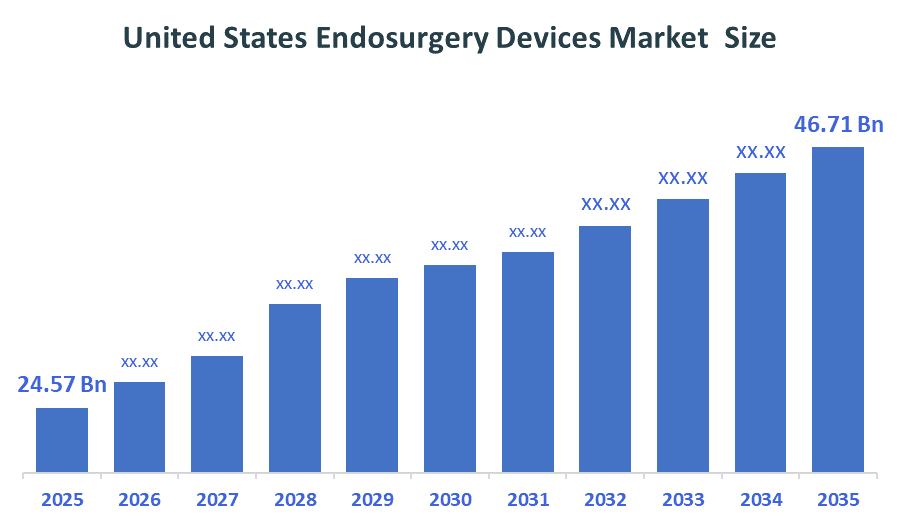
The United States Endosurgery Devices Market Size is foreseen to grow from USD 24.57 Billion in 2025 and is govern to reach around USD 46.71 Billion by 2035. According to Decision Advisors, a detailed research report on the United States Endosurgery Devices Market is boosted by the migration of procedures to outpatient settings, accounting for nearly upto the 53% to 55% share of the total share. Johnson & Johnson (Ethicon) is the prime player in the market with approximately USD 16.33 million in annual turnover and a 22-26% market share, positioning it as the primary driver of the United States Endosurgery Devices Market.
Market Snapshot
- United States Endosurgery Devices Market Size (2025): USD 24.57 Billion
- Projected United States Endosurgery Devices Market Size (2035): USD 46.71 Billion
- United States Endosurgery Devices Market Compound Annual Growth Rate (CAGR): 6.64%
- Market Base Year: 2025
- Historical Period: 2021–2024
- Forecast Period: 2026–2035
Market Overview/Introduction
The U.S. endosurgery market is undergoing a massive shift, and at its heart is a simple goal, making surgery less of a burden on the human body. Defined as the specialised field of minimally invasive medical devices, including high-tech endoscopes, laparoscopic tools, and energy-based tissue sealers, this sector allows surgeons to operate through tiny incisions with extreme precision. The field is shifting away from traditional open operations toward keyhole procedures that let patients heal faster and get back to their lives sooner. The market is seeing a huge trend where these surgeries are being performed out of intimidating hospitals and into local outpatient centres, powered by smarter tools like AI-guided cameras and robotic arms. With industry leaders constantly pushing the boundaries of what’s possible, this market isn't just about high-tech gadgets, it’s about a future where surgery is safer, more precise, and much more accessible for everyone.
Notable Insights: -
- By product type, the endoscopic staplers segment dominated the market in 2025, accounting for approximately 29% of market share, and is projected to grow at a substantial CAGR during the forecast period.
- By end user, the hospitals segment dominated the market in 2025, accounting for approximately 52% of market share, and is projected to grow at a substantial CAGR during the forecast period.
- The compound annual growth rate of the United States endosurgery devices market is 6.64%.
- The market is likely to achieve a valuation of USD 1608.5 by 2035.
What is the role of technology in grooming the market?
Technology plays a crucial role in shaping the United States endosurgery devices market by enhancing surgical precision, efficiency, and patient outcomes. Innovations such as robotic-assisted surgical systems, high-definition 3D imaging, and AI-based navigation tools allow surgeons to perform complex procedures with greater accuracy. Advanced energy devices, such as ultrasonic and bipolar instruments, improve tissue sealing and reduce intraoperative bleeding. Additionally, integration of digital platforms and smart sensors in surgical tools enables real-time feedback, improving decision-making during procedures. These advancements are significantly expanding the scope and adoption of minimally invasive surgeries.
Market Drivers
The thing which pushing this market forward isn't just technology, it’s the human desire for a smoother, faster recovery. The biggest driver is the massive shift toward minimally invasive keyhole surgeries. No one wants a long hospital stay or a large scar if they can avoid it, and these advanced tools allow patients to get back on their feet in days rather than weeks. This movement is being supported by the rise of local outpatient centres, which make surgery feel less like a major life event and more like a streamlined, same-day appointment. On top of that, we’re seeing a tech boost from AI and robotics, which act like a second set of expert eyes and hands for surgeons, making procedures safer and more precise. Finally, as our population ages, there is a natural, growing need for these smarter surgical solutions to help people stay healthy and active well into their later years.
Study on the Supply, Demand, Distribution, and Market Environment of the United States Endosurgery Devices Market
The United States endosurgery devices market operates within a well-established healthcare ecosystem supported by strong supply chains and high clinical demand. On the supply side, leading medical device manufacturers continuously develop advanced surgical instruments and maintain strong distribution networks through direct sales and third-party distributors. Demand is driven by increasing surgical volumes and the growing adoption of minimally invasive procedures across specialities such as general surgery, gynaecology, and urology. Distribution channels are highly efficient, ensuring timely delivery and maintenance services nationwide. The market environment is influenced by strict regulatory oversight from the FDA, ensuring product safety and efficacy. Additionally, the rise of outpatient surgical centres is driving demand for cost-effective and user-friendly devices.
Price Analysis and Consumer Behaviour Analysis
The price analysis of the United States endosurgery devices market indicates a high-cost structure due to advanced technology and product innovation. Endosurgical devices such as staplers and energy systems can range from USD 1,500 to USD 5,000 per unit, while complete surgical systems may cost significantly more. From a consumer behaviour perspective, hospitals prioritise high-quality, durable, and technologically advanced devices that ensure better clinical outcomes and long-term value. Meanwhile, ambulatory surgical centres focus on cost-effective and disposable instruments to reduce operational expenses. There is also a growing trend toward value-based purchasing, where healthcare providers evaluate devices based on performance, safety, and cost efficiency rather than price alone.
Market segmentation
The United States Endosurgery Devices Market is classified into product type, application and end user.
- The endoscopic staplers segment dominated the market in 2025, accounting for approximately 29% of market share, and is projected to grow at a substantial CAGR during the forecast period.
Based on the product type, the United States endosurgery devices market is divided into endoscopic staplers, energy devices, trocars, endoscopes, suction/irrigation devices, and others. Among these, the endoscopic staplers segment dominated the market in 2025, accounting for approximately 29% of market share, and is projected to grow at a substantial CAGR during the forecast period. This dominance is attributed to their critical role in tissue closure and anastomosis during minimally invasive surgeries, offering precision, reduced operation time, and lower risk of complications. For instance, endoscopic staplers are widely used in gastrointestinal and bariatric surgeries due to their ability to provide secure and consistent stapling. However, continuous advancements in energy-based devices and multifunctional surgical tools are encouraging the adoption of alternative technologies.
• The general surgery segment accounted for the largest share in 2025 and is anticipated to grow at a significant CAGR during the forecast period.
Based on the application, the United States endosurgery devices market is divided into general surgery, gynaecology, urology, gastrointestinal surgery, bariatric surgery, and others. Among these, the general surgery segment accounted for approximately 34% of market share in 2025 and is anticipated to grow at a significant CAGR during the forecast period. This growth is primarily driven by the high volume of minimally invasive procedures such as appendectomies, hernia repairs, and gallbladder removals. Additionally, the increasing prevalence of lifestyle-related disorders and rising surgical interventions are boosting demand for endosurgical devices in general surgery. Healthcare providers widely adopt these devices due to their ability to enhance precision, reduce recovery time, and improve patient outcomes, reinforcing the segment’s dominance.
- The hospitals segment dominated the market in 2025, accounting for approximately 52% of market share, and is projected to grow at a substantial CAGR during the forecast period.
Based on the end user, the United States endosurgery devices market is divided into hospitals, specialty clinics, ambulatory surgical centers, and others. Among these, the hospitals segment dominated the market in 2025, accounting for approximately 52% of market share, and is projected to grow at a substantial CAGR during the forecast period. This dominance is attributed to the presence of advanced healthcare infrastructure, the availability of skilled surgeons, and the capacity to handle complex surgical procedures using advanced endosurgical devices. In practice, hospitals are increasingly investing in technologically advanced minimally invasive surgical equipment to enhance clinical outcomes. Moreover, the rising number of surgical procedures and growing patient preference for minimally invasive treatments are encouraging hospitals to expand their endosurgery capabilities, thereby shaping evolving demand trends in the market.
Recent Development
- In December 2025, Medtronic plc advanced the rollout of its Hugo robotic-assisted surgery system, targeting minimally invasive procedures in urology and other specialities, with regulatory submissions and commercialisation efforts underway in the U.S
- In January 2025, Olympus Corporation introduced its AI-powered endoscopy ecosystem (OLYSENSE platform) in the U.S., designed to improve lesion detection and support real-time decision-making through artificial intelligence integration
Competitive Analysis
The report offers the appropriate analysis of the key organisations/companies involved within the United States endosurgery devices market, along with a comparative evaluation primarily based on their product offering, business overviews, geographic presence, enterprise strategies, segment market share, and SWOT analysis. The report also provides an elaborative analysis focusing on the current news and developments of the companies, which includes product development, innovations, joint ventures, partnerships, mergers & acquisitions, strategic alliances, and others. This allows for the evaluation of the overall competition within the market.
Top Key Companies in the United States Endosurgery Devices Market
- Medtronic plc
- Johnson & Johnson
- Olympus Corporation
- Stryker Corporation
- Boston Scientific Corporation
Key Target Audience
- Market Players
- Investors
- End-users
- Government Authorities
- Consulting and Research Firm
- Venture capitalists
- Value-Added Resellers (VARs)
Market Segment
This study forecasts revenue at the United Kingdom, regional, and country levels from 2020 to 2035. Decision Advisors has segmented the United States endosurgery devices market based on the below-mentioned segments
United States Endosurgery Devices Market, By Product Type
- Endoscopic Staplers
- Energy Devices
- Trocars
- Endoscopes
- Suction/Irrigation Devices
- Others
United States Endosurgery Devices Market, By Application
- General Surgery
- Gynecology
- Urology
- Gastrointestinal Surgery
- Bariatric Surgery
- Others
United States Endosurgery Devices Market, By End User
- Hospitals
- Specialty Clinics
- Ambulatory Surgical Centres
- Others
Frequently Asked Questions (FAQ)
Q1. How is the adoption of robotic-assisted surgery influencing the endosurgery devices market?
A. The growing adoption of robotic-assisted surgery is significantly enhancing the demand for advanced endosurgical instruments, as these systems require highly precise, compatible devices for minimally invasive procedures.
Q2. What role do disposable endosurgery devices play in infection control?
A. Disposable endosurgery devices are increasingly used to reduce the risk of cross-contamination and hospital-acquired infections, particularly in high-volume surgical settings and ambulatory centers.
Q3. How does the shortage of skilled surgeons impact market growth?
A. A shortage of adequately trained surgeons in minimally invasive techniques can limit the adoption of advanced endosurgery devices, especially in smaller healthcare facilities.
Q4. What sustainability trends are emerging in the endosurgery devices market?
A. Manufacturers are focusing on eco-friendly materials, reusable instruments, and reduced packaging waste to align with hospital sustainability goals and environmental regulations.
Q5. How are digital integration and data analytics transforming endosurgical procedures?
A. Integration of data analytics and digital platforms enables real-time surgical monitoring, performance tracking, and improved clinical decision-making, enhancing overall surgical outcomes.
Check Licence
Choose the plan that fits you best: Single User, Multi-User, or Enterprise solutions tailored for your needs.
We Have You Covered
- 24/7 Analyst Support
- Clients Across the Globe
- Tailored Insights
- Technology Tracking
- Competitive Intelligence
- Custom Research
- Syndicated Market Studies
- Market Overview
- Market Segmentation
- Growth Drivers
- Market Opportunities
- Regulatory Insights
- Innovation & Sustainability
Report Details
| Scope | Country |
| Pages | 210 |
| Delivery | PDF & Excel via Email |
| Language | English |
| Release | Apr 2026 |
| Access | Download from this page |