
United States Hip Replacement Devices Market
 |
Author:
David J
|
Pages:
210
|
Author:
David J
|
Pages:
210
United States Hip Replacement Devices Market Size, Share, By Product Type (Total Hip Replacement Implants, Partial Hip Replacement (Hemiarthroplasty), Hip Resurfacing Implants, Revision Hip Replacement Implants), By Material Type (Metal-on-Metal, Metal-on-Polyethylene, Ceramic-on-Polyethylene, Ceramic-on-Ceramic), By Fixation Type (Cemented Fixation, Cementless Fixation, Hybrid Fixation), and By End-User (Hospitals, Ambulatory Surgical Centers, Orthopedic Clinics, Rehabilitation Centers) Analysis and Forecast 2026 ? 2035.
CAGR
5.56%
REVENUE 2025
USD Billion 3.5
FORECAST 2035
USD Billion 6.01
REPORT COVERAGE
Country
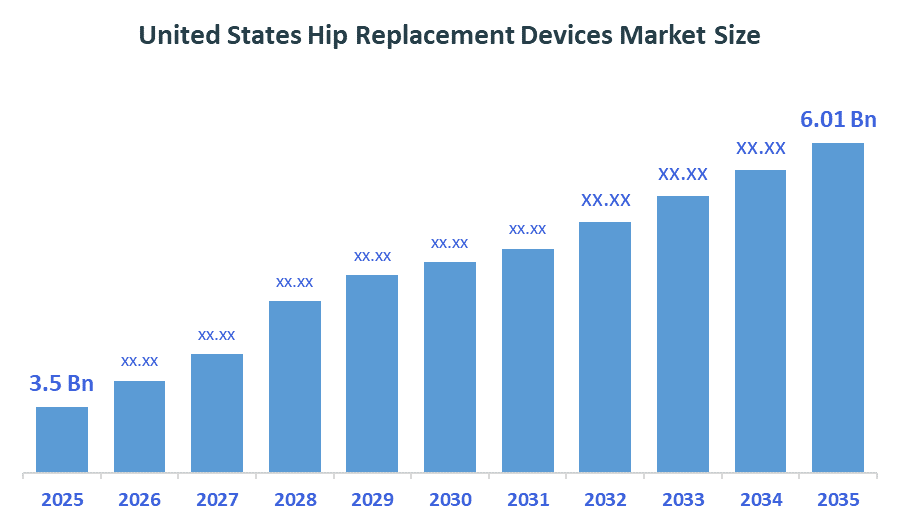
The United States Hip Replacement Devices Market size is forecast to grow from approximately USD 3.5 Billion in 2025 to around USD 6.01 Billion by 2035. According to Decision Advisors, a detailed research report on the anti-rheumatics market indicates that the Robotic Surgery trend dominates the market, accounting for approximately 30-35% of the total share in the United States. Zimmer Biomet Holdings, Inc. leads the market with an estimated 19.8% United States market share. The company's annual revenue of approximately USD 8.23 billion is making it one of the most influential forces shaping industry trends and overall market growth.
Market Snapshot
- United States Hip Replacement Devices Market Size (2025): USD 3.5 Billion
- Projected United States Hip Replacement Devices Market Size (2035): USD 6.01 Billion
- United States Hip Replacement Devices Market Compound Annual Growth Rate (CAGR): 5.56%
- Base Year: 2025
- Historical Period: 2021–2024
- Forecast Period: 2026–2035
Market Overview/Introduction
The United States hip replacement devices market refers to the industry involved in the development, supply, and adoption of implants and surgical technologies used to replace damaged hip joints across the UK. The medical system provides treatment for multiple health conditions, which include osteoarthritis, fractures, and degenerative diseases, while it works to improve patient mobility and their entire body function. The United States hip replacement devices market is experiencing steady growth because of two factors, which include the growing elderly demographic and the rising number of people with osteoarthritis and hip-related disorders. The demand for surgical procedures increases because people develop joint problems from their rising obesity levels and their inactive way of living. Patient outcomes and recovery times have improved because of developments in implant materials and minimally invasive surgical methods. The National Health Service provides strong funding support, which results in high numbers of medical procedures, while public awareness and early detection methods drive market growth.
- The Centers for Medicare & Medicaid Services expanded the CJR model to improve outcomes and reduce costs for hip and knee replacements. It bundles payments across hospitalization and recovery, incentivizing hospitals to deliver efficient, high-quality care while lowering overall Medicare spending.
- The Medicare provides coverage for medically necessary hip replacement surgeries, including hospital stays, physician services, rehabilitation, and medical devices. This ensures strong demand for implants and devices while reducing patient financial burden and improving access to advanced orthopedic procedures.
Notable Insights: -
- The total hip replacement implants segment dominated the market in 2025 and holds the largest market share, accounting for approximately 50% during the forecast period.
- The metal-on-polyethylene segment dominated the market in 2025 and holds the largest market share, accounting for approximately 40% during the forecast period.
- The cementless fixation segment dominated the market in 2025 and holds the largest market share, accounting for approximately 49.9% during the forecast period.
- The hospitals segment dominated the market in 2025 and holds the largest market share, accounting for approximately 70% during the forecast period.
- The compound annual growth rate of the United States Hip Replacement Devices Market is 5.56%.
- The market is likely to achieve a valuation of USD 6.01Billion by 2035.
What is the role of technology in grooming the market?
Technology plays a pivotal role in shaping the United States hip replacement devices market by enhancing surgical precision, patient outcomes, and implant longevity. The adoption of robotic-assisted surgery and computer navigation systems enables highly accurate implant placement, reducing complications and recovery time. Advances in biomaterials, such as highly cross-linked polyethylene and ceramic components, improve durability and minimize wear. Additionally, 3D printing supports the development of patient-specific implants, ensuring better anatomical fit. Digital health tools, including AI-driven preoperative planning and remote monitoring, further streamline care delivery. Integration of smart implants and data analytics also allows clinicians to track performance, optimize treatments, and improve long-term success rates.
Market Drivers
The United States Hip Replacement Devices Market is being driven by a rapidly aging population, which is increasing the incidence of hip fractures and degenerative joint disorders. At the same time, the growing burden of lifestyle-related conditions such as obesity and osteoarthritis is significantly boosting the need for joint replacement procedures. Technological advancements, particularly in biomaterials, are enhancing implant durability and longevity, while the adoption of robotic-assisted surgical systems is improving procedural accuracy and patient outcomes. Additionally, the National Health Service (NHS) continues to support a high volume of hip arthroplasty procedures, although occasional manufacturing and supply chain disruptions may influence device availability.
Restrain
The United States Hip Replacement Devices Market faces restraints due to long surgical waiting times within the NHS, driven by resource constraints and backlog pressures. High procedure costs and budget limitations also restrict adoption. Additionally, supply chain disruptions and regulatory compliance requirements can delay product availability and market growth.
Study on the Supply, Demand, Distribution, and Market Environment of the United States Hip Replacement Devices Market
The United States hip replacement devices market reflects a mature yet steadily expanding ecosystem shaped by strong demand, advanced supply chains, and supportive clinical infrastructure. Demand is primarily driven by the rising prevalence of osteoarthritis, an aging population, and increasing acceptance of minimally invasive and robotic-assisted procedures. On the supply side, leading manufacturers such as Zimmer Biomet, Stryker Corporation, and Johnson & Johnson ensure consistent product availability through innovation and large-scale production. Distribution networks are highly organized, relying on hospital procurement systems, group purchasing organizations, and specialized orthopedic centers. The market environment is further influenced by favorable reimbursement policies, strict regulatory oversight by the U.S. Food and Drug Administration, and continuous technological advancements, all contributing to sustained market growth and competitive dynamics.
Price Analysis and Consumer Behaviour Analysis
The United States hip replacement devices market exhibits a high-cost pricing structure influenced by advanced technology, hospital overheads, and complex insurance systems. The average cost of hip replacement procedures, including implants, typically ranges between $31,000 and $45,000, significantly shaping pricing sensitivity and purchasing decisions. Premium-priced implants incorporating robotics, advanced biomaterials, and longer durability often command higher adoption among hospitals prioritizing clinical outcomes. Consumer behavior is strongly influenced by insurance coverage, physician recommendations, and perceived quality rather than direct price comparison. Patients increasingly prefer minimally invasive and long-lasting implant solutions, even at higher costs, due to improved mobility and reduced revision risk. Additionally, rising awareness, aging demographics, and faster surgical access drive demand, while out-of-pocket costs and reimbursement structures continue to affect affordability and decision-making patterns.
Market Segmentation
The United States hip replacement devices market share is classified into product type, material type, fixation type, and end-user
- The total hip replacement implants segment dominated the market in 2025 and holds the largest market share, accounting for approximately 50% during the forecast period.
Based on the product type, the hip replacement devices market is divided into total hip replacement implants, partial hip replacement (hemiarthroplasty), hip resurfacing implants, and revision hip replacement implants. Among these, the total hip replacement implants segment dominated the market in 2025 and holds the largest market share, accounting for approximately 50% during the forecast period. The total hip replacement implants segment is driven by rising demand for advanced drug delivery systems in the UK, where polymers enhance stability, solubility, and controlled release. Growth in biologics, generics, and personalized medicines, along with strong pharmaceutical R&D and regulatory support, further accelerates the adoption of functional and multifunctional polymer excipients.
- The metal-on-polyethylene segment dominated the market in 2025 and holds the largest market share, accounting for approximately 40% during the forecast period.
Based on the material type, the hip replacement devices market is divided into metal-on-metal, metal-on-polyethylene, ceramic-on-polyethylene, and ceramic-on-ceramic. Among these, the metal-on-polyethylene segment dominated the market in 2025 and holds the largest market share, accounting for approximately 40% during the forecast period. The metal-on-polyethylene segment in the U.S. is driven by high demand for oral solid dosage forms due to their convenience, cost-efficiency, and patient compliance. Strong presence of generic drug manufacturers, increasing chronic disease prevalence, and advanced manufacturing technologies further boost large-scale tablet production, supporting significant market growth.
- The cementless fixation segment dominated the market in 2025 and holds the largest market share, accounting for approximately 49.9% during the forecast period.
Based on the fixation type, the hip replacement devices market is divided into cemented fixation, cementless fixation, and hybrid fixation. Among these, the cementless fixation segment dominated the market in 2025 and holds the largest market share, accounting for approximately 49.9% during the forecast period. The cementless fixation segment in the U.S. is driven by strong demand for convenient and non-invasive drug delivery systems, particularly for chronic disease management. High consumption of generics and OTC drugs, well-established pharmaceutical manufacturing infrastructure, and continuous innovation in oral formulations further support sustained market growth.
- The hospitals segment dominated the market in 2025 and holds the largest market share accounting for approximately 70% during the forecast period.
Based on the end-user, the hip replacement devices market is divided hospitals, ambulatory surgical centers, orthopedic clinics, and rehabilitation centers. Among these, the hospitals segment dominated the market in 2025 and holds the largest market share accounting for approximately 70% during the forecast period. The oral dosage forms segment in the U.S. is driven by strong demand for convenient and non-invasive drug delivery systems, particularly for chronic disease management. High consumption of generics and OTC drugs, well-established pharmaceutical manufacturing infrastructure, and continuous innovation in oral formulations further support sustained market growth.
Recent Development
- In February 2026, Zimmer Biomet announced that it had received U.S. FDA 510(k) clearance for its G7 TM Acetabular System, designed for both primary and complex revision hip replacement surgeries. The system integrates trabecular metal technology and advanced fixation features to enhance implant stability, strengthening innovation in the United States Hip Replacement Devices Market.
- In October 2025, Zimmer Biomet announced that it had received Breakthrough Device Designation from the U.S. Food and Drug Administration for its world’s first iodine-treated total hip replacement system. The innovation integrates a controlled-release iodine surface into hip implants to help reduce bacterial adhesion and lower the risk of post-surgical infections, a major concern in joint replacement procedures.
- In April 2022, Stryker Corporation introduced the Insignia Hip Stem at the AAOS Annual Meeting, designed to optimize patient fit and improve surgical outcomes through advanced anatomical modeling and compatibility with robotic-assisted systems. The launch strengthened its position in the United States Hip Replacement Devices Market.
Competitive Analysis
The report offers the appropriate analysis of the key organisations/companies involved within the United States excipients market, along with a comparative evaluation primarily based on their product offering, business overviews, geographic presence, enterprise strategies, segment market share, and SWOT analysis. The report also provides an elaborative analysis focusing on the current news and developments of the companies, which includes product development, innovations, joint ventures, partnerships, mergers & acquisitions, strategic alliances, and others. This allows for the evaluation of the overall competition within the market.
Top Key Companies in the United States Hip Replacement Devices Market
- Zimmer Biomet
- Johnson & Johnson (DePuy Synthes)
- Stryker Corporation
- Smith & Nephew plc
- Exactech, Inc.
- Others
Key Target Audience
- Market Players
- Investors
- End-users
- Government Authorities
- Consulting and Research Firm
- Venture capitalists
- Value-Added Resellers (VARs)
Market Segment
This study forecasts revenue at the United States, regional, and country levels from 2020 to 2035. Decision Adevisor has segmented the United States hip replacement devices market based on the below-mentioned segments
United States United States Hip Replacement Devices Market, By Product Type
- Total Hip Replacement Implants
- Partial Hip Replacement (Hemiarthroplasty)
- Hip Resurfacing Implants
- Revision Hip Replacement Implants
United States United States Hip Replacement Devices Market, By Material Type
- Metal-on-Metal
- Metal-on-Polyethylene
- Ceramic-on-Polyethylene
- Ceramic-on-Ceramic
United States United States Hip Replacement Devices Market, By Fixation Type
- Cemented Fixation
- Cementless Fixation
- Hybrid Fixation
United States United States Hip Replacement Devices Market, By End-User
- Hospitals
- Ambulatory Surgical Centers
- Orthopedic Clinics
- Rehabilitation Centers
Frequently Asked Questions (FAQ)
Q. How is patient demand influencing innovation in the United States hip replacement devices market?
A. Patient demand is increasingly shaping innovation in the UK hip replacement devices market, with individuals seeking faster recovery, reduced pain, and longer-lasting implants. This has encouraged manufacturers to focus on minimally invasive surgical techniques, enhanced implant ergonomics, and improved post-operative rehabilitation solutions, ultimately driving patient-centric product development.
Q. What role do private healthcare providers play in the United States hip replacement devices market?
A. Private healthcare providers play a significant role by reducing pressure on public healthcare systems and offering quicker access to hip replacement surgeries. They often adopt advanced technologies faster than public institutions, thereby accelerating the adoption of premium implants and innovative surgical solutions within the overall market.
Q. How does regulatory compliance impact product launches in the United States hip replacement devices market?
A Regulatory compliance in the UK ensures high safety and quality standards, but it can also lengthen product approval timelines. Strict guidelines from authorities require extensive clinical validation, which may delay market entry but ultimately enhances trust among healthcare providers and patients.
Q. What opportunities exist for emerging companies in the United States hip replacement devices market?
A. Emerging companies have opportunities in niche areas such as personalized implants, digital surgical planning tools, and smart implant technologies. With growing support for innovation and startups, smaller firms can collaborate with healthcare providers to introduce cost-effective and technologically advanced solutions, gaining competitive advantage in the evolving market.
Check Licence
Choose the plan that fits you best: Single User, Multi-User, or Enterprise solutions tailored for your needs.
We Have You Covered
- 24/7 Analyst Support
- Clients Across the Globe
- Tailored Insights
- Technology Tracking
- Competitive Intelligence
- Custom Research
- Syndicated Market Studies
- Market Overview
- Market Segmentation
- Growth Drivers
- Market Opportunities
- Regulatory Insights
- Innovation & Sustainability
Report Details
| Scope | Country |
| Pages | 210 |
| Delivery | PDF & Excel via Email |
| Language | English |
| Release | Apr 2026 |
| Access | Download from this page |