
United States Poultry Diagnostic Testing Market
 |
Author:
Disha B
|
Pages:
240
|
Author:
Disha B
|
Pages:
240
United States Poultry Diagnostic Testing Market Size, Share, By Product Type (Instruments, Consumables & Reagents), By Technology (PCR Testing, Immunoassays, Rapid Diagnostics, Others), By End User (Poultry Farms, Diagnostic Laboratories, Research Institutes), Analysis and Forecast 2025-2035
CAGR
11.41%
REVENUE 2025
USD Million 551.7
FORECAST 2035
USD Million 1625.1
REPORT COVERAGE
country
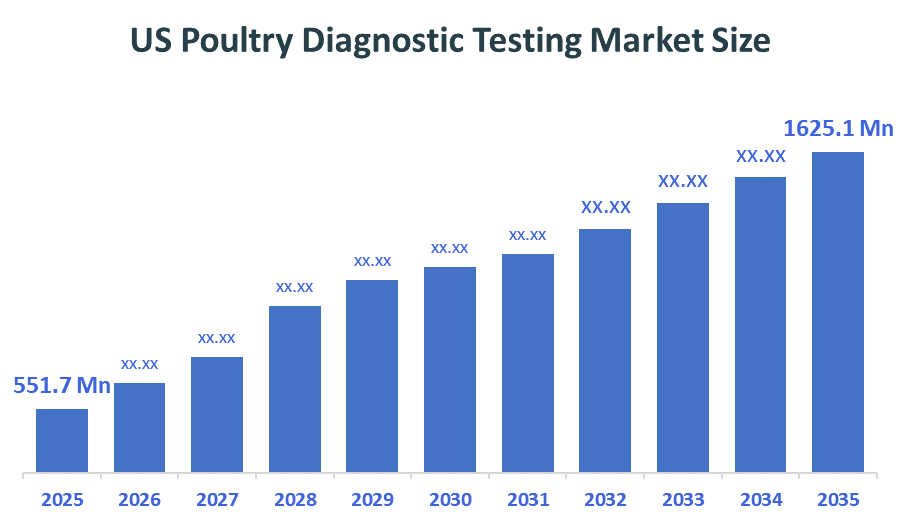
The United States Poultry Diagnostic Testing Market Size is foreseen to grow from USD 551.7 Million in 2025 and is govern to reach around USD 1625.1 Million by 2035. According to Decision Advisors, a detailed research report on the US poultry diagnostic testing market is boosted by the integration of digital health platforms, accounting for nearly upto the 15% to 25% share of the total share worldwide. IDEXX Laboratories is the prime player in the market with approximately USD $55 million - $75 million in annual turnover and a 40-50% global market share, positioning it as the primary driver of the US Poultry Diagnostic Testing Market.
Market Snapshot
- US Poultry Diagnostic Testing Market Size (2025): USD 551.7 Million
- Projected US Poultry Diagnostic Testing Market Size (2035): USD 1625.1 Million
- US Poultry Diagnostic Testing Market Compound Annual Growth Rate (CAGR): 11.41%
- Market Base Year: 2025
- Historical Period: 2021–2024
- Forecast Period: 2026–2035
Market Overview/Introduction
The U.S. poultry diagnostic testing market is the immune system of our food supply. This market is about the tools and technology, like the quick result kits used right in the barn or the high-tech PCR machines in labs, that help farmers and vets spot illnesses like bird flu or Salmonella before they become a crisis. With chicken being a staple on almost every American dinner table, the stakes are incredibly high. This is why the U.S. has become the world leader in this space, accounting for more than half of the entire global market. In the world of poultry farming, the old way of doing things, mailing off samples and waiting days for a lab to call back while a whole flock sits at risk, is quickly becoming a thing of the past. Giants like IDEXX and Zoetis are leading a digital makeover, swapping slow paperwork for high-speed tech. They’re rolling out AI-powered tools and mobile apps that work a lot like the health apps on our phones. A vet can now get a clear picture of a bird’s health in minutes. This shift isn't just about being high-tech, it’s about giving farmers peace of mind and the ability to act immediately when every second counts.
Notable Insights: -
- By product type, the consumables & reagents segment dominated the market in 2025, accounting for approximately 61% of market share, and is projected to grow at a substantial CAGR during the forecast period.
- By end user, the poultry farms segment dominated the market in 2025, accounting for approximately 55% of market share, and is projected to grow at a substantial CAGR during the forecast period.
- The compound annual growth rate of the US poultry diagnostic testing market is 11.41%.
- The Market is likely to achieve a valuation of USD 1625.1 Million by 2035.
What is the role of technology in grooming the market?
Technology plays a vital role in advancing the US poultry diagnostic testing market through innovations such as molecular diagnostics, automation, and portable testing kits. PCR-based testing enables early and precise detection of pathogens, reducing the spread of infectious diseases. Rapid diagnostic kits are increasingly being used on farms for immediate results, minimising delays associated with laboratory testing. Additionally, digital monitoring systems and data analytics are improving disease surveillance and enabling real-time tracking of outbreaks. Automation in laboratories is also enhancing testing efficiency, while advancements in biosensors and AI-based diagnostics are expected to further improve accuracy and speed.
Market Drivers
The primary driver behind this market is the constant threat of disease outbreaks, such as Avian Influenza and Salmonella, which can devastate a farm’s livelihood overnight. Deep down, the push for better testing is really about looking out for the animals and the people who care for them. The biggest driver is the heavy reality of outbreaks like bird flu. For a farmer, a single sick bird isn’t just a headline, it’s a threat to their entire livelihood and the heritage they have built. Because we are eating more chicken than ever, farms are busier than they have ever been, and in those bustling spaces, germs can hitch a ride and spread fast. This has turned routine testing from a to-do list item into a vital safety net that protects the whole farm. At the same time, we’re all more mindful of what we are feeding our families. But what’s really changing the game is the move toward friendly, fast technology. Instead of the anxiety of mailing off a sample and waiting days for a lab to call, farmers can now use simple kits to get an answer right in the barn. Getting those results in minutes doesn't just save time, it saves millions of birds and gives farmers the peace of mind to focus on what they do best.
Study on the Supply, Demand, Distribution, and Market Environment of the US Poultry Diagnostic Testing Market
The US poultry diagnostic testing market operates within a structured and regulated ecosystem supported by advanced diagnostic manufacturers and well-established laboratory networks. On the supply side, companies continuously develop innovative testing kits and molecular diagnostic solutions to meet industry needs. Demand is primarily driven by large-scale poultry farms and integrators focusing on disease prevention, biosecurity, and compliance with food safety regulations. Distribution is carried out through direct sales, veterinary distributors, and diagnostic service providers, ensuring the timely availability of testing solutions. The market environment is highly regulated, with strong involvement from government agencies to monitor disease outbreaks, maintain poultry health standards, and ensure food safety across the supply chain.
Price Analysis and Consumer Behaviour Analysis
Pricing in the poultry diagnostic testing market depends on the type of test, technology, and accuracy level. Molecular diagnostic tests are relatively expensive but offer high precision, while rapid test kits are cost-effective and widely used for on-site testing. From a consumer behaviour perspective, poultry producers prioritise speed, accuracy, and reliability over cost, as disease outbreaks can lead to significant economic losses. There is also a growing preference for preventive testing and routine health monitoring.
Market Segmentation
- The consumables & reagents segment dominated the market in 2025, accounting for approximately 61% of market share, and is projected to grow at a substantial CAGR during the forecast period.
Based on the product type, the US poultry diagnostic testing market is divided into instruments, consumables and reagents. Among these, the consumables & reagents segment dominated the market in 2025, accounting for approximately 61% of the market share, and is projected to grow at a substantial CAGR during the forecast period. This segment dominates due to the recurring need for diagnostic kits, assay reagents, and testing materials in routine poultry disease surveillance. Unlike instruments, which are one-time capital investments, consumables ensure continuous demand, especially in large-scale poultry farms and diagnostic laboratories. The increasing frequency of testing for diseases such as avian influenza and salmonella further supports segment growth. Additionally, advancements in rapid test kits and improved reagent efficiency are enhancing adoption, while instruments continue to witness steady demand due to technological upgrades.
- The molecular diagnostics segment accounted for the largest share in 2025 and is anticipated to grow at a significant CAGR during the forecast period.
Based on the technology, the US poultry diagnostic testing market is divided into molecular diagnostics, immunodiagnostics, rapid diagnostic tests, and others. Among these, the molecular diagnostics segment accounted for the largest share in 2025 and is anticipated to grow at a significant CAGR during the forecast period. This segment dominates due to its high sensitivity, accuracy, and ability to detect pathogens at early stages. Techniques such as PCR are widely used for identifying infectious poultry diseases including avian influenza and Newcastle disease. Molecular diagnostics are increasingly preferred for their precision and reliability in large-scale poultry operations. Immunodiagnostics and rapid tests also contribute significantly due to their cost-effectiveness and quick turnaround time, especially for on-site testing.
- The poultry farms segment dominated the market in 2025, accounting for approximately 55% of market share, and is projected to grow at a substantial CAGR during the forecast period.
Based on the end user, the US poultry diagnostic testing market is divided into poultry farms, diagnostic laboratories, and research institutes. Among these, the poultry farms segment dominated the market in 2025, accounting for approximately 55% of the market share, and is projected to grow at a substantial CAGR during the forecast period. This dominance is driven by the increasing adoption of routine diagnostic testing and biosecurity measures at the farm level. Poultry producers rely heavily on rapid and on-site diagnostic tools to detect diseases early and minimize production losses. The availability of portable testing kits has further strengthened this segment by enabling immediate decision-making. Diagnostic laboratories handle confirmatory and advanced testing, while research institutes contribute to innovation and disease control strategies.
Recent Development
- In February 2025, Zoetis received a conditional license from the U.S. Department of Agriculture for its avian influenza (H5N2) vaccine for poultry, which drove demand for diagnostic testing to monitor infection and vaccine effectiveness.
- In January 2024, Alveo Technologies partnered with Royal GD, Pharmsure International Ltd., and x-OvO to co-develop advanced molecular diagnostic tests for avian influenza. This collaboration focused on creating multiplex panels capable of detecting multiple virus strains, strengthening diagnostic capabilities relevant to the U.S. poultry sector.
Competitive Analysis
The report offers the appropriate analysis of the key organisations/companies involved within the US poultry diagnostic testing market, along with a comparative evaluation primarily based on their product offering, business overviews, geographic presence, enterprise strategies, segment Market share, and SWOT analysis. The report also provides an elaborative analysis focusing on the current news and developments of the companies, which includes product development, innovations, joint ventures, partnerships, mergers & acquisitions, strategic alliances, and others. This allows for the evaluation of the overall competition within the Market.
Top Key Companies in the US Poultry Diagnostic Testing Market
- IDEXX Laboratories, Inc.
- Zoetis Inc.
- Thermo Fisher Scientific Inc.
- BioChek
- QIAGEN
Key Target Audience
- Market Players
- Investors
- End-users
- Government Authorities
- Consulting and Research Firm
- Venture capitalists
- Value-Added Resellers (VARs)
Market Segment
This study forecasts revenue at the United States, regional, and country levels from 2020 to 2035. Decision Advisors has segmented the US poultry diagnostic testing market based on the below-mentioned segment
US Poultry Diagnostic Testing Market, By Product Type
- Instruments
- Consumables and reagents
US Poultry Diagnostic Testing Market, By Technology
- Molecular diagnostics
- Immunodiagnostics
- Rapid diagnostic tests
- Others
US Poultry Diagnostic Testing Market, By End User
- Poultry farms
- Diagnostic laboratories
- Research institutes.
Frequently Asked Questions (FAQ)
Q1. How is automation influencing poultry diagnostic laboratories in the US?
A. Automation is improving testing efficiency by reducing manual errors, increasing throughput, and enabling faster processing of large sample volumes, which is critical during disease outbreaks.
Q2. What role does biosecurity play in driving demand for poultry diagnostic testing?
A. Strong biosecurity measures require regular health monitoring and early disease detection, which significantly increases the demand for routine diagnostic testing across poultry farms.
Q3. How are export regulations impacting poultry diagnostic testing in the US?
A. Export requirements mandate strict disease-free certifications, encouraging poultry producers to adopt advanced and frequent diagnostic testing to meet international trade standards.
Q4. What challenges are associated with poultry diagnostic testing in rural areas?
A. Limited access to advanced diagnostic laboratories, higher transportation time for samples, and lack of skilled professionals can delay diagnosis and affect disease control efforts.
Q5. How is the integration of digital data systems benefiting poultry disease management?
A. Digital platforms enable centralised data collection, real-time disease tracking, and predictive analytics, helping farmers and authorities respond quickly to potential outbreaks.
Check Licence
Choose the plan that fits you best: Single User, Multi-User, or Enterprise solutions tailored for your needs.
We Have You Covered
- 24/7 Analyst Support
- Clients Across the Globe
- Tailored Insights
- Technology Tracking
- Competitive Intelligence
- Custom Research
- Syndicated Market Studies
- Market Overview
- Market Segmentation
- Growth Drivers
- Market Opportunities
- Regulatory Insights
- Innovation & Sustainability
Report Details
| Scope | country |
| Pages | 240 |
| Delivery | PDF & Excel via Email |
| Language | English |
| Release | Apr 2026 |
| Access | Download from this page |