
United States Solid State Transformers Market
 |
Author:
Achal E
|
Pages:
210
|
Author:
Achal E
|
Pages:
210
United States Solid State Transformers Market Size, Share, By Product (Distribution Solid State Transformers, Power Solid State Transformers, and Traction Solid State Transformers), By Component (Switches, High-frequency Transformers, Converters, and Others), By Application (Renewable Energy Generation, Electric Vehicle Charging Stations, Power Distribution, and Industrial Traction), Analysis and Forecast 2026 - 2035
CAGR
32.46%
REVENUE 2025
USD Million 33.7
FORECAST 2035
USD Million 560.18
REPORT COVERAGE
Country
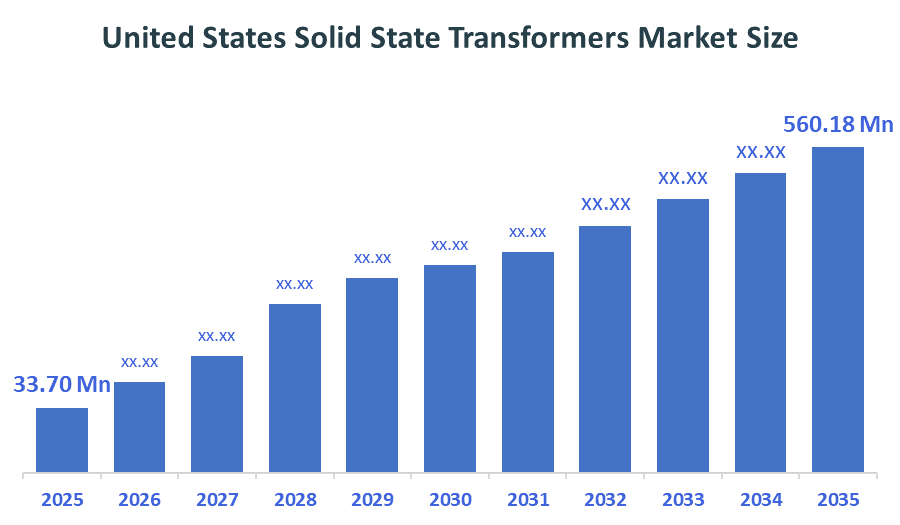
The US solid state transformers market size is projected to grow from USD 33.70 million in 2025 and is expected to reach approximately USD 560.18 million by 2035. According to Decision Advisors, analysis of the American market shows that the integration of smart grid technologies and the rapid expansion of renewable energy infrastructure are emerging as dominant trends. ABB Ltd reported total global revenues of $33,220 million in 2025. Making one of the market drivers shaping the industy
Market Snapshot
- US Solid State Transformers Market Size (2025): USD 33.70 Million
- US Solid State Transformers Projected Market Size (2035): USD 560.18 Million
- US Solid State Transformers Compound Annual Growth Rate (CAGR): 32.46%
- Base Year: 2025
- Historical Period: 2021-2024
- Forecast Period: 2026-2035
Market Overview and Introduction
The US solid-state transformers market involves the development and application of advanced power electronic devices designed to replace traditional copper and iron core transformers. These systems utilise sophisticated semiconductor switches and high-frequency transformers to manage voltage levels while providing superior control over power quality. Such equipment is crucial for the effective integration of renewable energy sources since they employ materials like Silicon Carbide to attain high energy efficiency levels according to modern utility standards. Their popularity results from the fact that these systems are instrumental in ensuring bidirectional power flow, voltage regulation, and harmonic distortion reduction. Market trends for solid state transformers in the United States involve the rapid acceptance of modular units capable of managing the volatile loads of offshore wind farms and large-scale electric vehicle fleet charging hubs. Precision power solutions have become popular in urban microgrids where space is limited and high power density is required to ensure operational stability and support the national transition toward a carbon-neutral economy.
- In March 2026, the Department of Energy announced new funding initiatives for the Grid Resilience and Innovation Partnership program, specifically targeting the deployment of solid-state conversion technologies in disaster-prone regions.
- In January 2026, leading American power electronics firms began commercial testing of megawatt-scale solid-state transformers designed for heavy duty freight electric vehicle charging
Notable Insights: -
The US solid state transformers market is expected to grow at an exceptional CAGR of 32.46% from 2025 to 2035, driven by the massive investment in smart grid modernisation and the decentralisation of energy production.
- By product, distribution solid state transformers are gaining higher adoption due to their ability to interface directly with smart meters and localised solar arrays while delivering high efficiency power conversion.
- By application, the renewable energy generation segment holds a dominant position, supported by federal tax credits and the rising focus on energy storage systems that require precise DC to AC conversion capabilities.
What is the Role of Technology in Grooming the Market?
The key reasons for the increasing complexity of the US solid-state transformers market are the application of wide-bandgap semiconductor science in tandem with digital control algorithms. The key trend of development refers to the creation of the Silicon Carbide and Gallium Nitride ecosystem featuring high reliability in compliance with requirements for extreme energy density. Advanced technological innovations include the application of intelligent communication modules and automated thermal management units to deliver advanced phase synchronisation in utility areas. The output quality is guaranteed by means of rigorous testing protocols and adherence to international electrical safety certifications.
Market Drivers
The driving forces behind the growth of the solid-state transformers market in the United States are the upgrading of outdated grid infrastructure and the development of large-scale utility energy storage. Among the major factors contributing to market growth is the increasing desire to have compact power solutions because of the rapid increase in the market share of urban electric vehicle charging stations. The unique demands of the industrial sector, which require high reliability for sensitive robotic manufacturing, guarantee that the technology segment will have steady interest. Additionally, the United States features world-class research facilities enabling local firms to convert experimental designs into high-performance commercial power modules.
Restraints
While the technology holds great importance, there are certain challenges that may arise because of the high initial capital expenditure compared to conventional electromagnetic transformers. One of the possible challenges could be the increased complexity of integrating these advanced electronic systems into legacy grid frameworks that were not originally designed for high-frequency power electronics.
Study on the Supply, Demand, Distribution, and Market Environment
As far as solid-state transformers for the American market are concerned, this product is perceived to be in an early but high-growth phase, regarded as essential for the clean energy transition. As regards the sources of production, components are provided by global semiconductor leaders and domestic electronics manufacturers, where these systems are increasingly assembled in specialised technology corridors. Speaking about the demand, it is worth saying that requirements are stable because of the commitments from utility companies and private infrastructure developers.
Price Analysis and Consumer Behaviour Analysis
Findings from the price-based analysis show that the market involves a premium pricing structure, where solid-state units are currently more expensive than traditional alternatives due to the cost of advanced semiconductor materials. Despite being expensive, utility operators and industrial consumers view them as assets for long-term operational efficiency and grid flexibility. In the case of American purchases, it is evident that buyers focus greatly on the total cost of ownership and the ability of the system to handle bidirectional energy flows. For consumers, it is better to purchase systems that are highly effective in terms of reducing footprint and weight.
Market Segmentation
The US solid-state transformers market is categorised by product, component, and application.
The distribution solid state transformers segment dominated the market in 2025 and held a market capture of approximately 45.2%.
Based on the product, the solid-state transformers market is divided into Distribution Solid State Transformers, Power Solid State Transformers, and Traction Solid State Transformers. Among these, the distribution of the solid state transformers segment dominated the market in 2025 and held a market capture of approximately 45.2%. This kind of domination is associated with the rising integration of localised renewable energy sources and the massive requirements of the residential utility sector for intelligent voltage regulation. These kinds of devices have high demand in American smart city initiatives and microgrid projects because they can meet the requirements of bidirectional power flow. Modern technologies of digital twin modelling and advanced cooling systems have quickly been introduced into domestic manufacturing facilities to follow the necessary energy efficiency mandates.
The switches component segment dominated the market in 2025 and held a market capture of approximately 38.5%.
Based on the component, the market is divided into Switches, High-frequency Transformers, Converters, and Others. Among these, the switches component segment dominated the market in 2025 and held a market capture of approximately 38.5%. In actual fact, it is because of the efficiency and effectiveness of Silicon Carbide and Gallium Nitride power semiconductors, coupled with stringent compliance to high-frequency operation standards, that makes the switch segments the most essential parts to bear with the high-power requirements of modern solid state systems. While traditional magnetic components have been maintaining presence in legacy infrastructures due to their long-standing reliability, the shift toward high-speed switching and reduced physical footprint still makes the switches segments the leaders of the market structure.
The renewable energy generation application segment accounted for the largest share in 2025 and represented a market capture of nearly 41.0%.
Based on the application, the market is divided into Renewable Energy Generation, Electric Vehicle Charging Stations, Power Distribution, and Industrial Traction. Among these, the renewable energy generation application segment accounted for the largest share in 2025 and represented a market capture of nearly 41.0%. The integration of advanced solid-state transformers in the process of wind and solar farm expansion becomes inevitable due to the need for precise grid synchronization and power stability in remote settings, following federal green energy tax credits and subsequent decarbonization goals. Among one of the factors responsible for the increase in potential is the emergence of utility-scale storage initiatives in the US, as well as the adoption of automated demand-response systems.
Recent Developments
- In November 2025, a coalition of American utilities and technology firms announced a strategic partnership to establish a standardised platform for solid-state transformer communication protocols, reducing integration times for new projects by nearly 30%.
- In August 2025, Eaton completed the acquisition of Resilient Power Systems, a Texas-based developer specializing in modular solid state transformer technology. This strategic move allows Eaton to integrate ultra-compact power conversion systems into its grid modernisation portfolio.
- In February 2024, Amperesand secured $12 million in seed funding to commercialise its Silicon Carbide-based solid state transformer technology.
Top Key Companies in the US Solid State Transformers Market
- General Electric
- ABB
- Siemens Energy
- Eaton Corporation
- Schneider Electric
- Mitsubishi Electric Power Products
- Hitachi Energy
- Varentec
- SPX Components
- GridBridge
Key Target Audience
- Market Players
- Investors
- End-users
- Government Authorities
- Consulting and Research Firm
- Venture capitalists
- Value-Added Resellers (VARs)
Frequently Asked Questions (FAQ)
How does the transition to Silicon Carbide impact the US solid state transformers market through 2035? The shift toward wide bandgap materials like Silicon Carbide is a defining trend. These materials allow transformers to operate at much higher frequencies and temperatures than silicon. This transition is essential for the domestic energy sector as it reduces the size and weight of transformers, making them easier to install in congested urban environments while significantly cutting energy losses during power conversion.
What influence does the expansion of EV charging networks have on demand? The nationwide rollout of fast charging infrastructure is a major catalyst. High speed chargers require massive amounts of power that can fluctuate rapidly. Solid state transformers play a vital role by providing stable power and protecting the grid from voltage spikes, ensuring the reliability of the charging network and supporting the mass adoption of electric vehicles.
How is grid modernization affecting the adoption of these systems? As the United States pushes toward a more resilient electrical grid, solid state technology becomes critical. Unlike traditional transformers, these units can actively manage power quality and handle the two way flow of electricity from home solar panels back to the grid. This capability is crucial for maintaining the stability of the modern decentralized energy system.
Check Licence
Choose the plan that fits you best: Single User, Multi-User, or Enterprise solutions tailored for your needs.
We Have You Covered
- 24/7 Analyst Support
- Clients Across the Globe
- Tailored Insights
- Technology Tracking
- Competitive Intelligence
- Custom Research
- Syndicated Market Studies
- Market Overview
- Market Segmentation
- Growth Drivers
- Market Opportunities
- Regulatory Insights
- Innovation & Sustainability
Report Details
| Scope | Country |
| Pages | 210 |
| Delivery | PDF & Excel via Email |
| Language | English |
| Release | Apr 2026 |
| Access | Download from this page |