
Global Urinary Tract Infection Market
 |
Pages:
240
|
Pages:
240
Global Urinary Tract Infection Market Size, Share, and COVID-19 Impact Analysis, By Drug Class (Quinolones, Beta & Cephalosporins, Aminoglycosides, Penicillin, and Azoles), By Application (Urethritis, Cystitis and Pyelonephritis), By Pathogen (Escherichia coli, Staphylococcus saprophyticus, Klebsiella pneumoniae, Proteus mirabilis and Enterococcus faecalis), and By Region (North America, Europe, Asia-Pacific, Latin America, Middle East, and Africa), Analysis and Forecast 2025-2035
REPORT COVERAGE
Global
Global Urinary Tract Infection Market Size Insights Forecasts to 2035
- The Global Urinary Tract Infection Market Size Was Estimated at USD 10.75 Billion in 2024
- The Market Size is Expected to Grow at a CAGR of around 2.53 % from 2025 to 2035
- The Worldwide Urinary Tract Infection Market Size is Expected to Reach USD 14.15 Billion by 2035
- North America is expected to grow the fastest during the forecast period.
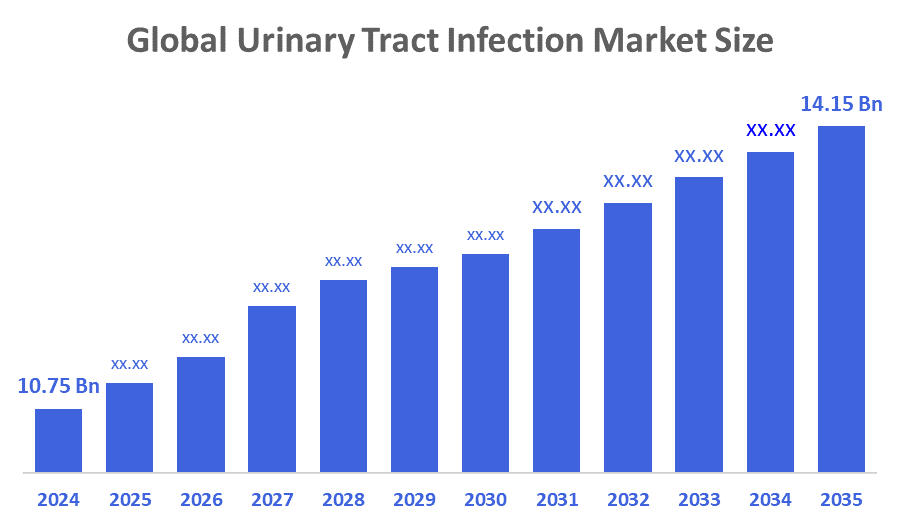
According to a research report published by Decisions Advisors and Consulting, The Global Urinary Tract Infection Market Size Was Worth Around USD 10.75 Billion In 2024 And Is Predicted To Grow To Around USD 14.15 Billion By 2035 With A Compound Annual Growth Rate (CAGR) Of 2.53 % From 2025 To 2035. Preventive measures are becoming more important in the market for urinary tract infections. Moreover, lowering the risk of infections, healthcare professionals are promoting lifestyle changes and education more, and a shift in treatment paradigms and a drop in incidence rates could result in market expansion.
Market Overview
A urinary tract infection (UTI) occurs when bacteria invade the kidneys, ureters, bladder, or urethra. The introduction of novel urinary incontinence devices, together with rising demand for minimally invasive procedures and the industry shift from traditional solutions toward modern urinary incontinence products, and the successful prevention of hospital-acquired infections (HAIs), drive global market growth. The market is restricted because people do not understand how to use urinary incontinence devices, experience post-operative challenges, and have growing concerns about disposable products. The global increase in UTI prevalence, especially among women and older populations, together with the growing use of point-of-care testing solutions and rapid diagnostic technologies, are the main factors driving the market's strong expansion. A favourable environment for market expansion is being created by the increase in hospital-acquired infections, rising awareness of early disease diagnosis, and developments in diagnostic automation. Furthermore, the need for advanced UTI testing solutions in hospitals, diagnostic labs, and home-care settings is being driven by the global healthcare sector's emphasis on lowering antibiotic resistance through increased diagnosis accuracy.
The Urinary Tract Infections Research Initiative, launched by The Urology Foundation (TUF) in 2024, addresses the urgent need for better prevention and treatment of urinary tract infections (UTIs). This initiative is crucial because UTIs are not only widespread but also increasingly resistant to standard antibiotics. By supporting new research, TUF aims to reduce recurrence, improve patient outcomes, and tackle the growing challenge of antimicrobial resistance.
ShanX Medtech, a Dutch diagnostics company and spin-off from Eindhoven University of Technology (TU/e), has raised €24 million to accelerate development of its ultra-rapid antimicrobial susceptibility testing (AST) platform, with an initial focus on urinary tract infections (UTIs).
Report Coverage
This research report categorizes the urinary tract infection market based on various segments and regions, forecasts revenue growth, and analyzes trends in each submarket. The report analyses the key growth drivers, opportunities, and challenges influencing the urinary tract infection market. Recent market developments and competitive strategies, such as expansion, product launch, development, partnership, merger, and acquisition, have been included to draw the competitive landscape in the market. The report strategically identifies and profiles the key market players and analyzes their core competencies in each sub-segment of the urinary tract infection market.
Driving Factors
The urinary tract infection market is currently experiencing notable shifts driven by various factors, for instance, having better knowledge about urinary tract infections and their health effects, which makes them more likely to visit doctors for treatment. The new diagnostic technologies provide better methods for detecting infections, which will result in better patient health outcomes. The market will develop through healthcare providers implementing these new technologies, which will meet the increasing need for effective treatment options. The urinary tract infection market experiences market growth because of increasing diabetes cases and urinary retention problems, which serve as risk factors for urinary tract infections. Telemedicine services have expanded, which now enables patients to receive healthcare through remote consultations with medical experts. The market will experience expansion because it implements new consumer trends and responds to emerging market trends.
The Medicines and Healthcare Products Regulatory Agency (MHRA) approved gepotidacin (brand name Blujepa), marking the UK’s first new type of oral antibiotic for urinary tract infections (UTIs) in nearly 30 years.
Restraining Factors
Complex regulatory requirements are expected to pose increasing obstacles for the global market for treating urinary tract infections. The design, interpretation, and analysis of clinical trials are among the clinical approval procedures that set antibiotic clinical trials apart from those of other pharmaceuticals. Clinical trials for antibacterial drug development are complex and require a rigorous, ethical, and scientific approach. These factors are expected to restrain market expansion during the course of the projection.
Market Segmentation
The urinary tract infection market share is classified into drug class, application and pathogen.
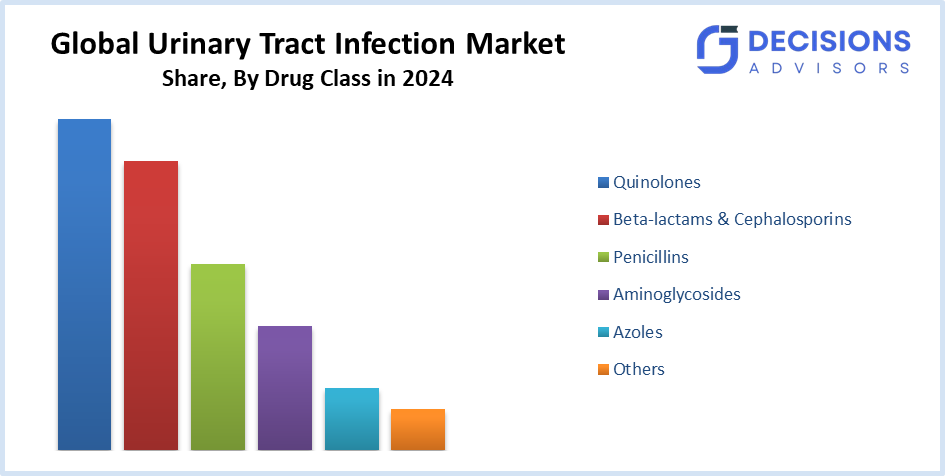
- The quinolones segment accounted for the largest market share in 2024 and is anticipated to grow at a substantial CAGR during the forecast period.
Based on the drug class, the urinary tract infection market is differentiated into quinolones, beta & cephalosporins, aminoglycosides, penicillin, and azoles. Among these, the quinolones segment accounted for the largest market share in 2024 and is anticipated to grow at a substantial CAGR during the forecast period. Many physicians recommend that patients take quinolones as soon as possible to eradicate the illness.
- The cystitis segment accounted for the largest share in 2024 and is anticipated to grow at a significant CAGR during the forecast period.
Based on the application, the urinary tract infection market is segmented into urethritis, cystitis and pyelonephritis. Among these, the cystitis segment accounted for the largest share in 2024 and is anticipated to grow at a significant CAGR during the forecast period. The high incidence and recurrence rate of cystitis, the growing number of approved products, and the large number of diabetes patients who are more susceptible to cystitis are the reasons for this.
For instance, every year, about 10% of women worldwide get acute cystitis.
- The Escherichia coli segment accounted for the highest market revenue in 2024 and is anticipated to grow at a significant CAGR during the forecast period.
Based on the pathogen, the urinary tract infection market is divided into Escherichia coli, Staphylococcus saprophyticus, Klebsiella pneumoniae, Proteus mirabilis and Enterococcus faecalis. Among these, the Escherichia coli segment accounted for the highest market revenue in 2024 and is anticipated to grow at a significant CAGR during the forecast period. This is because individuals are taking antibiotics, and healthcare professionals are promoting the rise in community-acquired UTIs brought on by the Escherichia coli (E. Coli) bacteria. The growing requirement for efficient antibiotic medications for UTIs brought on by Escherichia coli infections must thus be met by market participants in the urinary tract infection treatment sector.
For instance, CARB-X (Combating Antibiotic-Resistant Bacteria Biopharmaceutical Accelerator) has awarded up to $7.51 million in funding to GSK to support the development of a novel oral antibacterial drug targeting urinary tract infections (UTIs) caused by Escherichia coli.
Regional Segment Analysis of the Urinary Tract Infection Market
- North America (U.S., Canada, Mexico)
- Europe (Germany, France, U.K., Italy, Spain, Rest of Europe)
- Asia-Pacific (China, Japan, India, Rest of APAC)
- South America (Brazil and the Rest of South America)
- The Middle East and Africa (UAE, South Africa, Rest of MEA)
Asia Pacific is anticipated to hold the largest share of the urinary tract infection market over the predicted timeframe.
Asia Pacific is anticipated to hold the largest share of the urinary tract infection market over the predicted timeframe. The region experiences growth because people are becoming more aware of healthcare, while their disposable income increases and the population of elderly people who develop UTIs continues to grow. The market is expanding because government programs improve healthcare access and make medical services more affordable. China, India and Japan drive market development through their combination of domestic and foreign pharmaceutical companies that compete for market share. The competitive landscape is changing because organisations now focus on developing solutions that address antibiotic resistance and make healthcare services more accessible.
Cipla introduced HUENA, India’s first non-antibiotic drug specifically developed for recurring urinary tract infections (UTIs). Recurrent UTIs are a major health burden, often leading to repeated courses of antibiotics that disrupt the microbiome and fuel resistance. HUENA represents a paradigm shift - moving from treatment to prevention, and from antibiotics to novel therapeutics.
North America is expected to grow at a rapid CAGR in the urinary tract infection market during the forecast period. The area derives advantages from its modern medical facilities, its high UTI incidence, and its growing public understanding of treatment choices. The market expansion receives momentum from regulatory backing, which the FDA agencies provide because it enables speedier approval processes for fresh medical treatments and innovative developments. The United States leads this market, with Canada following behind. The companies maintain a continuous stream of new medical solutions while their research and development activities work to solve new UTI pathogen resistance problems.
The FDA approved GSK’s gepotidacin (brand name Blujepa) as a new oral antibiotic for uncomplicated urinary tract infections (uUTIs) in adult women and adolescents aged 12 and older. This approval could reshape UTI management, offering a new tool against resistant infections and reducing reliance on older antibiotics that are losing effectiveness.
Competitive Analysis:
The report offers the appropriate analysis of the key organizations/companies involved within the urinary tract infection market, along with a comparative evaluation primarily based on their product offering, business overviews, geographic presence, enterprise strategies, segment market share, and SWOT analysis. The report also provides an elaborative analysis focusing on the current news and developments of the companies, which includes product development, innovations, joint ventures, partnerships, mergers & acquisitions, strategic alliances, and others. This allows for the evaluation of the overall competition within the market.
List of Key Companies
- Abbott Laboratories
- Astellas Pharma Inc.
- AstraZeneca plc
- Bristol-Myers Squibb Company
- Cipla Limited
- Eli Lilly and Company
- GlaxoSmithKline plc
- Johnson & Johnson
- Merck & Co., Inc.
- Novartis AG
- Pfizer Inc.
- Reddy's Laboratories Ltd.
- Sanofi S.A.
- Sun Pharmaceutical Industries Ltd.
- Others
Key Target Audience
- Market Players
- Investors
- End-users
- Government Authorities
- Consulting and Research Firm
- Venture capitalists
- Value-Added Resellers (VARs)
Recent Development
- In February 2026, Pivya offers a narrow-spectrum substitute that might assist maintain the balance of the microbiome in light of the growing resistance to earlier antibiotics like ciprofloxacin and trimethoprim-sulfamethoxazole. Female patients 18 years of age and older with uncomplicated urinary tract infections (uUTI) brought on by susceptible isolates of Escherichia coli, Proteus mirabilis, and Staphylococcus saprophyticus can now be treated with Pivya (pivmecillinam tablets).
- In August 2025, Iterum Therapeutics officially launched ORLYNVAH (sulopenem etzadroxil and probenecid), the first and only oral penem antibiotic available in the United States for uncomplicated urinary tract infections (uUTIs). This marks a turning point in the development of antibiotics by providing physicians with a fresh oral treatment alternative for resistant UTIs. Additionally, it emphasises the growing significance of developing medications that target diseases that are resistant to several drugs in both community and hospital settings.
Market Segment
This study forecasts revenue at global, regional, and country levels from 2020 to 2035. Decisions Advisors has segmented the urinary tract infection market based on the below-mentioned segments:
Global Urinary Tract Infection Market, By Drug Class
- Quinolones
- Beta & Cephalosporins
- Aminoglycosides
- Penicillin
- Azoles
Global Urinary Tract Infection Market, By Application
- Urethritis
- Cystitis
- Pyelonephritis
Global Urinary Tract Infection Market, By Pathogen
- Escherichia coli
- Staphylococcus saprophyticus
- Klebsiella pneumoniae
- Proteus mirabilis
- Enterococcus faecalis
Global Urinary Tract Infection Market, By Regional Analysis
- North America
- US
- Canada
- Mexico
- Europe
- Germany
- UK
- France
- Italy
- Spain
- Russia
- Rest of Europe
- Asia Pacific
- China
- Japan
- India
- South Korea
- Australia
- Rest of Asia Pacific
- South America
- Brazil
- Argentina
- Rest of South America
- Middle East & Africa
- UAE
- Saudi Arabia
- Qatar
- South Africa
- Rest of the Middle East & Africa
Frequently Asked Questions (FAQ)
1. How is antimicrobial resistance (AMR) influencing investment trends in the urinary tract infection market?
Antimicrobial resistance is reshaping investment priorities by encouraging funding toward narrow-spectrum antibiotics, non-antibiotic preventive therapies, bacteriophage research, and rapid antimicrobial susceptibility testing (AST) platforms. Investors are increasingly supporting companies developing precision therapies to reduce broad-spectrum antibiotic overuse.
2. What role do point-of-care (POC) diagnostic technologies play in transforming the UTI treatment landscape?
Point-of-care diagnostic solutions enable faster identification of pathogens and resistance profiles, reducing empirical antibiotic use. This accelerates treatment decisions, improves patient outcomes, and supports antimicrobial stewardship programs, thereby creating new revenue streams within the diagnostics segment.
3. How are reimbursement policies impacting market penetration of novel UTI therapies?
Reimbursement frameworks significantly influence the adoption rates of newly approved antibiotics and diagnostic tools. Favourable insurance coverage and government healthcare programs can accelerate market uptake, whereas pricing pressures and reimbursement delays may slow commercialisation.
4. What emerging non-antibiotic treatment strategies are gaining traction in the UTI market?
Non-antibiotic approaches such as immunoprophylaxis, microbiome-based therapies, D-mannose formulations, probiotics, vaccines in development, and anti-adhesion therapies targeting bacterial attachment mechanisms are gaining attention as sustainable long-term solutions.
5. How does the ageing population affect demand dynamics in the urinary tract infection market?
An expanding geriatric population increases demand for UTI treatment due to higher susceptibility caused by comorbidities, catheter usage, weakened immune systems, and long-term care facility exposure. This demographic shift supports steady long-term market growth.
6. What technological advancements are shaping the future competitive landscape in the UTI market?
Artificial intelligence-driven diagnostic tools, molecular testing platforms, digital health integration for remote monitoring, and precision antibiotic selection algorithms are expected to redefine competitive differentiation among market players.
7. How are hospital-acquired infections (HAIs) influencing product innovation within the UTI market?
The growing burden of catheter-associated UTIs (CAUTIs) is driving innovation in antimicrobial-coated catheters, infection-prevention protocols, and hospital-grade surveillance systems. These advancements create opportunities beyond pharmaceuticals, expanding the market ecosystem.
Check Licence
Choose the plan that fits you best: Single User, Multi-User, or Enterprise solutions tailored for your needs.
We Have You Covered
- 24/7 Analyst Support
- Clients Across the Globe
- Tailored Insights
- Technology Tracking
- Competitive Intelligence
- Custom Research
- Syndicated Market Studies
- Market Overview
- Market Segmentation
- Growth Drivers
- Market Opportunities
- Regulatory Insights
- Innovation & Sustainability
Report Details
| Scope | Global |
| Pages | 240 |
| Delivery | PDF & Excel via Email |
| Language | English |
| Release | Feb 2026 |
| Access | Download from this page |