
US Vacuum Coating Machines Market
 |
Author:
Omkar J
|
Pages:
180
|
Author:
Omkar J
|
Pages:
180
US Vacuum Coating Machines Market Size, Share, By Type (Physical Vapor Deposition, Chemical Vapor Deposition), By Application (Automotive, Aerospace & Defense, Electronics & Semiconductors, Packaging, Optical Components, Others), and By End-User (Industrial, Commercial, Research & Development), Analysis and Forecast 2026-2035.
CAGR
6.2%
REVENUE 2025
USD Million 673.22
FORECAST 2035
USD Million 1229.1
REPORT COVERAGE
Country
Market Snapshot
- US Vacuum Coating Machines Market Size (2025): USD 673.22 Million
- Projected US Vacuum Coating Machines Market Size (2035): USD 1229.10 Million
- Compound Annual Growth Rate (CAGR): 6.2%
- Base Year: 2025
- Historical Period: 2021–2024
- Forecast Period: 2026–2035
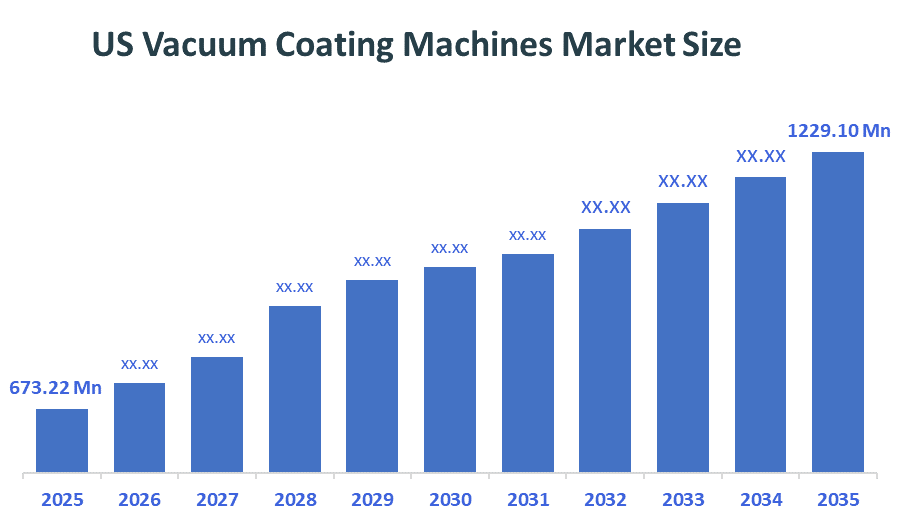
According to Decision Advisors, the US Vacuum Coating Machines Market Size is expected to grow from USD 673.22 Million in 2025 to USD 1229.10 Million by 2035, at a CAGR of 6.2% during the forecast period 2026-2035. US Vacuum Coating Machines Market is projected to grow significantly over the next decade due to rising demand for high-performance, durable, and precise coatings across automotive, aerospace, electronics, and industrial sectors, coupled with technological advancements, automation, and regulatory support for energy-efficient and sustainable manufacturing processes
Market Overview/Introduction
The US Vacuum Coating Machines Market comprises advanced Physical and Chemical Vapor Deposition systems that enable precise thin-film coatings on metals, plastics, glass, and semiconductor substrates. The market shows growth because industrial automation systems become more common while industries need high-performance coatings for automotive, aerospace and electronics, and packaging applications, which require lightweight, durable and environmentally friendly surfaces. The combination of government incentives that support energy-efficient sustainable manufacturing with government regulations that enforce environmental protection, creates an environment that encourages businesses to adopt energy-efficient sustainable manufacturing practices. Veeco Instruments and Oerlikon make R&D investments together with automation and application-specific solutions to improve their coating processes which lead to better coating uniformity, higher production, and lower energy consumption. The market provides precise solutions that deliver dependable performance across multiple applications, which will drive market growth until 2035 because technological progress and industrial demand continue to increase.
Notable Insights: -
- By type, the physical vapor deposition segment held a dominant position with 49% in terms of market share in 2025.
- By end-user, the industrial segment is the dominating accounting for over 53% of the UK market share in 2025.
- The compound annual growth rate of the US vacuum coating machines market is 6.2%.
- The market is likely to achieve a valuation of USD 1229.10 Million by 2035.
What is role of technology in grooming the market?
Technological innovations in US vacuum coating machines, including advanced PVD and CVD systems, precise process controls, automation, and AI-driven monitoring, enhance coating uniformity, adhesion, and durability. Smart monitoring reduces defects and material waste, while energy-efficient, eco-friendly systems ensure regulatory compliance. Rising demand across automotive, aerospace, electronics, packaging, and industrial sectors drives adoption of high-performance, lightweight, and corrosion-resistant coatings. Government incentives and sustainability regulations further support market expansion. Leading companies invest in R&D and application-specific solutions to improve efficiency and performance. These factors collectively position the US vacuum coating machines market for significant growth through 2035.
Market Drivers
The US Vacuum Coating Machines Market experiences growth because multiple industries require high-performance, durable, and lightweight coatings for their automotive, aerospace, electronics and industrial applications. The market expansion occurs because industrial automation increases, and businesses require precise coatings for semiconductor and optical components. The market develops because government regulations and incentives drive manufacturers to adopt energy-efficient, environmentally friendly and sustainable production methods. The advancements in deposition techniques, vacuum systems, and automation technology deliver higher production output while decreasing expenses and increasing coating quality. The US vacuum coating machines market will experience substantial growth until 2035 because these elements guarantee businesses access to dependable, exact and environmentally friendly coating technologies.
Restrain
The US vacuum coating machines market faces challenges from high capital expenditure and operational costs due to energy-intensive manufacturing. Competition from alternative coating technologies such as electroplating, spray coating, and sol-gel methods puts pressure on market share. Stringent environmental and safety regulations increase compliance expenses, while dependence on specialized raw materials adds supply chain risks. Manufacturers must optimize processes, invest in sustainable materials, and enhance efficiency to remain competitive and ensure continued adoption of vacuum coating solutions across industrial, automotive, and electronics sectors.
Strategies to Implement for Growth of the Market
US vacuum coating machines market growth depends on companies developing advanced PVD and CVD systems, which provide increased throughput and precise results and consume less energy. The company responds to growing industry needs by extending its product range, which includes automotive, aerospace, electronics and packaging solutions. AI-driven monitoring, predictive maintenance, and automation systems work together to improve process efficiency while maintaining product quality standards. The company expands its market presence by establishing strategic alliances with industrial OEMs, electronics manufacturers and research institutions. The company focuses on high-margin semiconductor coatings, optical components and specialty industrial applications to create a sustainable manufacturing base that meets regulatory requirements, which will drive long-term market expansion and competitive advantages.
Study on the Supply, Demand, Distribution, and Market Environment
The US vacuum coating machines industry experiences growth because various industries including automotive, aerospace, electronics, packaging and R&D sectors require precise and strong and lightweight coatings. The efficiency of PVD and CVD systems increases through process automation and AI-driven monitoring, while their coating quality and energy efficiency both improve. Leading companies spend money on research and development while developing solutions that meet market demands because government incentives and sustainability rules encourage businesses to adopt these technologies. The company establishes market presence through its strong distribution networks and strategic partnerships, enables them to deliver dependable supply and high-performance products. The sector achieves substantial growth through these elements, that secure its competitive advantage until 2035.
Price Analysis and Consumer Behaviour Analysis
The United States market for vacuum coating machines shows price differences that depend on the machine's system specifications, its capacity to process materials, and its level of automated functions. The price range for mid-range PVD systems in 2025 extended from USD 150,000 to 250,000, while high-end CVD machines required more than USD 400,000 for purchase. Buyers prioritize energy efficiency, consistent coating quality, maintenance support, and overall reliability over initial cost. Industrial users choose high-performance machines that provide extended operational life to maintain their productivity, while research and development organizations require machines that deliver flexibility, precision and adaptability for their specialized testing needs. The machine selection process and investment choices of organizations demonstrate how organizations work to achieve their performance targets through cost-efficient solutions which meet specific operational needs.
Market Segmentation
The US vacuum coating machines market share is classified into type, application and end-user.
- The physical vapor deposition segment dominated the market in 2025, and is projected to grow at a substantial CAGR of approximately 49% during the forecast period.
Based on the type, the US vacuum coating machines market is divided into Physical Vapor Deposition (PVD) and Chemical Vapor Deposition (CVD). Among these, the physical vapor deposition segment dominates the market in 2025, and is projected to grow at a substantial CAGR of approximately 49% during the forecast period. This is driven by higher adoption across automotive, aerospace, electronics, and industrial applications due to its precision, versatility, and energy-efficient operation compared to CVD systems.
- The automotive & aerospace segment dominated the market in 2025, and is projected to grow at a substantial CAGR during the forecast period.
Based on the application, the US vacuum coating machines market is divided into automotive, aerospace & defense, electronics & semiconductors, packaging, optical components, and others. Among these, the automotive & aerospace segment dominated the market in 2025, and is projected to grow at a substantial CAGR during the forecast period. The growth is driven by increasing demand for durable, lightweight, and corrosion-resistant coatings in high-performance components.
- The industrial segment accounted for the largest share in 2025, and is anticipated to grow at a significant CAGR of approximately 53% during the forecast period.
Based on the end-user, the US vacuum coating machines market is divided into industrial, commercial, and research & development. Among these, the industrial segment accounted for the largest share in 2025, and is anticipated to grow at a significant CAGR of approximately 53% during the forecast period. This is because industries require high-capacity, durable, and maintenance-free energy storage solutions for backup power, uninterrupted operations, and critical system support, making industrial applications the dominant end-user segment over residential, commercial, and utility sectors
Recent Development
- In September 2024, Oerlikon Balzers launched its INVENTA PVD vacuum coating system in the US, featuring Advanced Arc Technology (AAT) for higher coating efficiency, improved uniformity, and energy savings, targeting automotive, industrial, and precision component applications.
- In February?2025, a next?generation multi?source PVD vacuum coating platform designed to increase throughput and coating uniformity for high?volume production was introduced by Balzers, reflecting ongoing innovation in vacuum coating equipment.
Competitive Analysis
The report offers the appropriate analysis of the key organisations/companies involved within the US vacuum coating machines market, along with a comparative evaluation primarily based on their product offering, business overviews, geographic presence, enterprise strategies, segment market share, and SWOT analysis. The report also provides an elaborative analysis focusing on the current news and developments of the companies, which includes product development, innovations, joint ventures, partnerships, mergers & acquisitions, strategic alliances, and others. This allows for the evaluation of the overall competition within the market.
Top Key Companies in US Vacuum Coating Machines Market
- Applied Materials, Inc.
- Oerlikon Balzers
- ULVAC, Inc.
- Veeco Instruments Inc.
- Buhler AG / Buhler Leybold Optics
- IHI Hauzer Techno Coating B.V.
- Von Ardenne GmbH
- Singulus Technologies AG
- Kurt J. Lesker Company
- Denton Vacuum LLC
Key Target Audience
- Market Players
- Investors
- End-users
- Government Authorities
- Consulting and Research Firm
- Venture capitalists
- Value-Added Resellers (VARs)
Market Segment
This study forecasts revenue at the India, regional, and country levels from 2020 to 2035. Decision Advisors has segmented the US vacuum coating machines market based on the below-mentioned segments
US Vacuum Coating Machines Market, By Type
- Physical Vapor Deposition (PVD)
- Chemical Vapor Deposition (CVD)
US Vacuum Coating Machines Market, By Application
- Automotive
- Aerospace & Defense
- Electronics & Semiconductors
- Packaging
- Optical Components
- Others
US Vacuum Coating Machines Market, By End-User
- Industrial
- Commercial
- Research & Development
Frequently Asked Questions (FAQ)
Q. How does IoT integration benefit vacuum coating operations?
A. IoT-enabled machines provide real-time monitoring, remote diagnostics, and predictive alerts, reducing downtime and optimizing coating uniformit
Q. Can vacuum coating machines be used for 3D-printed components?
A. Yes, they apply uniform protective or functional coatings on complex geometries, enhancing strength, wear resistance, and aesthetic finish.
Q. Are vacuum coating machines adaptable to multiple materials?
A. Modern machines can handle metals, polymers, ceramics, and composites, allowing versatile applications across electronics, medical devices, optics, and automotive sectors.
Q. What is the role of vacuum coating machines in electric vehicles (EVs)?
A. They enhance battery contacts, lightweight components, and thermal management surfaces, improving efficiency, durability, and safety of EV systems.
Check Licence
Choose the plan that fits you best: Single User, Multi-User, or Enterprise solutions tailored for your needs.
We Have You Covered
- 24/7 Analyst Support
- Clients Across the Globe
- Tailored Insights
- Technology Tracking
- Competitive Intelligence
- Custom Research
- Syndicated Market Studies
- Market Overview
- Market Segmentation
- Growth Drivers
- Market Opportunities
- Regulatory Insights
- Innovation & Sustainability
Report Details
| Scope | Country |
| Pages | 180 |
| Delivery | PDF & Excel via Email |
| Language | English |
| Release | Apr 2026 |
| Access | Download from this page |