
US Wall Bed Market
 |
Author:
Rahul B
|
Pages:
200
|
Author:
Rahul B
|
Pages:
200
US Wall Bed Market Size, Share, By Type (Murphy Bed, Folding Wall Bed), By Application (Residential, Commercial, Hospitality, Office, Others), and By End-User (Homeowners, Hospitality Industry, Offices, Real Estate Developers), Analysis and Forecast 2026-2035
CAGR
5.9%
REVENUE 2025
USD Billion 513.37
FORECAST 2035
USD Billion 910.89
REPORT COVERAGE
country
Market Snapshot
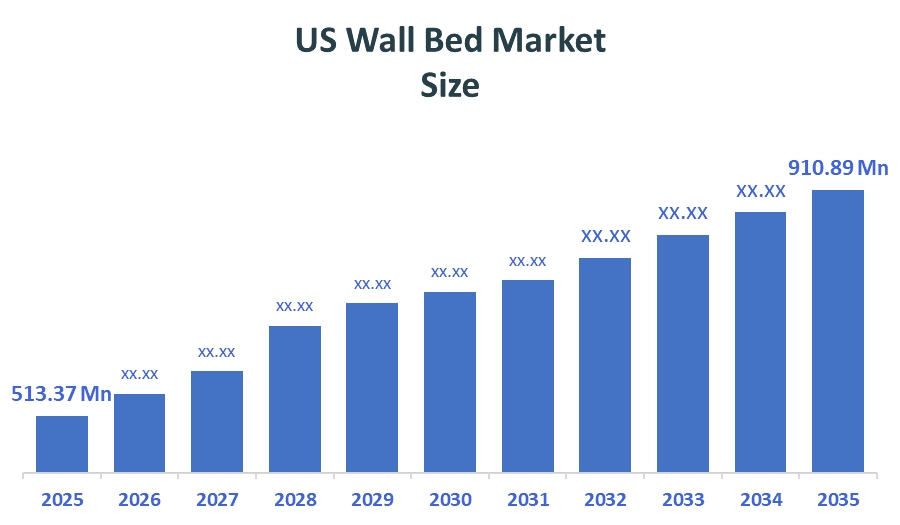
- US Wall Bed Market Size (2025): USD 513.37 Million
- Projected US Wall Bed Market Size (2035): USD 910.89 Million
- Compound Annual Growth Rate (CAGR): 5.9%
- Base Year: 2025
- Historical Period: 2021–2024
- Forecast Period: 2026–2035
Market Overview/Introduction
The US Wall Bed Market includes space-saving furniture products which feature Murphy beds, folding wall beds and multifunctional systems that serve residential, commercial and hospitality purposes. The market is experiencing strong growth because urban areas are expanding and people prefer to live in small apartments while they seek furniture that combines multiple functions with ergonomic design. Government schemes that promote affordable housing with energy-efficient, sustainable interior solutions create a favorable environment for implementation. Resource Furniture IKEA and WallBedKing lead the industry through their development of intelligent motorized systems, flexible product designs and Internet of Things technology. The market advantage provides customers with space optimization solutions that improve their daily activities while they select from different product options. The market will continue to grow because urban areas become denser, consumer behavior changes and technology progresses.
Notable Insights: -
- By type, the murphy bed segment held a dominant position with 62% in terms of market share in 2025.
- By end-user, the homeowners segment is the dominating accounting for over 51% of the UK market share in 2025.
- The compound annual growth rate of the US Wall Bed Market is 5.9%.
- The market is likely to achieve a valuation of USD 910.89 Million by 2035.
What is role of technology in grooming the market?
Growth is driven by urbanization, smaller living spaces, and rising demand for multifunctional furniture. Technological advancements, including smart automated lift systems, motorized mechanisms, modular designs, and IoT-enabled controls, enhance convenience, safety, and space optimization. Government schemes supporting affordable housing and sustainable interiors further encourage adoption. Companies like Resource Furniture and IKEA focus on innovation, smart integration, and customizable designs to meet diverse consumer needs. The key advantage lies in maximizing space, durability, and aesthetics. With ongoing innovation and increasing residential, commercial, and hospitality demand, the industry is expected to expand steadily over the next decade.
Market Drivers
The growing population of cities, with their shrinking residential areas, creates a need for furniture solutions that occupy less space. Consumers are increasingly seeking multifunctional, smart, and ergonomic solutions for both residential and commercial environments. The growth of office spaces, hotels, and rental housing further boosts commercial demand. Manufacturers develop their product designs through high-quality, durable materials that meet customer requirements together with their unique design solutions. Technological advancements through motorized mechanisms and modular configurations with smart integration create better safety, usability and convenience experiences. The combination of these elements with government programs that support sustainable housing solutions will maintain industry growth throughout the upcoming ten years.
Restrain
High manufacturing and customization costs can limit affordability for some buyers, while reliance on raw materials like wood, metal, and hardware affects production consistency. The industry also faces competition from alternative space-saving solutions, including sofa beds and loft beds. Additionally, limited consumer awareness and slower adoption of motorized or smart furniture systems pose challenges. Manufacturers must focus on cost optimization, supply chain stability, and education about advanced features to overcome these barriers and encourage broader acceptance of multifunctional, space-efficient furniture solutions.
Strategies to Implement for Growth of the Market
Companies are developing furniture solutions that have modular design and multiple functions to create furniture for small apartments and office spaces, which also provides maximum usability and convenience. The system now incorporates smart technologies together with IoT-enabled features to improve automation and safety while enhancing user experience. There is a growing emphasis on premium, customizable designs tailored for residential and hospitality segments to meet diverse customer needs. The company wants to expand its distribution channels by using e-commerce platforms and furniture retailers and establishing partnerships with real estate developers. The organization plans to invest in research and development to achieve three goals, which include increasing durability, decreasing production costs and using sustainable materials to guarantee growth and competitive advantage.
Study on the Supply, Demand, Distribution, and Market Environment
The industry benefits from urbanization which accelerates as housing prices increase and people use commercial and hospitality spaces more frequently. The company uses distribution channels that operate efficiently while it maintains partnerships with real estate developers and furniture retailers and operates its own e-commerce platform. The adoption rate increases because consumers prefer products that last long and install easily and look attractive. Companies develop smart designs together with modular systems and customizable solutions to fulfill different requirements in both residential and commercial spaces. The industry will experience continuous growth throughout the next ten years due to technological advancements and increasing knowledge of space-saving solutions.
Price Analysis and Consumer Behaviour Analysis
Pricing varies depending on type, size, mechanism (manual or motorized), materials, and design complexity. In 2025, mid-range wall beds were valued between USD 1,200 and 2,500, while premium motorized and smart-integrated designs exceeded USD 5,000. Consumers prioritize durability, space efficiency, ease of use, and aesthetics over cost. Residential buyers seek solutions optimized for small apartments, while commercial customers, including offices, hotels, and rental properties, focus on reliability, long-term usability, and low maintenance. Manufacturers and retailers tailor offerings to meet diverse needs, providing options from manual to advanced motorized designs, ensuring wide adoption and supporting industry growth.
Market Segmentation
The US Wall Bed Market share is classified into type, application and end-user.
- The murphy bed segment dominated the market in 2025, and is projected to grow at a substantial CAGR of approximately 62% during the forecast period.
Based on the type, the US wall bed market is divided into murphy beds and folding wall beds. Among these, the murphy beds segment dominates the market in 2025, and is projected to grow at a substantial CAGR of approximately 62% during the forecast period. This is driven by space-saving designs, ease of use, multifunctionality, and customizable features, meeting consumer needs for efficient, practical, and flexible living and working environments.
- The residential segment dominated the market in 2025, and is projected to grow at a substantial CAGR during the forecast period.
Based on the application, the US Wall Bed Market is divided into residential, commercial, hospitality, office, and others. Among these, the residential segment dominated the market in 2025, and is projected to grow at a substantial CAGR during the forecast period. Growth is driven by urbanization, smaller living spaces, and rising demand for multifunctional furniture, as consumers increasingly seek space-efficient, practical, and stylish solutions for residential, commercial, and hospitality environments.
- The homeowners segment accounted for the largest share in 2025, and is anticipated to grow at a significant CAGR of approximately 51% during the forecast period.
Based on the end-user, the US Wall Bed Market is divided into homeowners, hospitality industry, offices, and real estate developers. Among these, the homeowners segment accounted for the largest share in 2025, and is anticipated to grow at a significant CAGR of approximately 51% during the forecast period. This is due to increasing urban living, smaller apartments, and high demand for space-saving, durable, easy-to-install, and multifunctional furniture solutions that enhance convenience, efficiency, and living comfort.
Recent Development
- In April 2025, Circular Designs BV launched modular wall beds made entirely from recycled materials, emphasizing sustainability and eco-friendly design trends, catering to environmentally conscious consumers and advancing circular economy practices.
- In November?2024, Mobiliario Moderno SA de CV announced investments to expand its manufacturing capacity, aiming to enhance production of wall beds and multifunctional furniture for the growing U.S. market.
Competitive Analysis
The report offers the appropriate analysis of the key organisations/companies involved within the US Wall Bed Market, along with a comparative evaluation primarily based on their product offering, business overviews, geographic presence, enterprise strategies, segment market share, and SWOT analysis. The report also provides an elaborative analysis focusing on the current news and developments of the companies, which includes product development, innovations, joint ventures, partnerships, mergers & acquisitions, strategic alliances, and others. This allows for the evaluation of the overall competition within the market.
Top Key Companies in US Wall Bed Market
- Resource Furniture
- IKEA
- California Closets
- WallBedKing
- Murphy Bed Depot
- Zoom-Room
- Wayfair (Wall Bed Products)
- Expand Furniture
- Snooze Innovations
- Clei USA
Key Target Audience
- Market Players
- Investors
- End-users
- Government Authorities
- Consulting and Research Firm
- Venture capitalists
- Value-Added Resellers (VARs)
Market Segment
This study forecasts revenue at the India, regional, and country levels from 2020 to 2035. Decision Advisors has segmented the US Wall Bed Market based on the below-mentioned segments
US Wall Bed Market, By Type
- Murphy Bed
- Folding Wall Bed
US Wall Bed Market, By Application
- Residential
- Commercial
- Hospitality
- Office
- Others
US Wall Bed Market, By End-User
- Homeowners
- Hospitality Industry
- Offices
- Real Estate Developers
Frequently Asked Questions (FAQ)
Q. Are motorized wall beds safer than manual ones?
A. Yes, modern motorized systems include safety locks, anti-fall mechanisms, and controlled speed, reducing risks during folding and unfolding.
Q. How do wall beds contribute to sustainable building practices?
A. By maximizing usable floor space, reducing the need for additional furniture, and using eco-friendly materials, wall beds support sustainable interior solutions.
Q. What challenges exist in mass adoption for corporate clients?
A. High upfront costs, installation requirements, and integration with existing interiors can slow adoption without strategic planning and supplier support.
Q. What role does customization play in market competitiveness?
A. Customizable dimensions, finishes, and integrated storage solutions allow companies to meet diverse client needs, enhancing brand differentiation and customer loyalty.
Check Licence
Choose the plan that fits you best: Single User, Multi-User, or Enterprise solutions tailored for your needs.
We Have You Covered
- 24/7 Analyst Support
- Clients Across the Globe
- Tailored Insights
- Technology Tracking
- Competitive Intelligence
- Custom Research
- Syndicated Market Studies
- Market Overview
- Market Segmentation
- Growth Drivers
- Market Opportunities
- Regulatory Insights
- Innovation & Sustainability
Report Details
| Scope | country |
| Pages | 200 |
| Delivery | PDF & Excel via Email |
| Language | English |
| Release | Apr 2026 |
| Access | Download from this page |