
Global Veterinary Anesthesia Market
 |
Author:
David J
|
Pages:
210
|
Author:
David J
|
Pages:
210
Veterinary Anesthesia Market Size, Share, By Product Type (Injectable Anesthesia, Inhalation Anesthesia, Local Anesthesia, Sedatives & Analgesics), By Application (Surgical Procedures, Diagnostic Procedures, Pain Management, Emergency & Critical Care, Dental Procedures, Others), By End User (Veterinary Clinics, Veterinary Hospitals, Research & Academic Institutes, Farms & Livestock Facilities), and By Region (North America, Europe, Asia-Pacific, Latin America, Middle East & Africa), Analysis and Forecast 2026?2035
CAGR
4.8%
REVENUE 2025
USD Million 174.3
FORECAST 2035
USD Million 278.6
REPORT COVERAGE
Global
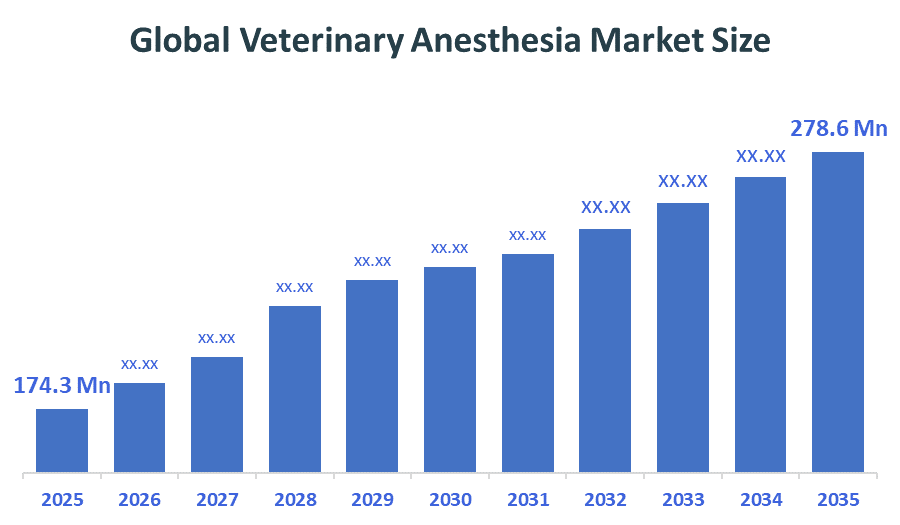
The Global Veterinary Anesthesia Market Size is foreseen to grow from USD 174.3 Million in 2025 and is govern to reach around USD 278.6 Million by 2035. According to Decision Advisors, a detailed research report on the global veterinary anesthesia market is boosted by technological convergence, accounting for nearly upto the 64% to 66% share of the total share worldwide. Zoetis is the prime player in the market with approximately USD 6.65 Billion in annual turnover and a 20-25 % market share, positioning it as the primary driver of the global veterinary anesthesia market.
Market Snapshot
- Global Veterinary Anesthesia Market Size (2025): USD 174.3 Million
- Projected Global Veterinary Anesthesia Market Size (2035): USD 278.6 Million
- Global Veterinary Anesthesia Market Compound Annual Growth Rate (CAGR): 4.8%
- Largest Growing Region: North America
- Fastest Regional Market: Asia Pacific
- 2nd Largest Region: Europe
- Base Year: 2025
- Historical Period: 2021–2024
- Forecast Period: 2026–2035
Market Overview/ Introduction
The veterinary anesthesia market as the safety net behind the scenes of modern pet care. It’s no longer just about putting an animal to sleep for a quick procedure, it’s about a massive shift toward treating our pets with the same medical precision we expect for ourselves. As more of us start viewing our dogs and cats as true family members, we are approving to complex surgeries like hip replacements or advanced dental work that were rare a decade ago. Right now, the tech revolution is making these procedures much safer. We are moving away from one-size-fits-all dosing. Instead, new smart machines use AI and real-time monitoring to adjust anesthesia levels instantly based on a pet's vitals. This is a game-changer for prior pets or high-risk breeds that owners used to be terrified to put under. Industry giants like Zoetis and Mindray are leaning hard into this, creating portable, high-tech tools that permit even small local clinics or mobile vets to offer hospital-grade safety. Looking ahead, the goal is smarter and greener. The industry is focused on low-flow anesthesia, which uses less gas to protect the environment and save costs, while regions like the Asia-Pacific are seeing a massive boom in pet hospitals. Essentially, the market is growing because our standard of care has levelled up, we don't just want our pets to get through surgery, we want them to wake up faster, feel less pain, and get back to their spot on the couch as quickly as possible.
Notable Insights: -
- North America is anticipated to hold approximately 37% share of the global veterinary anesthesia market over the predicted timeframe.
- Asia Pacific is the fastest-growing region in the global veterinary anesthesia market during the forecast period, holding approximately 29% share.
- By product type, the injectable anesthesia segment dominated the market and holds approximately 48% share in 2025 and is projected to grow at a substantial CAGR during the forecast period.
- By end user, the veterinary hospitals segment dominated the market and holds approximately 44% share in 2025 and is projected to grow at a substantial CAGR during the forecast period.
- The compound annual growth rate of the global veterinary anesthesia market is 4.8%.
6. The market is likely to achieve a valuation of USD 278.6 Million by 2035.
What is the role of technology in grooming the market?
Technology plays a crucial role in shaping the veterinary thermography market by improving diagnostic accuracy, speed, and accessibility. Advanced infrared cameras combined with AI analytics enable veterinarians to detect subtle temperature variations linked to inflammation, injury, or disease at an early stage, even before visible symptoms appear. For example, AI-powered thermography systems developed by Osaka Metropolitan University are being used to monitor temperature patterns in calves, helping detect stress and illness non-invasively. Additionally, portable handheld and smartphone-based devices allow field veterinarians to perform real-time assessments on farms, making thermography more practical and widely adopted in everyday veterinary care.
Market Drivers
This market is growing because we’ve stopped seeing pets as just animals and started treating them like family. When a pet needs surgery today, we aren't just looking for them to survive the procedure; we want the same level of safety, comfort, and high-tech care that we’d expect for a human relative. This emotional bond is the real engine it’s what pushes owners to choose advanced treatments for their senior dogs or specialised care for their cats, knowing that modern technology has made the scary part of anesthesia much safer. On the professional side, veterinarians are being empowered by a tech safety net. New AI-driven tools take the guesswork out of dosing, acting like an extra set of eyes that monitors every breath and heartbeat in real time. This shift is removing the fear factor for both the vet and the pet parent. Plus, with pet insurance becoming more common, the high cost of these human-grade surgeries is no longer a total dealbreaker for many families. It’s a combination of deeper love for our animals and the tech finally catching up to make that love actionable, ensuring our pets can live longer, healthier lives by our side.
Restrain
The veterinary thermography market is restrained by the high cost of advanced infrared imaging devices, which limits adoption among small veterinary clinics and livestock owners, especially in developing regions. Additionally, the lack of standardized diagnostic protocols and trained professionals to accurately interpret thermal images reduces reliability and slows widespread acceptance.
Competitive Analysis:
The report offers the appropriate analysis of the key organizations/companies involved within the global veterinary anesthesia market, along with a comparative evaluation primarily based on their product of offering, business overviews, geographic presence, enterprise strategies, segment market share, and SWOT analysis. The report also provides an elaborative analysis focusing on the current news and developments of the companies, which includes product development, innovations, joint ventures, partnerships, mergers & acquisitions, strategic alliances, and others. This allows for the evaluation of the overall competition within the market.
Top Companies in the Global Veterinary Anesthesia Market
- Midmark Corporation
- Zoetis Inc.
- Boehringer Ingelheim
- Dispomed
- Hallowell EMC
- Kent Scientific Corporation
- JD Medical
- Smith’s Group PLC
- Avante Health Solutions
- RWD Life Science Co., LTD
Government Initiatives
|
Country |
Key Government Initiatives |
|
India |
This fund, with a total outlay of ?29,610 crore, is extended until March 31, 2026, supporting private investment in veterinary hospitals and diagnostic centres. |
|
UK |
The Royal Veterinary College (RVC) has received substantial government investment, including a £5 million grant to drive research and commercialization in veterinary medicine. |
|
South Korea |
Animal Medicine Expansion: The Ministry of Agriculture, Food and Rural Affairs aims to boost the overall animal medicine market to 4 trillion won ($2.7 billion) by 2035. |
Study on the Supply, Demand, Distribution, and Market Environment of the Global Veterinary Anesthesia Market
The global veterinary anesthesia market operates through a well-established supply chain of pharmaceutical manufacturers, medical device companies, and distributors supplying veterinary hospitals, clinics, and livestock facilities. The market is witnessing steady demand growth, driven by a approximately7% annual increase in veterinary surgical procedures globally, along with rising pet ownership and livestock healthcare needs. Companion animals account for nearly 60–65% of total anesthesia usage, due to higher surgical intervention rates. Distribution is primarily handled through direct sales and veterinary pharmaceutical networks, with increasing penetration of online veterinary supply platforms. The overall market environment remains favourable, supported by growing animal healthcare expenditure (estimated to exceed USD 200 billion globally) and advancements in safer anesthetic agents and monitoring technologies, although cost sensitivity in developing regions continues to influence adoption rates.
Price Analysis and Consumer Behaviour Analysis
Veterinary anesthesia products are moderately to highly priced depending on drug type and delivery system, with inhalation anesthesia equipment and advanced monitoring systems costing significantly more than injectable anesthetics. Prices are influenced by factors such as drug safety profile, duration of action, and regulatory approvals. From a consumer behavior perspective, veterinarians prioritize efficacy, safety, and faster recovery times over cost, especially for companion animals. Pet owners, driven by increasing pet humanization, are more willing to spend on safe anesthesia solutions, contributing to a steady rise in premium product adoption. However, in livestock and developing regions, cost sensitivity remains high, leading to preference for affordable and widely available injectable anesthetics.
Market Segmentation
The Global Veterinary Anesthesia Market is classified into product type, application and end user.
- The injectable anesthesia segment dominated the market and holds approximately 48% share in 2025 and is projected to grow at a substantial CAGR during the forecast period.
Based on the product type, the global veterinary anesthesia market is divided into injectable anesthesia, inhalation anesthesia, local anesthesia, and sedatives & analgesics. Among these, the injectable anesthesia segment dominated the market and holds approximately 48% share in 2025 and is projected to grow at a substantial CAGR during the forecast period. This dominance is attributed to its rapid onset of action, ease of administration, and widespread use in routine veterinary procedures. Injectable anesthetics are highly preferred for short-duration surgeries and emergency interventions across both companion and livestock animals. Additionally, their cost-effectiveness and minimal requirement for complex equipment are further driving segment growth.
- The surgical procedures segment accounted for the largest share of approximately 42% in 2025 and is anticipated to grow at a significant CAGR during the forecast period.
Based on the application, the global veterinary anesthesia market is divided into surgical procedures, diagnostic procedures, pain management, emergency & critical care, dental procedures, and others. Among these, the surgical procedures segment accounted for the largest share of approximately 42% in 2025 and is anticipated to grow at a significant CAGR during the forecast period. This is primarily due to the increasing number of surgeries such as orthopedic, soft tissue, and reproductive procedures in animals. Anesthesia is essential for ensuring pain-free and safe surgical interventions, making it a critical component in veterinary care. Furthermore, the growing adoption of advanced surgical techniques and rising pet healthcare expenditure are significantly contributing to the growth of this segment.
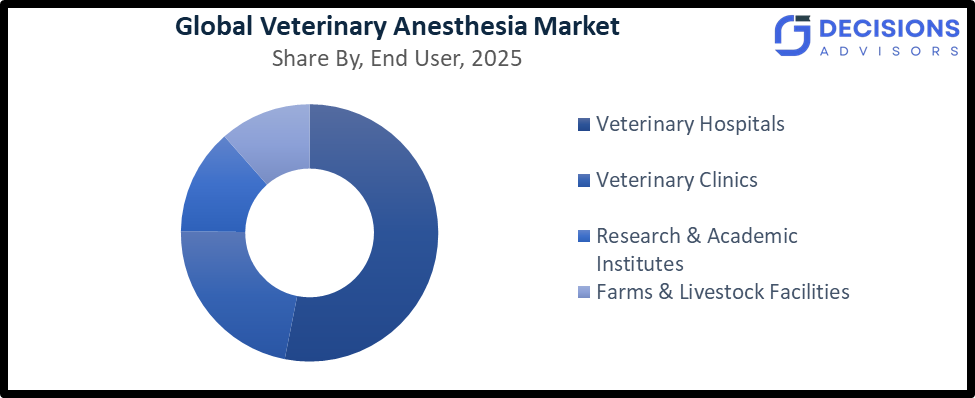
- The veterinary hospitals segment dominated the market and holds approximately 44% share in 2025 and is projected to grow at a substantial CAGR during the forecast period.
Based on end user, the global veterinary anesthesia market is divided into veterinary hospitals, veterinary clinics, research & academic institutes, and farms & livestock facilities. Among these, the veterinary hospitals segment dominated the market and holds approximately 44% share in 2025 and is projected to grow at a substantial CAGR during the forecast period, owing to the availability of advanced surgical infrastructure and skilled veterinary professionals. Veterinary hospitals serve as primary centres for complex surgeries and critical care procedures that require precise anesthesia administration and monitoring. The increasing number of surgical cases, rising awareness about animal welfare, and growing investment in veterinary healthcare infrastructure are further supporting segment growth. Additionally, improved access to specialised veterinary services is strengthening the dominance of this segment.
Strategies to Implement for Growth of the Market in Non-Leading Regions
Growth in non-leading regions can be accelerated by improving access to affordable veterinary anesthesia products and expanding veterinary infrastructure, particularly in rural and developing areas. Companies should focus on introducing cost-effective injectable anesthetics and portable anesthesia delivery systems to suit resource-limited settings. Strengthening distribution networks through partnerships with local veterinary clinics, livestock programs, and government initiatives can enhance market penetration. Additionally, conducting training programs for veterinarians on safe anesthesia administration and monitoring will improve adoption. Increasing awareness about animal welfare and pain management, along with flexible pricing and financing options, will further support market growth in these regions.
Regional Segment Analysis of the Global Veterinary Anesthesia Market
- North America (U.S., Canada, Mexico)
- Europe (Germany, France, U.K., Italy, Spain, Rest of Europe)
- Asia-Pacific (China, Japan, India, Rest of APAC)
- South America (Brazil and the Rest of South America)
- The Middle East and Africa (UAE, South Africa, Rest of MEA)
North America is anticipated to hold approximately 37% share of the global veterinary anesthesia market over the predicted timeframe.
North America is anticipated to hold approximately 37% share of the global veterinary anesthesia market over the predicted timeframe. It maintains a dominant market position due to advanced veterinary healthcare infrastructure, high pet ownership rates, and strong adoption of surgical and anesthesia technologies. The United States is the key contributor, supported by increasing expenditure on companion animal healthcare and a high volume of veterinary surgical procedures. For instance, veterinary hospitals in the U.S. routinely use advanced inhalation anesthesia systems and monitoring equipment for complex surgeries in pets. Continuous advancements in anesthetic drugs, the presence of major veterinary pharmaceutical companies, and growing awareness regarding animal pain management are further strengthening the region’s leadership.
Asia Pacific is the fastest-growing region in the global veterinary anesthesia market during the forecast period, holding approximately 29% share.
Asia Pacific is the fastest-growing region in the global veterinary anesthesia market during the forecast period, holding approximately 29% share. This growth is driven by the rising livestock population, increasing pet adoption, and improving veterinary infrastructure in countries such as China, India, and Japan. The region is witnessing growing demand for anesthesia in both surgical and disease management procedures, particularly in dairy and poultry farms. For example, in India and China, anesthesia is increasingly used during surgical interventions and disease treatment in livestock to improve productivity and animal welfare. Additionally, government initiatives supporting livestock healthcare and rising investments in veterinary services are accelerating market growth.
Europe is expected to hold approximately 23% share and is the second-largest region in the global veterinary anesthesia market during the forecast period.
Europe is expected to hold approximately 23% share and is the second-largest region in the global veterinary anesthesia market during the forecast period. The region’s growth is supported by strict animal welfare regulations, well-established veterinary systems, and high adoption of advanced anesthesia practices. Countries such as Germany, the United Kingdom, and France are leading the market due to strong emphasis on animal safety and mandatory use of anesthesia in surgical and experimental procedures. For instance, veterinary clinics across Europe widely use multimodal anesthesia techniques to ensure safer and more effective pain management in animals. Additionally, increasing investments in veterinary research and favourable regulatory frameworks are contributing to innovation and adoption, further supporting market expansion.
Future Market Trends in the Global Veterinary Anesthesia Market:
1. Shift Toward Safer and Minimally Invasive Anesthesia Techniques
There is a growing trend toward the use of safer anesthetic agents and minimally invasive surgical procedures in veterinary care. Modern anesthesia solutions are designed to reduce complications, improve recovery time, and enhance overall patient safety. This shift is driven by increasing awareness of animal welfare and the need for precision in surgical interventions.
2. Adoption of Advanced Monitoring and Smart Anesthesia Systems
Veterinary practices are increasingly integrating advanced monitoring technologies with anesthesia systems to track vital parameters such as heart rate, oxygen levels, and blood pressure in real time. Innovations like automated anesthesia delivery and software-assisted monitoring are improving procedural accuracy and reducing risks during surgeries.
3. Rising Demand for Gas-Based and Portable Anesthesia Systems
There is a significant shift toward inhalation (gas-based) anesthesia systems due to their precise dosage control and faster recovery benefits. Additionally, portable and compact anesthesia machines are gaining popularity, especially in mobile veterinary services and field applications, enhancing accessibility and flexibility in animal healthcare.
Recent Development
- In January 2026, Parnell launched Isoflurane, an advanced inhalation anesthetic designed to improve anesthesia management in veterinary procedures. The product offers rapid induction and recovery, enhanced safety profile, and precise control over anesthesia depth, enabling veterinarians to perform complex surgeries more efficiently while ensuring better patient outcomes
- In September 2025, Dechra Veterinary Products partnered with the American Veterinary Medical Foundation (AVMF) to expand its veterinary scholarship program, introducing a new category focused on anesthesia, surgery, and critical care. This partnership aims to support the development of skilled professionals in anesthesia practices, strengthening future workforce capabilities in veterinary healthcare.
- In March 2025, SageTech Veterinary partnered with National Veterinary Services (NVS) to expand access to sustainable anesthesia solutions across the United Kingdom. The collaboration focused on distributing advanced anesthetic gas capture and recycling technologies, enabling veterinary clinics to improve environmental sustainability while enhancing the safety and efficiency of anesthesia procedures.
- In January 2025, Parnell introduced PropofolVet Multidose, an injectable anesthetic formulation for dogs aimed at improving procedural efficiency in veterinary practices. The product features an extended 28-day shelf life without refrigeration and supports both induction and maintenance of anesthesia, helping clinics optimize workflow and reduce drug wastage.
- In April 2024, Mars Veterinary Health collaborated with SageTech Veterinary and Waltham Petcare Science Institute to pilot an innovative anesthetic gas capture system. The partnership aimed to reduce greenhouse gas emissions from anesthesia procedures while improving sustainability and operational efficiency in veterinary clinics.
How is Recent Developments Helping the Market?
Recent developments are significantly enhancing the growth of the veterinary anesthesia market by improving safety, precision, and efficiency in animal care. Innovations such as advanced inhalation anesthesia systems and newer drug formulations with faster recovery times are reducing procedural risks and improving surgical outcomes. For example, modern isoflurane and sevoflurane-based anesthesia systems are widely adopted in veterinary hospitals for better control over anesthesia depth during complex surgeries. Additionally, the integration of real-time monitoring devices allows veterinarians to track vital parameters more accurately, minimizing complications. These advancements are increasing confidence among veterinarians and pet owners, thereby driving higher adoption of veterinary anesthesia in both companion and livestock animal care.
Market Segment
This study forecasts revenue at global, regional, and country levels from 2020 to 2035. Decision Advisors has segmented the Global Veterinary Anesthesia Market based on the below-mentioned segments:
Global Veterinary Anesthesia Market, By Product Type
- Injectable Anesthesia
- Inhalation Anesthesia
- Local Anesthesia
- Sedatives & Analgesics
Global Veterinary Anesthesia Market, By Applications
- Surgical Procedures
- Diagnostic Procedures
- Pain Management
- Emergency & Critical Care
- Dental Procedures
- Others
Global Veterinary Anesthesia Market, By End User
- Veterinary Hospitals
- Veterinary Clinics
- Research & Academic Institutes
- Farms & Livestock Facilities
Global Veterinary Anesthesia Market, By Regional Analysis
- North America
- US
- Canada
- Mexico
- Europe
- Germany
- UK
- France
- Italy
- Spain
- Russia
- Rest of Europe
- Asia Pacific
- China
- Japan
- India
- South Korea
- Australia
- Rest of Asia Pacific
- South America
- Brazil
- Argentina
- Rest of South America
- Middle East & Africa
- UAE
- Saudi Arabia
- Qatar
- South Africa
- Rest of the Middle East & Africa
Frequently Asked Questions (FAQ)
Q1. How does the age of animal’s impact anesthesia selection in veterinary practice?
A. An older animal often requires modified anesthesia protocols due to reduced organ function and higher risk of complications, leading veterinarians to prefer safer, short-acting agents.
Q2. What role does pre-anesthetic evaluation play in veterinary procedures?
A. Pre-anesthetic assessments, including blood tests and physical exams, help determine the safest anesthesia type and dosage, reducing the risk of adverse reactions during procedures.
Q3. How is anesthesia managed differently in exotic or wildlife animals?
A. Exotic animals often require species-specific anesthesia protocols due to differences in metabolism, physiology, and stress response, making administration more complex.
Q4. What are the common post-anesthesia complications in animals?
A. Common complications include hypothermia, delayed recovery, respiratory depression, and cardiovascular issues, which require careful monitoring during the recovery phase.
Q5. How does anesthesia impact recovery time in veterinary surgeries?
A. The type and dosage of anesthesia directly affect recovery time, with modern agents designed to provide quicker recovery and fewer side effects, improving overall treatment outcomes.
Check Licence
Choose the plan that fits you best: Single User, Multi-User, or Enterprise solutions tailored for your needs.
We Have You Covered
- 24/7 Analyst Support
- Clients Across the Globe
- Tailored Insights
- Technology Tracking
- Competitive Intelligence
- Custom Research
- Syndicated Market Studies
- Market Overview
- Market Segmentation
- Growth Drivers
- Market Opportunities
- Regulatory Insights
- Innovation & Sustainability
Report Details
| Scope | Global |
| Pages | 210 |
| Delivery | PDF & Excel via Email |
| Language | English |
| Release | Apr 2026 |
| Access | Download from this page |