
Global Veterinary Thermography Market
 |
Author:
Disha B
|
Pages:
240
|
Author:
Disha B
|
Pages:
240
Veterinary Thermography Market Size, Share, By Product Type (Handheld Infrared Thermography Devices, Fixed/Stationary Thermography Systems, Drone-Mounted Thermography Systems, Smartphone-Based Thermal Imaging Devices), By Application (Musculoskeletal Injury Detection, Inflammation & Pain Assessment, Disease Diagnosis & Monitoring, Post-Surgical Monitoring, Reproductive Health Monitoring, Preventive Healthcare & Screening), By End User (Veterinary Clinics, Veterinary Hospitals, Animal Rehabilitation Centers, Research & Academic Institutes, Farms & Livestock Facilities), and By Region (North America, Europe, Asia-Pacific, Latin America, Middle East & Africa), Analysis and Forecast 2026-2035.
CAGR
7.97%
REVENUE 2025
USD Billion 230.1
FORECAST 2035
USD Billion 495.5
REPORT COVERAGE
Global
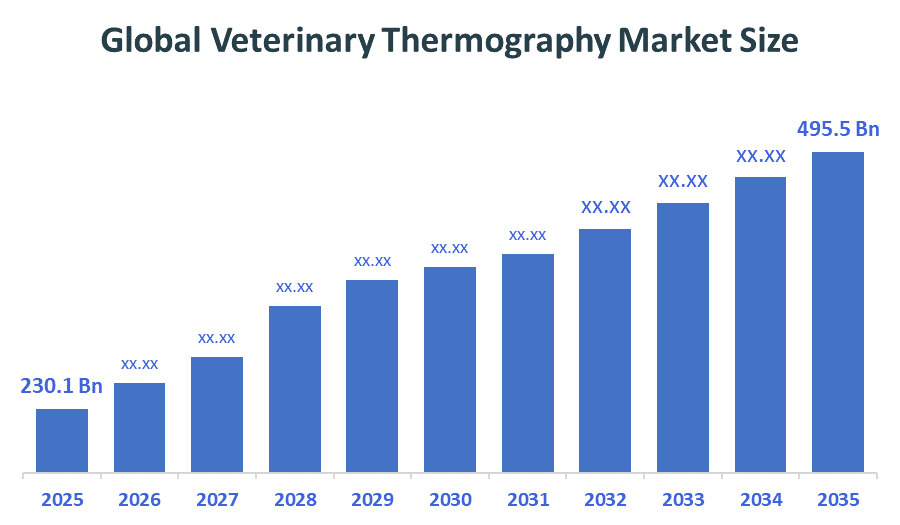
The Global Veterinary Thermography Market Size is foreseen to grow from USD 230.1 Billion in 2025 and is govern to reach around USD 495.5 Billion by 2035. According to Decision Advisors, a detailed research report on the Global Veterinary Thermography Market is boosted by integration of Artificial Intelligence (AI) and data analytics, accounting for nearly upto the 30% to 40% share of the total share worldwide. GE HealthCare is the prime player in the market with approximately USD 9.2 Billion in annual turnover and a 42-45% market share, positioning it as the primary driver of the global veterinary thermography market.
Market Snapshot
- Global Veterinary Thermography Market Size (2025): USD 230.1 Billion
- Projected Global Veterinary Thermography Market Size (2035): USD 495.5 Billion
- Global Veterinary Thermography Market Compound Annual Growth Rate (CAGR): 7.97%
- Largest Growing Region: North America
- Fastest Regional Market: Asia Pacific
- 2nd Largest Region: Europe
- Base Year: 2025
- Historical Period: 2021–2024
- Forecast Period: 2026–2035
Market Overview/ Introduction
The Global Veterinary Thermography Market is witnessing a major transformation as owners increasingly view pets as family members, a trend known as pet humanisation. This shift has turned thermal imaging from a small livestock tool into a mainstream diagnostic for companion animals. Since pets can’t communicate pain, owners are now demanding and paying for non invasive, stress free health screenings that mirror human medical standards. Technologically, this human grade demand has sparked a wave of innovation. Veterinary clinics are adopting AI-powered handheld cameras that offer the same precision as human medical thermography, allowing for early detection of arthritis or dental issues. Companies like GE HealthCare and IDEXX are leading this charge by integrating these tools into standard wellness areas. Because humanised pets often have comprehensive insurance, the barrier to high-tech diagnostics has lowered, allowing thermography to become a routine part of preventative care rather than just an emergency option.
Notable Insights: -
- North America is anticipated to hold approximately 38% share of the Global Veterinary Thermography Market over the predicted timeframe.
- Asia Pacific is the fastest-growing region in the Global Veterinary Thermography Market during the forecast period, holding approximately 30% share.
- By product type, the handheld infrared thermography devices segment dominated the market and holds approximately 52% share in 2025, and is projected to grow at a substantial CAGR during the forecast period.
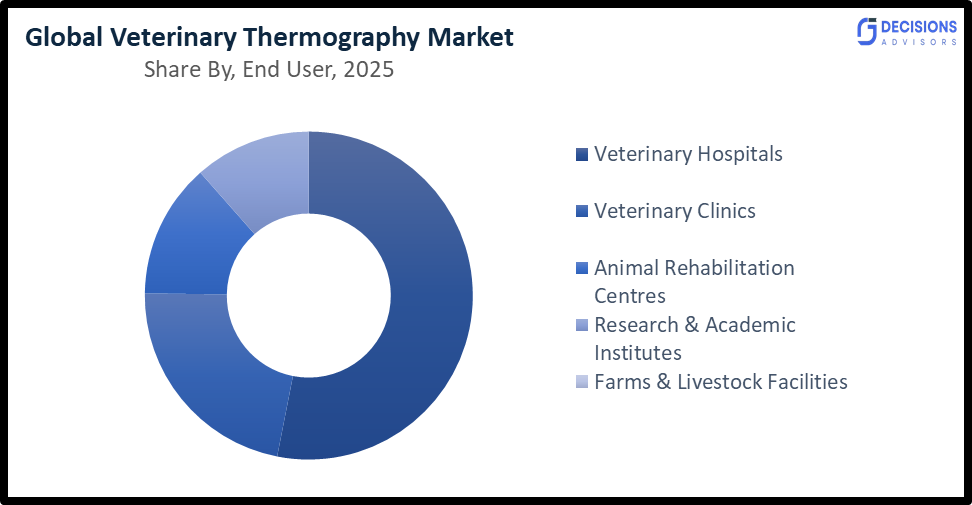
- By end user, the veterinary hospitals segment dominated the market and holds approximately 46% share in 2025 and is projected to grow at a substantial CAGR during the forecast period.
- The compound annual growth rate of the global veterinary thermography market is 7.97%.
- The market is likely to achieve a valuation of USD 495.5 Billion by 2035.
What is the role of technology in grooming the market?
Technology plays a transformative role in veterinary thermography by enhancing diagnostic accuracy and usability. Modern infrared cameras offer high-resolution imaging, real-time temperature mapping, and cloud-based data storage. AI-powered analytics help veterinarians interpret thermal patterns more effectively, enabling early disease detection and predictive diagnostics. Additionally, portable and handheld devices allow field veterinarians and livestock managers to conduct on-site assessments, improving efficiency and reducing diagnostic delays. Integration with mobile applications and IoT-based animal health monitoring systems is also supporting continuous tracking of animal health conditions.
Market Drivers
The market drivers as a shift in how we treat our animals less like livestock and more like family. At the surface of this growth is the stress-free movement. Since our pets can't tell us where it hurts, owners are jumping at the chance to use non-invasive tools that spot pain without the need for needles, sedation, or scary radiation. It’s about catching problems like a brewing ear infection or early arthritis before the animal even shows a limp. This emotional bond is being met by some seriously cool tech upgrades. We have moved past bulky, expensive lab equipment to sleek, AI-powered handheld cameras that any vet can use during a routine checkup. Because these devices now sync directly to smartphones and cloud systems, they have become as common as a stethoscope. On top of that, the pet insurance boom means more families can say yes to these advanced screenings without worrying about the bill. Essentially, the market is surging because we finally have the technology to match the level of care we feel our pets deserve
Restrain
The veterinary thermography market is constrained by the high cost of advanced infrared imaging devices, which limits adoption among small veterinary clinics and livestock owners, particularly in developing regions. Additionally, the lack of standardized diagnostic protocols and trained professionals to accurately interpret thermal images reduces reliability and wider clinical acceptance.
Competitive Analysis:
The report offers the appropriate analysis of the key organizations/companies involved within the global veterinary thermography market, along with a comparative evaluation primarily based on their product of offering, business overviews, geographic presence, enterprise strategies, segment market share, and SWOT analysis. The report also provides an elaborative analysis focusing on the current news and developments of the companies, which includes product development, innovations, joint ventures, partnerships, mergers & acquisitions, strategic alliances, and others. This allows for the evaluation of the overall competition within the market.
Top Companies in the Global Veterinary Thermography Market
- Teledyne FLIR LLC
- Digatherm
- Animal Infrared Imaging
- Fluke Corporation
- Vet Therm
- Teletherm Infrared Systems
- Seek Thermal
- Optotherm, Inc.
- Opgal Optronic Industries Ltd.
- InfraTec GmbH
Government Initiatives
|
Country |
Key Government Initiatives |
|
India |
The Government is actively promoting digital livestock health through initiatives like the National Digital Livestock Mission and disease control programs with significant public funding support. This creates strong opportunities for adoption of advanced diagnostic tools such as veterinary thermography for real-time disease monitoring. |
|
Europe |
Through Horizon Europe, the EU is investing in digital and sensor-based livestock monitoring technologies, including AI-driven health detection systems. This funding environment directly supports the integration of thermography into precision livestock farming. |
|
Australia |
The Government is strengthening livestock biosecurity through mandatory electronic tagging and traceability systems. This regulatory push is encouraging the adoption of advanced monitoring technologies, including thermography, for early disease detection. |
Study on the Supply, Demand, Distribution, and Market Environment of the Global Veterinary Thermography Market
The global veterinary thermography market operates through a supply chain of infrared device manufacturers, distributors, and veterinary equipment providers supplying clinics, hospitals, and livestock farms. Demand is driven by the rising need for non-invasive and early diagnostic solutions in animal healthcare. Distribution is expanding beyond traditional dealer networks to include direct sales and online platforms, improving accessibility. The overall market environment is favourable due to growing awareness of animal health and technological advancements, although high costs and limited expertise in some regions continue to pose challenges.
Price Analysis and Consumer Behaviour Analysis
Veterinary thermography devices are generally priced at a premium due to advanced infrared imaging technology, with higher costs associated with high-resolution and AI-enabled systems. Despite this, consumers, primarily veterinarians and livestock owners, are increasingly willing to invest in these devices due to their long-term cost efficiency, ability to enable early disease detection, and reduction in invasive diagnostic procedures. Buying behaviour is strongly influenced by ease of use, portability, accuracy, and return on investment, with growing preference for handheld and smartphone-compatible devices that offer quick and reliable results.
Market Segmentation
The Global Veterinary Thermography Market is classified into product type, application and end user.
- The handheld infrared thermography devices segment dominated the market and holds approximately 52% share in 2025, and is projected to grow at a substantial CAGR during the forecast period.
Based on the product type, the global veterinary thermography market is divided into handheld infrared thermography devices, fixed/stationary thermography systems, drone-mounted thermography systems, and smartphone-based thermal imaging devices. Among these, the handheld infrared thermography devices segment dominated the market and holds approximately 52% share in 2025, and is projected to grow at a substantial CAGR during the forecast period. This dominance is attributed to their portability, ease of use, and suitability for field applications in veterinary clinics and livestock farms. These devices enable real-time, non-invasive diagnostics, making them highly preferred among veterinarians. Additionally, continuous advancements in compact imaging technologies and increasing demand for point-of-care diagnostics are further driving segment growth.
- The musculoskeletal injury detection segment accounted for the largest share of approximately 34% in 2025 and is anticipated to grow at a significant CAGR during the forecast period.
Based on the application, the global veterinary thermography market is divided into musculoskeletal injury detection, inflammation & pain assessment, disease diagnosis & monitoring, post-surgical monitoring, reproductive health monitoring, and preventive healthcare & screening. Among these, the musculoskeletal injury detection segment accounted for the largest share of approximately 34% in 2025 and is anticipated to grow at a significant CAGR during the forecast period. This is primarily due to the high incidence of injuries in companion animals and performance animals such as horses. Thermography is widely used for early detection of inflammation and stress in tissues, enabling timely intervention. Furthermore, rising awareness regarding preventive diagnostics and increasing adoption in sports and rehabilitation veterinary practices are significantly contributing to the growth of this segment.
- The veterinary hospitals segment dominated the market and holds approximately 46% share in 2025 and is projected to grow at a substantial CAGR during the forecast period.
Based on end user, the global veterinary thermography market is divided into veterinary hospitals, veterinary clinics, animal rehabilitation centres, research & academic institutes, and farms & livestock facilities. Among these, the veterinary hospitals segment dominated the market and holds approximately 46% share in 2025 and is projected to grow at a substantial CAGR during the forecast period, owing to the availability of advanced diagnostic infrastructure and skilled veterinary professionals. Veterinary hospitals serve as primary centres for comprehensive diagnosis, treatment, and monitoring of animal health conditions. The increasing number of diagnostic procedures, rising pet healthcare expenditure, and growing adoption of advanced imaging technologies are further supporting segment growth. Additionally, improved access to specialised veterinary care is strengthening the dominance of this segment.
Strategies to Implement for Growth of the Market in Non-Leading Regions
Growth in non-leading regions can be driven by increasing awareness of veterinary thermography through training programs and educational initiatives for veterinarians and livestock owners. Introducing cost-effective and portable devices will improve accessibility, especially in rural and developing areas. Companies should expand distribution networks through partnerships with local veterinary clinics and government livestock programs. Additionally, offering flexible pricing models, financing options, and technical support can encourage adoption, while investment in skill development will ensure accurate usage and interpretation of thermography technology.
Regional Segment Analysis of the Global Veterinary Thermography Market
- North America (U.S., Canada, Mexico)
- Europe (Germany, France, U.K., Italy, Spain, Rest of Europe)
- Asia-Pacific (China, Japan, India, Rest of APAC)
- South America (Brazil and the Rest of South America)
- The Middle East and Africa (UAE, South Africa, Rest of MEA)
North America is anticipated to hold approximately 38% share of the Global Veterinary Thermography Market over the predicted timeframe.
North America is anticipated to hold approximately 38% share of the Global Veterinary Thermography Market over the predicted timeframe. It maintains a dominant market position due to advanced veterinary healthcare infrastructure, high pet ownership rates, and strong adoption of innovative diagnostic technologies. The United States is the key contributor, supported by increasing spending on companion animal healthcare and widespread use of non-invasive diagnostic tools such as infrared thermography. For instance, veterinary hospitals and equine clinics in the U.S. are increasingly using thermography for early lameness detection in horses and injury assessment in pets. Continuous technological advancements, the presence of major thermal imaging companies, and growing awareness among veterinarians are further strengthening the region’s leadership.
Asia Pacific is the fastest-growing region in the Global Veterinary Thermography Market during the forecast period, holding approximately 30% share.
Asia Pacific is the fastest-growing region in the Global Veterinary Thermography Market during the forecast period, holding approximately 30% share. This growth is driven by the rising livestock population, increasing awareness of animal health, and improving veterinary infrastructure in countries such as China, India, and Japan. The region is witnessing growing adoption of thermography for disease detection and herd health monitoring, particularly in dairy and poultry farms. For example, in India and China, thermography is being increasingly used to detect mastitis in cattle at an early stage, reducing economic losses. Additionally, government initiatives supporting smart farming and rising investments in animal healthcare are accelerating market growth.
Europe is expected to hold approximately 22% share and is the second-largest region in the Global Veterinary Thermography Market during the forecast period.
Europe is expected to hold approximately 22% share and is the second-largest region in the Global Veterinary Thermography Market during the forecast period. The region’s growth is supported by strict animal welfare regulations, well-established veterinary systems, and increasing adoption of advanced diagnostic technologies. Countries such as Germany, the United Kingdom, and France are leading the market due to a strong focus on preventive animal healthcare and research-based veterinary practices. For instance, thermography is widely used in equine sports medicine across Europe to monitor performance horses and prevent injuries. Additionally, increasing investments in veterinary research and favourable regulatory frameworks are contributing to innovation and adoption, further supporting market expansion.
Future Market Trends in the Global Veterinary Thermography Market:
1. Integration of AI in Thermography Analysis
The adoption of artificial intelligence is enhancing the accuracy and efficiency of veterinary thermography by enabling automated detection of abnormal heat patterns and early disease prediction, reducing reliance on manual interpretation.
2. Growing Demand for Portable and Smartphone-Based Devices
There is a rising shift toward compact, handheld, and smartphone-compatible thermal imaging devices, making thermography more accessible for field veterinarians and livestock monitoring in remote areas.
3. Expansion in Livestock Health Monitoring and Smart Farming
Veterinary thermography is increasingly being integrated into smart farming practices, where it is used for continuous monitoring of livestock health, early disease detection, and improving productivity through precision agriculture technologies.
Recent Development
- In July 2025, A recent update in the veterinary field highlighted growing interest in advanced imaging technologies, including infrared thermography, for improving non-invasive diagnostics in animal care. The report emphasised that modern imaging tools are increasingly being explored to support early disease detection, remote assessments, and enhanced clinical decision-making in veterinary practice.
- In July 2025, Researchers from Osaka Metropolitan University developed an AI-enhanced infrared thermography system that automatically detects temperature patterns in calves’ eyes and muzzles. This advancement improved accuracy in non-invasive health monitoring and enabled consistent detection of stress and disease indicators in livestock.
- In December 2023, WellVu Veterinary Thermal Imaging (formerly Digatherm) became the first thermal imaging company to be recognized as a Fear Free Preferred Product. This recognition highlighted its non-invasive imaging technology that enables veterinarians to detect abnormalities, screen for underlying conditions, and monitor treatment progress while minimizing stress, fear, and anxiety in animals.
- In January 2023, Multi Radiance Veterinary partnered with Digatherm Thermal Imaging to become the exclusive global distributor of its veterinary thermography products, particularly infrared imaging cameras.
How is Recent Developments Helping the Market?
Recent developments are accelerating the growth of the veterinary thermography market by improving device accuracy, portability, and ease of use. Innovations such as AI-enabled thermal imaging and smartphone-based devices are making diagnostics faster and more accessible for veterinarians. For example, portable thermal cameras are now widely used in equine clinics to detect early signs of lameness and inflammation before visible symptoms appear, enabling timely treatment. Similarly, in dairy farms, advanced thermography systems are helping in early detection of mastitis in cattle, reducing productivity losses and improving overall herd health management.
Market Segment
This study forecasts revenue at global, regional, and country levels from 2020 to 2035. Decision Advisors has segmented the global veterinary thermography market based on the below-mentioned segments:
Global Veterinary Thermography Market, By Product Type
- Handheld Infrared Thermography Devices
- Fixed/Stationary Thermography Systems
- Drone-Mounted Thermography Systems
- Smartphone-Based Thermal Imaging Devices
Global Veterinary Thermography Market, By Applications
- Musculoskeletal Injury Detection
- Inflammation & Pain Assessment
- Disease Diagnosis & Monitoring
- Post-Surgical Monitoring
- Reproductive Health Monitoring
- Preventive Healthcare & Screening
Global Veterinary Thermography Market, By End User
- Veterinary Hospitals
- Veterinary Clinics
- Animal Rehabilitation Centers
- Research & Academic Institutes
- Farms & Livestock Facilities
Global Veterinary Thermography Market, By Regional Analysis
- North America
- US
- Canada
- Mexico
- Europe
- Germany
- UK
- France
- Italy
- Spain
- Russia
- Rest of Europe
- Asia Pacific
- China
- Japan
- India
- South Korea
- Australia
- Rest of Asia Pacific
- South America
- Brazil
- Argentina
- Rest of South America
- Middle East & Africa
- UAE
- Saudi Arabia
- Qatar
- South Africa
- Rest of the Middle East & Africa
Frequently Asked Questions (FAQ)
Q1. What is the typical return on investment (ROI) for veterinary thermography devices?
A. ROI depends on usage frequency and service pricing, but clinics can recover costs through early diagnostics, reduced need for expensive imaging, and increased client visits for preventive care.
Q2. How does environmental temperature affect thermography results in animals?
A. External factors such as ambient temperature, humidity, and airflow can influence thermal readings, requiring controlled conditions or standardised protocols for accurate interpretation.
Q3. What level of training is required to operate veterinary thermography equipment effectively?
A. While basic operation is simple, accurate diagnosis requires specialised training or certification in thermographic image interpretation to ensure reliable results.
Q4. Can veterinary thermography be integrated with other diagnostic systems?
A. Yes, it can be integrated with imaging modalities like ultrasound or X-ray and digital health records to provide a more comprehensive diagnostic approach.
Q5. What are the regulatory or certification requirements for veterinary thermography devices?
A. Requirements vary by region, but devices often need approvals such as CE marking in Europe or FDA clearance in the U.S., along with compliance with veterinary diagnostic standards.
Check Licence
Choose the plan that fits you best: Single User, Multi-User, or Enterprise solutions tailored for your needs.
We Have You Covered
- 24/7 Analyst Support
- Clients Across the Globe
- Tailored Insights
- Technology Tracking
- Competitive Intelligence
- Custom Research
- Syndicated Market Studies
- Market Overview
- Market Segmentation
- Growth Drivers
- Market Opportunities
- Regulatory Insights
- Innovation & Sustainability
Report Details
| Scope | Global |
| Pages | 240 |
| Delivery | PDF & Excel via Email |
| Language | English |
| Release | Apr 2026 |
| Access | Download from this page |