
Global Vibrator Motors Market
 |
Pages:
210
|
Pages:
210
Global Vibrator Motors Market Size, Share, By Type (ERM Motors, LRA Motors, and Others) By Sales Channel (Direct Sales and Retail Sales) By Application (Smartphones, Wearables, Gaming Controllers, Industrial Equipment, and Medical Devices) By End User (Consumer Electronics, Industrial, Healthcare, and Automotive) and By Region (North America, Europe, Asia-Pacific, Latin America, Middle East and Africa), Analysis and Forecast 2026 - 2035
REPORT COVERAGE
Global
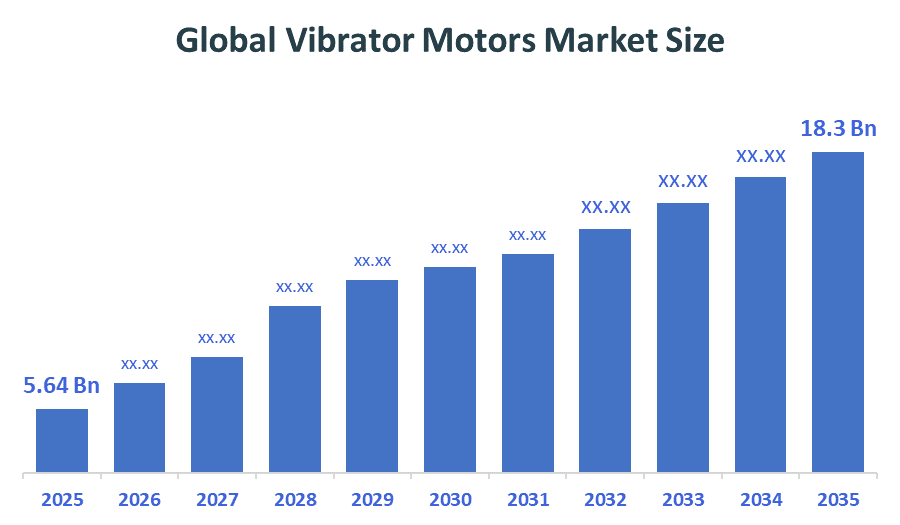
The Global Vibrator Motors Market Size was expected to grow from USD 5.64 Billion in 2025 and is projected to reach around USD 18.3 Billion by 2035. According to Decision Advisors, a detailed research report on the vibrator motors market shows that the LRA technology trend dominates the global vibrator motors market, holding approximately 35-45% of the total share worldwide. AAC Technologies leads the market with an annual revenue of approximately USD 4.67 billion in 2025, making it one of the major market drivers for shaping the industry.
Market Snapshot
- Global Vibrator Motors Market Size (2025): USD 5.64 Billion
- Global Vibrator Motors Projected Market Size (2035): USD 18.3 Billion
- Global Vibrator Motors Compound Annual Growth Rate (CAGR): 12.49%
- Largest Regional Market: Asia-Pacific
- Fastest Growing Region: North America
- 3rd Largest Region: Europe
- Base Year: 2025
- Historical Period: 2021-2024
- Forecast Period: 2026-2035
Market Overview / Introduction
Vibrator motors are miniature electro-mechanical units created to produce mechanical vibrations to enable haptic stimulation or agitation of materials. These components act as an essential bridge between the digital world and the physical experience through the creation of rapid vibrations with the least power consumption by means of eccentric rotors or magnetic resonance. Contemporary vibrator motors are equipped with capabilities like maximum G-force and ultra-low latency for efficient tactile sensations while minimising energy consumption. The vibrator motors, which were initially simple cylindrical units, have since been advanced into highly efficient haptic engines with programmable vibration patterns, energy-efficient operation, and incorporation into wearable Internet-of-Things (IoT) gadgets. The rising popularity of vibrator motors is due to the increasing need for immersive gaming and silent notifications on personal communication devices.
- The consumer electronics and wearable segments contribute to approximately 70% of the application-based use in the market, driven by the increasing demand for high-end haptic feedback in smartphones and fitness trackers.
- Haptic feedback technology in the automotive sector is experiencing substantial growth, with a CAGR forecasted to surpass 7% on account of the increasing adoption of vibrating steering wheels and seats as part of the advanced generation of driver assistance systems.
Notable Insights: -
- Linear Resonant Actuators (LRA) make up about 52.4% of the total market share of this sector.
- About 68.3% of all installations occur in consumer-facing digital devices and mobile communication hardware.
- Precision micro-motors show an annual increase above 5.5%.
What is the Role of Technology in Shaping the Market?
Technology advances are leading to some radical changes in the world of haptics regarding the speed of reaction, size effectiveness, and energy efficiency. Current vibratory platforms are no longer only means of notifications; they have evolved into sophisticated haptic engines able to recreate various textures and pressures due to their ability to use modern magnets, piezoelectric devices, and circuitry control.
How are Recent Developments Helping the Market?
Such developments are made up of software-defined haptic libraries, thin-film piezoelectric actuators, and low-power standby modes, among others. Such developments have greatly assisted in ensuring the development and growth of the market. The developments have involved modular vibration systems that can fit into the thin shells used in modern wearable devices and medical patches without fail. Through the use of high-frequency drive chips, such developments make it possible for the autonomous control of vibration intensity by the use of real-time user interaction data without any sort of lag or system failure.
Market Drivers
The demand for global vibrator motors is increasing due to the higher investments being made by electronics manufacturers and consumer technology organisations in immersive digital interfaces as well as power-efficient parts, which will help to fulfil the objective of achieving long battery life in today’s time. The latest vibrators have become very popular in the market due to the advantages of having multiple features, such as touch reality, quick booting, and compact design within one system. On the other hand, foldable screen technology has brought about the need for haptic solutions, as they will facilitate the changeover from ERM motors to LRA motors.
Restraints
The development of the global market of the vibrator motors sector faces limitations due to the challenges associated with maintaining the durability of mechanical components when operating continuously at high frequencies, owing to the risk of coil burnout and bearing wear.
Competitive Analysis:
The report offers the appropriate analysis of the key organisations/companies involved within the vibrator motors market, along with a comparative evaluation primarily based on their product offerings, business overviews, geographic presence, enterprise strategies, segment market share, and SWOT analysis. The report also provides an elaborate analysis focusing on the current news and developments of the companies, which includes product development, innovations, joint ventures, partnerships, mergers & acquisitions, strategic alliances, and others. This allows for the evaluation of the overall competition within the market.
Top 10 Companies in the Global Vibrator Motors Market
- AAC Technologies
- Nidec Corporation
- MinebeaMitsumi Inc.
- Jinlong Machinery & Electronics Co., Ltd.
- TDK Corporation
- Texas Instruments (Haptic Drivers)
- Johnson Electric
- Murata Manufacturing Co., Ltd.
- Precision Microdrives
- Vybronics
Government Initiatives
|
Country |
Key Government Initiatives |
|
China |
Under the 15th Five-Year Plan (2026-2030), the Ministry of Industry and Information Technology (MIIT) has allocated nearly 1.3 trillion yuan (approx. USD 180 billion) for science and technology development in 2026. This initiative focuses on new quality productive forces, including intelligent robots and integrated circuits, which are projected to reach a market value of 10 trillion yuan by 2030. |
|
India |
The PM E-DRIVE Scheme, notified in late 2024 with an outlay of ?10,900 crore through 2028, mandates a Phased Manufacturing Programme (PMP) for electric vehicle components. This includes incentives for advanced tactile safety features, such as haptic-feedback steering wheels and seats. |
|
US |
The CHIPS for America program expanded its R&D flagship facilities with a USD 285 million award to establish a specialised institute for Digital Twins in manufacturing. This initiative aims to reduce the development costs of precision electronics, including vibrator motors and haptic actuators, by over 40%. |
Study on the Supply, Demand, Distribution, and Market Environment
The vibratory motor business's success hinges upon achieving an optimal balance between having a capacity for operation with absolute haptic accuracy and a rising demand for small physical profiles. Vibratory motors’ availability is based on a strategy that involves manufacturing top-quality neodymium magnets and precision coiling that can provide instant feedback without the loud vibrations of previous vibrating machinery.
Price Analysis and Consumer Behaviour Analysis
The cost of the vibrator motors depends on the magnitude of acceleration, frequency, and the latency of the response. The higher-end vibrators that make use of LRA or Piezo actuators and have advanced haptic drive integrated circuits, along with wide-band frequencies, will be more costly than others. However, ordinary ERM motors and industrial vibration motors are less expensive and can prove to be ideal for developing local alerting systems and simple feedback systems due to their cost-effectiveness. Consumers are certainly fond of realism and silent functionality; therefore, manufacturers would opt for motors that are reliable, easy to fit on PC boards, and accurate for positioning.
Market Segmentation
The Global Vibrator Motors Market share is classified into type, sales channel, application, and end user.
The LRA segment holds the largest share, contributing approximately 51% of the market in 2025.
Based on the Type, the global vibrator motors market is divided into ERM Motors, LRA Motors, and Others. Among these, the LRA segment holds the largest share, contributing approximately 51% of the market in 2025. The reason for this dominance lies in their ability to perform better in terms of power efficiency in mobile devices and their ability to provide sharper, more distinct haptic sensations without consuming excessive amounts of energy compared to the standard ERM variants.
The Direct Sales segment accounts for the largest share, representing over 65% of the global market in 2025.
Based on the Sales Channel, the global vibrator motors market is divided into Direct Sales and Retail Sales. Among these, the Direct Sales segment accounts for the largest share, representing over 65% of the global market in 2025. These transactions are critical for maintaining the supply chain of large-scale OEMs, improving customised motor specifications, and reducing lead times through the adoption of modern, B2B procurement platforms.
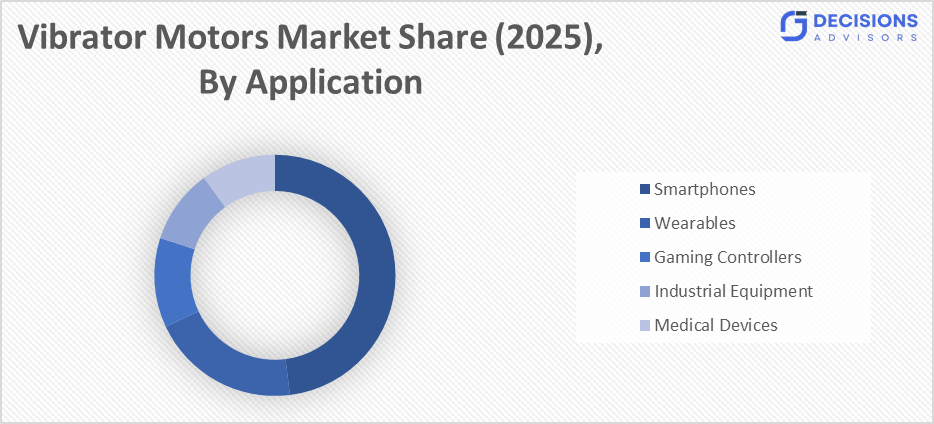
Smartphones dominate the global market, accounting for approximately 48% of the total revenue in 2025.
Based on the Application, the global vibrator motors market is divided into Smartphones, Wearables, Gaming Controllers, Industrial Equipment, and Medical Devices. Among these, Smartphones dominate the global market, accounting for approximately 48% of the total revenue in 2025. This segment is preferred by manufacturers who require high-performance haptic engines for UI interaction and mobile gaming.
The Consumer Electronics segment dominates the global market, accounting for approximately 55% of the total revenue in 2025.
Based on the End User, the global vibrator motors market is divided into Consumer Electronics, Industrial, Healthcare, and Automotive. Among these, the Consumer Electronics segment dominates the global market, accounting for approximately 55% of the total revenue in 2025. This segment is preferred by planners who require high-volume integrated solutions and professional haptic engineering for mass-market communication devices.
Strategies to Implement for Growth of the Market in Non-Leading Regions
It is possible that the growth opportunities available in the vibrator motors market can be further maximised in developing countries if inexpensive micro-motor modules can be utilised by budding electronic firms or local makers of wearables. Government initiatives geared towards improving the capacity of local manufacturers, in addition to improved access to mobile communications, play a considerable role in meeting the demands in regions where traditional manufacturing makes precision actuators difficult to produce.
Regional Segment Analysis of the Global Vibrator Motors Market
- North America (U.S., Canada, Mexico)
- Europe (Germany, France, U.K., Italy, Spain, Rest of Europe)
- Asia-Pacific (China, Japan, India, South Korea, Rest of APAC)
- Latin America (Brazil and the Rest of Latin America)
- The Middle East and Africa (UAE, South Africa, Rest of MEA)
Asia-Pacific is projected to be the fastest-growing region over the forecast period. This region is anticipated to witness a growth rate of around 6.85% CAGR, maintaining a dominant market share within the global industry. In 2025, the Asia-Pacific region will already account for approximately 41.5% of global revenue. This is owing to the fast-developing electronics manufacturing hubs, coupled with the growing demand for modern consumer gadgets in countries such as China, India, and Vietnam. In addition, the regional superiority is reinforced by huge investments from foreign companies into semiconductor assembly as well as the emergence of homegrown companies which specialize in low-power micro-actuators used in the rapidly expanding wearable devices market. Furthermore, the shift to Industry 4.0 in China and Japan has resulted in the greater use of industrial vibrator motors in smart factories.
North America is expected to hold a significant share of the vibrator motors market during the forecast period. This region holds approximately 25.4% share of global revenue in 2025, thanks to its highly sophisticated R&D centers related to haptic technology and the extensive adoption of advanced gaming peripherals in high-value entertainment applications. The market is also driven by a strong presence of automotive manufacturers integrating haptic-based Advanced Driver Assistance Systems (ADAS) to enhance vehicle safety and driver alertness. North American growth is further augmented by substantial investments in the healthcare sector, where vibrator motors are increasingly utilised in medical simulation equipment, rehabilitation robotics, and non-invasive therapeutic devices for patient monitoring.
Europe is anticipated to hold a substantial share, contributing approximately 21.2% of the global market share. There is a competitive advantage in the region owing to clusters of automotive innovation and financing for haptic-enabled safety systems, as well as medical device research. European manufacturers are leading the transition toward haptic-integrated cockpit solutions, replacing traditional mechanical buttons with tactile touch interfaces in premium and electric vehicles. Furthermore, the region’s strict regulatory standards regarding industrial energy efficiency are pushing the market toward high-performance brushless vibration motors. The integration of haptic feedback into precision surgical tools and pharmaceutical automation equipment also represents a significant growth pillar for the European market through 2035.
Recent Developments
- In March 2026, Johnson Electric showcased its latest innovative motion solutions at the Appliance & Electronics World Expo (AWE) 2026 in Shanghai. The company presented advanced haptic motors and Humanoid Robot Joints, highlighting a strategic focus on high-torque micro-motion for the service robot and smart home sectors.
- In January 2026, MinebeaMitsumi Inc. made its debut at CES 2026, unveiling a high-torque micro actuator (13 mm x 19.4 mm) co-developed with Harmonic Drive Systems.
- In July 2021, TDK Corporation accelerated its PiezoHapt and PowerHap actuator lines, securing major design wins in the automotive and industrial sectors. These actuators provide world-class acceleration and response times.
Market Segmentation
This study forecasts revenue at global, regional, and country levels from 2021 to 2035. The Global Vibrator Motors Market is segmented based on the following categories:
Global Vibrator Motors Market, By Type
- ERM Motors
- LRA Motors
- Others
Global Vibrator Motors Market, By Sales Channel
- Direct Sales
- Retail Sales
Global Vibrator Motors Market, By Application
- Smartphones
- Wearables
- Gaming Controllers
- Industrial Equipment
- Medical Devices
Global Vibrator Motors Market, By End User
- Consumer Electronics
- Industrial
- Healthcare
- Automotive
Global Vibrator Motors Market, By Regional Analysis
- North America
- United States
- Canada
- Mexico
- Europe
- Germany
- United Kingdom
- France
- Italy
- Spain
- Russia
- Rest of Europe
- Asia Pacific
- China
- Japan
- India
- South Korea
- Australia
- Rest of Asia Pacific
- Latin America
- Brazil
- Argentina
- Rest of Latin America
- Middle East & Africa
- United Arab Emirates
- Saudi Arabia
- Qatar
- South Africa
- Rest of Middle East & Africa
Frequently Asked Questions (FAQ)
What is the difference between Piezoelectric Actuators and standard Linear Resonant Actuators (LRA)?
Although Linear Resonant Actuators are the industry standard because of their effectiveness, Piezoelectric Actuators will be the future of haptics. Unlike LRA, which uses moving mass and has only one resonance frequency ranging between 170 Hz and 180 Hz, Piezo actuators lack any moving mass and provide a wide frequency band from 0 Hz up to 500 Hz or even more. Therefore, Piezo actuators can imitate any texture and create complex sensations that LRA is unable to recreate.
How do vibrator motors contribute to energy efficiency in Electric Vehicles (EVs)?
Eco-Driving haptics is now being deployed through vibrator motors in the automotive industry. Studies conducted in 2026 show that adaptive haptic feedback systems in steering wheel and pedal applications have the potential to save up to 9% of vehicle energy when compared to conventional visual warnings alone. Through their tactile assistance for maintaining lanes and accelerating, drivers may maximise their battery life while still concentrating on driving.
What is the impact of Wideband Haptics on the future market?
Wideband haptics is a growing trend where motors are designed to operate across a broad range of frequencies rather than a single buzz. This technology is critical for the Metaverse and XR (Extended Reality) markets, as it enables high-definition touch.
How is the medical sector utilising vibration motors for patient safety?
Beyond simple alerts, vibration motors are now integral to neuropathy screening and pain management. In 2026, clinical devices use precisely calibrated vibrator motors to test patients nerve responses to varying tactile levels, helping in early diabetes diagnosis.
Check Licence
Choose the plan that fits you best: Single User, Multi-User, or Enterprise solutions tailored for your needs.
We Have You Covered
- 24/7 Analyst Support
- Clients Across the Globe
- Tailored Insights
- Technology Tracking
- Competitive Intelligence
- Custom Research
- Syndicated Market Studies
- Market Overview
- Market Segmentation
- Growth Drivers
- Market Opportunities
- Regulatory Insights
- Innovation & Sustainability
Report Details
| Scope | Global |
| Pages | 210 |
| Delivery | PDF & Excel via Email |
| Language | English |
| Release | Apr 2026 |
| Access | Download from this page |