
Global Video Surveillance Market
 |
Author:
Kunal M
|
Pages:
200
|
Author:
Kunal M
|
Pages:
200
Global Video Surveillance Market Size, Share By Component (Camera, Storage, Video Management Software, and Services), By Application (Commercial, Government, Industrial, Residential, and Transportation), By Technology (IP Video Surveillance, Analog Video Surveillance, AI-Based Video Analytics, and Thermal Imaging), and By Region (North America, Europe, Asia-Pacific, Latin America, Middle East & Africa), Analysis and Forecast 2026-2035
CAGR
10.15%
REVENUE 2025
USD Billion 63.25
FORECAST 2035
USD Billion 166.3
REPORT COVERAGE
Global
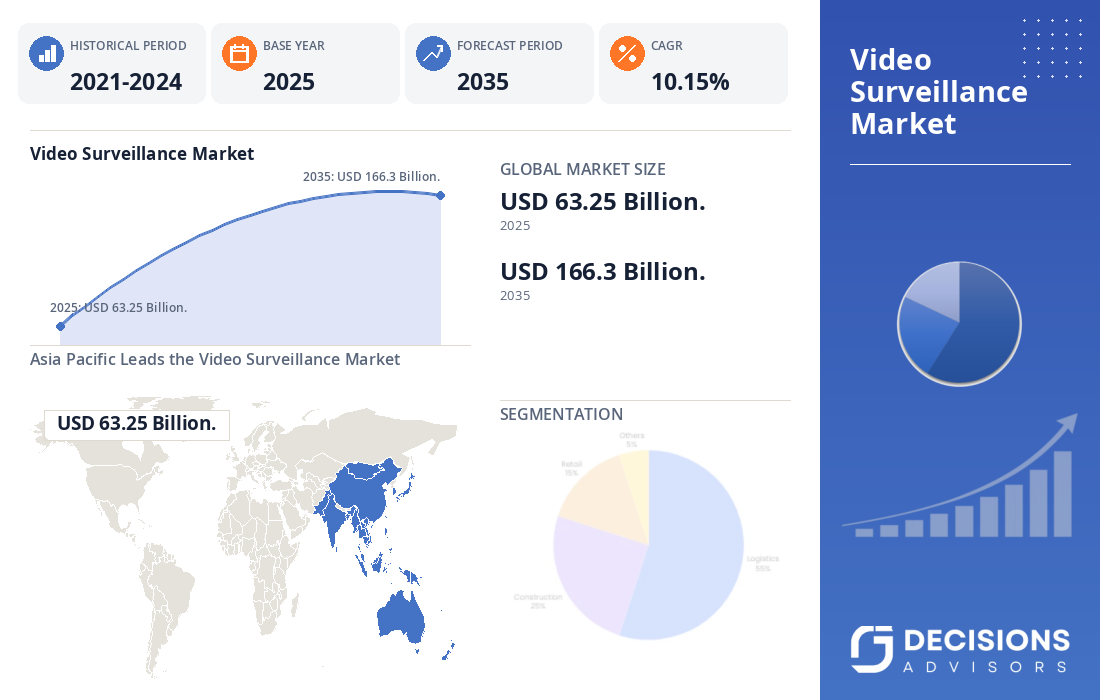
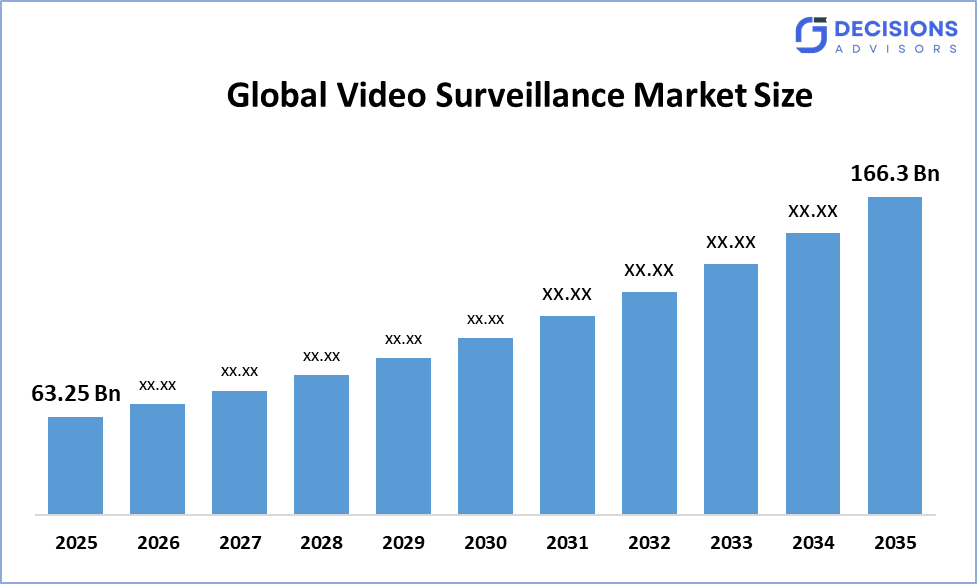
The Global Video Surveillance Market Size is predicted to grow from USD 63.25 Billion in 2025 and is likely to reach around USD 166.3 Billion by 2035 with a CAGR of 10.15%. According to Decision Advisors, the market is being strongly influenced by the transition toward IP-based systems, cloud-connected surveillance, and AI-enabled video analytics. Asia-Pacific remains the largest regional market, supported by extensive security infrastructure and smart-city deployments, while major companies such as Hikvision, Dahua Technology, Axis Communications, Bosch Security Systems, and Hanwha Vision continue to strengthen the competitive landscape. Recent market estimates similarly identify Asia-Pacific as the largest regional market.
Market Snapshot
- Global Video Surveillance Market Size (2025): USD 63.25 Billion.
- Projected Global Video Surveillance Market Size (2035): USD 166.3 Billion.
- Global Video Surveillance Market CAGR: 10.15%.
- Largest Regional Market: Asia Pacific
- 2nd Largest Region: North America
- Fastest Growing Region: Europe
- Base Year: 2025
- Historical Period: 2021-2024
- Market Forecast Period: 2026-2035
Market Overview/ Introduction
The global video surveillance market comprises cameras, recording equipment, video management software, analytics platforms, storage systems, and related services used to monitor people, assets, facilities, and public spaces. The market is expanding as organizations move from conventional analog systems toward IP cameras, cloud-based video surveillance, edge computing, and AI-powered analytics. Growing concerns around public safety, theft, vandalism, workplace security, and critical infrastructure protection are encouraging governments and businesses to modernize surveillance networks. Recent industry estimates place the market at USD 83.71 billion in 2025 under a broader market definition, illustrating the substantial scale of global surveillance deployment.AI is becoming an important differentiator because modern systems can identify objects, detect unusual activities, support automated alerts, improve forensic searches, and reduce the workload on security personnel.
- United States, Federal procurement rules under Section 889 restrict government acquisition of specified telecommunications and video-surveillance equipment and services, increasing demand for compliant and trusted security infrastructure.
- Japan, Public-security and counter-terrorism policy discussions continue to support stronger security capabilities, while cybersecurity modernization is also increasing attention to connected surveillance infrastructure.
- China, China continues to strengthen technical standards surrounding public-security video surveillance. New 2025 standards cover surveillance cameras, video-image enhancement, retrieval, and information-sharing networks.
Notable Insights: -
- Asia Pacific is anticipated to hold approximately 55% share of the Global Video Surveillance Market over the predicted timeframe.
- Europe is expected to grow at a rapid CAGR in the Global Video Surveillance Market, supported by AI adoption, infrastructure modernization, and stringent security requirements.
- By Component, the Camera segment dominated the market and holds approximately 52% share in 2025 and is projected to grow at a substantial CAGR during the forecast period.
- By Application, the Commercial segment dominated the market and holds approximately 31% share in 2025 and is projected to grow at a substantial CAGR during the forecast period.
- The compound annual growth rate of the Global Video Surveillance Market is 10.15%.
- The market is likely to achieve a valuation of USD 166.3 Billion by 2035.
Market Drivers
The Global Video Surveillance Market is primarily driven by increasing security requirements across commercial buildings, transportation infrastructure, industrial facilities, residential properties, and public spaces. The rapid transition from analog CCTV toward IP-based cameras enables higher resolution, remote access, centralized management, and integration with broader IT infrastructure. AI and edge computing are further accelerating adoption by enabling real-time object detection, facial and vehicle recognition, behavioral analytics, intrusion detection, and automated alerts. Smart-city investments are creating large-scale deployments across roads, airports, railway stations, public buildings, and municipal infrastructure. Retailers are also adopting video analytics to reduce theft, improve customer-flow analysis, and strengthen operational visibility. In industrial environments, surveillance systems are increasingly integrated with access control, perimeter security, workplace safety, and operational monitoring.
Restrain
The market faces several challenges, including privacy concerns, cybersecurity vulnerabilities, regulatory restrictions, high installation costs, and complexity associated with managing large volumes of video data. AI-enabled systems require significant computing and storage resources, particularly when organizations retain high-resolution footage for long periods. Connected cameras can also become potential cybersecurity entry points if firmware, passwords, network architecture, or cloud services are inadequately protected. Government procurement restrictions and country-specific certification requirements can further complicate international deployment. India's 2025 connected-CCTV testing requirements, for example, created certification bottlenecks and supply-chain pressure for several manufacturers.
Competitive Analysis:
The report offers the appropriate analysis of the key organizations/companies involved within the Global Video Surveillance Market, along with a comparative evaluation primarily based on their product offerings, business overviews, geographic presence, enterprise strategies, segment market share, and SWOT analysis. The report also provides an elaborative analysis focusing on the current news and developments of the companies, which includes product development, innovations, joint ventures, partnerships, mergers & acquisitions, strategic alliances, and others. This allows for the evaluation of the overall competition within the market.
Top Companies in the Global Video Surveillance Market
- Hikvision
- Dahua Technology
- Axis Communications
- Bosch Security Systems
- Hanwha Vision
- Motorola Solutions
- Honeywell International
- Johnson Controls
- Teledyne FLIR
- Panasonic Connect.
Government Initiatives
|
Country |
Key Government Initiatives |
|
United States |
Section 889 procurement restrictions prohibit federal acquisition of specified covered telecommunications and video-surveillance equipment and services, encouraging secure and compliant surveillance infrastructure |
|
Japan |
Government security and counter-terrorism initiatives are supporting stronger public-security capabilities, while national cybersecurity modernization is strengthening requirements for connected infrastructure |
|
China |
New 2025 standards address public-security surveillance cameras, video analytics, image enhancement, retrieval, and video-information sharing, supporting standardized surveillance infrastructure |
Market Segmentation
The Global Video Surveillance Market share is classified into Component, Application, and Technology.
- The Camera segment dominated the market and holds approximately 52% share in 2025 and is projected to grow at a substantial CAGR during the forecast period.
Based on Component, the global video surveillance market is divided into Camera, Storage, Video Management Software, and services. Among these, the Camera segment dominates the market because cameras represent the primary hardware layer of surveillance systems. Demand is being supported by upgrades toward 4K, multisensor, PTZ, thermal, low-light, and AI-enabled cameras. Increasing camera density in smart cities, retail locations, industrial facilities, and transportation infrastructure continues to support the segment.
- The Commercial segment accounted for the largest share of approximately 31% in 2025 and is anticipated to grow at a significant CAGR during the forecast period.
Based on Application, the market is divided into commercial, government, industrial, residential, and transportation. Commercial applications include retail stores, offices, financial institutions, hotels, shopping centers, and other business facilities. Businesses increasingly use surveillance not only for security but also for loss prevention, workforce safety, customer-flow analysis, and operational intelligence. The integration of video analytics with access control and business systems further strengthens commercial adoption.
- The IP Video Surveillance segment accounted for the largest share of approximately 68% in 2025 and is anticipated to grow at a significant CAGR during the forecast period.
Based on Technology, the market is divided into IP Video surveillance, analog video surveillance, ai-based video analytics, and thermal imaging. IP systems dominate because they provide higher scalability, network connectivity, remote monitoring, and easier integration with software platforms. AI functionality is increasingly embedded directly into IP cameras, enabling edge-based analytics without requiring every video stream to be processed in a centralized server. The transition toward cloud-connected and intelligent security infrastructure is expected to strengthen IP surveillance adoption.
Regional Segment Analysis of the Global Video Surveillance Market
- North America (U.S., Canada, Mexico)?
- Europe (Germany, U.K., France, Italy, Spain, Netherlands, Rest of Europe).
- Asia-Pacific (China, Japan, India, Australia, South Korea, Rest of Asia-Pacific).
- South America (Brazil, Argentina, Rest of South America).
- Middle East & Africa (UAE, Saudi Arabia, South Africa, Rest of MEA).
Asia Pacific is anticipated to hold approximately 55% share of the global video surveillance market over the predicted timeframe.
Asia Pacific represents the largest regional market because of extensive surveillance deployments across China, India, Japan, South Korea, and Southeast Asia. Large urban populations, smart-city programs, transportation infrastructure development, industrialization, and high electronics manufacturing capabilities support demand. China maintains a particularly extensive surveillance ecosystem, while India is increasingly emphasizing secure and locally compliant connected-camera infrastructure. China also introduced updated standards for security surveillance cameras and video-image analysis in 2025, demonstrating continued institutional development around the sector.
North America is expected to grow at a rapid CAGR in the Global Video Surveillance Market, holding approximately 21% share during the forecast period.
The region benefits from strong demand for enterprise security, critical infrastructure protection, transportation monitoring, retail loss prevention, and public safety systems. The United States is home to major technology and security companies and has significant demand for AI-enabled surveillance, cloud video management, and cybersecurity-focused solutions. Federal procurement requirements surrounding covered telecommunications and video-surveillance equipment are also encouraging government buyers to focus on trusted and compliant solutions.
Europe is the fastest-growing region in the Global Video Surveillance Market during the period, holding approximately 14% share.
Growth is supported by modernization of transportation infrastructure, smart-city programs, industrial automation, retail security, and demand for advanced analytics. European customers increasingly prioritize privacy-aware surveillance, cybersecurity, edge processing, and controlled data management. AI-powered cameras are gaining traction because they can perform analytics locally, potentially reducing bandwidth requirements and allowing organizations to design more controlled data-processing architectures. Germany, the U.K., France, Italy, and Spain are important contributors to regional demand.
Future Market Trends in Global Video Surveillance Market: -
-
- AI-Powered Video Analytics
AI will increasingly transform cameras from passive recording devices into intelligent detection systems. Object classification, anomaly detection, automated alerts, people counting, vehicle recognition, and forensic search will become standard capabilities. This transition should increase the value of software and analytics relative to conventional camera hardware.
-
- Edge-Based Intelligence
Processing video directly at the camera or edge gateway will continue to gain importance. Edge analytics can reduce latency, bandwidth consumption, and dependence on centralized servers while supporting faster responses to security incidents. This approach is particularly valuable for transportation, industrial facilities, and large distributed surveillance networks.
-
- Cloud and VSaaS Adoption
Video Surveillance as a Service will gain momentum among organizations seeking flexible deployment and centralized management. Cloud platforms allow customers to manage geographically distributed cameras, update software remotely, and scale storage according to operational requirements. The model is particularly attractive for small and medium-sized businesses.
-
- Multisensor and Thermal Surveillance
Multisensor cameras, PTZ systems, thermal cameras, and combined visual-thermal platforms will see stronger adoption in perimeter security and critical infrastructure. Recent product development illustrates this shift: Axis introduced a bispectral PTZ combining thermal and visual imaging alongside AI-powered cameras and radar technologies in 2025.
Recent Development
- In January 2025, Hanwha Vision introduced the TNO-A26081 26MP AI-powered camera, combining ultra-high-resolution imaging, advanced analytics, low-light performance, and rugged protection for large-area surveillance applications.
- In May 2025, Dahua Technology launched its PT Series Camera, offering 360° horizontal and 90° vertical coverage with remote pan-and-tilt control to reduce surveillance blind spots.
- In September 2025, Axis Communications unveiled new multisensory security technologies, including a bispectral PTZ, AI-powered bullet cameras, multilayer radar, and an air-quality sensor with two-way audio.
Market Segment
This study forecasts revenue at global, regional, and country levels from 2021 to 2035. Decision Advisors has segmented the global video surveillance market based on the below-mentioned segment:
Global Video Surveillance Market, By Component.
- Camera
- Storage
- Video Management Software
- Services
- Others.
Global Video Surveillance Market, By Application.
- Commercial
- Government
- Industrial
- Residential
- Transportation.
Global Video Surveillance Market, By Technology.
- IP Video Surveillance
- Analog Video Surveillance
- AI-Based Video Analytics
- Thermal Imaging.
Global Video Surveillance Market, By Regional Analysis.
- North America
- US
- Canada
- Mexico
- Europe
- Germany
- UK
- France
- Italy
- Spain
- Russia
- Rest of Europe
- Asia Pacific
- China
- Japan
- India
- South Korea
- Australia
- Rest of Asia Pacific
- South America
- Brazil
- Argentina
- Rest of South America
- Middle East & Africa
- UAE
- Saudi Arabia
- Qatar
- South Africa
- Rest of the Middle East & Africa
Frequently Asked Questions (FAQ)
Q. What is driving the growth of the Global Video Surveillance Market?
A. Growth is being driven by increasing security requirements, smart-city development, IP-camera adoption, AI-based analytics, cloud surveillance, and modernization of public and private infrastructure. Demand is also increasing across retail, transportation, industrial, residential, and government applications.
Q. Why are IP video surveillance systems replacing traditional analog systems?
A. IP systems provide higher resolution, network connectivity, scalability, remote access, and integration with AI analytics and cloud platforms. They can also support centralized management across geographically distributed surveillance locations.
Q. How is artificial intelligence changing video surveillance?
A. AI enables cameras and software to automatically identify people, vehicles, objects, unusual activities, and security events. This reduces dependence on continuous manual monitoring and enables faster incident detection and response.
Q. Which region dominates the Global Video Surveillance Market?
A. Asia Pacific is the leading region, supported by extensive surveillance infrastructure, smart-city development, electronics manufacturing, urbanization, and increasing deployment of AI-enabled security systems. A recent market estimate places Asia Pacific at more than 55% of global market share in 2025.
Check Licence
Choose the plan that fits you best: Single User, Multi-User, or Enterprise solutions tailored for your needs.
We Have You Covered
- 24/7 Analyst Support
- Clients Across the Globe
- Tailored Insights
- Technology Tracking
- Competitive Intelligence
- Custom Research
- Syndicated Market Studies
- Market Overview
- Market Segmentation
- Growth Drivers
- Market Opportunities
- Regulatory Insights
- Innovation & Sustainability
Report Details
| Scope | Global |
| Pages | 200 |
| Delivery | PDF & Excel via Email |
| Language | English |
| Release | Aug 2026 |
| Access | Download from this page |